Map of Britain showing where the Oppie arms are recorded
The Oppie arms were recorded in Cornouailles, c. 1700.
This is where the arms were entered in the register. Families often moved to other parts of the country, so the same name can turn up in more than one region.
The body that granted and recorded arms in Britain in this period.
William III of England
Sovereign of the period
William III of England
1694–1702
Reigning in Britain when the Oppie arms are first recorded.
How Arms Worked in Britain
English heraldry allowed arms to be shared by all legitimate descendants of the original owner. These symbols were treated as personal property that moved through the generations to all children. While the eldest son kept the original design, other family members could use the same shield without needing to change it or register their own unique versions.
Granting authority
The College of Arms in London has regulated the use of coats of arms throughout England and Wales since 1484.
How they got arms
Families typically obtained their coats of arms through a formal grant from the Crown or by proving their ancient right to them.
Where arms were recorded
All official coats of arms are recorded in the registers kept at the College of Arms, which date back to the fifteenth century.
The family's standing
Recorded among the armigerous families of Britain.
Origin & History of the Oppie Family in Britain
The surname Oppie is deeply rooted in the rugged landscape of Cornwall, where it first appeared in historical records during the early 18th century. Linguists and historians generally classify the name as a patronymic, meaning it likely evolved from a shortened or affectionate version of a given name, such as Osbert or a similar Old English personal name. By the year 1700, the family was well-established within Cornish parish communities, where they lived as part of the local working population. Because Cornwall was geographically isolated from the rest of Britain for centuries, families like the Oppies often remained in the same coastal regions for generations. This stability allowed the name to persist in local church registers and tax documents, marking the family as a distinct part of the region's unique social history.
Coat of Arms & Family Crest Details
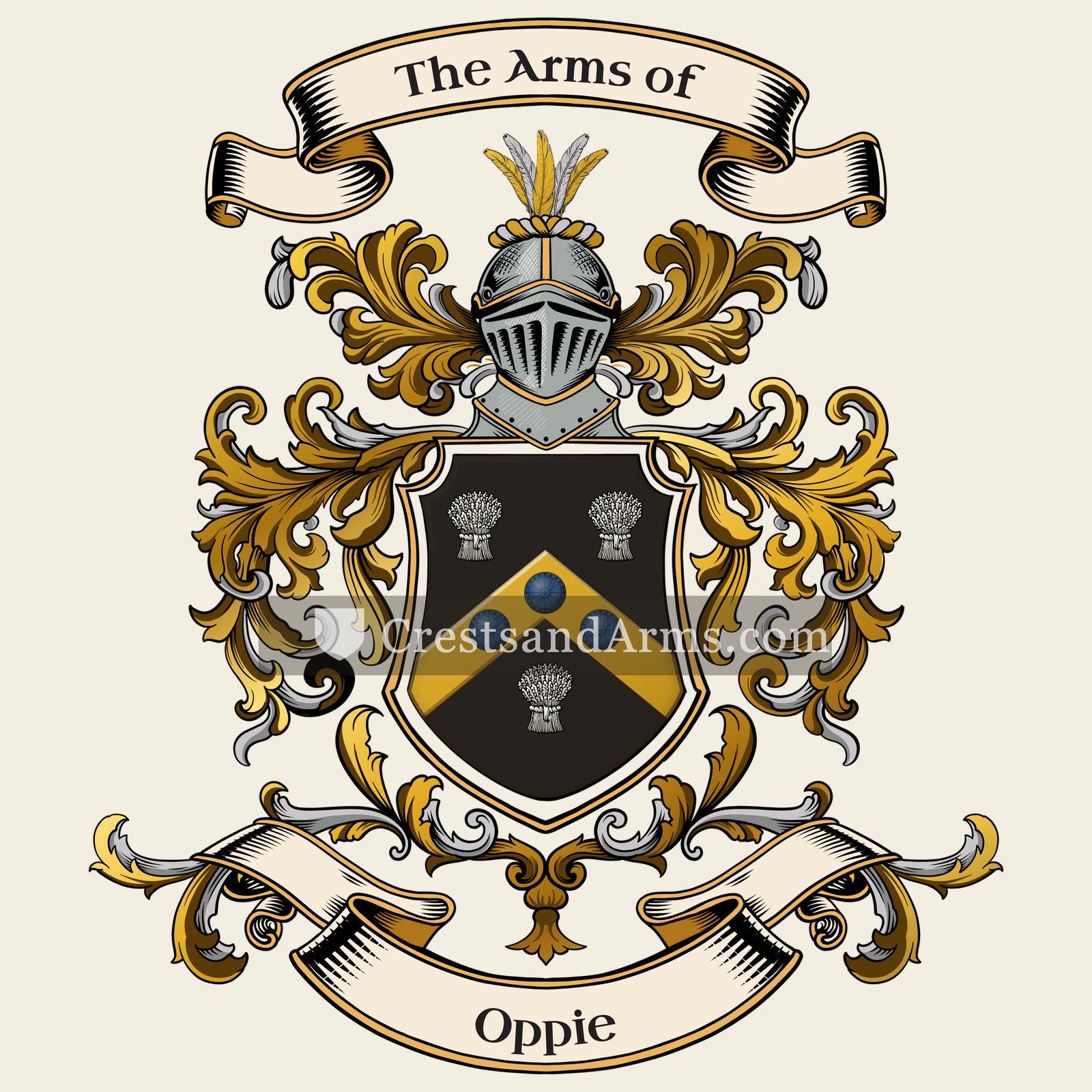
Symbols on this shield
chevronProtection, and faithful service completed
wheatsheafPlenty, and the harvest of one's own labour
roundelA coin, and one who has been to the crusades
Colours
Black (Sable)Means: Constancy
Gold (Or)Means: Generosity
Silver (Argent)Means: Peace and sincerity
Blue (Azure)Means: Loyalty and truth
Historical info
Source
Sir Bernard Burke, The General Armory of England, Scotland, Ireland and Wales, London: Harrison & Sons, 1884
Blazon (the actual original written record)
“Sa. on a chev. or, betw. three garbs ar. as many hurts”
DevonPlymouth · Devon, c. 1620
Digital archive packCoat of arms PNG, gold border print PDF, vector SVG and the certificate of authenticity. Sent to your email in minutes.
Map of England showing where the Oppie arms are recorded
The Oppie arms were recorded in Devon, c. 1620.
Devon was a county of small manors and seafaring families. Its gentry were spread thickly across the countryside, and money made at sea often bought an estate, which in turn brought a coat of arms.
This is where the arms were entered in the register. Families often moved to other parts of the country, so the same name can turn up in more than one region.
The body that granted and recorded arms in England in this period.
James VI and I
Sovereign of the period
James VI and I
1603–1625
Reigning in Britain when the Oppie arms are first recorded.
How Arms Worked in England
English heraldry allowed arms to be shared by all legitimate descendants of the original owner. These symbols were treated as personal property that moved through the generations to all children. While the eldest son kept the original design, other family members could use the same shield without needing to change it or register their own unique versions.
Granting authority
The College of Arms in London has regulated the use of coats of arms throughout England and Wales since 1484.
How they got arms
Families typically obtained their coats of arms through a formal grant from the Crown or by proving their ancient right to them.
Where arms were recorded
All official coats of arms are recorded in the registers kept at the College of Arms, which date back to the fifteenth century.
The family's standing
Recorded among the armigerous families of Devon.
Origin & History of the Oppie Family in England
The family name Oppie has deep roots in the rugged landscape of Devon, England, where records confirm the family was established by at least 1620. During the early seventeenth century, the name was primarily associated with the rural communities of the West Country, a region defined by its tin mining heritage and maritime trade. Families in this area often lived in small, tight-knit parishes where surnames were frequently shaped by local dialects and regional pronunciations. While the name is relatively rare, its presence in Devon suggests that the early Oppies were likely involved in the traditional industries of the period, such as agriculture or the coastal commerce that connected Devon to the wider world. By settling in this part of England, the family became part of a long history of local resilience, living through a time of significant social and economic change in the British Isles.
Related Branches & Arms
Root word
Osbeorn
Derived from Old Norse elements meaning god and bear.
This name
OppieA patronymic surname originating from the medieval personal name Osbern or Osbert.
also spelled
Opy
Opiee
Opye
Opee
Documented Sources
J. B. Rietstap, Armorial Général, Gouda: G. B. van Goor Zonen, 1884–87
Gover, J.E.B., The Place-Names of Cornwall, 1948
Peskett, Hugh, Guide to Cornish Parish Registers, 1978
Kresen Kernow, Bishop’s Transcripts of Parish Registers for the Deanery of Penwith
The National Archives, Exchequer: King's Remembrancer: Lay Subsidy Rolls
Digital archive packCoat of arms PNG, gold border print PDF, vector SVG and the certificate of authenticity. Sent to your email in minutes.


 chevronProtection, and faithful service completed
 wheatsheafPlenty, and the harvest of one's own labour
 chevronProtection, and faithful service completed
 wheatsheafPlenty, and the harvest of one's own labour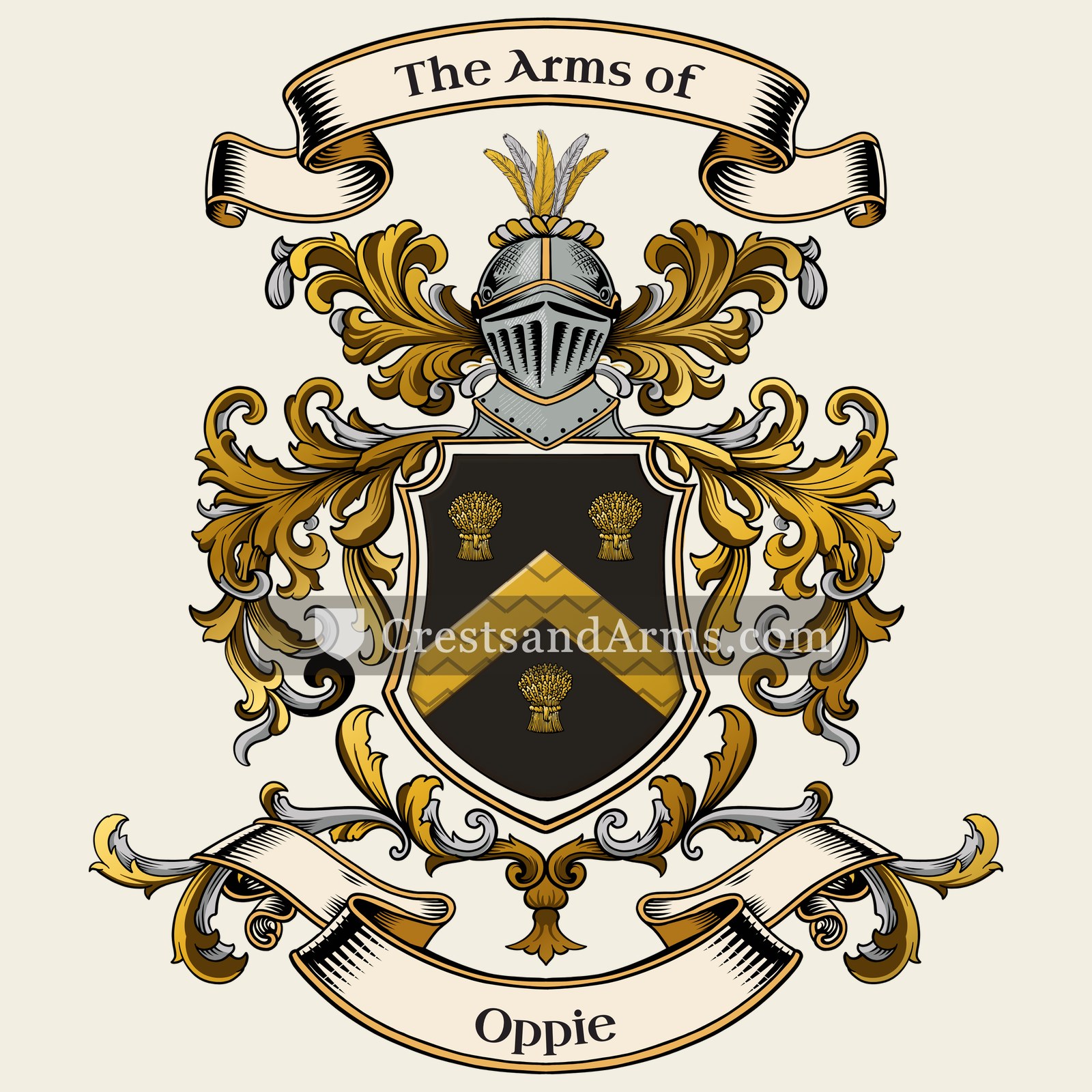


 roundelA coin, and one who has been to the crusades