A record of documented arms, meaning and origin, researched for the Orahilly family lines. Documented in 3 countries.
Reg. 4656 · Britain, M–O
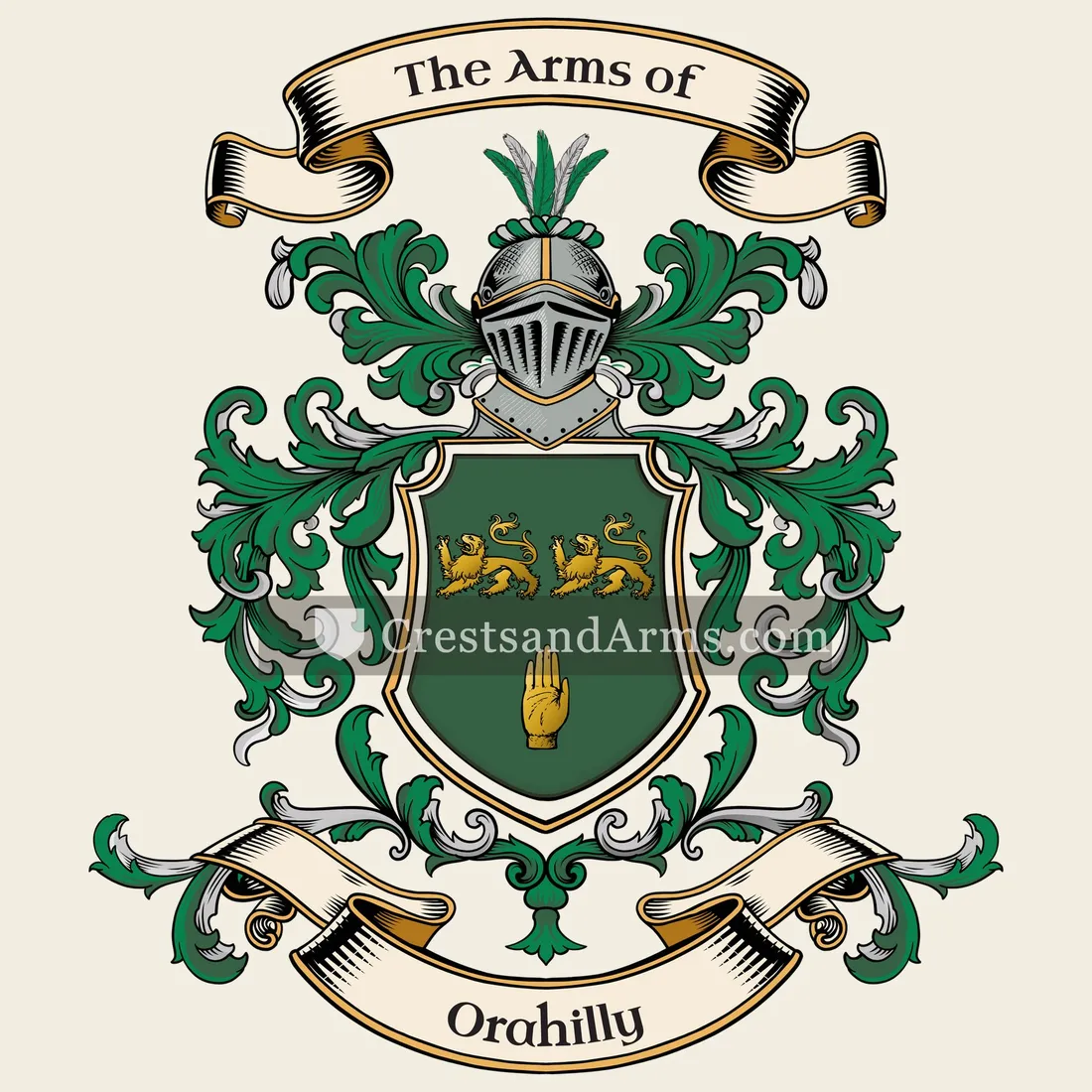
Meaning of the Orahilly family crest colors & symbols
Symbols on this shield
lionCourage, strength and royalty
handFaith, sincerity and justice
Colours
Green (Vert)Means: Hope
Gold (Or)Means: Generosity
Historical info
Source
J. B. Rietstap, Armorial Général, Gouda: G. B. van Goor Zonen, 1884–87
Blazon (the actual original written record)
“De sin. à deux lions affr. d'or, supp. ensemble une main sen. appaumée du même, en pal. Cq. cour. C.: un chène, le fût accolé d'un serpent, le tout au nat. D.: FORTITUDINE ET PRUDENTIA.”
Britainc. 1700
Digital archive packCoat of arms PNG, gold border print PDF, vector SVG and the certificate of authenticity. Sent to your email in minutes.
Map of Britain showing where the Orahilly arms are recorded
The Orahilly arms were recorded in Britain, c. 1700.
Arms such as these were typically recorded in Kent.
Kent sits between London and the short crossing to Europe, and the trade passing through made it wealthy. Merchant families bought land with that money, and it was landowners who took coats of arms.
This is where the arms were entered in the register. Families often moved to other parts of the country, so the same name can turn up in more than one region.
The body that granted and recorded arms in Britain in this period.
William III of England
Sovereign of the period
William III of England
1694–1702
Reigning in Britain when the Orahilly arms are first recorded.
How Arms Worked in Britain
English heraldry allowed arms to be shared by all legitimate descendants of the original owner. These symbols were treated as personal property that moved through the generations to all children. While the eldest son kept the original design, other family members could use the same shield without needing to change it or register their own unique versions.
Granting authority
The College of Arms in London has regulated the use of coats of arms throughout England and Wales since 1484.
How they got arms
Families typically obtained their coats of arms through a formal grant from the Crown or by proving their ancient right to them.
Where arms were recorded
All official coats of arms are recorded in the registers kept at the College of Arms, which date back to the fifteenth century.
The family's standing
Recorded among the armigerous families of Britain.
Origin & History of the Orahilly Family in Britain
The family name Orahilly, often spelled O'Rahilly, has deep roots that trace back to the Gaelic traditions of Ireland, but its presence in Britain became notable by the dawn of the eighteenth century. By the year 1700, records indicate that members of the family had established themselves in the county of Kent. During this period, Kent served as a vital hub for trade and movement between the British Isles and the European continent. Families settling in this region were often involved in the local agricultural economy or the bustling maritime industries found along the southern coast. While the name remains strongly associated with its Irish origins, the migration of these early individuals to Kent suggests a pattern of movement driven by the search for new opportunities in the rapidly developing British landscape. This transition marked the beginning of the family’s long integration into the social and economic fabric of southern England.
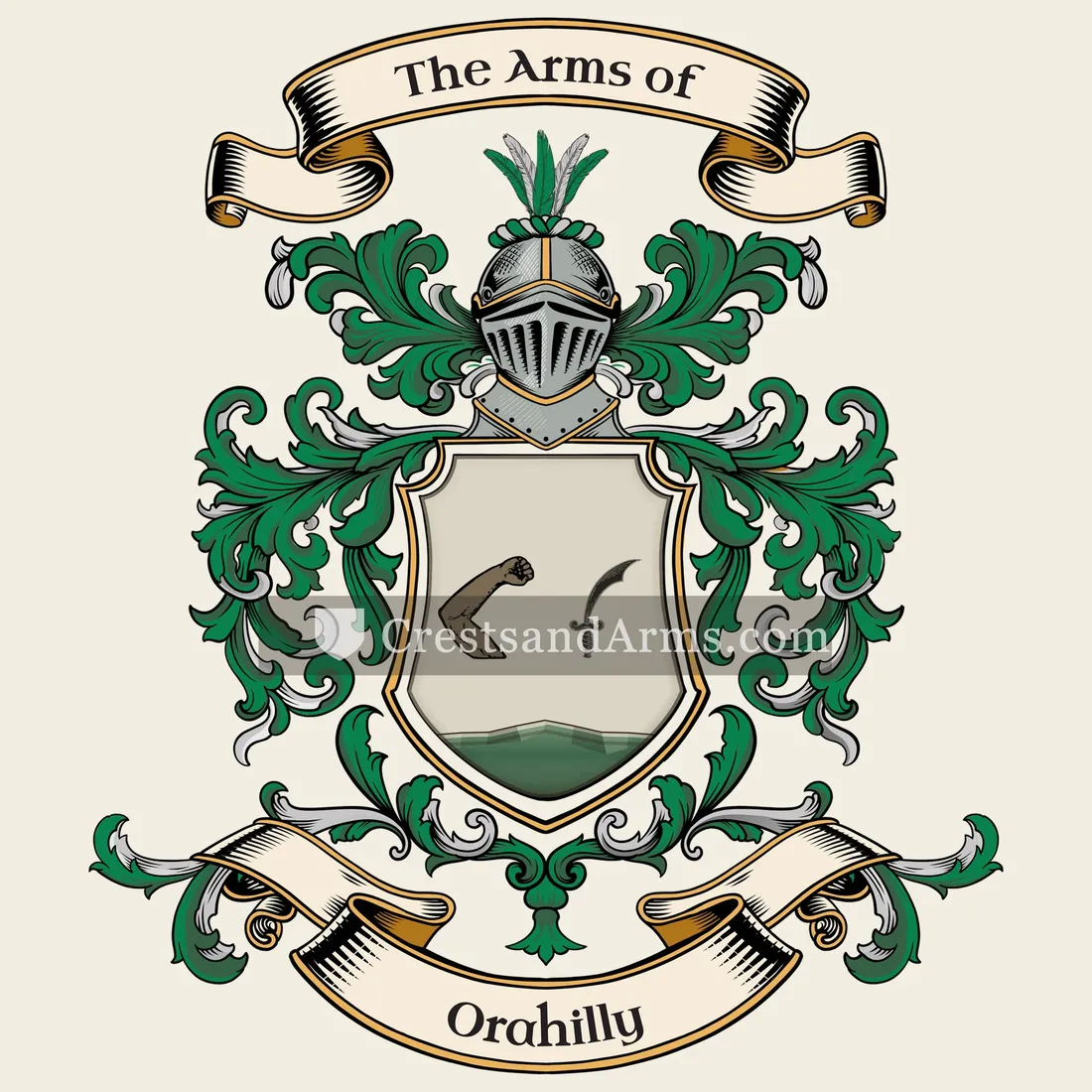
Meaning of the Orahilly family crest colors & symbols
Symbols on this shield
mountThe ground held, and steadfastness upon it
armA person of action, industrious and laborious
swordJustice, and military honour
Colours
Silver (Argent)Means: Peace and sincerity
Green (Vert)Means: Hope
Historical info
Source
J. B. Rietstap, Armorial Général, Gouda: G. B. van Goor Zonen, 1884–87
Blazon (the actual original written record)
“D'arg. à un chène de sin., terrassé du même; à un senestrochère de carn., arm. d'une épée, mouv. du flanc et perçant la tête d'un serpent enroulé autour du fût de l'arbre. Cq. cour. C.: un bras, arm. au nat., tenant une épée en barre. D.: VI ET PRUDENTIA.”
Francec. 1663
Digital archive packCoat of arms PNG, gold border print PDF, vector SVG and the certificate of authenticity. Sent to your email in minutes.
Map of France showing where the Orahilly arms are recorded
The Orahilly arms were recorded in France, c. 1663.
Arms such as these were typically recorded in Bretagne.
More families held coats of arms in Bretagne than anywhere else in France. The land was divided into many small estates rather than a few large ones, so far more households counted as gentry, and each needed a shield of its own to be told apart.
This is where the arms were entered in the register. Families often moved to other parts of the country, so the same name can turn up in more than one region.
The body that granted and recorded arms in France in this period.
Louis XIV of France
Sovereign of the period
Louis XIV of France
1643–1715
Reigning in Britain when the Orahilly arms are first recorded.
How Arms Worked in France
In France, a coat of arms was a mark of honor that passed down through the male line to all legitimate descendants. Families often used the same shield without changes to show their shared heritage. If a branch wanted to stand out, they could add a small mark to their shield to show their specific place in the family tree.
Granting authority
The Juge d'armes de France acted as the official authority that regulated and verified coats of arms across the country.
How they got arms
Families typically inherited their arms from ancestors, though they could also receive them through royal grants or by proving their noble status.
Where arms were recorded
Coats of arms were officially recorded in the Armorial Général de France, which began its main collection in the year 1696.
The family's standing
Recorded among the armigerous families of France.
Origin & History of the Orahilly Family in France
The family name Orahilly, often associated with Irish roots, finds a fascinating historical anchor in the Brittany region of France during the mid-seventeenth century. By 1663, records confirm that members of the family were established within this coastal province, likely arriving as part of the migration patterns involving soldiers and merchants fleeing political instability in the British Isles. Life in Brittany during this era was defined by a unique blend of Celtic heritage and French administrative control, providing a stable environment for families to integrate into local society. These early settlers often transitioned into roles within the maritime trade or local governance, adapting their names to fit the phonetic structures of the French language. Their presence in the region highlights the long-standing connections between the Atlantic fringe of Europe and the historical movement of families seeking new opportunities across the sea.
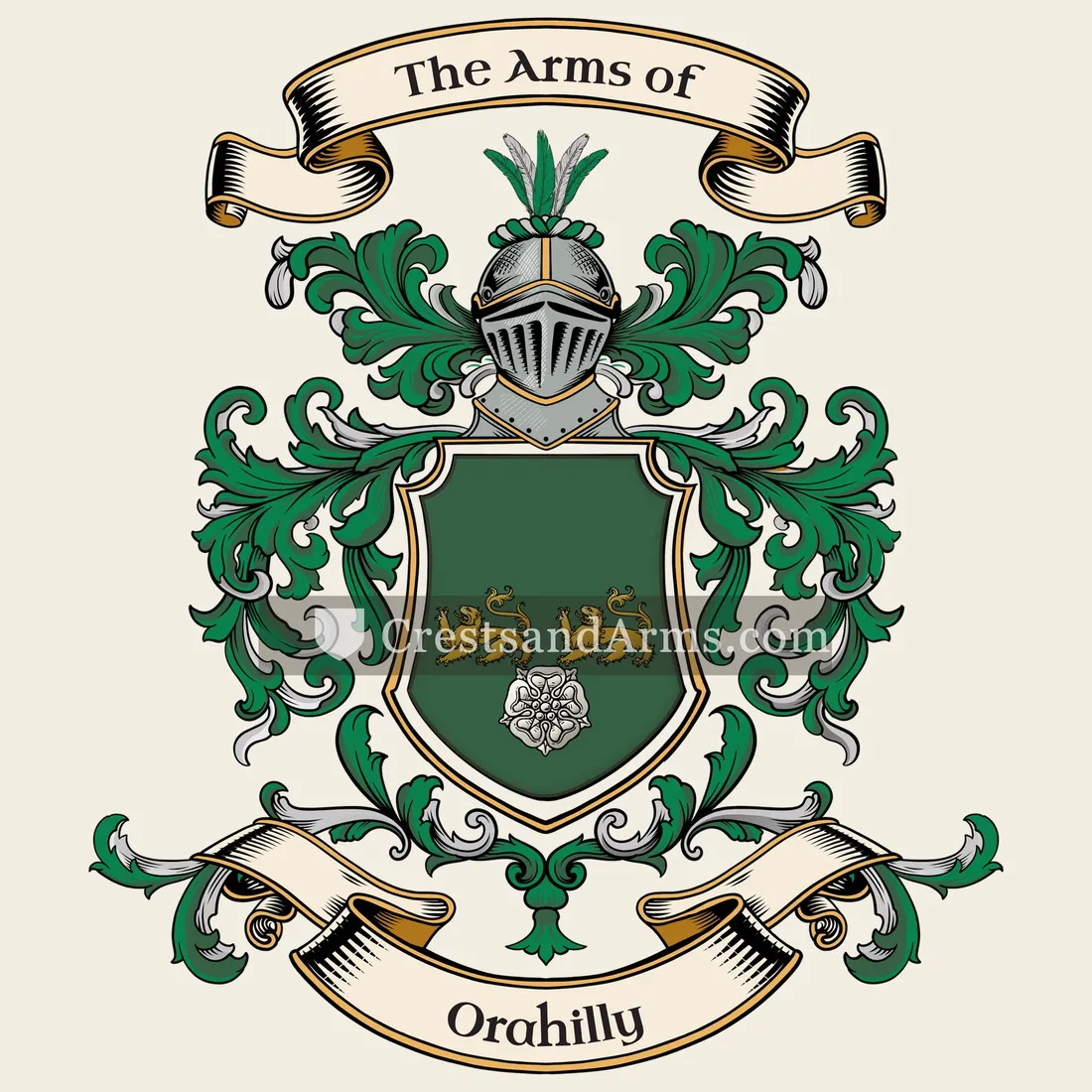
Meaning of the Orahilly family crest colors & symbols
Symbols on this shield
lionCourage, strength and royalty
roseThe seventh son, and beauty with grace
Colours
Green (Vert)Means: Hope
Gold (Or)Means: Generosity
Silver (Argent)Means: Peace and sincerity
Historical info
Source
Sir Bernard Burke, The General Armory of England, Scotland, Ireland and Wales, London: Harrison & Sons, 1884
Blazon (the actual original written record)
“Vert two lions combatant or, supporting a dexter hand ppr. in base a rose ar. seeded and barbed of the second”
YorkScarborough · York, c. 1620
Digital archive packCoat of arms PNG, gold border print PDF, vector SVG and the certificate of authenticity. Sent to your email in minutes.
Map of England showing where the Orahilly arms are recorded
The Orahilly arms were recorded in York, c. 1620.
Yorkshire is the largest of the English counties, and it held more gentry families than any other. Land there was split among a great many households rather than a few, so a great many of them carried arms.
This is where the arms were entered in the register. Families often moved to other parts of the country, so the same name can turn up in more than one region.
The body that granted and recorded arms in England in this period.
James VI and I
Sovereign of the period
James VI and I
1603–1625
Reigning in Britain when the Orahilly arms are first recorded.
How Arms Worked in England
English heraldry allowed arms to be shared by all legitimate descendants of the original owner. These symbols were treated as personal property that moved through the generations to all children. While the eldest son kept the original design, other family members could use the same shield without needing to change it or register their own unique versions.
Granting authority
The College of Arms in London has regulated the use of coats of arms throughout England and Wales since 1484.
How they got arms
Families typically obtained their coats of arms through a formal grant from the Crown or by proving their ancient right to them.
Where arms were recorded
All official coats of arms are recorded in the registers kept at the College of Arms, which date back to the fifteenth century.
The family's standing
Recorded among the armigerous families of York.
Origin & History of the Orahilly Family in England
The family name Orahilly, while deeply rooted in Irish origins, appears in English historical records as early as 1620 within the city of York. During this period, York served as a vital northern hub for trade and administration, attracting families who were often involved in merchant guilds or local craft industries. The presence of the Orahilly name in this city suggests that these early members were part of the broader movement of people crossing the Irish Sea to seek new economic opportunities in England. As they settled into the urban environment of York, these individuals likely integrated into the local parish life, which was the primary way families were documented through baptismal and burial registers at the time. This transition from their ancestral lands to a major English city highlights the mobility of families during the seventeenth century and their role in the evolving social fabric of northern England.
Orahilly Meaning & Related Branches
Root word
Ó Rathaille
Descendant of the prince or chieftain
This name
OrahillyRefers to a lineage tracing back to a noble leader or ruler
also spelled
Oreilli
Oraylee
Reilly
Documented Sources
J. B. Rietstap, Armorial Général, Gouda: G. B. van Goor Zonen, 1884–87
MacLysaght, Edward, The Surnames of Ireland, 1985
Kent History and Library Centre, Parish Registers of Kent, 1700–1750
Cottle, Basil, The Penguin Dictionary of Surnames, 1967
Digital archive packCoat of arms PNG, gold border print PDF, vector SVG and the certificate of authenticity. Sent to your email in minutes.


 lionCourage, strength and royalty
 handFaith, sincerity and justice
 lionCourage, strength and royalty
 handFaith, sincerity and justice


 mountThe ground held, and steadfastness upon it
 armA person of action, industrious and laborious
 swordJustice, and military honour


 roseThe seventh son, and beauty with grace