Map of Switzerland showing where the Orbe arms are recorded
The Orbe arms were recorded in Franche-Comte, c. 1745.
Franche-Comte sat between France and the Empire and changed hands more than once. Border families held their land under arms and expected to defend it, so a shield was a practical thing rather than an ornament.
This is where the arms were entered in the register. Families often moved to other parts of the country, so the same name can turn up in more than one region.
The body that granted and recorded arms in Switzerland in this period.
How Arms Worked in Switzerland
In Switzerland, coats of arms were not restricted to the nobility and were often adopted by common citizens and families. These symbols were passed down through generations to show family identity. When branches of a family grew, they often changed small details of the design to distinguish their own line from the original group.
Granting authority
Cantonal and civic authorities managed the use of coats of arms within their specific regions and local jurisdictions.
How they got arms
Families typically assumed their own coats of arms based on local custom rather than receiving them from a central monarch.
Where arms were recorded
Arms were recorded in various cantonal and civic registers starting from the fourteenth century throughout the Swiss region.
The family's standing
Recorded among the armigerous families of Franche-Comte.
Origin & History of the Orbe Family in Switzerland
The family name Orbe is deeply connected to the geography of the Jura region, which spans the border between modern-day Switzerland and the Franche-Comté area of France. The name likely originated as a locative surname, meaning it was adopted by people who lived near the town of Orbe or the Orbe River in the Swiss canton of Vaud. By the mid-18th century, the family had established a presence in the Franche-Comté region, as evidenced by records from 1745. During this period, the area served as a crossroads for families moving between the Swiss Confederation and the neighboring French territories due to shared linguistic roots and trade routes. These early family members were often part of the rural population that navigated the complex political and religious borders of the time. Their movement reflects the historical fluidity of the Jura mountains, where families frequently crossed regional boundaries to seek new opportunities in agriculture or local crafts.
Meaning of the Orbe family crest colors & symbols
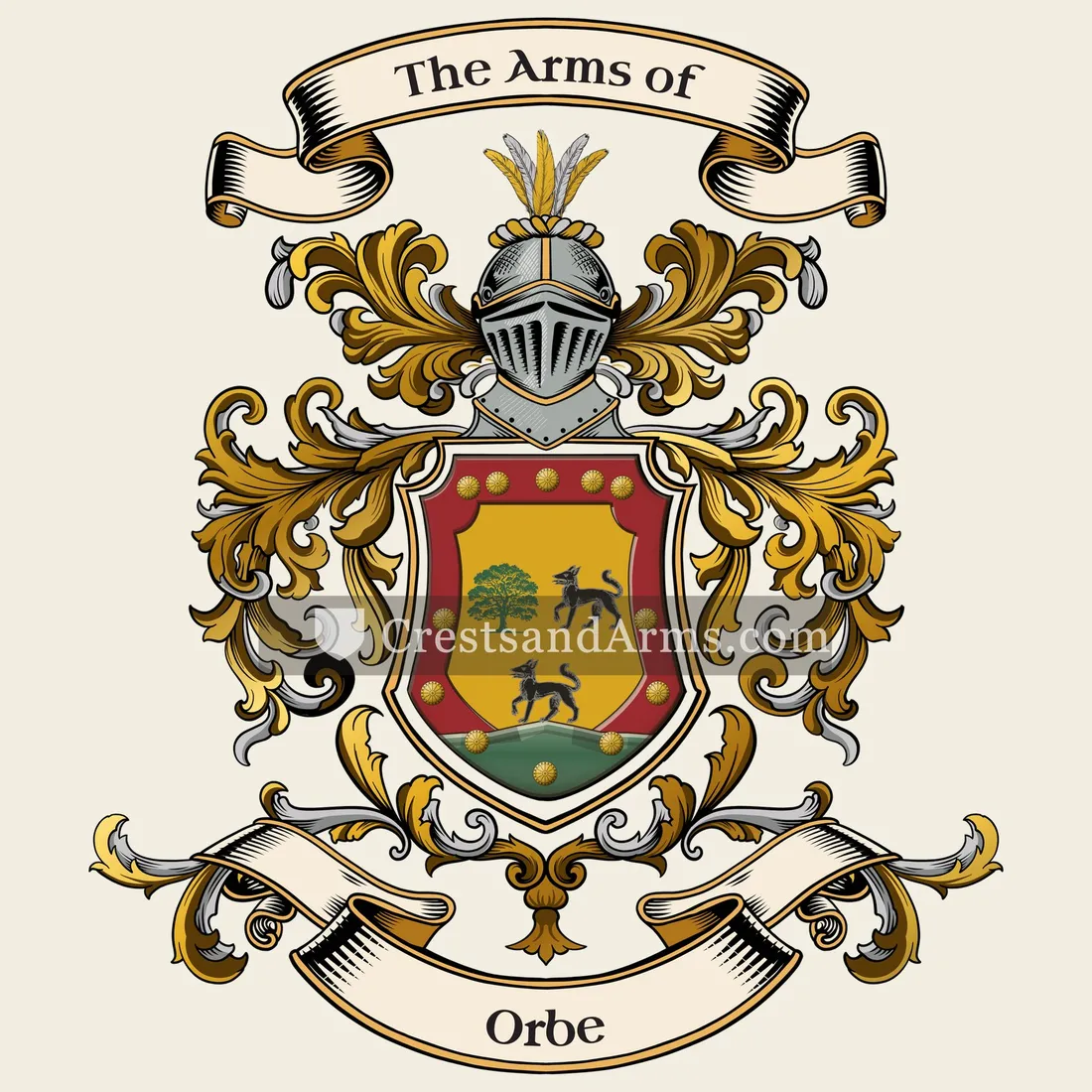
Symbols on this shield
mountThe ground held, and steadfastness upon it
treeLife, endurance and deep roots
wolfReward from long service and hard work
roundelA coin, and one who has been to the crusades
Colours
Gold (Or)Means: Generosity
Red (Gules)Means: Military strength
Green (Vert)Means: Hope
Black (Sable)Means: Constancy
Historical info
Source
J. B. Rietstap, Armorial Général, Gouda: G. B. van Goor Zonen, 1884–87
Blazon (the actual original written record)
“D'or à un arbre de sin., accosté de deux loups affr. de sa., ramp. contre le fût, le tout soutenu d'une terrasse de sin.; à la bord. de gu., ch. de treize bes. d'or.”
SpainGuipuzcoa, c. 1722
Digital archive packCoat of arms PNG, gold border print PDF, vector SVG and the certificate of authenticity. Sent to your email in minutes.
Map of Spain showing where the Orbe arms are recorded
The Orbe arms were recorded in Guipuzcoa, c. 1722.
This is where the arms were entered in the register. Families often moved to other parts of the country, so the same name can turn up in more than one region.
The body that granted and recorded arms in Spain in this period.
Philip V of Spain
Sovereign of the period
Philip V of Spain
1714–1724
Reigning in Switzerland when the Orbe arms are first recorded.
How Arms Worked in Spain
In Spain, a coat of arms was considered a form of property that belonged to the entire family line. These arms were passed down from a father to all his children equally. Younger branches of the family usually kept the original design without needing to add any special marks to distinguish their specific line.
Granting authority
The Cronista Rey de Armas was the official body that regulated and granted coats of arms throughout Spain.
How they got arms
Families often obtained their arms through royal grants or by proving their noble status to the official heraldic authority.
Where arms were recorded
Coats of arms were officially recorded in the registers of the Cronista Rey de Armas starting in 1496.
The family's standing
Recorded among the armigerous families of Spain.
Origin & History of the Orbe Family in Spain
The family name Orbe traces its roots to the rugged landscape of the Basque Country in northern Spain. By the early 18th century, the family was firmly established in the province of Guipuzcoa. The name itself is deeply connected to the Basque language, where the term "orbe" refers to a rounded shape or a circular area of land. This suggests that the earliest ancestors likely earned the name by living near a specific geographic landmark, such as a hill or a bend in a river. During the 1700s, families in this region were often deeply tied to their local parishes and agricultural lands. The presence of the Orbe family in Guipuzcoa in 1722 reflects a time when the Basque people were maintaining strong traditions and local autonomy within the Spanish kingdom. By studying these early records, we see a family that was well-integrated into the rural social structure of northern Spain long before the modern era.
Orbe Meaning & Related Branches
Root word
Urba
A Latin term referring to a city or a settlement.
This name
OrbeA topographic name derived from the town of Orbe, signifying a dweller from that specific settlement.
also spelled
Orbee
Orbes
Orb
Related arms
Benaventesimilar arms
Tremposimilar arms
Orbvariant spelling
Documented Sources
J. B. Rietstap, Armorial Général, Gouda: G. B. van Goor Zonen, 1884–87
Borel, André. Histoire de la ville d'Orbe. 1904
Dictionnaire historique de la Suisse. Orbe (commune). 2010
Digital archive packCoat of arms PNG, gold border print PDF, vector SVG and the certificate of authenticity. Sent to your email in minutes.


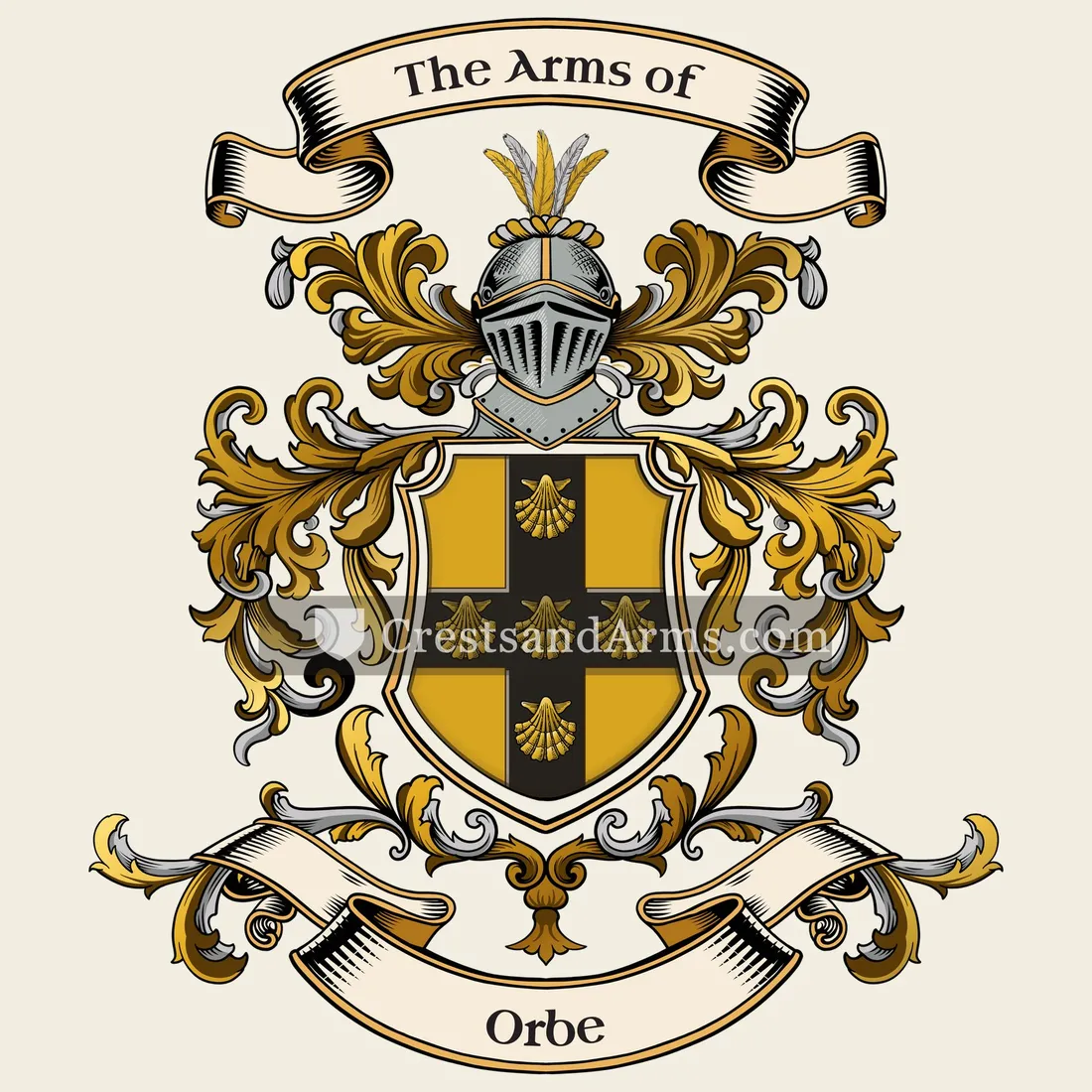
 cross symbolChristian faith and service
 escallopThe pilgrim's shell, and a long journey made
 cross symbolChristian faith and service
 escallopThe pilgrim's shell, and a long journey made

 mountThe ground held, and steadfastness upon it
 treeLife, endurance and deep roots
 wolfReward from long service and hard work
 roundelA coin, and one who has been to the crusades