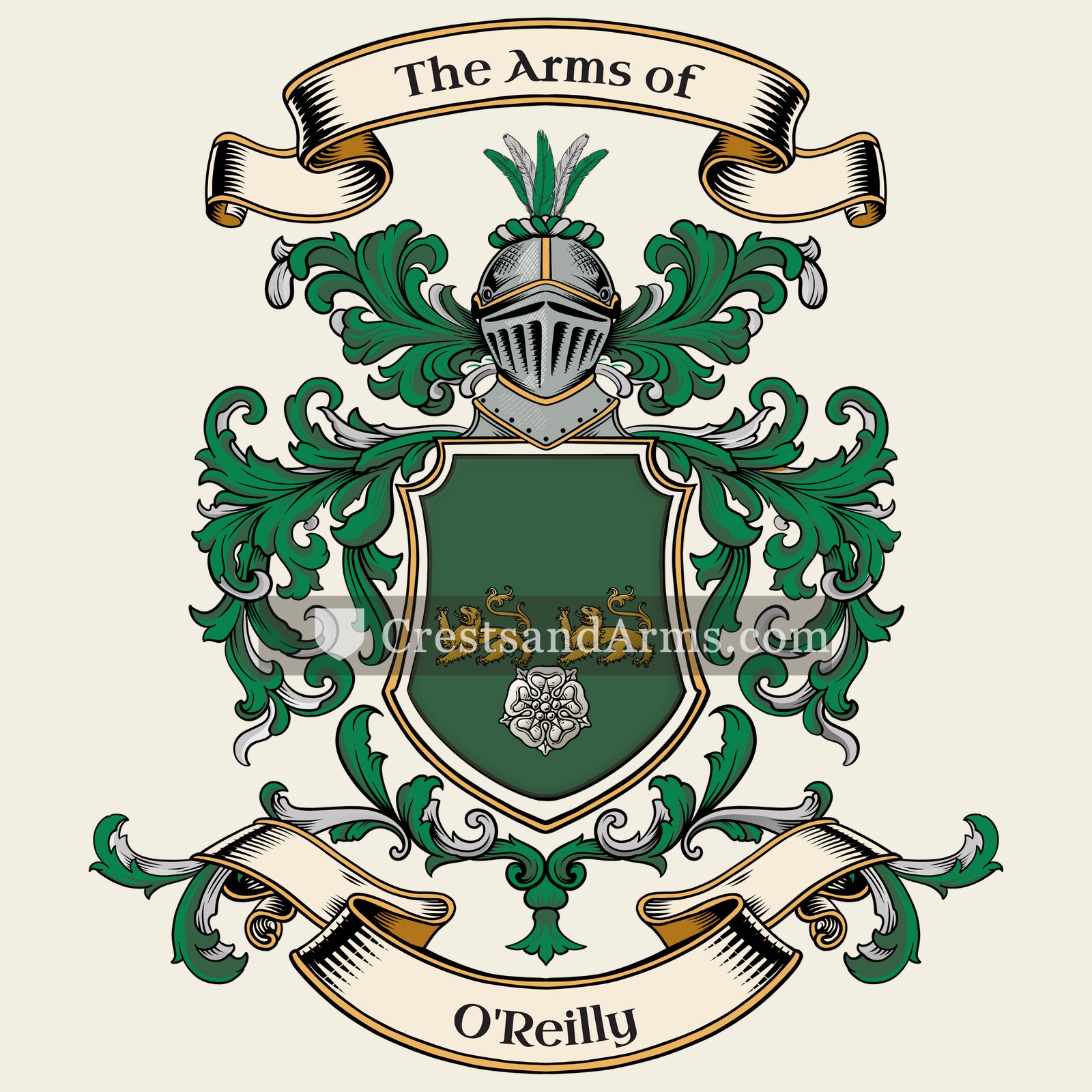
A record of documented arms, meaning and origin, researched for the O'Reilly family lines. Documented in 3 countries.
Reg. 1195 · Britain, M–O
Coat of Arms & Family Crest Details
Symbols on this shield
lionCourage, strength and royalty
handFaith, sincerity and justice
Colours
Green (Vert)Means: Hope
Gold (Or)Means: Generosity
Historical info
Source
J. B. Rietstap, Armorial Général, Gouda: G. B. van Goor Zonen, 1884–87
Blazon (the actual original written record)
“De sin. à deux lions affr. d'or, supp. ensemble une main sen. appaumée du même, en pal. Cq. cour. C.: un chène, le fût accolé d'un serpent, le tout au nat. D.: FORTITUDINE ET PRUDENTIA.”
Britainc. 1700
Digital archive packCoat of arms PNG, gold border print PDF, vector SVG and the certificate of authenticity. Sent to your email in minutes.
Map of Britain showing where the O'Reilly arms are recorded
The O'Reilly arms were recorded in Britain, c. 1700.
Arms such as these were typically recorded in Kent.
Kent sits between London and the short crossing to Europe, and the trade passing through made it wealthy. Merchant families bought land with that money, and it was landowners who took coats of arms.
This is where the arms were entered in the register. Families often moved to other parts of the country, so the same name can turn up in more than one region.
The body that granted and recorded arms in Britain in this period.
William III of England
Sovereign of the period
William III of England
1694–1702
Reigning in Britain when the O'Reilly arms are first recorded.
How Arms Worked in Britain
English heraldry allowed arms to be shared by all legitimate descendants of the original owner. These symbols were treated as personal property that moved through the generations to all children. While the eldest son kept the original design, other family members could use the same shield without needing to change it or register their own unique versions.
Granting authority
The College of Arms in London has regulated the use of coats of arms throughout England and Wales since 1484.
How they got arms
Families typically obtained their coats of arms through a formal grant from the Crown or by proving their ancient right to them.
Where arms were recorded
All official coats of arms are recorded in the registers kept at the College of Arms, which date back to the fifteenth century.
The family's standing
Recorded among the armigerous families of Britain.
Origin & History of the O'Reilly Family in Britain
The O'Reilly family name originates from the Gaelic tradition of Ireland, but its presence in Britain became notable during the late seventeenth and early eighteenth centuries. By the year 1700, records indicate that members of the family had established themselves in the county of Kent. During this period, many Irish families moved to Britain due to shifting political landscapes and the search for new economic opportunities. Those who settled in Kent often integrated into local communities by working in trade, agriculture, or military service. As they settled into English life, the spelling of the name sometimes shifted to reflect the phonetic habits of their new neighbors. This migration pattern highlights how families moved across the Irish Sea to build new lives while maintaining the heritage of their ancestral name.
Coat of Arms & Family Crest Details
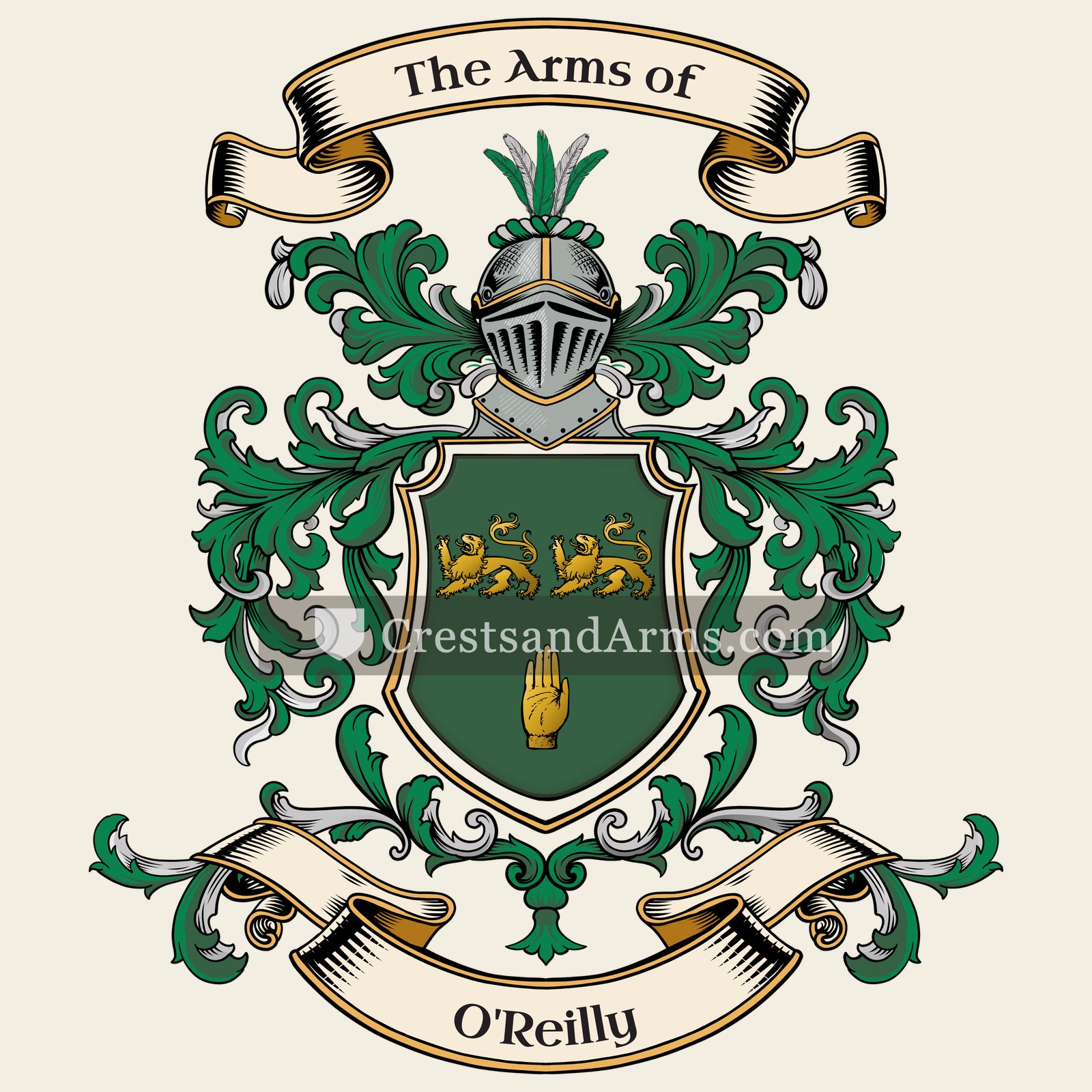
Symbols on this shield
mountThe ground held, and steadfastness upon it
armA person of action, industrious and laborious
swordJustice, and military honour
Colours
Silver (Argent)Means: Peace and sincerity
Green (Vert)Means: Hope
Historical info
Source
J. B. Rietstap, Armorial Général, Gouda: G. B. van Goor Zonen, 1884–87
Blazon (the actual original written record)
“D'arg. à un chène de sin., terrassé du même; à un senestrochère de carn., arm. d'une épée, mouv. du flanc et perçant la tête d'un serpent enroulé autour du fût de l'arbre. Cq. cour. C.: un bras, arm. au nat., tenant une épée en barre. D.: VI ET PRUDENTIA.”
Francec. 1663
Digital archive packCoat of arms PNG, gold border print PDF, vector SVG and the certificate of authenticity. Sent to your email in minutes.
Map of France showing where the O'Reilly arms are recorded
The O'Reilly arms were recorded in France, c. 1663.
Arms such as these were typically recorded in Bretagne.
More families held coats of arms in Bretagne than anywhere else in France. The land was divided into many small estates rather than a few large ones, so far more households counted as gentry, and each needed a shield of its own to be told apart.
This is where the arms were entered in the register. Families often moved to other parts of the country, so the same name can turn up in more than one region.
The body that granted and recorded arms in France in this period.
Louis XIV of France
Sovereign of the period
Louis XIV of France
1643–1715
Reigning in Britain when the O'Reilly arms are first recorded.
How Arms Worked in France
In France, a coat of arms was a mark of honor that passed down through the male line to all legitimate descendants. Families often used the same shield without changes to show their shared heritage. If a branch wanted to stand out, they could add a small mark to their shield to show their specific place in the family tree.
Granting authority
The Juge d'armes de France acted as the official authority that regulated and verified coats of arms across the country.
How they got arms
Families typically inherited their arms from ancestors, though they could also receive them through royal grants or by proving their noble status.
Where arms were recorded
Coats of arms were officially recorded in the Armorial Général de France, which began its main collection in the year 1696.
The family's standing
Recorded among the armigerous families of France.
Origin & History of the O'Reilly Family in France
The O’Reilly family name first appeared in the historical records of Brittany, France, in 1663. During this period, many Irish families sought refuge in France due to the political and religious turmoil occurring in their homeland. These families often integrated into French society by joining the military or pursuing careers in trade and administration. In Brittany, the O’Reilly name became associated with the local nobility and the professional classes who served the French crown. By settling in this coastal region, the family established a new life that blended their Gaelic heritage with the customs of their adopted country. This migration marked the beginning of a long history where the family name became recognized within the French social and political landscape.
Coat of Arms & Family Crest Details
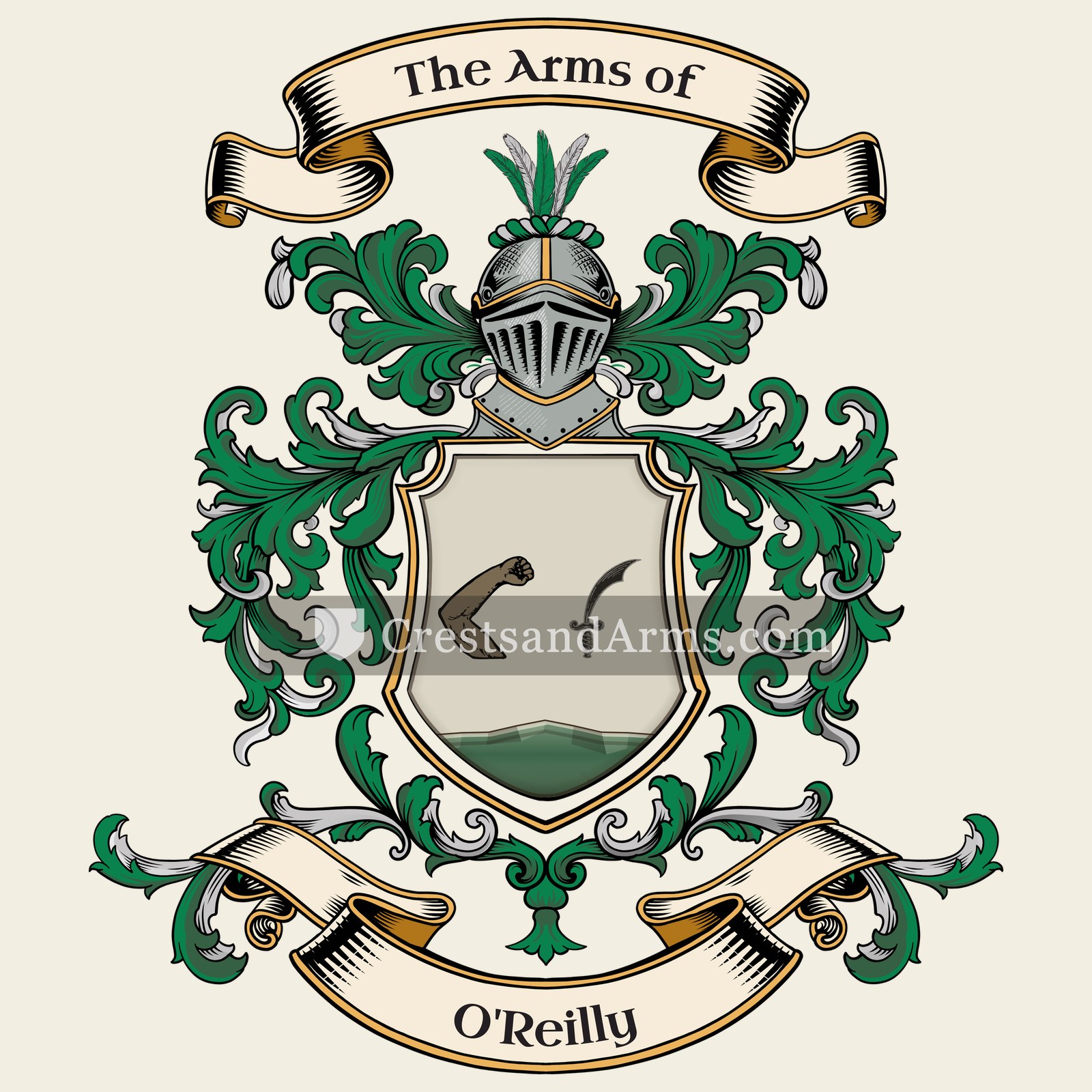
Symbols on this shield
lionCourage, strength and royalty
roseThe seventh son, and beauty with grace
Colours
Green (Vert)Means: Hope
Gold (Or)Means: Generosity
Silver (Argent)Means: Peace and sincerity
Historical info
Source
Sir Bernard Burke, The General Armory of England, Scotland, Ireland and Wales, London: Harrison & Sons, 1884
Blazon (the actual original written record)
“Vert two lions combatant or, supporting a dexter hand ppr. in base a rose ar. seeded and barbed of the second”
YorkScarborough · York, c. 1620
Digital archive packCoat of arms PNG, gold border print PDF, vector SVG and the certificate of authenticity. Sent to your email in minutes.
Map of England showing where the O'Reilly arms are recorded
The O'Reilly arms were recorded in York, c. 1620.
Yorkshire is the largest of the English counties, and it held more gentry families than any other. Land there was split among a great many households rather than a few, so a great many of them carried arms.
This is where the arms were entered in the register. Families often moved to other parts of the country, so the same name can turn up in more than one region.
The body that granted and recorded arms in England in this period.
James VI and I
Sovereign of the period
James VI and I
1603–1625
Reigning in Britain when the O'Reilly arms are first recorded.
How Arms Worked in England
English heraldry allowed arms to be shared by all legitimate descendants of the original owner. These symbols were treated as personal property that moved through the generations to all children. While the eldest son kept the original design, other family members could use the same shield without needing to change it or register their own unique versions.
Granting authority
The College of Arms in London has regulated the use of coats of arms throughout England and Wales since 1484.
How they got arms
Families typically obtained their coats of arms through a formal grant from the Crown or by proving their ancient right to them.
Where arms were recorded
All official coats of arms are recorded in the registers kept at the College of Arms, which date back to the fifteenth century.
The family's standing
Recorded among the armigerous families of York.
Origin & History of the O'Reilly Family in England
The O’Reilly family name originates from the Gaelic name Ó Raghallaigh, which translates to descendant of Raghallach. While the family is primarily associated with the Kingdom of Breifne in Ireland, members of the lineage began appearing in English records during the early seventeenth century. By 1620, historical documentation confirms the presence of O’Reilly individuals living in the city of York. This migration was likely driven by the shifting political and economic landscape of the British Isles during the Stuart period. These early settlers in England often integrated into local urban communities, transitioning from their traditional Irish roots to life in northern English trade centers. Their presence in York suggests that the family was part of a broader movement of people crossing the Irish Sea to seek new opportunities in English cities during an era of significant social change.
O'Reilly Meaning & Related Branches
Root word
Raghallach
Derived from the Old Irish elements for race or progeny and sociable.
This name
O'ReillyDescendant of the man who was sociable or of a noble race.
also spelled
Oreilli
Oraylee
Reilly
Related arms
Reillyvariant spelling
Fishrecorded with O'Reilly, same area
Lawrencerecorded with O'Reilly, same area
Lynchrecorded with O'Reilly, same area
Documented Sources
J. B. Rietstap, Armorial Général, Gouda: G. B. van Goor Zonen, 1884–87
Canny, Nicholas, Making Ireland British, 1580-1650, 2001
The National Archives, State Papers Domestic: George I, 1714-1727
Whyte, Ian D., Migration and Society in Britain 1550-1830, 2000
Digital archive packCoat of arms PNG, gold border print PDF, vector SVG and the certificate of authenticity. Sent to your email in minutes.


 lionCourage, strength and royalty
 handFaith, sincerity and justice
 lionCourage, strength and royalty
 handFaith, sincerity and justice


 mountThe ground held, and steadfastness upon it
 armA person of action, industrious and laborious
 swordJustice, and military honour


 roseThe seventh son, and beauty with grace