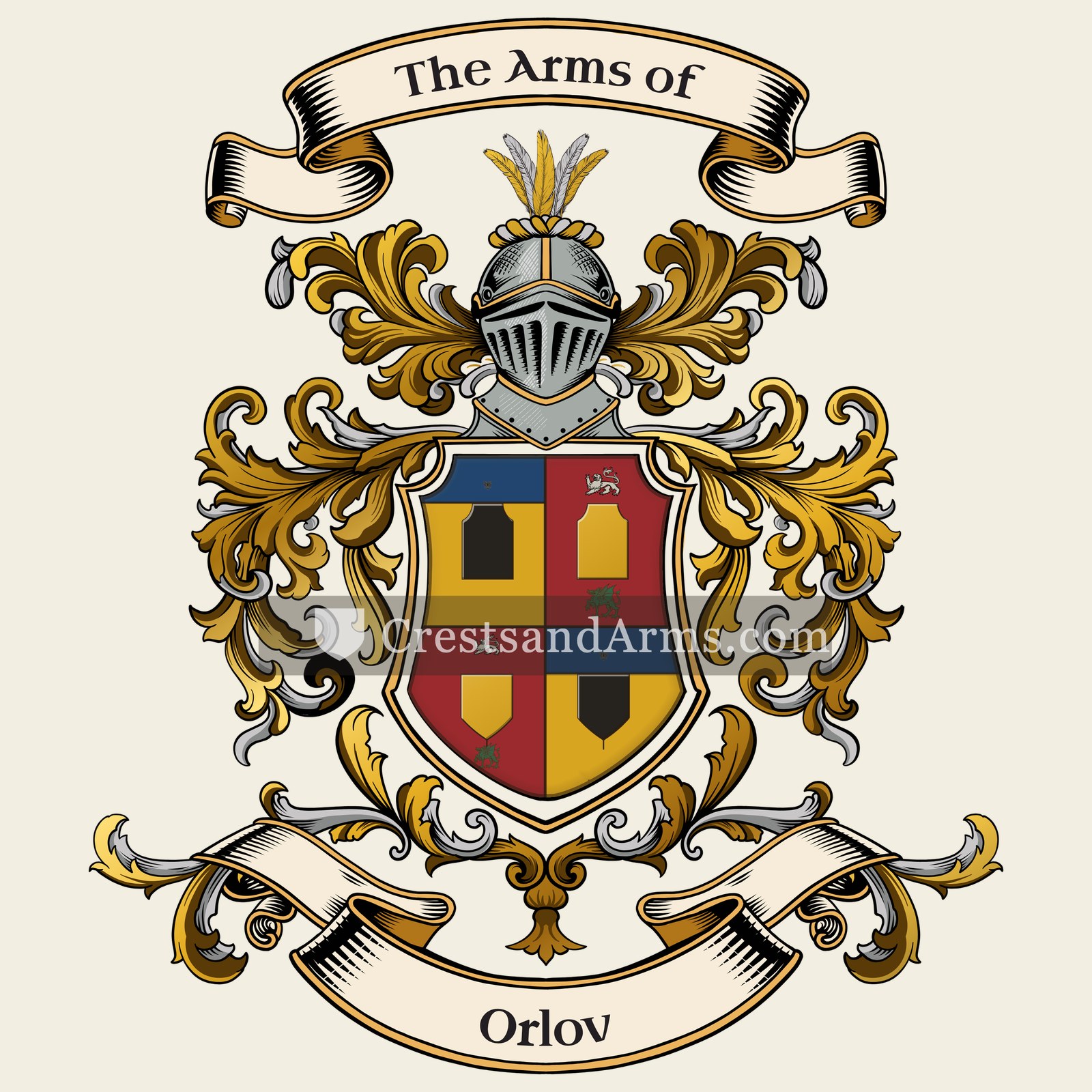
A record of documented arms, meaning and origin, researched for the Orlov family lines. Documented in 2 countries.
Reg. 9081 · Polish, M–O
Coat of Arms & Family Crest Details
Symbols on this shield
chiefAuthority, wisdom and dominion
cross symbolChristian faith and service
eagleNobility, strength and a keen mind
lionCourage, strength and royalty
Colours
Gold (Or)Means: Generosity
Red (Gules)Means: Military strength
Blue (Azure)Means: Loyalty and truth
Black (Sable)Means: Constancy
ErmineMeans: Dignity
Historical info
Source
J. B. Rietstap, Armorial Général, Gouda: G. B. van Goor Zonen, 1884–87
Blazon (the actual original written record)
“Éc.: aux 1 et 4 d'or à l'aigle ép. de sa., bq. et m. d'or, chaque tête sommée d'une couronne impériale; au chef d'azur, ch. de la couronne impériale de Russie, d'or; aux 2 et 3 de gu. au lion d'herm., arm. et lamp. de gu., l'épaule ch. d'un écusson d'azur surch. d'une croix pattée alésée d'or, le lion du 3 cont. Sur le tout burelé d'or et d'azur, à l'aigle de gu., bq. et m. d'arg., br. sur le burelé. Trois cq., les 1 et 2 cour. C.: 1° un vol cont. de gu.; 2° l'aigle ép.; 3° le lion du 2, ch. de l'écusson. L.: à dextre d'or et d'azur, à sen. d'or et de gu. T.: deux chevaliers, tenant chacun une bannière, celle à dextre aux armes du surtout, celle à sen. aux armes du 2. D.: FORTITUDINE ET CONSTANTIA.”
LivoniaEsthonie · Livonia, c. 1762
Digital archive packCoat of arms PNG, gold border print PDF, vector SVG and the certificate of authenticity. Sent to your email in minutes.
Map of Poland showing where the Orlov arms are recorded
The Orlov arms were recorded in Livonia, c. 1762.
Livonia was Baltic country held by a small number of landed families who kept their estates for centuries. Land there passed down whole rather than being divided, and long unbroken tenure is what fills a register.
This is where the arms were entered in the register. Families often moved to other parts of the country, so the same name can turn up in more than one region.
Region
Livonia
Town
Esthonie
First recorded
1762
Granting Authority for the Orlov Arms
Ennoblement by the Sejm
Author: Olek Remesz · CC BY-SA 3.0
The body that granted and recorded arms in Poland in this period.
Augustus III of Poland
Sovereign of the period
Augustus III of Poland
1733–1763
Reigning in Poland when the Orlov arms are first recorded.
How Arms Worked in Poland
Polish noble families shared a single coat of arms across many different surnames, creating large clans rather than individual designs. These symbols were held collectively by all members of the clan regardless of their specific family name. When a new family joined the nobility, they were adopted into an existing clan and began using that group's established shield.
Granting authority
The Sejm, which was the Polish parliament, held the power to grant noble status and the right to bear arms.
How they got arms
Families typically received their coat of arms through a formal act of ennoblement granted by the Sejm for distinguished service.
Where arms were recorded
These grants were officially recorded in the Crown Metrica, which served as the central archive for state documents starting in the sixteenth century.
The family's standing
Recorded among the armigerous families of Livonia.
Origin & History of the Orlov Family in Poland
The history of the Orlov family name is deeply tied to the shifting borders and cultural exchanges of Eastern Europe. While the name is widely recognized for its prominence in the Russian Empire, its roots extend into the historical region of Livonia, which encompassed parts of modern-day Latvia and Estonia. By 1762, members of the family were established figures in this territory, a region that served as a crossroads for Polish, Baltic, and Russian influences. During this era, the Polish-Lithuanian Commonwealth maintained significant political and social connections to Livonia, allowing families to move across these permeable frontiers. The Orlovs navigated these complex geopolitical landscapes by integrating into the local administration and military structures of the time. This transition from the Baltic periphery into the broader imperial sphere highlights how the family name became synonymous with the expansion of influence across the diverse lands of the North.
Coat of Arms & Family Crest Details
Symbols on this shield
chiefAuthority, wisdom and dominion
cross symbolChristian faith and service
saltireResolution, and St Andrew's cross
eagleNobility, strength and a keen mind
lionCourage, strength and royalty
dragonA most valiant defender of treasure
Colours
Gold (Or)Means: Generosity
Red (Gules)Means: Military strength
Black (Sable)Means: Constancy
Blue (Azure)Means: Loyalty and truth
ErmineMeans: Dignity
Green (Vert)Means: Hope
Historical info
Source
J. B. Rietstap, Armorial Général, Gouda: G. B. van Goor Zonen, 1884–87
Blazon (the actual original written record)
“Éc.: aux 1 et 4 d'or à l'aigle ép. de sa., bq. et m. d'or, chaque tête sommée d'une couronne impériale; au chef d'azur, ch. de la couronne impériale de Russie, d'or; aux 2 et 3 de gu. au lion d'herm., cour. d'or, arm. et lamp. de gu., étouffant entre ses pattes un dragon de sin.; l'épaule du lion ch. d'un écusson d'azur, surch. d'une croix pattée d'or. Sur le tout un écusson coupé, timbré de la couronne princière: a. d'or à l'aigle ép. de sa., chaque tête cour. d'or; b. burelé d'or et d'azur, à l'aigle de gu., bq. et m. d'arg., br. sur le burelé. Cinq cq., les 2, 4 et 5 cour., le 3 sommé d'une couronne princière. C.: 1° un lion iss. et cont. d'herm., cour. d'or, arm. et lamp. de gu.; 2° un vol cont. de gu.; 3° une aigle ép. de sa., chaque tête sommée d'une couronne impériale, surm. d'une autre couronne impériale aux rubans flottants d'azur, tenant sceptre et globe, l'estomac ch. d'un écusson de gu., bordé d'or, surch. d'un chevalier monté sur un cheval galopant; 4° une aigle ép. de sa., surm. d'une couronne royale d'or; 5° une épée en barre et un rameau de laurier, au nat., passés en saut., surm. d'une couronne royale d'or. L. d'or et de sa. T.: deux cuirassiers, à pied, chacun tenant une bannière, celle à dextre aux armes du compartiment b. du surtout, celle à sen. aux armes du 2. D.: FORTITUDINE ET CONSTANTIA.”
CourlandEsthonie · Courland, c. 1856
Digital archive packCoat of arms PNG, gold border print PDF, vector SVG and the certificate of authenticity. Sent to your email in minutes.
Map of Russia showing where the Orlov arms are recorded
The Orlov arms were recorded in Courland, c. 1856.
Courland was Baltic coast country held in large estates by a small number of families. They kept their land for generations and served as officers abroad, and both landholding and service brought arms with them.
This is where the arms were entered in the register. Families often moved to other parts of the country, so the same name can turn up in more than one region.
The body that granted and recorded arms in Russia in this period.
Alexander II of Russia
Sovereign of the period
Alexander II of Russia
1855–1881
Reigning in Poland when the Orlov arms are first recorded.
How Arms Worked in Russia
Russian heraldry was strictly tied to the nobility and the state service system. Families proved their ancient status or earned new rank to receive an official grant from the Tsar. These symbols were then inherited by all legitimate children of the noble line. If a family lacked proof of their status, they were often excluded from the official records entirely.
Granting authority
The Herald Master's Office acted as the central state body that strictly regulated and verified all noble heraldic symbols.
How they got arms
Families typically received their arms through a formal state grant or by proving their noble status to the government authorities.
Where arms were recorded
All approved coats of arms were officially recorded in the General Armorial of the Noble Families of the Russian Empire starting in 1797.
The family's standing
Recorded among the armigerous families of Courland.
Origin & History of the Orlov Family in Russia
The Orlov family name holds a significant place in the history of the Russian Empire, originating from the Russian word for eagle. While many associate the name with the powerful brothers who helped Catherine the Great take the throne in the eighteenth century, the family roots reach back into the service nobility of the Russian state. By the middle of the nineteenth century, the family had established a presence in the region of Courland, which is modern-day Latvia. During this period, Courland served as a vital crossroads between Russian imperial administration and Baltic German culture. The presence of the Orlovs in this area in 1856 reflects the family's role as administrators and landowners who moved across the vast territories of the Russian Empire to manage state affairs. Their history is defined by a long tradition of military and civil service that allowed them to maintain influence and property across diverse regions for many generations.
Related Branches & Arms
Root word
Oryol
A large bird of prey known as an eagle.
This name
OrlovDerived from the Slavic word for eagle, often denoting a person with eagle-like qualities or characteristics.
also spelled
Orloff
Orlov
Orlo
Documented Sources
J. B. Rietstap, Armorial Général, Gouda: G. B. van Goor Zonen, 1884–87
Dunsdorfs, Edgars. Der große schwedische Kataster in Livland 1681-1710. 1974
Plakans, Andrejs. The Latvians: A Short History. 1995
Raun, Toivo U. Estonia and the Estonians. 2001
Latvian State Historical Archives, Livland Landtag Records
Estonian Historical Archives, Livonian Nobility Matrikel
Digital archive packCoat of arms PNG, gold border print PDF, vector SVG and the certificate of authenticity. Sent to your email in minutes.


 chiefAuthority, wisdom and dominion
 cross symbolChristian faith and service
 eagleNobility, strength and a keen mind
 lionCourage, strength and royalty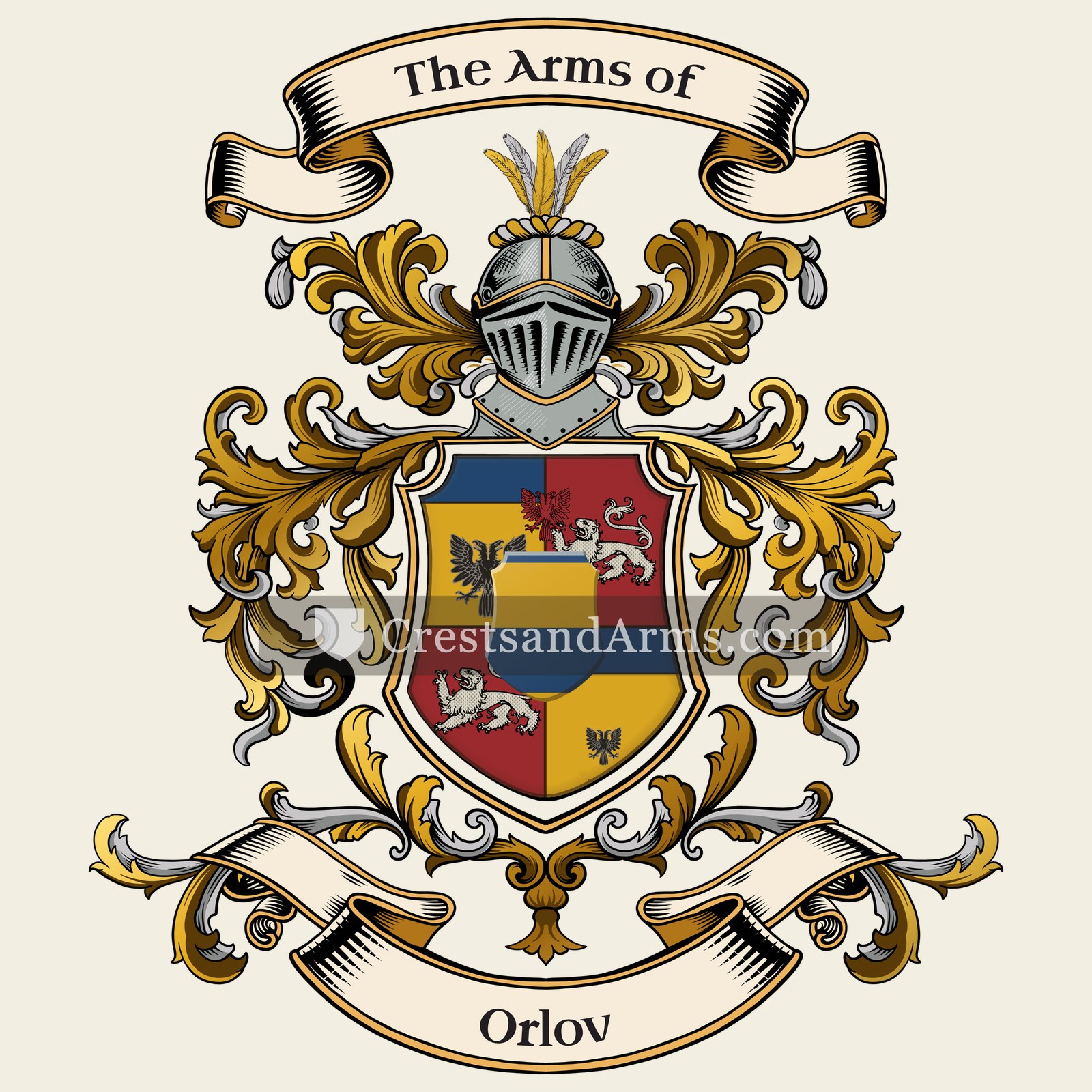


 saltireResolution, and St Andrew's cross
 dragonA most valiant defender of treasure