Map of England showing where the Ormiston arms are recorded
The Ormiston arms were recorded in Essex, c. 1620.
Essex lay close enough to London for City money to buy land there. Merchants who prospered moved out to estates within a day's ride, and a new landowner almost always wanted arms to go with the ground.
This is where the arms were entered in the register. Families often moved to other parts of the country, so the same name can turn up in more than one region.
The body that granted and recorded arms in England in this period.
James VI and I
Sovereign of the period
James VI and I
1603–1625
Reigning in England when the Ormiston arms are first recorded.
How Arms Worked in England
English heraldry allowed arms to be shared by all legitimate descendants of the original owner. These symbols were treated as personal property that moved through the generations to all children. While the eldest son kept the original design, other family members could use the same shield without needing to change it or register their own unique versions.
Granting authority
The College of Arms in London has regulated the use of coats of arms throughout England and Wales since 1484.
How they got arms
Families typically obtained their coats of arms through a formal grant from the Crown or by proving their ancient right to them.
Where arms were recorded
All official coats of arms are recorded in the registers kept at the College of Arms, which date back to the fifteenth century.
The family's standing
Recorded among the armigerous families of Essex.
Origin & History of the Ormiston Family in England
The family name Ormiston originates from a place name in the Scottish Borders, but its presence in England became notable by the early seventeenth century. By 1620, records confirm that members of the family had established themselves in Essex, a county known for its agricultural wealth and proximity to the growing trade hub of London. During this period, families often migrated south to seek new opportunities in the burgeoning merchant classes or to manage landholdings outside of the traditional northern strongholds. The movement of the Ormiston name into Essex reflects a broader trend of internal migration where individuals moved to follow economic shifts and social changes. As these early settlers integrated into the local community, they helped transition the name from its regional Scottish roots into the diverse social fabric of English life.
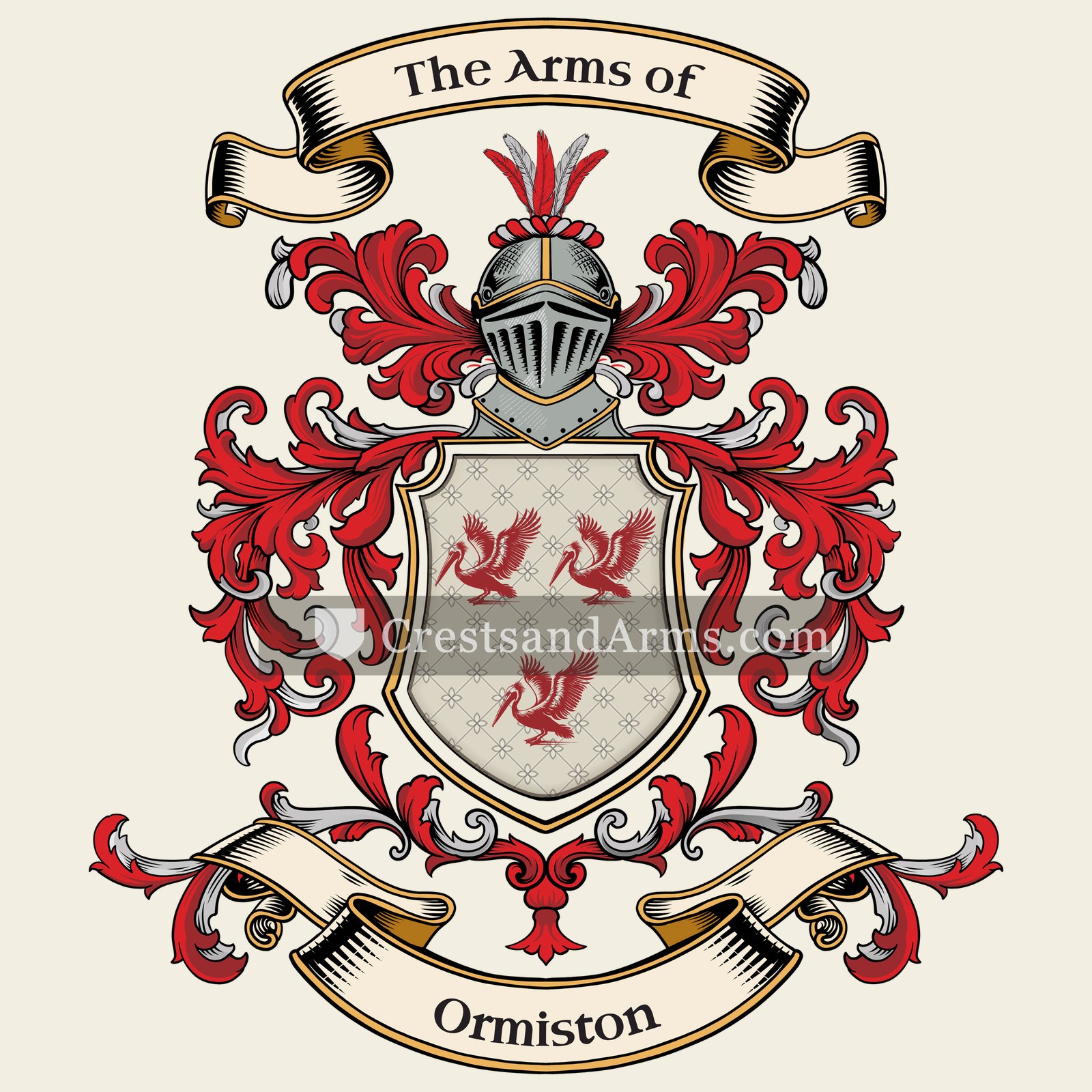
Coat of Arms & Family Crest Details
Symbols on this shield
pelicanSelf-sacrifice and devotion to one's children
Colours
Silver (Argent)Means: Peace and sincerity
Red (Gules)Means: Military strength
Historical info
Source
Sir Bernard Burke, The General Armory of England, Scotland, Ireland and Wales, London: Harrison & Sons, 1884
Blazon (the actual original written record)
“Ar. three pelicans vulning themselves gu”
HaddingtonHaddington, c. 1748
Digital archive packCoat of arms PNG, gold border print PDF, vector SVG and the certificate of authenticity. Sent to your email in minutes.
Map of Scotland showing where the Ormiston arms are recorded
The Ormiston arms were recorded in Haddington, c. 1748.
Haddington, now East Lothian, was the best farmland in Scotland and lay close to Edinburgh. Good land near the capital stayed in the hands of families of standing, and standing brought arms.
This is where the arms were entered in the register. Families often moved to other parts of the country, so the same name can turn up in more than one region.
The body that granted and recorded arms in Scotland in this period.
George II of Great Britain
Sovereign of the period
George II of Great Britain
1727–1760
Reigning in England when the Ormiston arms are first recorded.
How Arms Worked in Scotland
Scottish heraldry is unique because it treats a coat of arms as a piece of personal property protected by law. Only one person can own a specific design at any given time. When a family grows, the head keeps the original shield while other relatives must apply for their own distinct version with slight changes to prove their specific identity.
Granting authority
The Court of the Lord Lyon acts as the official body that regulates and controls all heraldic matters throughout Scotland.
How they got arms
Individuals obtain a legal right to their arms through a formal petition process that confirms their identity and family connection.
Where arms were recorded
All valid coats of arms are officially entered into the Public Register of All Arms and Bearings starting from 1672.
The family's standing
Recorded among the armigerous families of Haddington.
Origin & History of the Ormiston Family in Scotland
The name Ormiston originates from a place name in the historic county of East Lothian, Scotland. The name itself is derived from the Old English words for a farmstead belonging to a man named Orm, which translates to "Orm’s town." By the time the family was firmly established in the town of Haddington in 1748, they were part of a long tradition of families who took their surnames from the lands they inhabited. During the medieval period, the village of Ormiston served as a significant site for local landholders who held their property under the authority of the Scottish Crown. Over several centuries, the family name spread from these rural roots into the nearby burghs, where members became involved in the local trade and civic life that defined the Haddington area. By the mid-18th century, the Ormiston name was well-integrated into the social and economic fabric of the region, reflecting a history tied closely to the development of the Scottish Lowlands.
Related Branches & Arms
Root word
Orm
Old Norse name meaning serpent or dragon.
This name
OrmistonRefers to the settlement or farmstead belonging to a man named Orm.
also spelled
Ormiston
Related arms
Ormestonvariant spelling
Ormestonevariant spelling
Documented Sources
Sir Bernard Burke, The General Armory of England, Scotland, Ireland and Wales, London: Harrison & Sons, 1884
Reaney, P.H., A Dictionary of British Surnames, 1958
Essex Record Office, Quarter Sessions Rolls (Q/SR), 1620
Black, George F., The Surnames of Scotland: Their Origin, Meaning, and History, 1946
Digital archive packCoat of arms PNG, gold border print PDF, vector SVG and the certificate of authenticity. Sent to your email in minutes.


 chevronProtection, and faithful service completed
 bordureA difference between branches of one family
 arms pheon arrowheadReadiness for battle, and the broad arrow of the sovereign
 chevronProtection, and faithful service completed
 bordureA difference between branches of one family
 arms pheon arrowheadReadiness for battle, and the broad arrow of the sovereign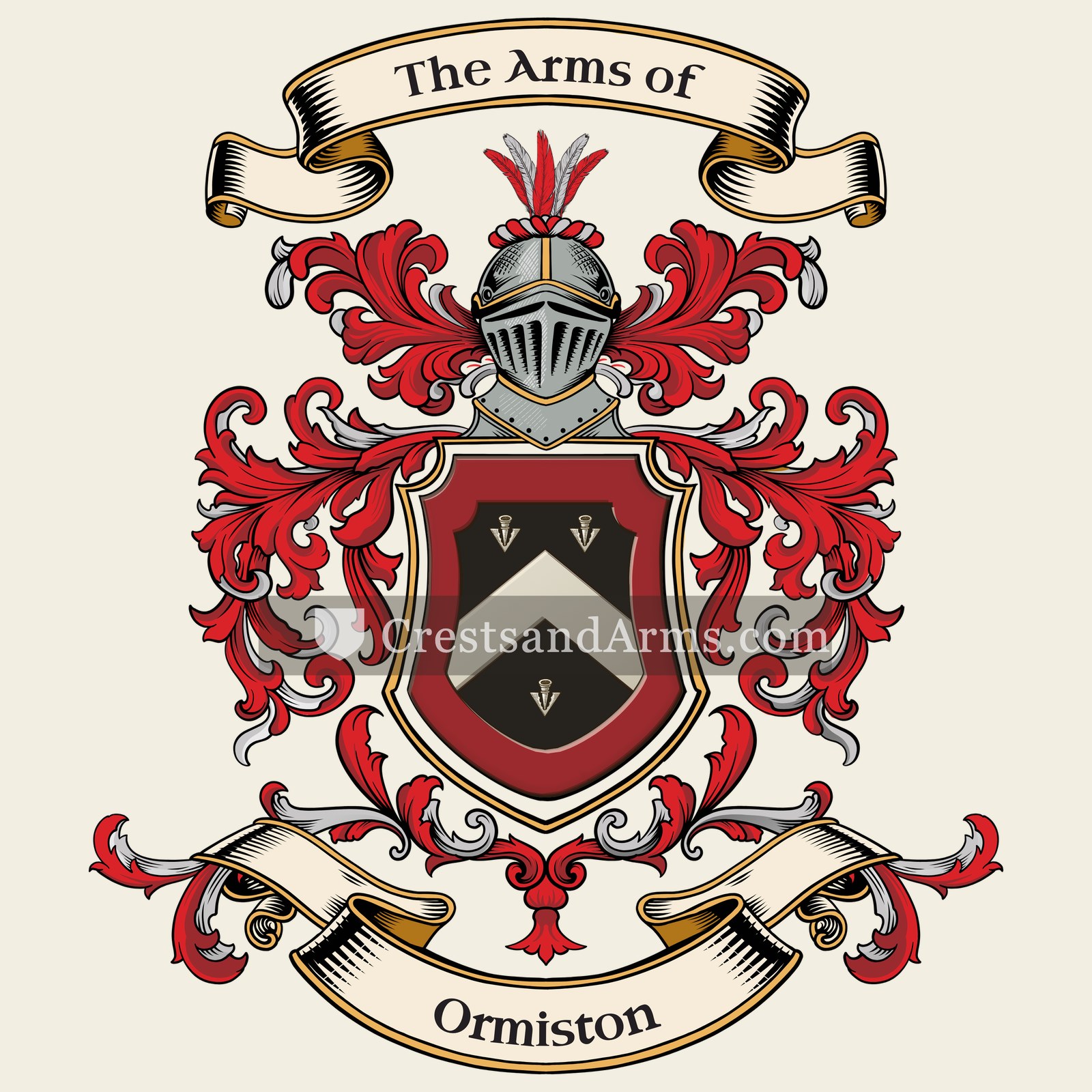


 pelicanSelf-sacrifice and devotion to one's children