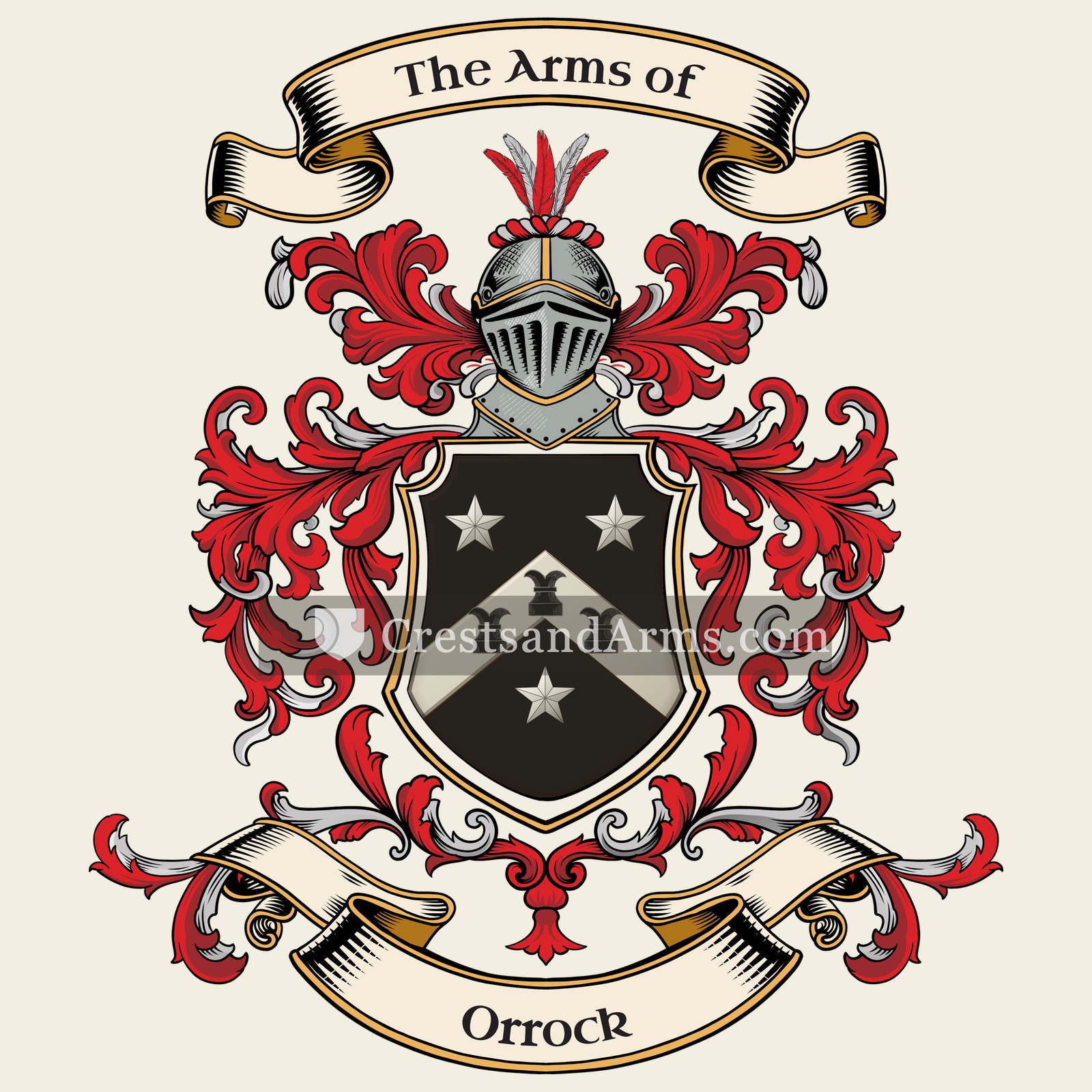
A record of documented arms, meaning and origin, researched for the Orrock family lines. Documented in 2 countries.
Reg. 8668 · Britain, M–O
Coat of Arms & Family Crest Details
Symbols on this shield
chevronProtection, and faithful service completed
chess rookStrategy, and the defence of a position
starThe celestial goddess, and nobility
Colours
Black (Sable)Means: Constancy
Gold (Or)Means: Generosity
Silver (Argent)Means: Peace and sincerity
Historical info
Source
J. B. Rietstap, Armorial Général, Gouda: G. B. van Goor Zonen, 1884–87
Blazon (the actual original written record)
“De sa. au chev. d'or, le bord supérieur ondé, le bord inférieur bastillé; le chev. ch. de trois rocs d'échiquier de sa. et acc. de trois étoiles (5) d'arg. C.: un faucon au nat., sur une perche. D.: CHRISTUS SOLUS MEA RUPES. L. d'arg. et de sa.”
BritainHoll, c. 1700
Digital archive packCoat of arms PNG, gold border print PDF, vector SVG and the certificate of authenticity. Sent to your email in minutes.
Map of Britain showing where the Orrock arms are recorded
The Orrock arms were recorded in Holl, c. 1700.
Arms such as these were typically recorded in Kent.
Kent sits between London and the short crossing to Europe, and the trade passing through made it wealthy. Merchant families bought land with that money, and it was landowners who took coats of arms.
This is where the arms were entered in the register. Families often moved to other parts of the country, so the same name can turn up in more than one region.
The body that granted and recorded arms in Britain in this period.
William III of England
Sovereign of the period
William III of England
1694–1702
Reigning in Britain when the Orrock arms are first recorded.
How Arms Worked in Britain
English heraldry allowed arms to be shared by all legitimate descendants of the original owner. These symbols were treated as personal property that moved through the generations to all children. While the eldest son kept the original design, other family members could use the same shield without needing to change it or register their own unique versions.
Granting authority
The College of Arms in London has regulated the use of coats of arms throughout England and Wales since 1484.
How they got arms
Families typically obtained their coats of arms through a formal grant from the Crown or by proving their ancient right to them.
Where arms were recorded
All official coats of arms are recorded in the registers kept at the College of Arms, which date back to the fifteenth century.
The family's standing
Recorded among the armigerous families of Britain.
Origin & History of the Orrock Family in Britain
The surname Orrock is deeply rooted in the history of Scotland, with its origins tracing back to the lands of Orrock in the parish of Burntisland in Fife. The name is locational, meaning it was first adopted by individuals who lived on or owned these specific estates during the medieval period. By the early 18th century, the family had expanded their reach beyond their Scottish origins, with records confirming their presence in Kent by 1700. This movement likely reflected the broader migration patterns of the time, as families moved south toward London for trade, military service, or professional opportunities. While the name remained relatively rare, its transition from a specific Scottish landscape to the southern counties of England highlights the mobility of families during the late Stuart period.
Coat of Arms & Family Crest Details
Symbols on this shield
chevronProtection, and faithful service completed
mulletThe third son, and a divine quality from above
chess rookStrategy, and the defence of a position
Colours
Black (Sable)Means: Constancy
Silver (Argent)Means: Peace and sincerity
Historical info
Source
Sir Bernard Burke, The General Armory of England, Scotland, Ireland and Wales, London: Harrison & Sons, 1884
Blazon (the actual original written record)
“Sa. on a chev. betw. three mullets ar. as many chessrooks of the first”
FifeFife, c. 1748
Digital archive packCoat of arms PNG, gold border print PDF, vector SVG and the certificate of authenticity. Sent to your email in minutes.
Map of Scotland showing where the Orrock arms are recorded
The Orrock arms were recorded in Fife, c. 1748.
Fife was farming country between two firths, with royal palaces and old burghs along its coast. Its landed families were numerous and close to the court, and closeness to the court brought arms.
This is where the arms were entered in the register. Families often moved to other parts of the country, so the same name can turn up in more than one region.
The body that granted and recorded arms in Scotland in this period.
George II of Great Britain
Sovereign of the period
George II of Great Britain
1727–1760
Reigning in Britain when the Orrock arms are first recorded.
How Arms Worked in Scotland
Scottish heraldry is unique because it treats a coat of arms as a piece of personal property protected by law. Only one person can own a specific design at any given time. When a family grows, the head keeps the original shield while other relatives must apply for their own distinct version with slight changes to prove their specific identity.
Granting authority
The Court of the Lord Lyon acts as the official body that regulates and controls all heraldic matters throughout Scotland.
How they got arms
Individuals obtain a legal right to their arms through a formal petition process that confirms their identity and family connection.
Where arms were recorded
All valid coats of arms are officially entered into the Public Register of All Arms and Bearings starting from 1672.
The family's standing
Recorded among the armigerous families of Fife.
Origin & History of the Orrock Family in Scotland
The Orrock family name is deeply rooted in the geography of the Fife region in Scotland. The name is locational, meaning it was likely taken from the lands of Orrock near Burntisland. Historical records confirm that the family held these lands as early as the thirteenth century, establishing them as local landowners long before the mid-1700s. By 1748, the family was well-integrated into the social and economic fabric of Fife, where they were known as minor gentry. They often served in local administrative roles or as tenants of larger estates. Their history reflects the broader patterns of Scottish life during this era, characterized by a strong connection to the land and the local parish community. The family remained a steady presence in the region for centuries, moving through the changing political landscape of Scotland while maintaining their ancestral ties to the Fife coastline.
Related Branches & Arms
Root word
Orrock
Derived from the Gaelic 'odhar' meaning pale or dun colored.
This name
OrrockA locational surname originating from the lands of Orrock in Fife, Scotland.
also spelled
Orrok
Orroke
Related arms
Balneavisrecorded with Orrock, same area
Couttsrecorded with Orrock, same area
Macalester-Louprecorded with Orrock, same area
Nichollsrecorded with Orrock, same area
Documented Sources
J. B. Rietstap, Armorial Général, Gouda: G. B. van Goor Zonen, 1884–87
Black, George F., The Surnames of Scotland: Their Origin, Meaning, and History, 1946
National Records of Scotland, Register of the Great Seal of Scotland (Registrum Magni Sigilli Regum Scotorum), 1306–1668
The National Archives (UK), Prerogative Court of Canterbury and Related Probate Jurisdictions: Will Registers, 1700
Digital archive packCoat of arms PNG, gold border print PDF, vector SVG and the certificate of authenticity. Sent to your email in minutes.


 chevronProtection, and faithful service completed
 chess rookStrategy, and the defence of a position
 starThe celestial goddess, and nobility
 chevronProtection, and faithful service completed
 chess rookStrategy, and the defence of a position
 starThe celestial goddess, and nobility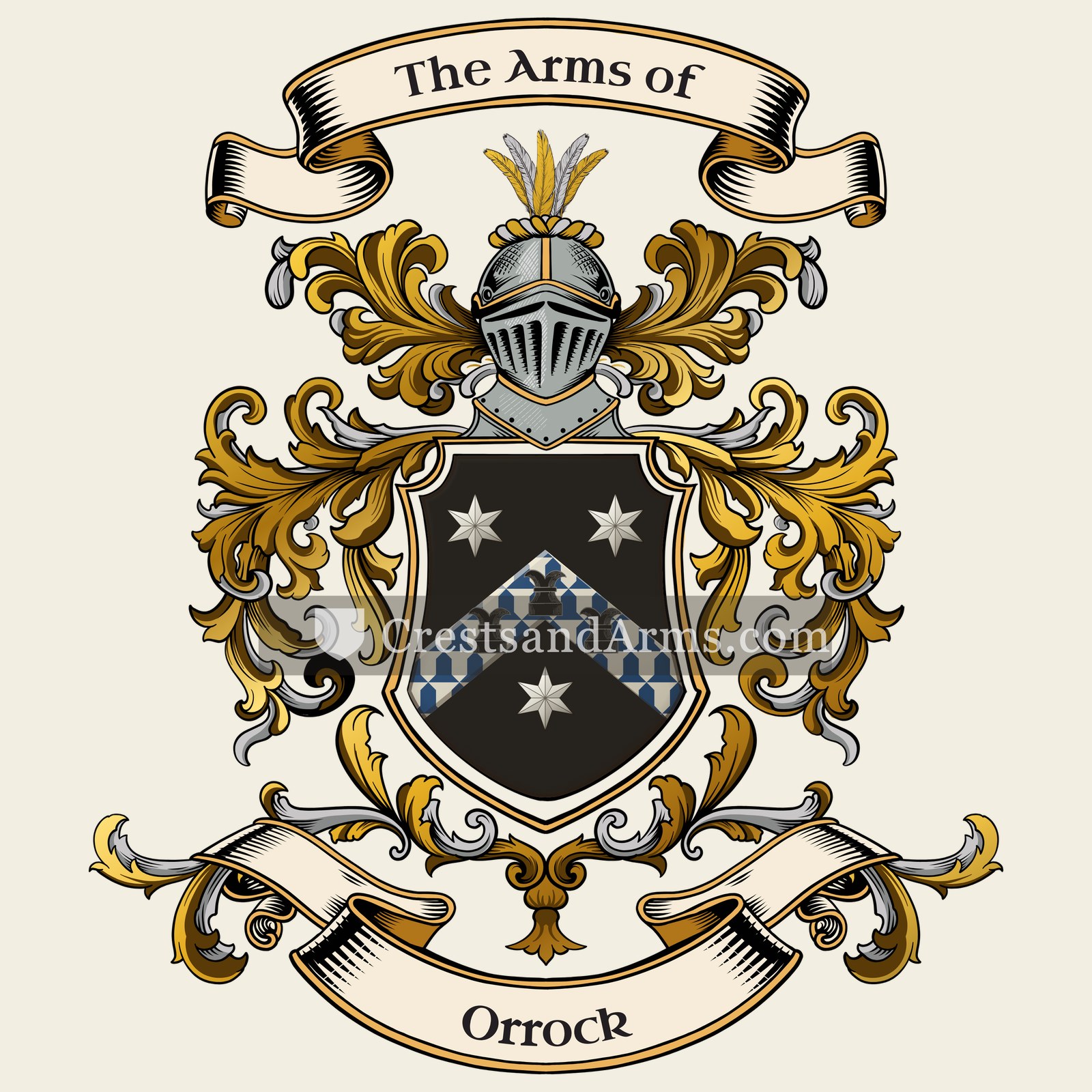


 mulletThe third son, and a divine quality from above