Map of Switzerland showing where the Orzechowski arms are recorded
The Orzechowski arms were recorded in Switzerland, c. 1745.
Arms such as these were typically recorded in Bern.
Bern was the largest of the Swiss cantons and ran itself, with its own council and its own courts. Its governing families held office for generations, and office of that kind carried a shield with it.
This is where the arms were entered in the register. Families often moved to other parts of the country, so the same name can turn up in more than one region.
The body that granted and recorded arms in Switzerland in this period.
How Arms Worked in Switzerland
In Switzerland, coats of arms were not restricted to the nobility and were often adopted by common citizens and families. These symbols were passed down through generations to show family identity. When branches of a family grew, they often changed small details of the design to distinguish their own line from the original group.
Granting authority
Cantonal and civic authorities managed the use of coats of arms within their specific regions and local jurisdictions.
How they got arms
Families typically assumed their own coats of arms based on local custom rather than receiving them from a central monarch.
Where arms were recorded
Arms were recorded in various cantonal and civic registers starting from the fourteenth century throughout the Swiss region.
The family's standing
Recorded among the armigerous families of Switzerland.
Origin & History of the Orzechowski Family in Switzerland
The surname Orzechowski is rooted in the Polish language, derived from the word "orzech," which means walnut. Historically, this type of name often identified a person by their trade, their physical appearance, or the specific location where they lived, such as a grove of walnut trees. While the name is distinctly Polish in its origins, the presence of the family in Bern by 1745 suggests a history of migration and adaptation. During the eighteenth century, many families moved across European borders for work, religious freedom, or trade opportunities. By settling in a Swiss city like Bern, the Orzechowski family became part of a diverse group of residents navigating a new cultural landscape while maintaining their unique ancestral identity. This transition highlights how a family name can travel across vast distances, evolving from a local descriptor in a Polish village to a recognized name in the heart of Central Europe.
Related Branches & Arms
Root word
Orzech
A Slavic term referring to a nut or walnut tree.
This name
OrzechowskiA locative surname denoting someone who originated from a place characterized by walnut trees.
also spelled
Orzochowski
Orzochovsky
Documented Sources
J. B. Rietstap, Armorial Général, Gouda: G. B. van Goor Zonen, 1884–87
Dziadulewicz, Stanisław. Herbarz rodzin tatarskich w Polsce. 1929


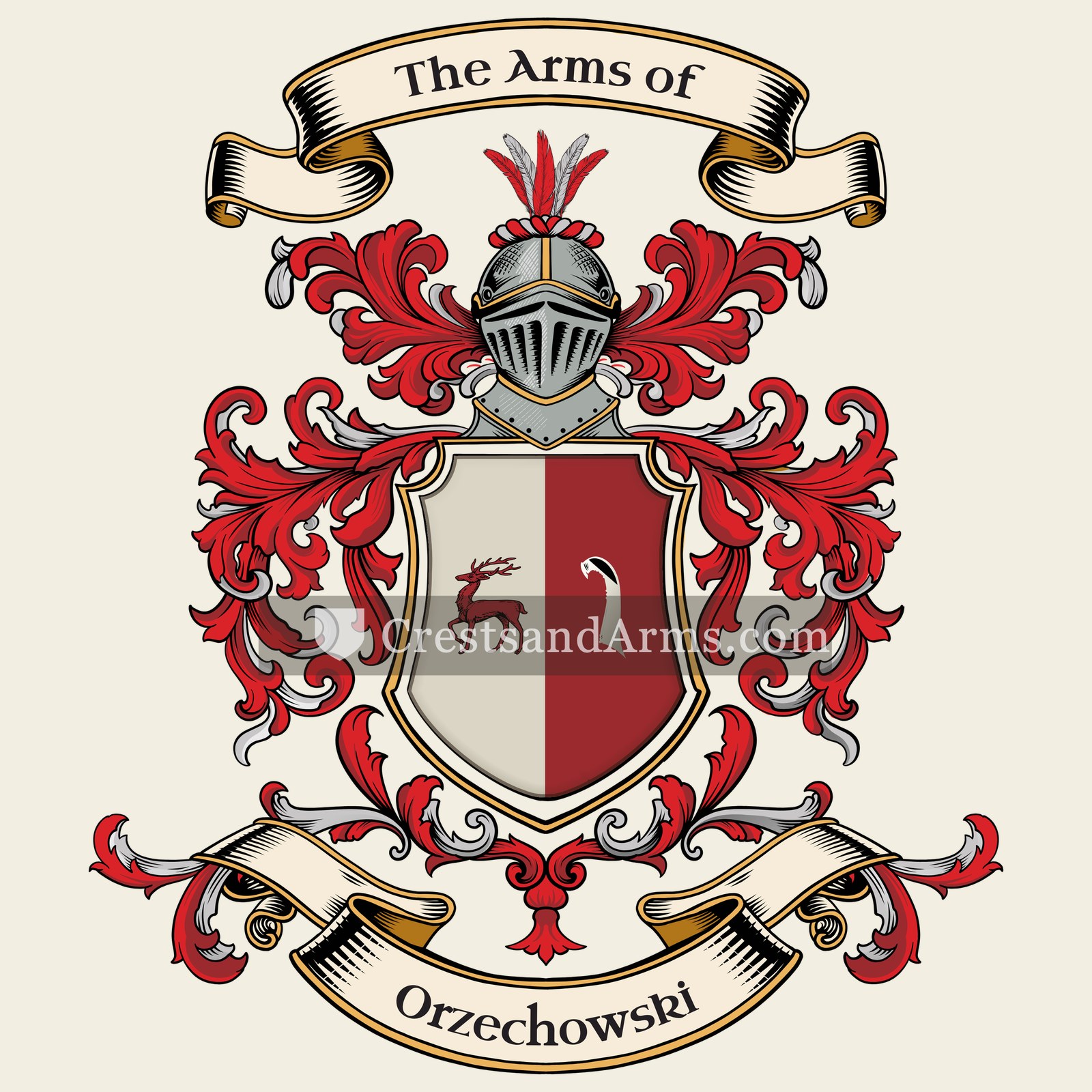
 stagPeace and harmony, and one who will not fight unprovoked
 proboscides trunksGreat strength and long memory
 stagPeace and harmony, and one who will not fight unprovoked
 proboscides trunksGreat strength and long memory