Map of England showing where the Osbaldeston arms are recorded
The Osbaldeston arms were recorded in Oxford, c. 1574.
Oxfordshire was farming country with the university at its centre, and both produced families of standing. Scholars and lawyers who did well bought manors nearby, and holding a manor was the ordinary route to a coat of arms.
This is where the arms were entered in the register. Families often moved to other parts of the country, so the same name can turn up in more than one region.
The body that granted and recorded arms in England in this period.
Elizabeth I of England
Sovereign of the period
Elizabeth I of England
1558–1603
Reigning in England when the Osbaldeston arms are first recorded.
How Arms Worked in England
English heraldry allowed arms to be shared by all legitimate descendants of the original owner. These symbols were treated as personal property that moved through the generations to all children. While the eldest son kept the original design, other family members could use the same shield without needing to change it or register their own unique versions.
Granting authority
The College of Arms in London has regulated the use of coats of arms throughout England and Wales since 1484.
How they got arms
Families typically obtained their coats of arms through a formal grant from the Crown or by proving their ancient right to them.
Where arms were recorded
All official coats of arms are recorded in the registers kept at the College of Arms, which date back to the fifteenth century.
The family's standing
Recorded among the armigerous families of Oxford.
Origin & History of the Osbaldeston Family in England
The surname Osbaldeston originates from a place name in Lancashire, specifically the township of Osbaldeston near Blackburn. The name itself is derived from Old English, combining the personal name Osbeald with the word tun, which refers to an enclosed settlement or farmstead. While the family established deep roots in the north of England during the medieval period, their influence eventually spread to other parts of the country. By 1574, records confirm that members of the family were well-established in Oxford, indicating that they were involved in the academic and professional life of that city during the Elizabethan era. This movement suggests that the family was upwardly mobile and connected to the intellectual centers of the time, transitioning from their original rural holdings to roles within the university and civic administration.
Osbaldeston Meaning & Related Branches
Root word
Osbald
Derived from the Old English elements os meaning god and bald meaning bold.
This name
OsbaldestonRefers to the settlement or estate belonging to a person named Osbald.
also spelled
Osbaldiston
Osbaldestoun
Related arms
Cuerdallsame arms
Fitz-Humfreysame arms
Keverdalesame arms
Ledshamsame arms
Documented Sources
Sir Bernard Burke, The General Armory of England, Scotland, Ireland and Wales, London: Harrison & Sons, 1884
Ekwall, Eilert. The Place-Names of Lancashire. 1922
Foster, Joseph. Alumni Oxonienses: The Members of the University of Oxford, 1500-1714. 1891
The National Archives. Records of the Prerogative Court of Canterbury, Will Registers, PROB 11
Digital archive packCoat of arms PNG, gold border print PDF, vector SVG and the certificate of authenticity. Sent to your email in minutes.


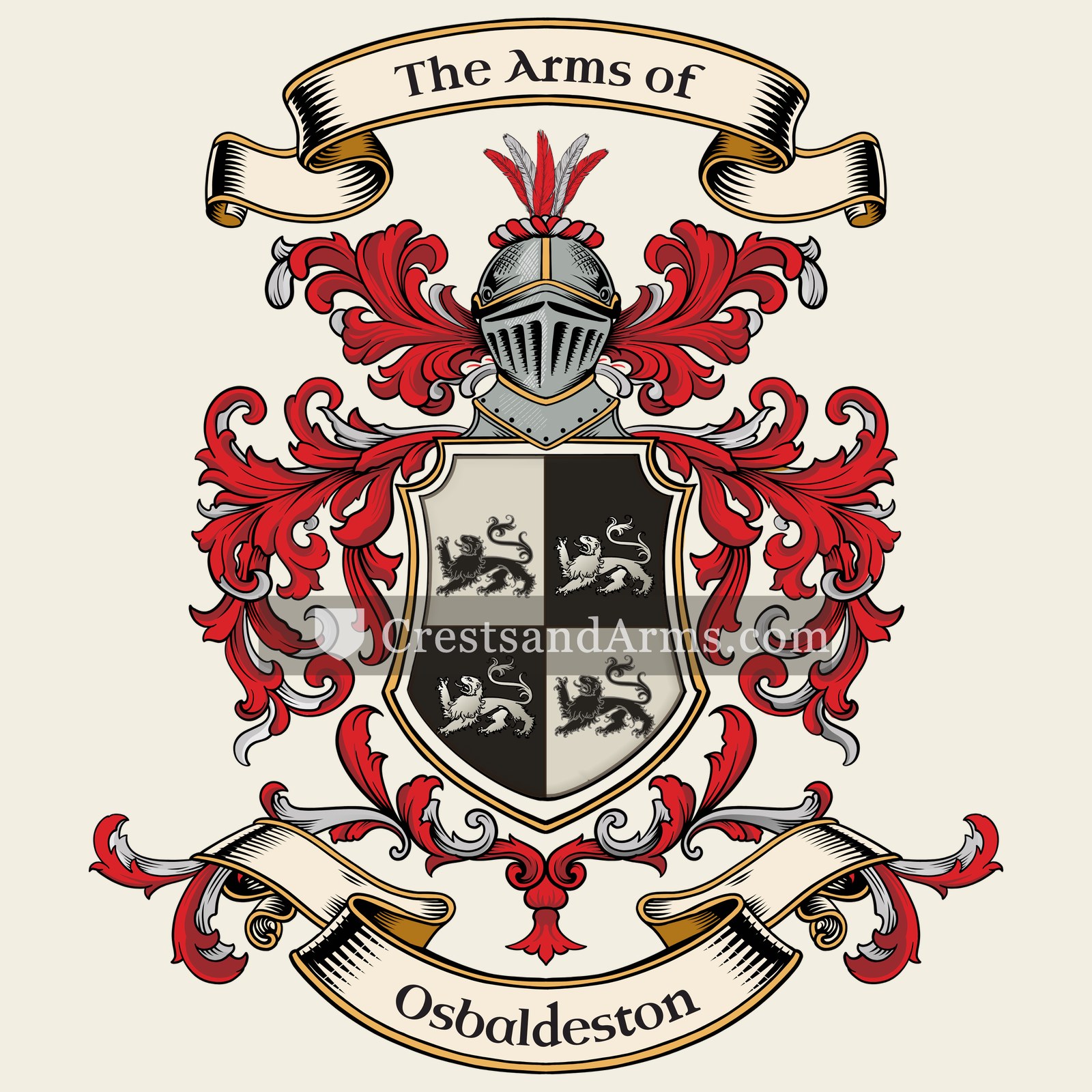
 lionCourage, strength and royalty
 lionCourage, strength and royalty