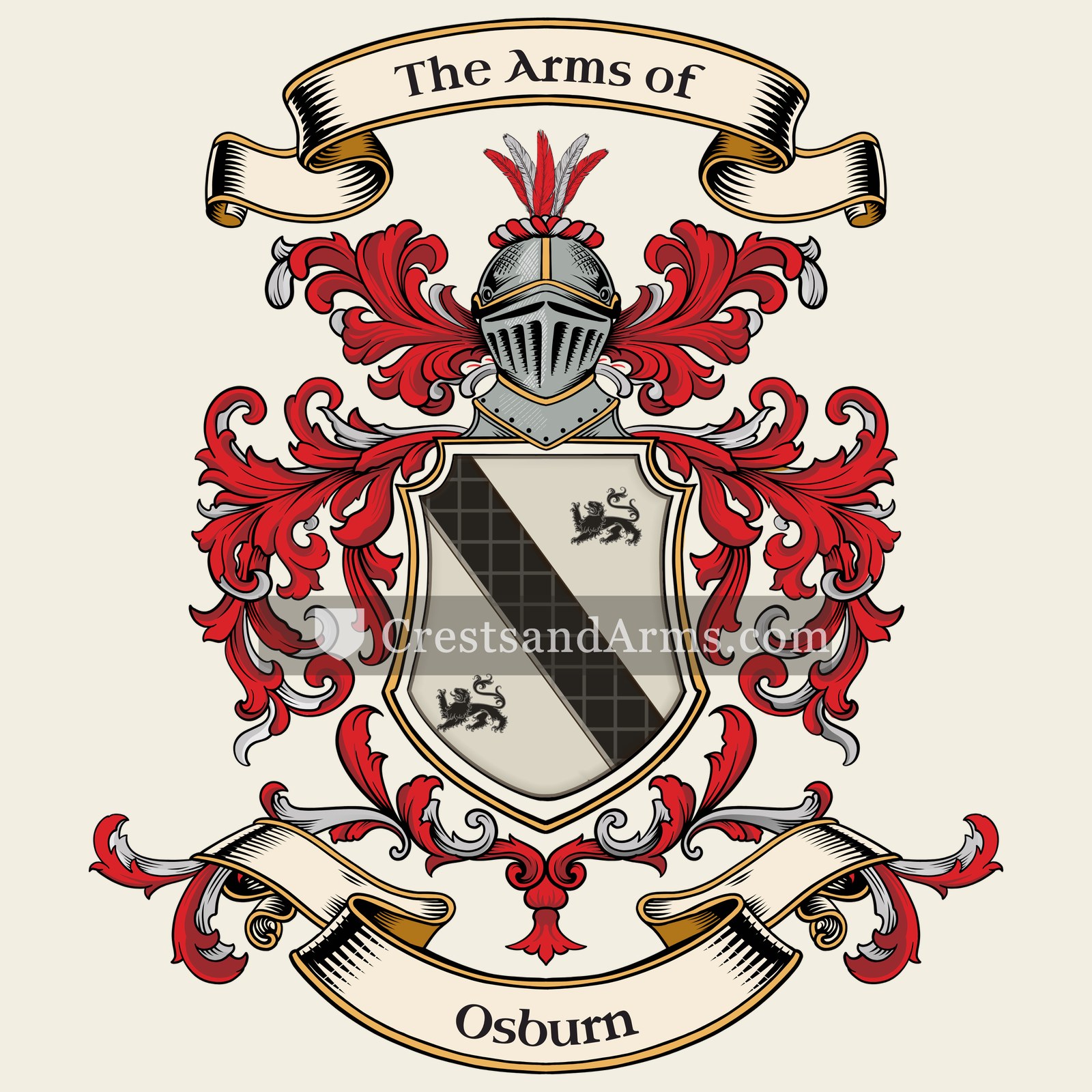
A record of documented arms, meaning and origin, researched for the Osburn family of France.
Reg. 5251 · French, M–O
Coat of Arms & Family Crest Details
Symbols on this shield
bendDefence, and the scarf of a commander
lionCourage, strength and royalty
Colours
Silver (Argent)Means: Peace and sincerity
Black (Sable)Means: Constancy
Historical info
Source
J. B. Rietstap, Armorial Général, Gouda: G. B. van Goor Zonen, 1884–87
Blazon (the actual original written record)
“D'arg. à la bande de sa., acc. de deux lions du même. C.: une tête et col de lion au nat., cour. d'or. S.: deux griffons, ch. chacun sur la poitrine d'une herse sarasine. D.: QUANTUM IN REBUS INANE.”
BedfordshireBedfordshire, c. 1662
Digital archive packCoat of arms PNG, gold border print PDF, vector SVG and the certificate of authenticity. Sent to your email in minutes.
Map of France showing where the Osburn arms are recorded
The Osburn arms were recorded in Bedfordshire, c. 1662.
This is where the arms were entered in the register. Families often moved to other parts of the country, so the same name can turn up in more than one region.
The body that granted and recorded arms in France in this period.
Louis XIV of France
Sovereign of the period
Louis XIV of France
1643–1715
Reigning in France when the Osburn arms are first recorded.
How Arms Worked in France
In France, a coat of arms was a mark of honor that passed down through the male line to all legitimate descendants. Families often used the same shield without changes to show their shared heritage. If a branch wanted to stand out, they could add a small mark to their shield to show their specific place in the family tree.
Granting authority
The Juge d'armes de France acted as the official authority that regulated and verified coats of arms across the country.
How they got arms
Families typically inherited their arms from ancestors, though they could also receive them through royal grants or by proving their noble status.
Where arms were recorded
Coats of arms were officially recorded in the Armorial Général de France, which began its main collection in the year 1696.
The family's standing
Recorded among the armigerous families of Bedfordshire.
Origin & History of the Osburn Family in France
The surname Osburn is a variation of the Old English name Osbeorn, which translates to divine bear. This name was common in England long before the seventeenth century, reflecting a time when people identified themselves through descriptive nicknames or ancestral roots. By 1662, records confirm that members of the Osburn family were firmly established in the county of Bedfordshire. During this period, families in this region were often involved in agricultural work or local trades that supported the growing rural economy. Life in Bedfordshire at that time was shaped by the restoration of the monarchy and the daily routines of village life. As the family grew, they became part of the local history that defined the social fabric of the English countryside during the late seventeenth century.
Related Branches & Arms
Root word
Osbeorn
Derived from Old Norse elements meaning god and bear.
This name
OsburnA locational or patronymic surname signifying a descendant of one named divine bear.
also spelled
Osburn
Osborne
Osburne
Documented Sources
J. B. Rietstap, Armorial Général, Gouda: G. B. van Goor Zonen, 1884–87
Reaney, P.H., A Dictionary of English Surnames, 1958


 bendDefence, and the scarf of a commander
 lionCourage, strength and royalty
 bendDefence, and the scarf of a commander
 lionCourage, strength and royalty