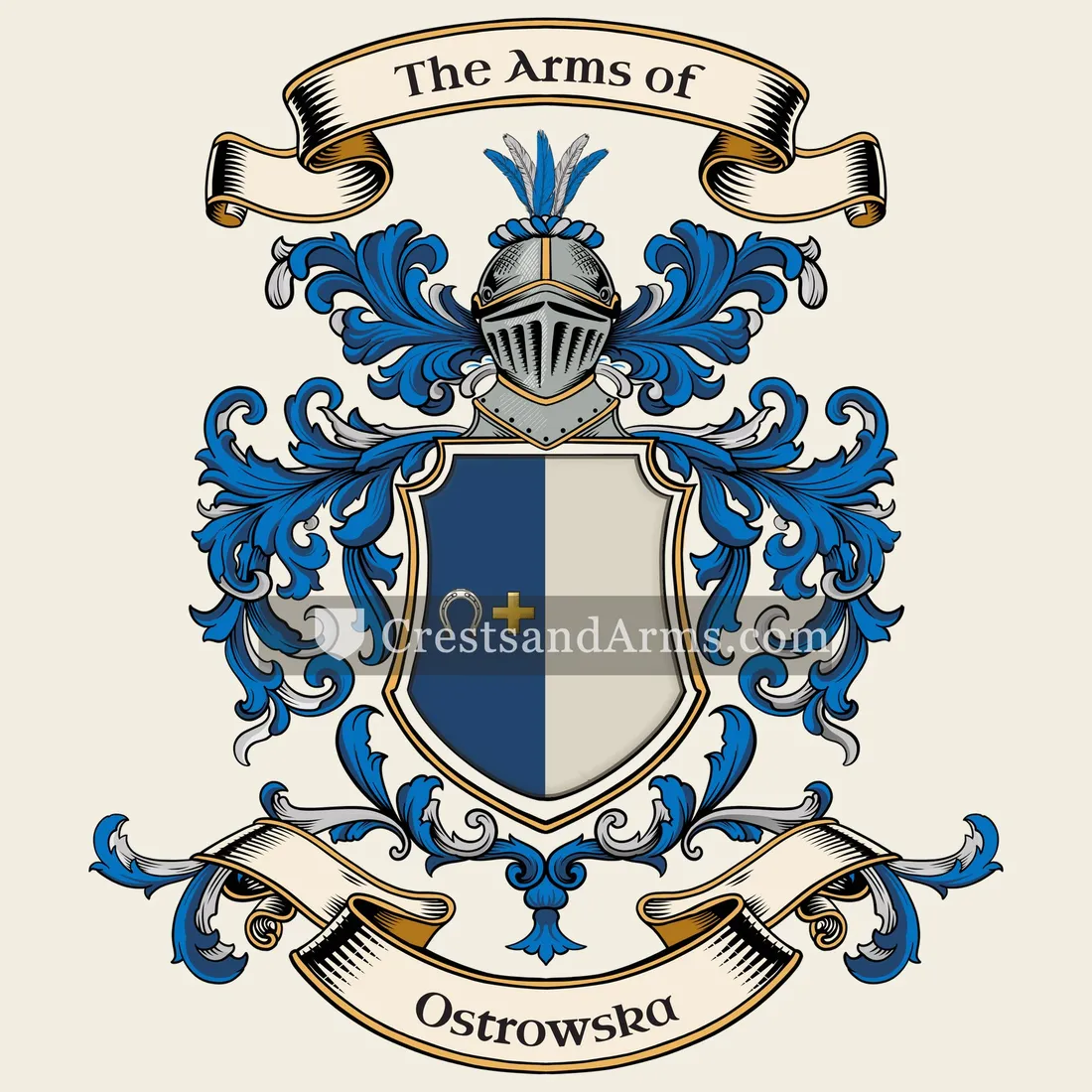
A record of documented arms, meaning and origin, researched for the Ostrowska family of Austria.
Reg. 2016 · Austrian, M–O
Meaning of the Ostrowska family crest colors & symbols
Symbols on this shield
horseshoeGood fortune and protection from harm
cross symbolChristian faith and service
Colours
Blue (Azure)Means: Loyalty and truth
Silver (Argent)Means: Peace and sincerity
Gold (Or)Means: Generosity
Historical info
Source
J. B. Rietstap, Armorial Général, Gouda: G. B. van Goor Zonen, 1884–87
Blazon (the actual original written record)
“Parti: au 1 d'azur à un fer-à-cheval d'arg., les bouts en bas, sommé d'un croissette d'or; au 2 les armes de Korab. Cq. cour. C.: un demi-vol d'arg., percé d'une flèche d'or, empennée d'arg., en fasce, la pointe à sen.”
GaliciaGalicia, c. 1772
Digital archive packCoat of arms PNG, gold border print PDF, vector SVG and the certificate of authenticity. Sent to your email in minutes.
Map of Austria showing where the Ostrowska arms are recorded
The Ostrowska arms were recorded in Galicia, c. 1772.
Galicia was eastern country of large estates and small farming villages, held by families who had been there for a very long time. Land was what entitled a family to arms, and land there rarely changed hands.
This is where the arms were entered in the register. Families often moved to other parts of the country, so the same name can turn up in more than one region.
Region
Galicia
First recorded
1772
Granting Authority for the Ostrowska Arms
Imperial and Royal chancery
Sodacan · CC BY-SA 3.0
The body that granted and recorded arms in Austria in this period.
Joseph II, Holy Roman Emperor
Sovereign of the period
Joseph II, Holy Roman Emperor
1765–1790
Reigning in Austria when the Ostrowska arms are first recorded.
How Arms Worked in Austria
Austrian coats of arms were often linked directly to noble titles granted by the Emperor. These symbols belonged to the entire family line rather than just one individual. When a family grew, new branches kept the original design without needing to change it. This system allowed all members of a noble house to share the same identity across many generations.
Granting authority
The Imperial and Royal chancery managed all heraldic matters and controlled the official granting of arms throughout the Austrian lands.
How they got arms
Families typically received their arms through a formal imperial decree that often accompanied the elevation of a person to noble status.
Where arms were recorded
Official records of these grants were kept in the Imperial Register of Nobility which began its formal documentation process in 1453.
The family's standing
Recorded among the armigerous families of Galicia.
Origin & History of the Ostrowska Family in Austria
The surname Ostrowska is a habitational name, which means it was originally derived from the place where a family lived. In Polish, the root word "ostrow" refers to an island or a piece of land surrounded by marshes or water. Families who took this name likely lived near such a geographical feature, and over time, the name became a way to identify them within their community. By 1772, when the region of Galicia was incorporated into the Austrian Empire, the Ostrowski and Ostrowska families were already well-established in the area. During this period, the family members were often part of the local social fabric, living in rural settlements or small towns across the Galician landscape. Because the name is based on a common landscape feature, it emerged independently in several different parts of Poland, meaning that not all people with this name share a single common ancestor.
Ostrowska Meaning & Related Branches
Root word
ostrov
Slavic term for an island or land surrounded by water.
This name
OstrowskaRefers to a person who originated from a place located on an island or riverbank.
also spelled
Ostrowsky
Ostrowske
Documented Sources
J. B. Rietstap, Armorial Général, Gouda: G. B. van Goor Zonen, 1884–87
Brückner, Aleksander. Słownik etymologiczny języka polskiego (1927)


 horseshoeGood fortune and protection from harm
 cross symbolChristian faith and service
 horseshoeGood fortune and protection from harm
 cross symbolChristian faith and service