Map of Netherlands showing where the Ottman arms are recorded
The Ottman arms were recorded in Netherlands, c. 1815.
Arms such as these were typically recorded in Friesland.
Friesland was low, wet country on the northern coast of the Netherlands, farmed by families who had held the same land for centuries. Free landholders were unusually common there, and a free landholder could carry arms.
This is where the arms were entered in the register. Families often moved to other parts of the country, so the same name can turn up in more than one region.
Region
Friesland
First recorded
1815
Granting Authority for the Ottman Arms
Hoge Raad van Adel
Photograph made by me · CC BY-SA 3.0
The body that granted and recorded arms in Netherlands in this period.
William I of the Netherlands
Sovereign of the period
William I of the Netherlands
1815–1840
Reigning in Netherlands when the Ottman arms are first recorded.
How Arms Worked in Netherlands
In the Netherlands, coats of arms were often used by noble families and those who held specific public offices. These arms were passed down through the generations to legitimate descendants. Younger branches of a family usually kept the original design without needing to add special marks. This system ensured that the family identity remained clear and consistent over many years.
Granting authority
The Hoge Raad van Adel is the official body that regulates and manages noble titles and coats of arms in the Netherlands.
How they got arms
Families typically obtained their coats of arms through official royal grants or by proving their long-standing historical use of the symbols.
Where arms were recorded
Coats of arms are officially recorded in the registers held by the Hoge Raad van Adel, which began its work in 1814.
The family's standing
Recorded among the armigerous families of Netherlands.
Origin & History of the Ottman Family in Netherlands
The family name Ottman finds its roots in the Germanic linguistic tradition, where it likely evolved from the ancient personal name Otto combined with the suffix man. This structure suggests that the name originally identified a person as a follower or a member of the household of someone named Otto. By the early nineteenth century, the family was well established in the northern province of Friesland in the Netherlands. During this period, the region was undergoing significant administrative changes following the end of French occupation, which led to more formal record-keeping for citizens. As residents of Friesland in 1815, the Ottman family lived in a landscape defined by its unique Frisian language and a long history of maritime trade. The family likely participated in the agricultural or merchant activities that shaped the local economy of the coastal provinces during the transition into the modern Dutch state.
Ottman Meaning & Related Branches
Root word
Otto
Derived from the Germanic element aud meaning wealth or prosperity.
This name
OttmanA patronymic surname signifying a descendant or servant of a man named Otto.
also spelled
Outmanse
Outmanns
Outmanne
Documented Sources
J. B. Rietstap, Armorial Général, Gouda: G. B. van Goor Zonen, 1884–87
Tresoar, Burgerlijke Stand van Friesland (1811–1950)
Van der Schaar, J., Woordenboek van voornamen, 1964
Nederlandse Familienamenbank, Ottman, 2023
Digital archive packCoat of arms PNG, gold border print PDF, vector SVG and the certificate of authenticity. Sent to your email in minutes.


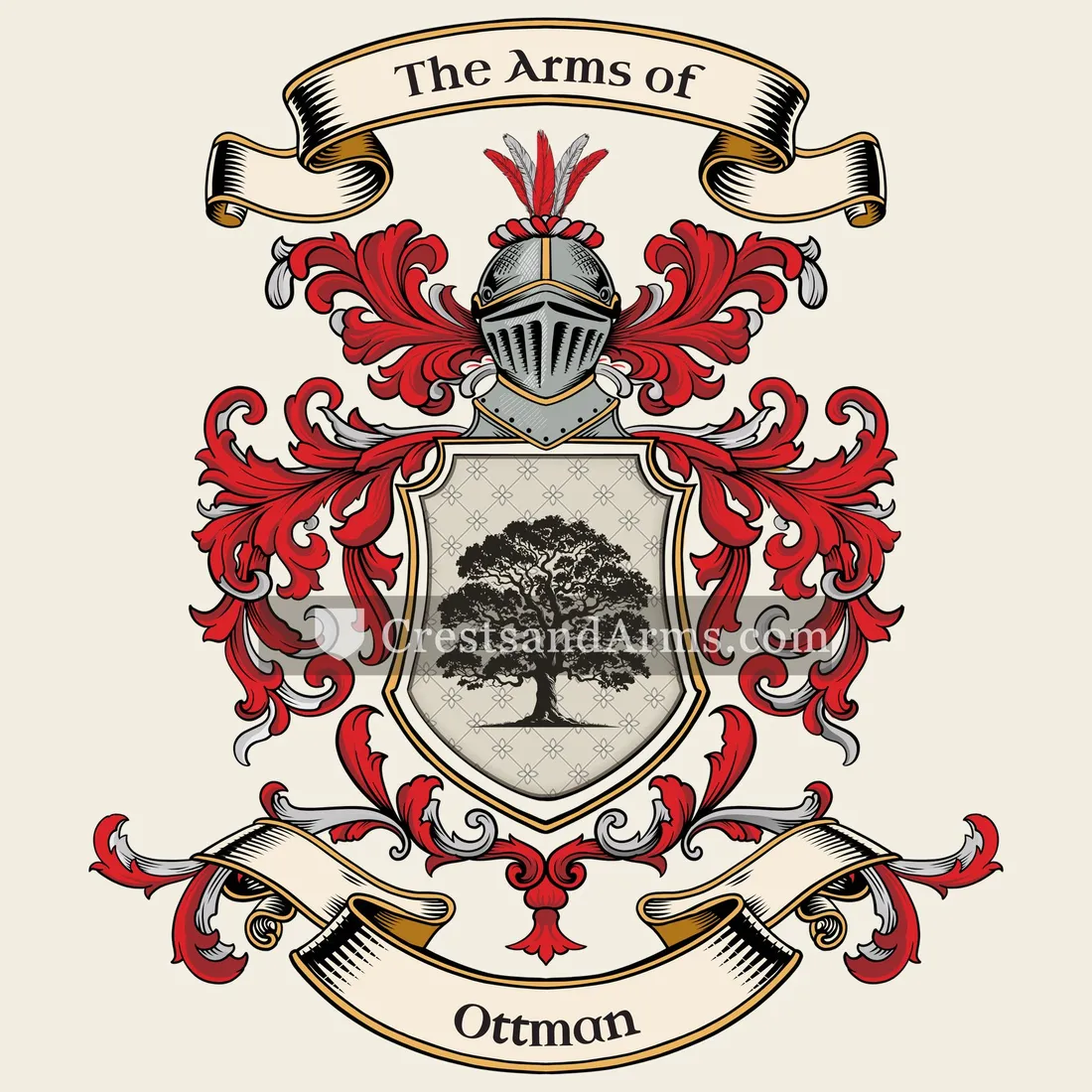
 treeLife, endurance and deep roots
 treeLife, endurance and deep roots