Map of Germany showing where the Ouder arms are recorded
The Ouder arms were recorded in Nuremberg, c. 1765.
This is where the arms were entered in the register. Families often moved to other parts of the country, so the same name can turn up in more than one region.
The body that granted and recorded arms in Germany in this period.
Francis I, Holy Roman Emperor
Sovereign of the period
Francis I, Holy Roman Emperor
1745–1765
Reigning in Germany when the Ouder arms are first recorded.
How Arms Worked in Germany
In the Holy Roman Empire, coats of arms were often granted to individuals by the Emperor or his representatives. These arms were then passed down through the generations to all legitimate descendants of the original holder. Younger branches of a family usually kept the same shield design without needing to change it, as the arms belonged to the entire lineage.
Granting authority
The Holy Roman Emperor held the sole power to grant new coats of arms throughout his vast imperial territories.
How they got arms
Families typically obtained their coats of arms through a formal imperial grant or by proving their noble status to the authorities.
Where arms were recorded
These grants were officially recorded in the Imperial Chancery registers, which began keeping formal records of such honors during the Middle Ages.
The family's standing
Recorded among the armigerous families of Germany.
Origin & History of the Ouder Family in Germany
The family name Ouder has deep roots in the historic city of Nuremberg, where records confirm members of the family were established by 1765. During the eighteenth century, Nuremberg was a thriving hub of trade and craftsmanship, and families like the Ouders were often integrated into the city’s complex guild systems. The name itself likely originated as a descriptive term in Middle High German, potentially linked to the word "alt" or "older," which was commonly used to distinguish a senior member of a household or a respected elder within a community. As the family navigated life in this bustling center of the Holy Roman Empire, they were part of a society that valued skilled labor, religious tradition, and civic participation. By settling in such a prominent urban environment, the early Ouders were positioned at the heart of European commerce and cultural exchange, helping to shape the identity of their lineage through their daily work and community ties.
Related Branches & Arms
Root word
Alt
Old or ancient
This name
OuderA descriptive term for an elderly person or a long-time resident.
Documented Sources
J. B. Rietstap, Armorial Général, Gouda: G. B. van Goor Zonen, 1884–87
Stadtarchiv Nürnberg, Einwohnerverzeichnisse der Reichsstadt Nürnberg
Bayerisches Hauptstaatsarchiv, Reichsstädtische Akten der Stadt Nürnberg
Endres, Rudolf, Nürnberg: Die Stadt im Mittelalter und in der frühen Neuzeit, 1993
Schultheiß, Werner, Die reichsstädtische Gesellschaft Nürnbergs, 1956
Digital archive packCoat of arms PNG, gold border print PDF, vector SVG and the certificate of authenticity. Sent to your email in minutes.


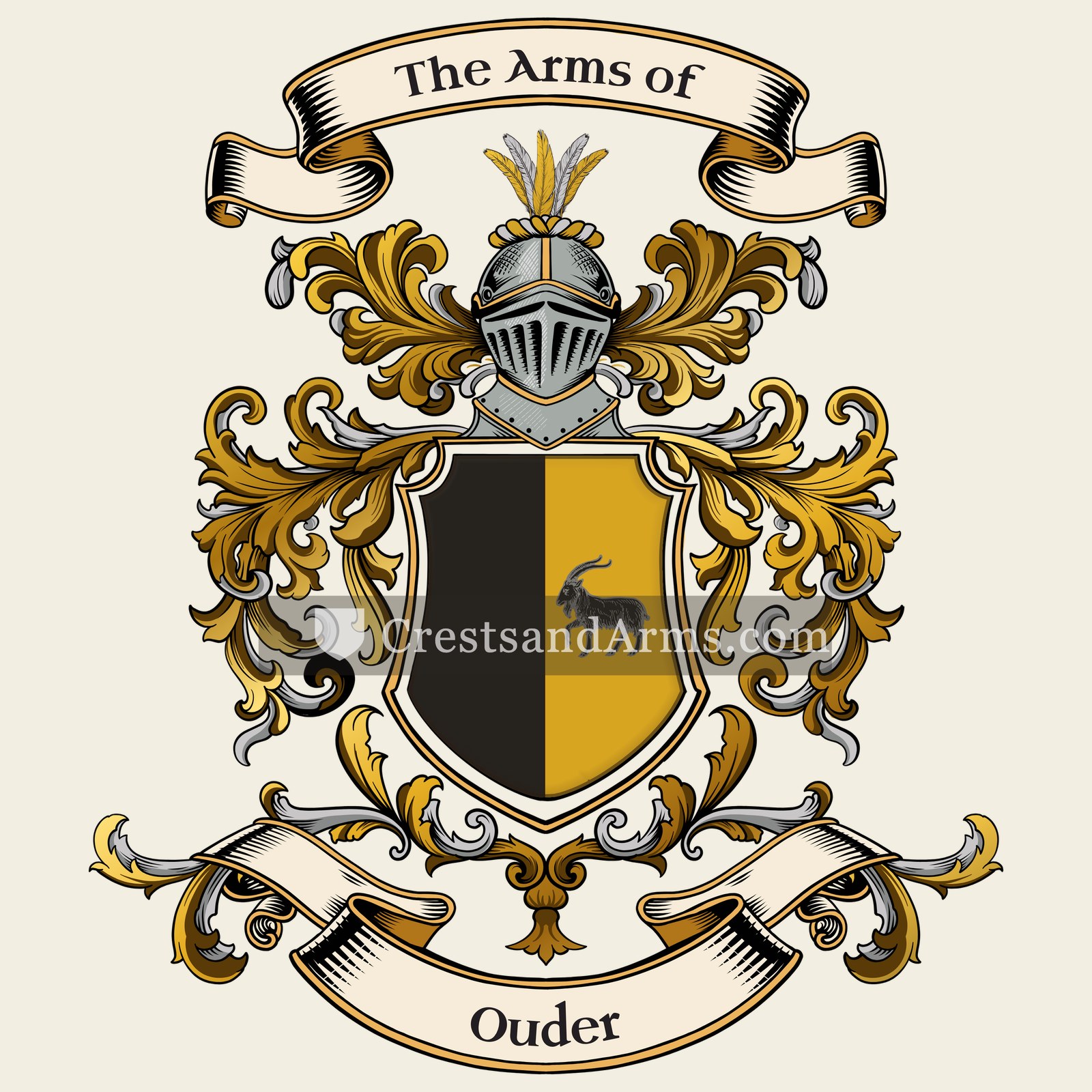
 goatOne who wins by diplomacy rather than force
 goatOne who wins by diplomacy rather than force