Map of Wales showing where the Owen arms are recorded
The Owen arms were recorded in Pembroke, c. 1647.
Pembrokeshire was settled from England early enough to be called Little England beyond Wales. Its landed families were Norman in origin and held their ground for centuries, which is what put them in the records.
This is where the arms were entered in the register. Families often moved to other parts of the country, so the same name can turn up in more than one region.
The body that granted and recorded arms in Wales in this period.
Charles I of England
Sovereign of the period
Charles I of England
1625–1649
Reigning in Wales when the Owen arms are first recorded.
How Arms Worked in Wales
English heraldry allowed arms to be shared by all legitimate descendants of the original owner. These symbols were treated as personal property that moved through the generations to all children. While the eldest son kept the original design, other family members could use the same shield without needing to change it or register their own unique versions.
Granting authority
The College of Arms in London has regulated the use of coats of arms throughout England and Wales since 1484.
How they got arms
Families typically obtained their coats of arms through a formal grant from the Crown or by proving their ancient right to them.
Where arms were recorded
All official coats of arms are recorded in the registers kept at the College of Arms, which date back to the fifteenth century.
The family's standing
Recorded among the armigerous families of Pembroke.
Origin & History of the Owen Family in Wales
The surname Owen finds its deep roots in the ancient Welsh language, originating as a patronymic name derived from the personal name Owain. This name likely stems from the Welsh word for noble or well-born, reflecting a status held by early ancestors in the region. By the time the family was firmly established in Pembrokeshire during the mid-seventeenth century, the name had transitioned from a simple description of lineage into a permanent family identifier. Pembrokeshire served as a unique cultural crossroads during this era, where the influence of the Welsh language met the administrative changes of the English crown. Families bearing this name were often deeply integrated into the local social fabric, participating in the agricultural and civic life of the Welsh countryside. The presence of the Owen family in Pembrokeshire by 1647 highlights their long-standing connection to the landscape and the enduring legacy of Welsh naming traditions that helped shape the identity of the region.
Coat of Arms & Family Crest Details
Symbols on this shield
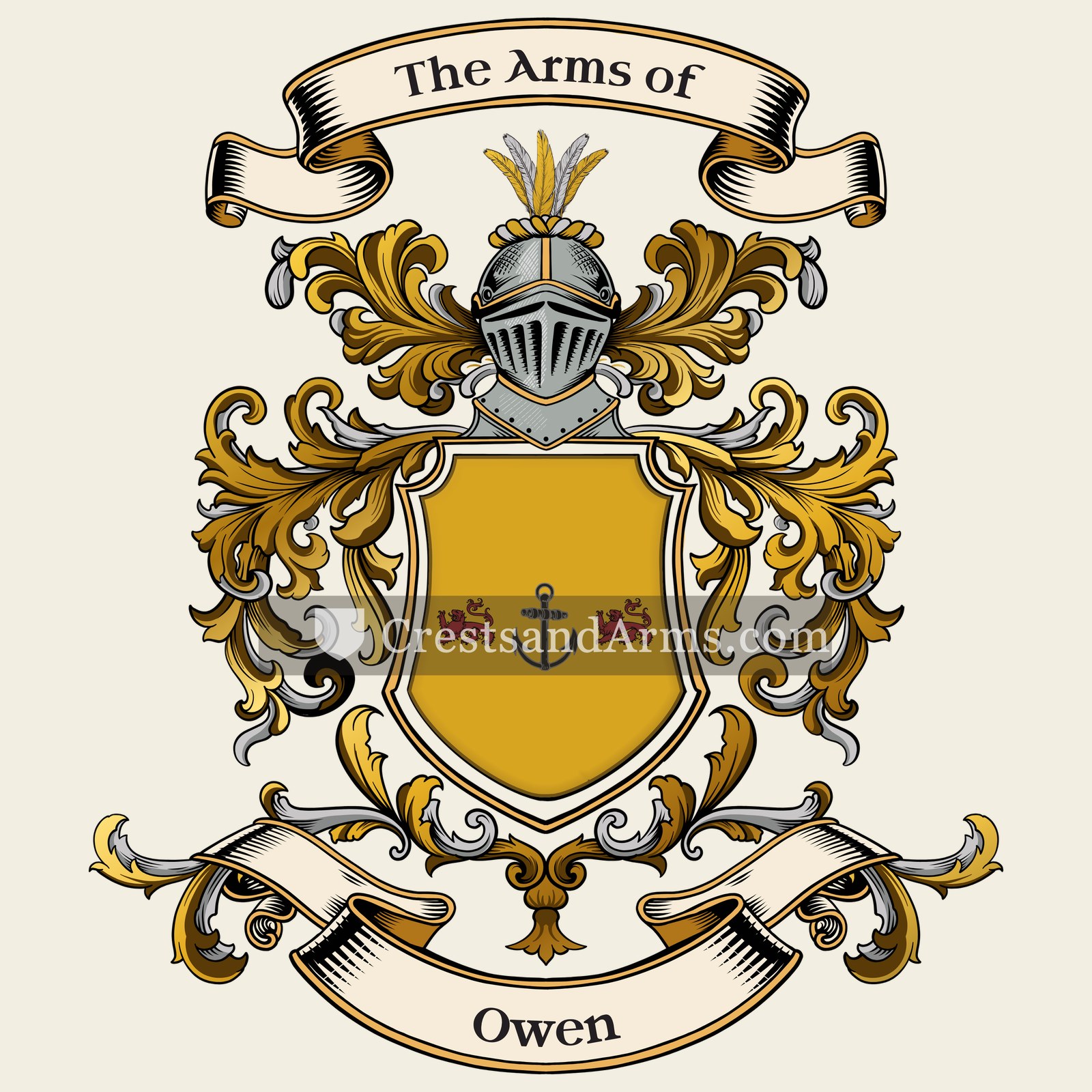
anchorHope, and steadfastness in trouble
lionCourage, strength and royalty
Colours
Gold (Or)Means: Generosity
Black (Sable)Means: Constancy
Red (Gules)Means: Military strength
Historical info
Source
Sir Bernard Burke, The General Armory of England, Scotland, Ireland and Wales, London: Harrison & Sons, 1884
Blazon (the actual original written record)
“Or, an anchor in fess sa. betw. two lions pass. gu”
Englandc. 1620
Digital archive packCoat of arms PNG, gold border print PDF, vector SVG and the certificate of authenticity. Sent to your email in minutes.
Map of England showing where the Owen arms are recorded
The Owen arms were recorded in England, c. 1620.
Arms such as these were typically recorded in York.
Yorkshire is the largest of the English counties, and it held more gentry families than any other. Land there was split among a great many households rather than a few, so a great many of them carried arms.
This is where the arms were entered in the register. Families often moved to other parts of the country, so the same name can turn up in more than one region.
The body that granted and recorded arms in England in this period.
James VI and I
Sovereign of the period
James VI and I
1603–1625
Reigning in Wales when the Owen arms are first recorded.
How Arms Worked in England
English heraldry allowed arms to be shared by all legitimate descendants of the original owner. These symbols were treated as personal property that moved through the generations to all children. While the eldest son kept the original design, other family members could use the same shield without needing to change it or register their own unique versions.
Granting authority
The College of Arms in London has regulated the use of coats of arms throughout England and Wales since 1484.
How they got arms
Families typically obtained their coats of arms through a formal grant from the Crown or by proving their ancient right to them.
Where arms were recorded
All official coats of arms are recorded in the registers kept at the College of Arms, which date back to the fifteenth century.
The family's standing
Recorded among the armigerous families of England.
Origin & History of the Owen Family in England
The surname Owen traces its roots to the ancient Welsh name Owain, which translates to noble-born or well-born. While the name originated in Wales, it gradually spread across the border into England as families migrated for trade and opportunity. By the time members of the Owen family were documented in York in 1620, the name had already become established within English society. During this period, families often moved to major cities like York to participate in the growing merchant class or to take advantage of the city's role as a regional hub for commerce. The presence of the family in York during the early seventeenth century suggests they were part of a broader movement of people who brought their cultural heritage from the Welsh borders into the heart of northern England. As these families settled in new regions, they helped integrate the name into the local record-keeping systems of English parishes and municipal offices.
Coat of Arms & Family Crest Details
Symbols on this shield
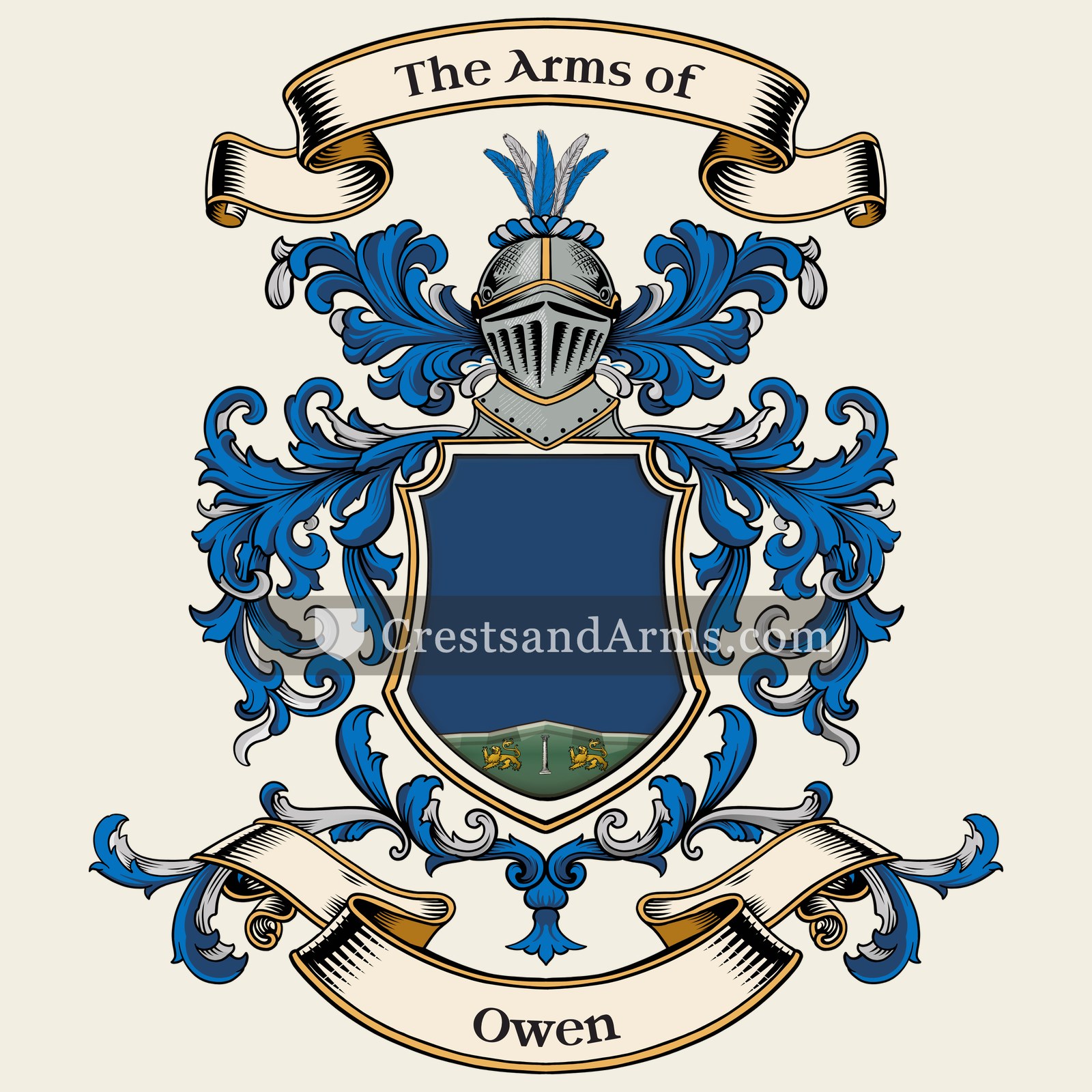
mountThe ground held, and steadfastness upon it
columnFortitude and constancy
lionCourage, strength and royalty
Colours
Blue (Azure)Means: Loyalty and truth
Green (Vert)Means: Hope
Silver (Argent)Means: Peace and sincerity
Gold (Or)Means: Generosity
Historical info
Source
Sir Bernard Burke, The General Armory of England, Scotland, Ireland and Wales, London: Harrison & Sons, 1884
Blazon (the actual original written record)
“Az. on a mount vert an Ionic pillar ar. base and capital or, supported by two lions counter-ramp. of the last”
MerionethMerioneth, c. 1645
Digital archive packCoat of arms PNG, gold border print PDF, vector SVG and the certificate of authenticity. Sent to your email in minutes.
Map of Ireland showing where the Owen arms are recorded
The Owen arms were recorded in Merioneth, c. 1645.
Merioneth was mountain country in north-west Wales, poor and thinly settled. Its families held small estates for centuries, and long tenure counted for more than wealth.
This is where the arms were entered in the register. Families often moved to other parts of the country, so the same name can turn up in more than one region.
The body that granted and recorded arms in Ireland in this period.
Charles I of England
Sovereign of the period
Charles I of England
1625–1649
Reigning in Wales when the Owen arms are first recorded.
How Arms Worked in Ireland
The Ulster King of Arms granted coats of arms to individuals who proved their social standing and good character. These symbols were typically inherited by all legitimate descendants of the original holder. If a family branch wanted a unique look, they could apply for a specific change to their design through the office to ensure their identity remained distinct.
Granting authority
The Ulster King of Arms acted as the official body that regulated and issued all coats of arms throughout Ireland.
How they got arms
Families obtained their arms through formal grants issued by the office after proving their eligibility and paying the required fees.
Where arms were recorded
All official grants were recorded in the registers held by the Ulster King of Arms starting from the year 1552.
The family's standing
Recorded among the armigerous families of Merioneth.
Origin & History of the Owen Family in Ireland
The name Owen finds its deepest roots in the Welsh language as a variation of the name Owain, which signifies a noble birth or a young warrior. While the family established a strong presence in the Welsh county of Merioneth by 1645, their connection to Ireland grew through the movement of people across the Irish Sea during the seventeenth century. Many families from Wales migrated to Ireland during this period to serve in administrative roles or to participate in land settlements sponsored by the English crown. As these individuals settled in Irish counties, the name Owen became integrated into the local population. Over time, the name also became associated with the anglicized version of various Gaelic surnames that sounded similar to Owen. This blending of Welsh heritage and Irish residency created a unique family history that spans across both nations.
Owen Meaning & Related Branches
Root word
Eugenius
Derived from the Greek word meaning well-born or noble.
This name
OwenA Welsh name traditionally interpreted as noble born or youth.
also spelled
Owyn
Owynne
Owan
Related arms
Evelynrecorded with Owen, same area
Fletcherrecorded with Owen, same area
Rogersrecorded with Owen, same area
Vynerrecorded with Owen, same area
Documented Sources
Sir Bernard Burke, The General Armory of England, Scotland, Ireland and Wales, London: Harrison & Sons, 1884
Charles, B. G., The Place-Names of Pembrokeshire, 1992
Morgan, T. J. and Morgan, P., Welsh Surnames, 1985
National Library of Wales, Pembrokeshire Quarter Sessions Records, 1647
Digital archive packCoat of arms PNG, gold border print PDF, vector SVG and the certificate of authenticity. Sent to your email in minutes.


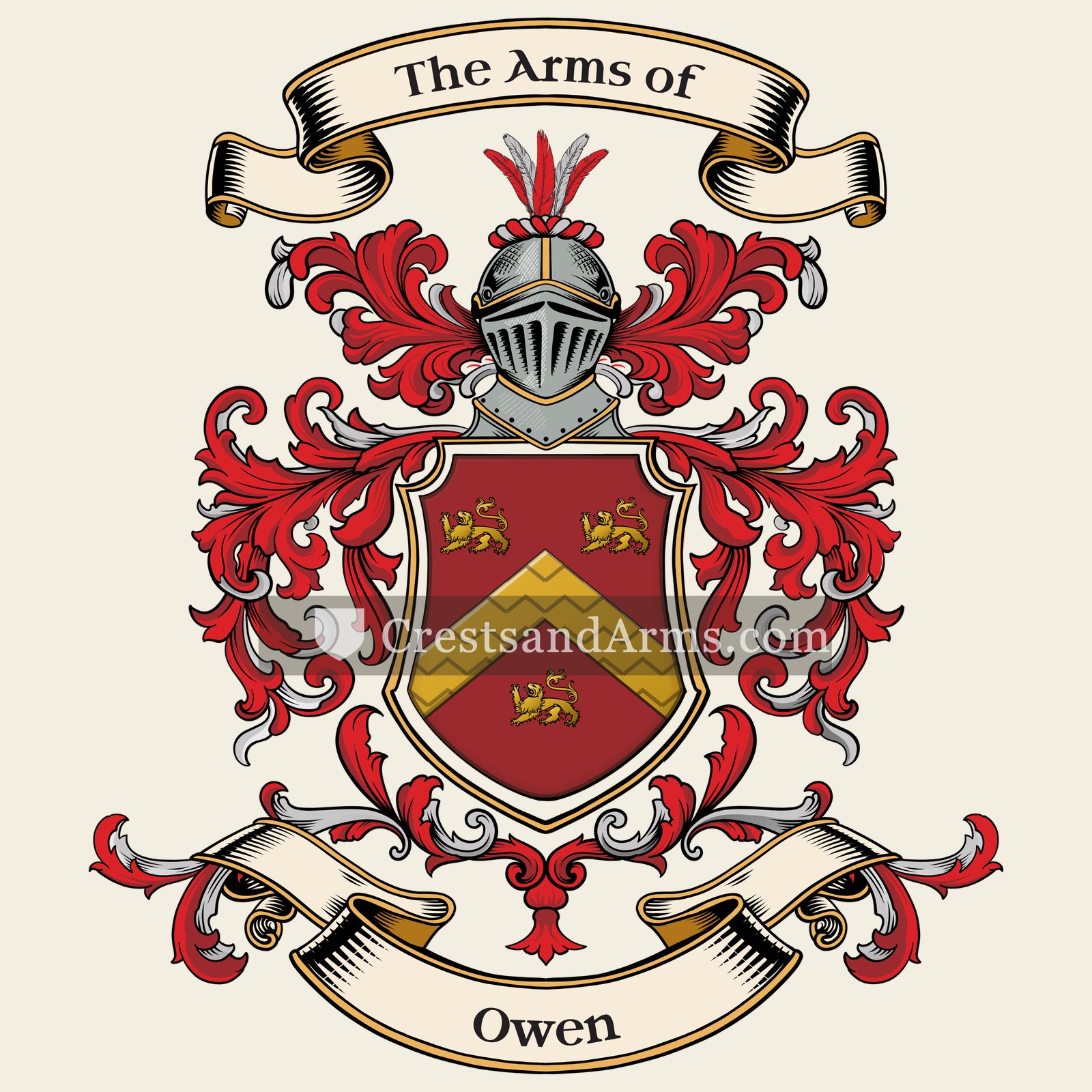
 chevronProtection, and faithful service completed
 lionCourage, strength and royalty
 chevronProtection, and faithful service completed
 lionCourage, strength and royalty


 anchorHope, and steadfastness in trouble

 mountThe ground held, and steadfastness upon it
 columnFortitude and constancy