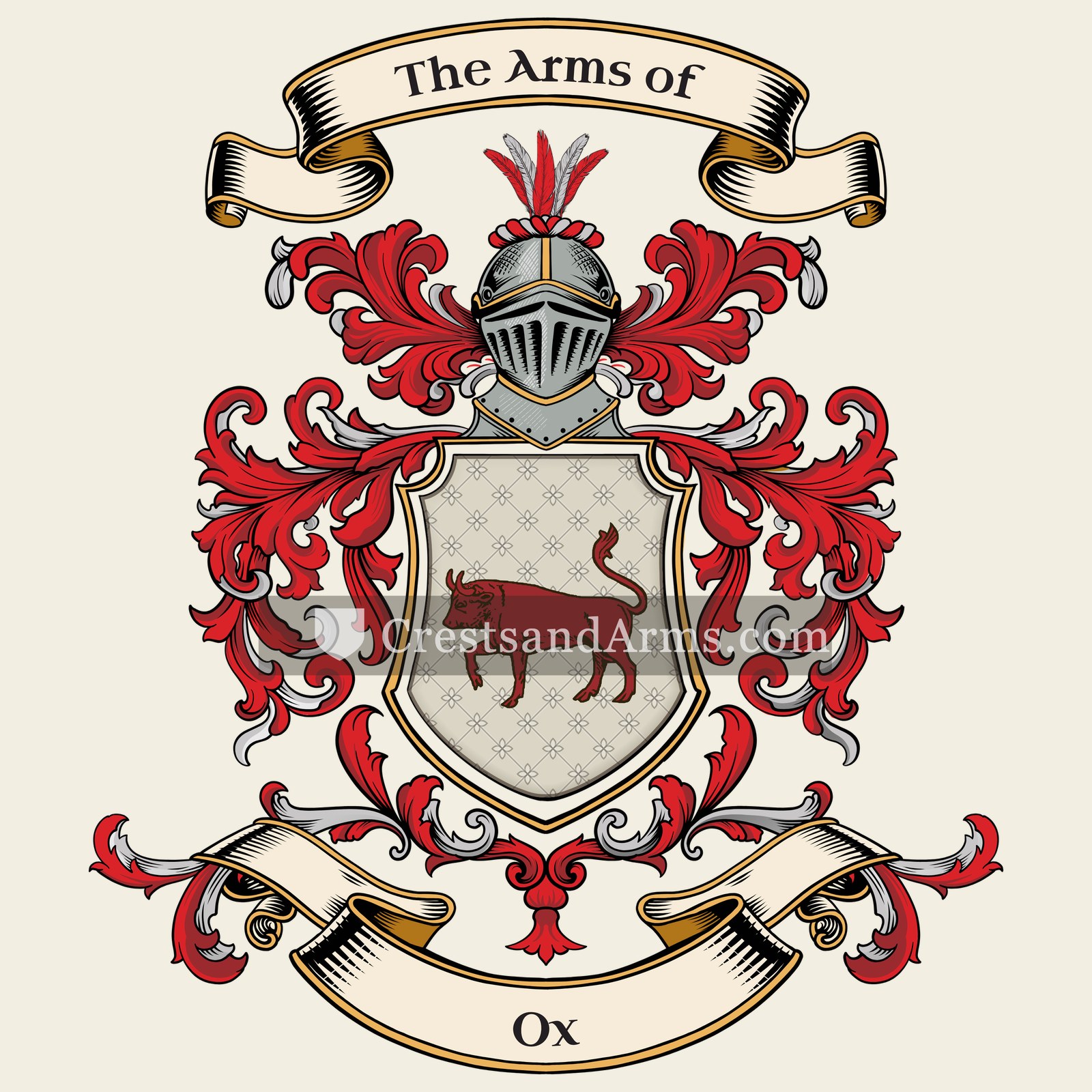
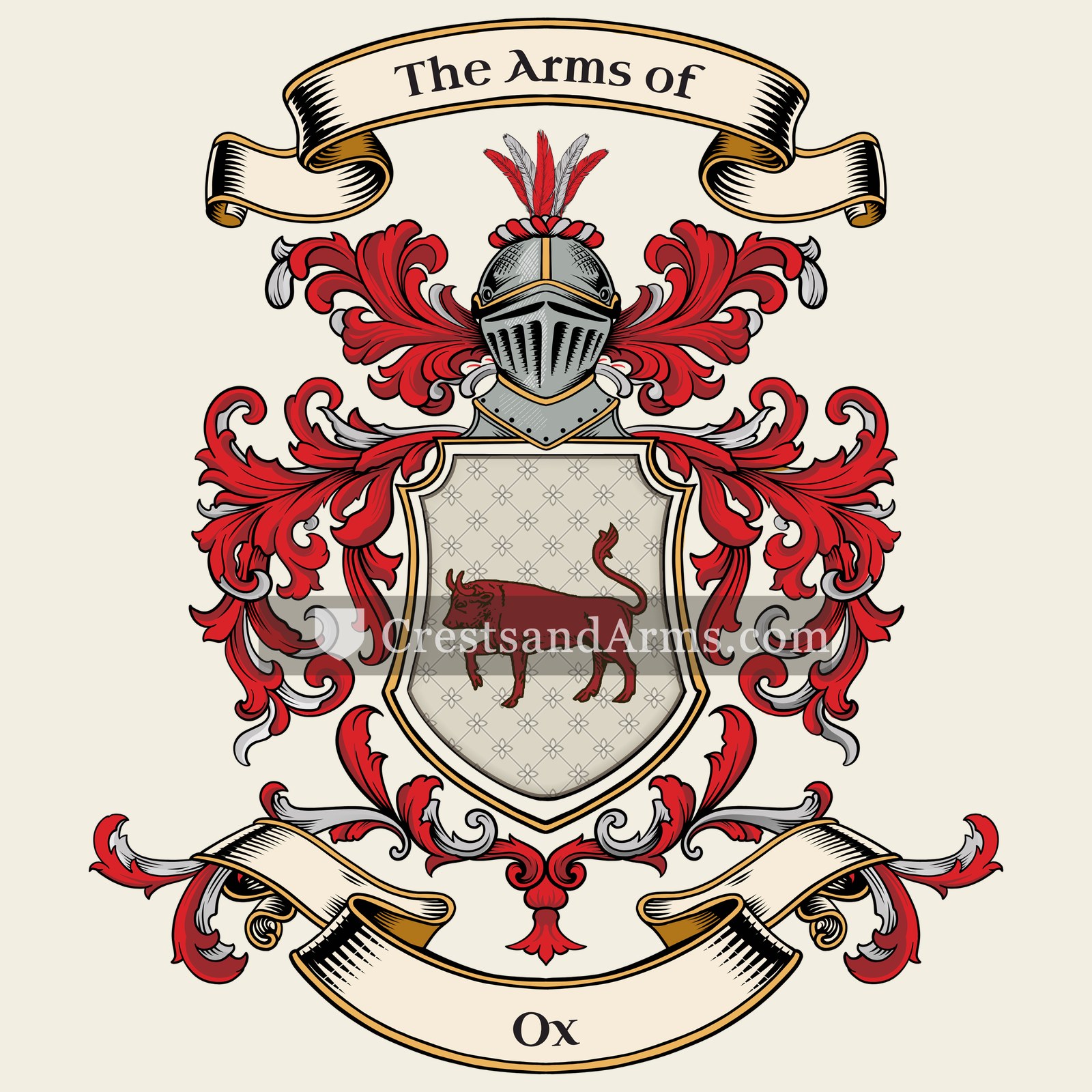
A record of documented arms, meaning and origin, researched for the Ox family lines. Documented in 2 countries.
Reg. 4310 · Swedish, M–O
Coat of Arms & Family Crest Details
Symbols on this shield
bullValour and generosity
Colours
Silver (Argent)Means: Peace and sincerity
Red (Gules)Means: Military strength
Historical info
Source
J. B. Rietstap, Armorial Général, Gouda: G. B. van Goor Zonen, 1884–87
Blazon (the actual original written record)
“D'arg. à un demi-boeuf pass. et cont. de gu., mouv. du flanc dextre. C.: deux prob. coupées alt. d'arg. et de gu., accostant le boeuf de l'écu, mouv. de la prob. dextre”
Swedenc. 1700
Digital archive packCoat of arms PNG, gold border print PDF, vector SVG and the certificate of authenticity. Sent to your email in minutes.
Map of Sweden showing where the Ox arms are recorded
The Ox arms were recorded in Sweden, c. 1700.
Arms such as these were typically recorded in Stockholm.
Stockholm held the Swedish court and the House of Nobility, where every noble family's arms were entered and kept. Families ennobled for service registered there, which is why so many are recorded around the city.
This is where the arms were entered in the register. Families often moved to other parts of the country, so the same name can turn up in more than one region.
The body that granted and recorded arms in Sweden in this period.
Carl XII of Sweden
Sovereign of the period
Carl XII of Sweden
1697–1718
Reigning in Sweden when the Ox arms are first recorded.
How Arms Worked in Sweden
In Sweden, a coat of arms belonged to a noble family as a whole rather than just one individual. These arms were passed down through the generations to all legitimate descendants. Younger branches of the family used the same shield without needing to change it. This system ensured that the entire lineage shared the same identity and status under the law.
Granting authority
The Riddarhuset, or House of Nobility, regulated all noble coats of arms in Sweden under royal authority.
How they got arms
Families received their coats of arms through royal grants of nobility which were then officially registered with the House.
Where arms were recorded
Coats of arms were officially recorded in the Swedish House of Nobility register starting in the year 1626.
The family's standing
Recorded among the armigerous families of Sweden.
Origin & History of the Ox Family in Sweden
The surname Ox holds a distinct place in Swedish history, appearing in the bustling urban landscape of Stockholm as early as the year 1700. During this period, the name was often associated with families living in the capital city who were integrated into the growing trade and craft sectors of the Swedish Empire. Because the name translates directly to the word for an ox, it likely originated as a descriptive nickname for an ancestor known for their physical strength or their work as a farmer or livestock handler. As Stockholm grew into a major center for commerce in the eighteenth century, families bearing this name were part of the social shift that saw people moving from rural areas to take up roles in the city. These early residents helped establish the name within the urban administrative records of the time, marking the beginning of a long family presence in the region.
Coat of Arms & Family Crest Details
Symbols on this shield
bullValour and generosity
Colours
Silver (Argent)Means: Peace and sincerity
Red (Gules)Means: Military strength
Historical info
Source
J. B. Rietstap, Armorial Général, Gouda: G. B. van Goor Zonen, 1884–87
Blazon (the actual original written record)
“D'arg. à un boeuf pass. de gu. C.: un boeuf iss. de gu.”
Denmarkc. 1577
Digital archive packCoat of arms PNG, gold border print PDF, vector SVG and the certificate of authenticity. Sent to your email in minutes.
Map of Denmark showing where the Ox arms are recorded
The Ox arms were recorded in Denmark, c. 1577.
Arms such as these were typically recorded in Sjaælland.
Zealand held the Danish court, the crown's offices and Copenhagen itself. Families who served the king kept estates within reach of it, and royal service was the ordinary route to a coat of arms.
This is where the arms were entered in the register. Families often moved to other parts of the country, so the same name can turn up in more than one region.
The body that granted and recorded arms in Denmark in this period.
Frederick II of Denmark
Sovereign of the period
Frederick II of Denmark
1559–1588
Reigning in Sweden when the Ox arms are first recorded.
How Arms Worked in Denmark
Danish heraldry during this period was closely tied to noble status and royal favor rather than being open to all citizens. Arms were typically granted by the monarch to individuals, and these symbols were then shared by all members of the noble house. If a family line died out, the right to use those specific arms ended with them.
Granting authority
The Danish royal chancery held the power to issue and regulate official coats of arms for the kingdom.
How they got arms
Families usually received their arms through a formal royal grant that confirmed their noble status and rights.
Where arms were recorded
These grants were officially recorded in the Danish Royal Chancery records starting in the sixteenth century.
The family's standing
Recorded among the armigerous families of Denmark.
Origin & History of the Ox Family in Denmark
The history of the Ox family in Denmark is deeply rooted in the landscape of Sjælland, where members of the family were documented as early as 1577. During this period, the name was often associated with individuals who held positions of local influence and managed rural estates. The name itself reflects a common naming convention of the era, where families were frequently identified by terms related to animals or nature. As the family established itself on the island, they became integrated into the social fabric of the Danish countryside. Their presence in historical records from the late sixteenth century suggests they were part of a growing class of landowners who played a vital role in the agricultural and administrative life of the region. Over time, the family name became a permanent fixture in the local history of Sjælland, marking their long-standing connection to the Danish soil.
Related Branches & Arms
Root word
oxe
A castrated male bovine used for draft work.
This name
OxA topographic or occupational surname referring to a person who raised or worked with oxen.
also spelled
Ox
Documented Sources
J. B. Rietstap, Armorial Général, Gouda: G. B. van Goor Zonen, 1884–87
Hellquist, Elof. Svensk etymologisk ordbok. 1922
Otterbjörk, Roland. Svenska förnamn: Kortfattat namnlexikon. 1964
Stockholm City Archives (Stockholms stadsarkiv), Mantalslängder för Stockholms stad
Digital archive packCoat of arms PNG, gold border print PDF, vector SVG and the certificate of authenticity. Sent to your email in minutes.


 bullValour and generosity
 bullValour and generosity