Map of Switzerland showing where the Pack arms are recorded
The Pack arms were recorded in Saxony, c. 1745.
Saxony had mines, trade and old landed families all at once. Silver made some fortunes and land held others, and both sorts of family kept arms, which is why Saxon names appear so often in the registers.
This is where the arms were entered in the register. Families often moved to other parts of the country, so the same name can turn up in more than one region.
The body that granted and recorded arms in Switzerland in this period.
How Arms Worked in Switzerland
In Switzerland, coats of arms were not restricted to the nobility and were often adopted by common citizens and families. These symbols were passed down through generations to show family identity. When branches of a family grew, they often changed small details of the design to distinguish their own line from the original group.
Granting authority
Cantonal and civic authorities managed the use of coats of arms within their specific regions and local jurisdictions.
How they got arms
Families typically assumed their own coats of arms based on local custom rather than receiving them from a central monarch.
Where arms were recorded
Arms were recorded in various cantonal and civic registers starting from the fourteenth century throughout the Swiss region.
The family's standing
Recorded among the armigerous families of Saxony.
Origin & History of the Pack Family in Switzerland
The history of the Pack family name is deeply rooted in the Germanic regions of Europe, where it functioned as a descriptive surname. In the Swiss context, the name often emerged from local dialects that identified individuals based on their trade or physical characteristics. While many families with this name eventually migrated toward Saxony by the mid-eighteenth century, their earlier presence in the Swiss cantons suggests they were part of the mobile artisan or merchant classes who moved along established trade routes. These early family members were typically integrated into local parish life, where their names were recorded in baptismal and marriage registers as they moved between mountain valleys and growing urban centers. By the time the family was firmly established in Saxony in 1745, they carried with them linguistic traditions and naming patterns that had been refined over generations of living within the diverse cultural landscape of the Swiss Confederation.
Coat of Arms & Family Crest Details
Symbols on this shield
cinquefoilHope and joy
Colours
Silver (Argent)Means: Peace and sincerity
ErmineMeans: Dignity
Gold (Or)Means: Generosity
Historical info
Source
Sir Bernard Burke, The General Armory of England, Scotland, Ireland and Wales, London: Harrison & Sons, 1884
Blazon (the actual original written record)
“Quarterly, ar. and erm. in the first quarter a cinquefoil or”
Englandc. 1620
Digital archive packCoat of arms PNG, gold border print PDF, vector SVG and the certificate of authenticity. Sent to your email in minutes.
Map of England showing where the Pack arms are recorded
The Pack arms were recorded in England, c. 1620.
Arms such as these were typically recorded in York.
Yorkshire is the largest of the English counties, and it held more gentry families than any other. Land there was split among a great many households rather than a few, so a great many of them carried arms.
This is where the arms were entered in the register. Families often moved to other parts of the country, so the same name can turn up in more than one region.
The body that granted and recorded arms in England in this period.
James VI and I
Sovereign of the period
James VI and I
1603–1625
Reigning in Switzerland when the Pack arms are first recorded.
How Arms Worked in England
English heraldry allowed arms to be shared by all legitimate descendants of the original owner. These symbols were treated as personal property that moved through the generations to all children. While the eldest son kept the original design, other family members could use the same shield without needing to change it or register their own unique versions.
Granting authority
The College of Arms in London has regulated the use of coats of arms throughout England and Wales since 1484.
How they got arms
Families typically obtained their coats of arms through a formal grant from the Crown or by proving their ancient right to them.
Where arms were recorded
All official coats of arms are recorded in the registers kept at the College of Arms, which date back to the fifteenth century.
The family's standing
Recorded among the armigerous families of England.
Origin & History of the Pack Family in England
The surname Pack is rooted in the social and linguistic landscape of medieval England, likely originating as a nickname or a shortened version of personal names like Patrick or Paschal. By the early 17th century, the family had established a notable presence in the historic city of York. Records from 1620 confirm that individuals bearing the name were active members of the local community during this period of significant urban growth. At that time, York served as a vital center for trade and administration in Northern England, and families like the Packs often integrated into the local merchant or artisan classes. As they navigated the changing economic conditions of the Stuart era, these early ancestors helped define the name’s legacy within the region. Their presence in the city archives illustrates a transition from rural origins to the structured life of an English provincial hub, marking the Pack family as a long-standing part of the northern social fabric.
Coat of Arms & Family Crest Details
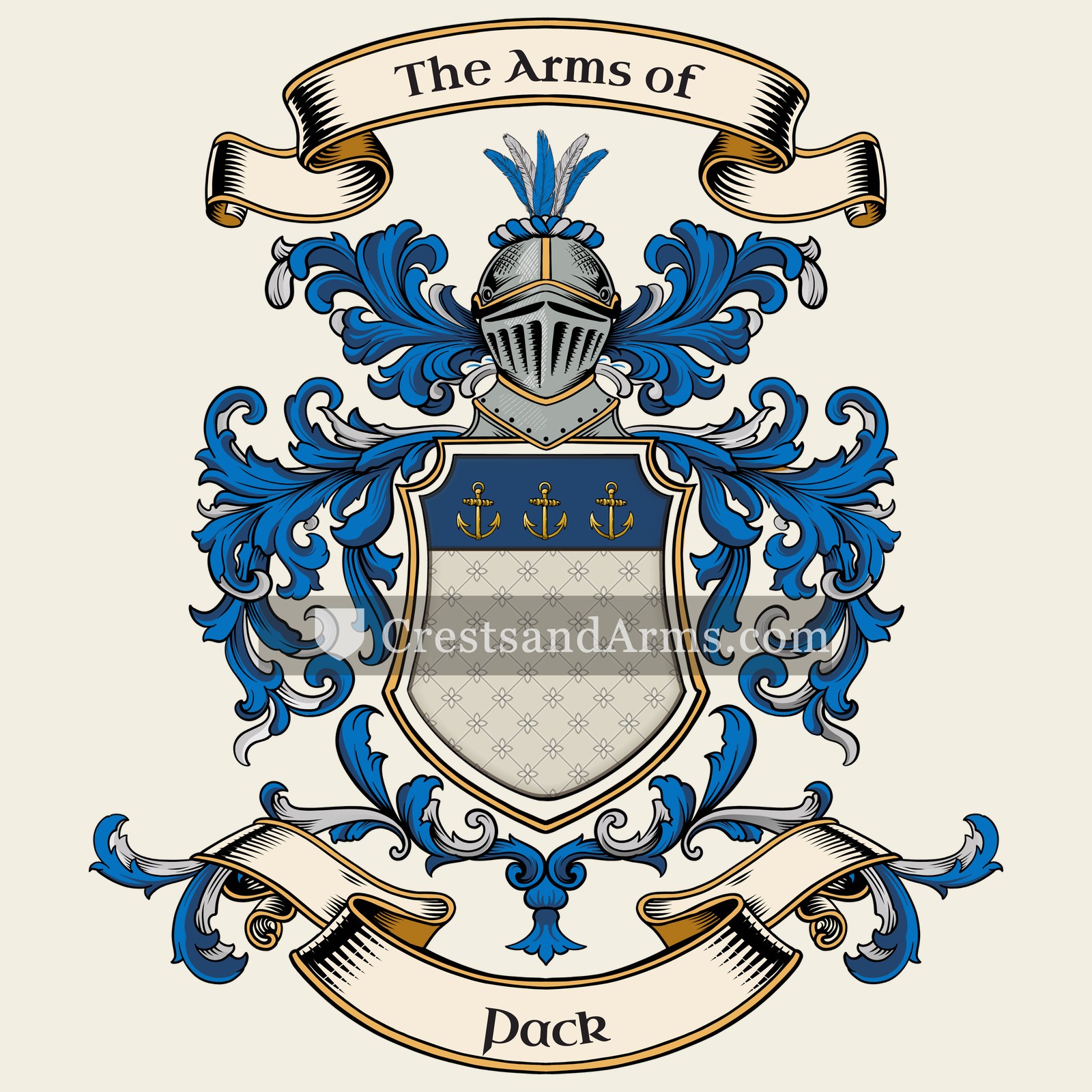
Symbols on this shield
chiefAuthority, wisdom and dominion
anchorHope, and steadfastness in trouble
Colours
Silver (Argent)Means: Peace and sincerity
Blue (Azure)Means: Loyalty and truth
Gold (Or)Means: Generosity
Historical info
Source
Sir Bernard Burke, The General Armory of England, Scotland, Ireland and Wales, London: Harrison & Sons, 1884
Blazon (the actual original written record)
“Ar. on a chief az. three anchors or”
Irelandc. 1645
Digital archive packCoat of arms PNG, gold border print PDF, vector SVG and the certificate of authenticity. Sent to your email in minutes.
Map of Ireland showing where the Pack arms are recorded
The Pack arms were recorded in Ireland, c. 1645.
Arms such as these were typically recorded in Dublin.
Dublin was the seat of government in Ireland and the place where grants were sought and recorded. Families with business at the castle or the courts settled nearby, and settling there put their arms on record.
This is where the arms were entered in the register. Families often moved to other parts of the country, so the same name can turn up in more than one region.
The body that granted and recorded arms in Ireland in this period.
Charles I of England
Sovereign of the period
Charles I of England
1625–1649
Reigning in Switzerland when the Pack arms are first recorded.
How Arms Worked in Ireland
The Ulster King of Arms granted coats of arms to individuals who proved their social standing and good character. These symbols were typically inherited by all legitimate descendants of the original holder. If a family branch wanted a unique look, they could apply for a specific change to their design through the office to ensure their identity remained distinct.
Granting authority
The Ulster King of Arms acted as the official body that regulated and issued all coats of arms throughout Ireland.
How they got arms
Families obtained their arms through formal grants issued by the office after proving their eligibility and paying the required fees.
Where arms were recorded
All official grants were recorded in the registers held by the Ulster King of Arms starting from the year 1552.
The family's standing
Recorded among the armigerous families of Ireland.
Origin & History of the Pack Family in Ireland
The history of the Pack family in Ireland is firmly rooted in the mid-seventeenth century, with records confirming their presence in Dublin by 1645. During this era, Dublin was a bustling center of trade and political transition, and the family likely integrated into the city’s growing merchant and professional classes. The name itself is thought to be an anglicized version of older surnames or a descriptive occupational name that evolved as families settled into urban life. As the seventeenth century progressed, members of the Pack family became established residents of the capital, navigating the complex social and economic shifts that defined Ireland during the Cromwellian period and the later Restoration. Their early residence in Dublin suggests they were part of the demographic changes occurring in the city at the time, helping to lay the foundation for the family's long-standing connection to the region.
Related Branches & Arms
Root word
Pach
A Middle High German term referring to a brook or stream.
This name
PackA topographic name for someone who lived near a small creek or watercourse.
also spelled
Pak
Pake
Documented Sources
J. B. Rietstap, Armorial Général, Gouda: G. B. van Goor Zonen, 1884–87
Brechenmacher, Josef Karlmann. Etymologisches Wörterbuch der deutschen Familiennamen. 1957
Heintze, Albert. Die deutschen Familiennamen: geschichtlich, geographisch, sprachlich. 1903
Staatsarchiv des Kantons Zürich. Kirchenbücher der Zürcher Landgemeinden. 1600–1750
Digital archive packCoat of arms PNG, gold border print PDF, vector SVG and the certificate of authenticity. Sent to your email in minutes.


 paleMilitary strength, and a fortified defence
 paleMilitary strength, and a fortified defence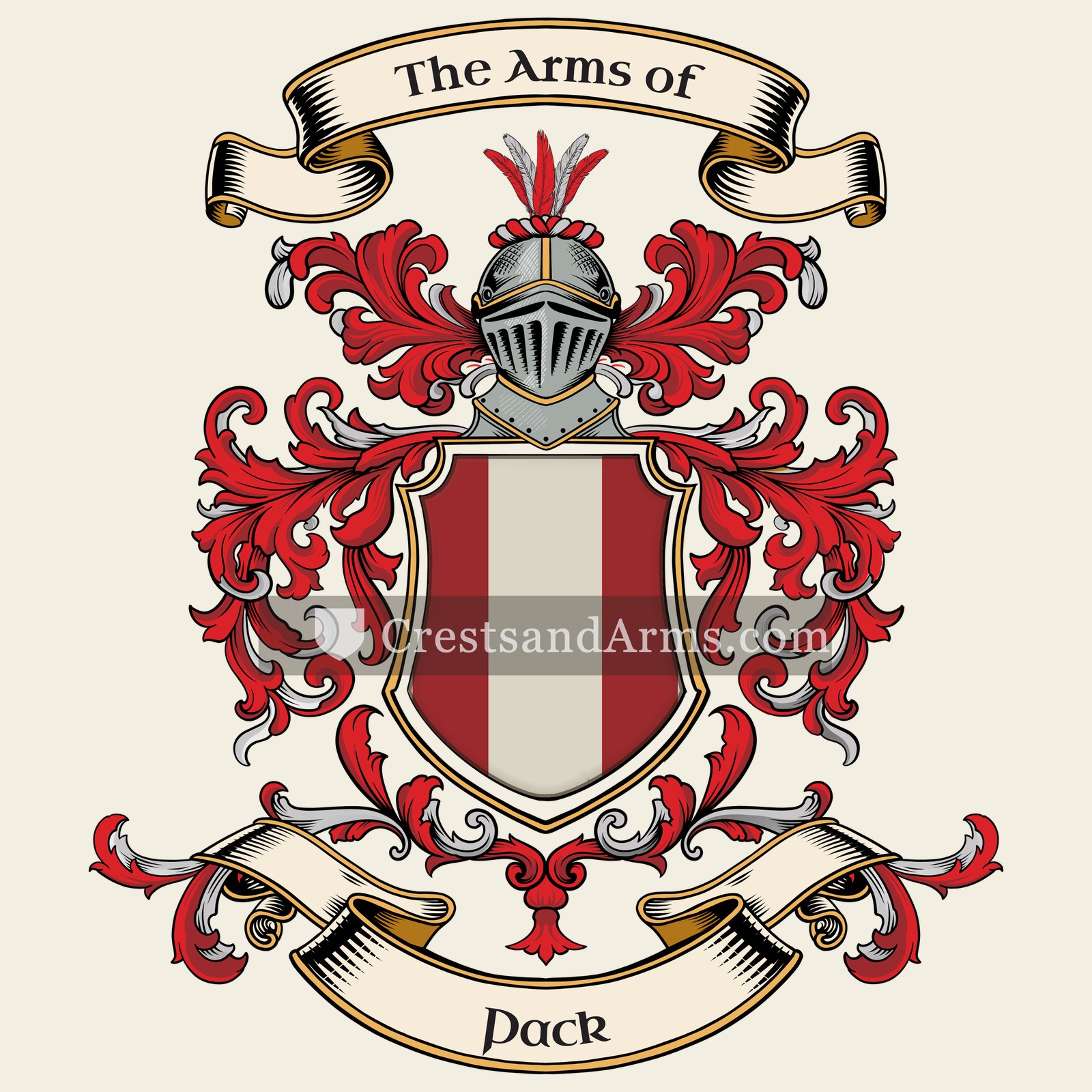

 cinquefoilHope and joy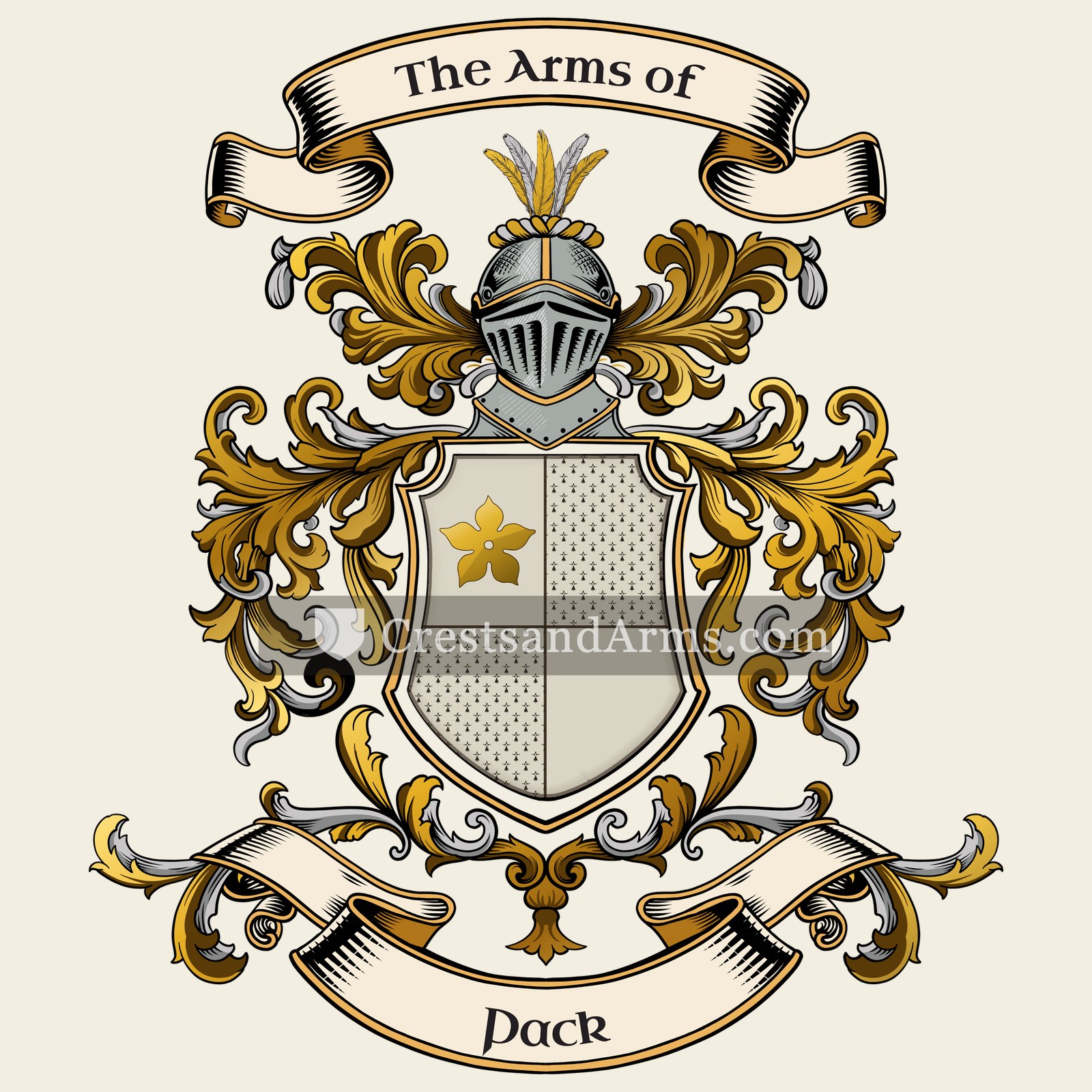


 chiefAuthority, wisdom and dominion
 anchorHope, and steadfastness in trouble