Map of England showing where the Padden arms are recorded
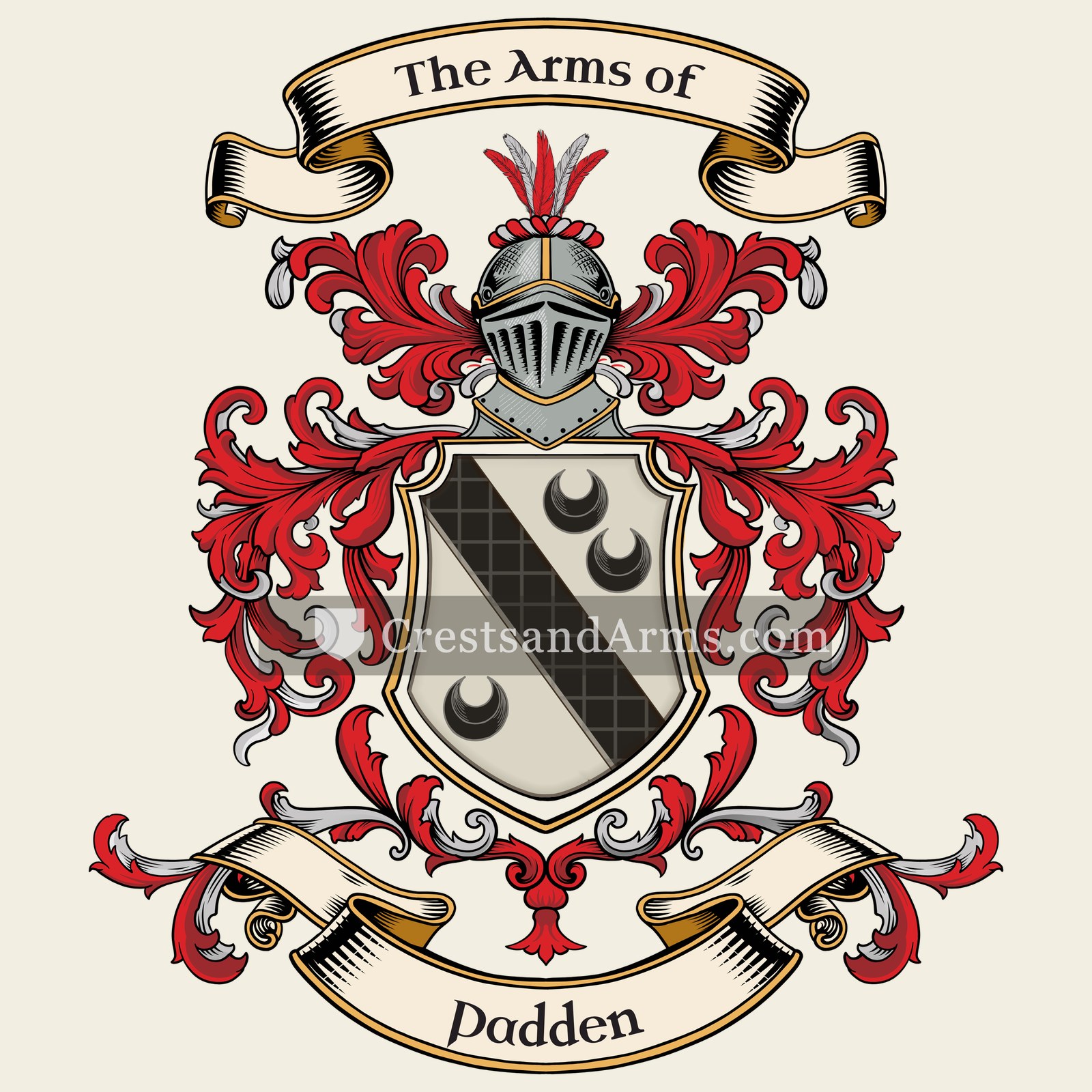
The Padden arms were recorded in Hants, c. 1590.
Hampshire had the naval dockyards at Portsmouth on one side and good farmland on the other. Sea money and land money both bought estates, and an estate was what brought a family its coat of arms.
This is where the arms were entered in the register. Families often moved to other parts of the country, so the same name can turn up in more than one region.
The body that granted and recorded arms in England in this period.
Elizabeth I of England
Sovereign of the period
Elizabeth I of England
1558–1603
Reigning in England when the Padden arms are first recorded.
How Arms Worked in England
English heraldry allowed arms to be shared by all legitimate descendants of the original owner. These symbols were treated as personal property that moved through the generations to all children. While the eldest son kept the original design, other family members could use the same shield without needing to change it or register their own unique versions.
Granting authority
The College of Arms in London has regulated the use of coats of arms throughout England and Wales since 1484.
How they got arms
Families typically obtained their coats of arms through a formal grant from the Crown or by proving their ancient right to them.
Where arms were recorded
All official coats of arms are recorded in the registers kept at the College of Arms, which date back to the fifteenth century.
The family's standing
Recorded among the armigerous families of Hants.
Origin & History of the Padden Family in England
The surname Padden has deep roots in the English county of Hampshire, where records confirm that members of the family were established as early as 1590. The name is generally considered to be a variation of the name Patrick, which was a popular choice in the British Isles during the medieval period. Over time, families often adopted nicknames or shortened versions of formal names to distinguish themselves within their local communities. As these families settled into rural life in Hampshire, the spelling of their name evolved based on how it sounded to local clerks and record keepers. By the late sixteenth century, the Padden family had become a recognized part of the regional population, likely working in agriculture or local trades that supported the growing economy of southern England. Their presence in official documents from this era suggests they were settled members of the community who participated in the legal and social life of their parish.
Related Branches & Arms
Root word
Pad
A diminutive or pet form of the medieval name Patrick.
This name
PaddenA patronymic surname meaning son of Pad, derived from the given name Patrick.
also spelled
Paden
Paddun
Documented Sources
Sir Bernard Burke, The General Armory of England, Scotland, Ireland and Wales, London: Harrison & Sons, 1884
Hampshire Archives, Bishop's Transcripts of Parish Registers, 1590
Reaney, P.H., A Dictionary of English Surnames, 1958


 bendDefence, and the scarf of a commander
 crescentHonour by the sovereign, and the second son
 bendDefence, and the scarf of a commander
 crescentHonour by the sovereign, and the second son