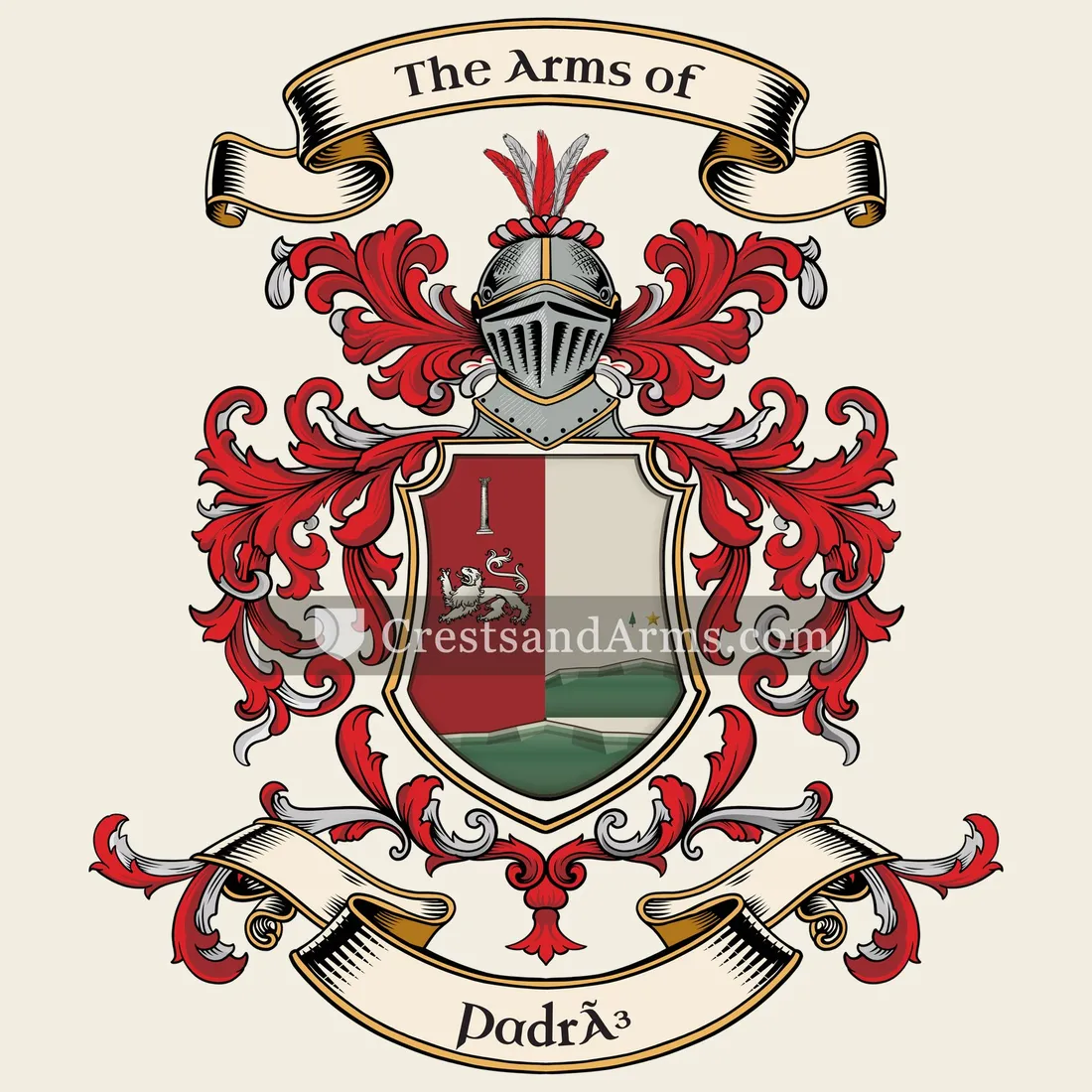
A record of documented arms, meaning and origin, researched for the Padró family of Spain.
Reg. 2738 · Spanish, P–S
Meaning of the Padró family crest colors & symbols
Symbols on this shield
mountThe ground held, and steadfastness upon it
lionCourage, strength and royalty
columnFortitude and constancy
pine treeSteadfastness through every season
mulletThe third son, and a divine quality from above
Colours
Red (Gules)Means: Military strength
Silver (Argent)Means: Peace and sincerity
Green (Vert)Means: Hope
Gold (Or)Means: Generosity
Historical info
Source
J. B. Rietstap, Armorial Général, Gouda: G. B. van Goor Zonen, 1884–87
Blazon (the actual original written record)
“Parti: au 1 de gu. au lion d'arg., ramp. contre une colonne du même, posée à dextre, le piédestal inscrit des mots NON PLUS ULTRA en lettres de sa.; au 2 d'arg. à un pin terrassé de sin., fruité d'or, surm. d'une étoile (8) du même.”
CataloniaCatalonia, c. 1722
Digital archive packCoat of arms PNG, gold border print PDF, vector SVG and the certificate of authenticity. Sent to your email in minutes.
Map of Spain showing where the Padró arms are recorded
The Padró arms were recorded in Catalonia, c. 1722.
Catalonia lived by sea trade, and its merchant houses were as powerful as its landowners. Both sorts of family took arms, and Barcelona kept records of the houses entitled to bear them.
This is where the arms were entered in the register. Families often moved to other parts of the country, so the same name can turn up in more than one region.
The body that granted and recorded arms in Spain in this period.
Philip V of Spain
Sovereign of the period
Philip V of Spain
1714–1724
Reigning in Spain when the Padró arms are first recorded.
How Arms Worked in Spain
In Spain, a coat of arms was considered a form of property that belonged to the entire family line. These arms were passed down from a father to all his children equally. Younger branches of the family usually kept the original design without needing to add any special marks to distinguish their specific line.
Granting authority
The Cronista Rey de Armas was the official body that regulated and granted coats of arms throughout Spain.
How they got arms
Families often obtained their arms through royal grants or by proving their noble status to the official heraldic authority.
Where arms were recorded
Coats of arms were officially recorded in the registers of the Cronista Rey de Armas starting in 1496.
The family's standing
Recorded among the armigerous families of Catalonia.
Origin & History of the Padró Family in Spain
The surname Padró finds its deep historical roots in the Catalonia region of Spain. By the early eighteenth century, families bearing this name were well-established members of the local community. The name is often linked to the Catalan word "padro," which historically referred to a godfather or a protector. This suggests that the earliest ancestors may have been recognized for their roles as community leaders or guardians within their villages. During the 1700s, families with this name were typically involved in agriculture and local trade, which were the primary ways of life in the rural Catalan landscape. As the family grew, they became a permanent part of the social fabric of the region, leaving behind records in local parish registers that document their daily lives, marriages, and contributions to their towns.
Padró Meaning & Related Branches
Root word
Petrus
Latin for stone or rock
This name
PadróDerived from a Catalan topographic term referring to a rocky place or stone quarry.
Documented Sources
J. B. Rietstap, Armorial Général, Gouda: G. B. van Goor Zonen, 1884–87
Moll, Francesc de Borja, Els llinatges catalans, 1959
Alcover, Antoni Maria, Diccionari català-valencià-balear, 1930
Arxiu de la Corona d'Aragó, Registres de la Reial Audiència
Arxiu Diocesà de Barcelona, Llibres de baptismes i matrimonis
Digital archive packCoat of arms PNG, gold border print PDF, vector SVG and the certificate of authenticity. Sent to your email in minutes.


 mountThe ground held, and steadfastness upon it
 lionCourage, strength and royalty
 columnFortitude and constancy
 pine treeSteadfastness through every season
 mulletThe third son, and a divine quality from above
 mountThe ground held, and steadfastness upon it
 lionCourage, strength and royalty
 columnFortitude and constancy
 pine treeSteadfastness through every season
 mulletThe third son, and a divine quality from above