Map of France showing where the Page arms are recorded
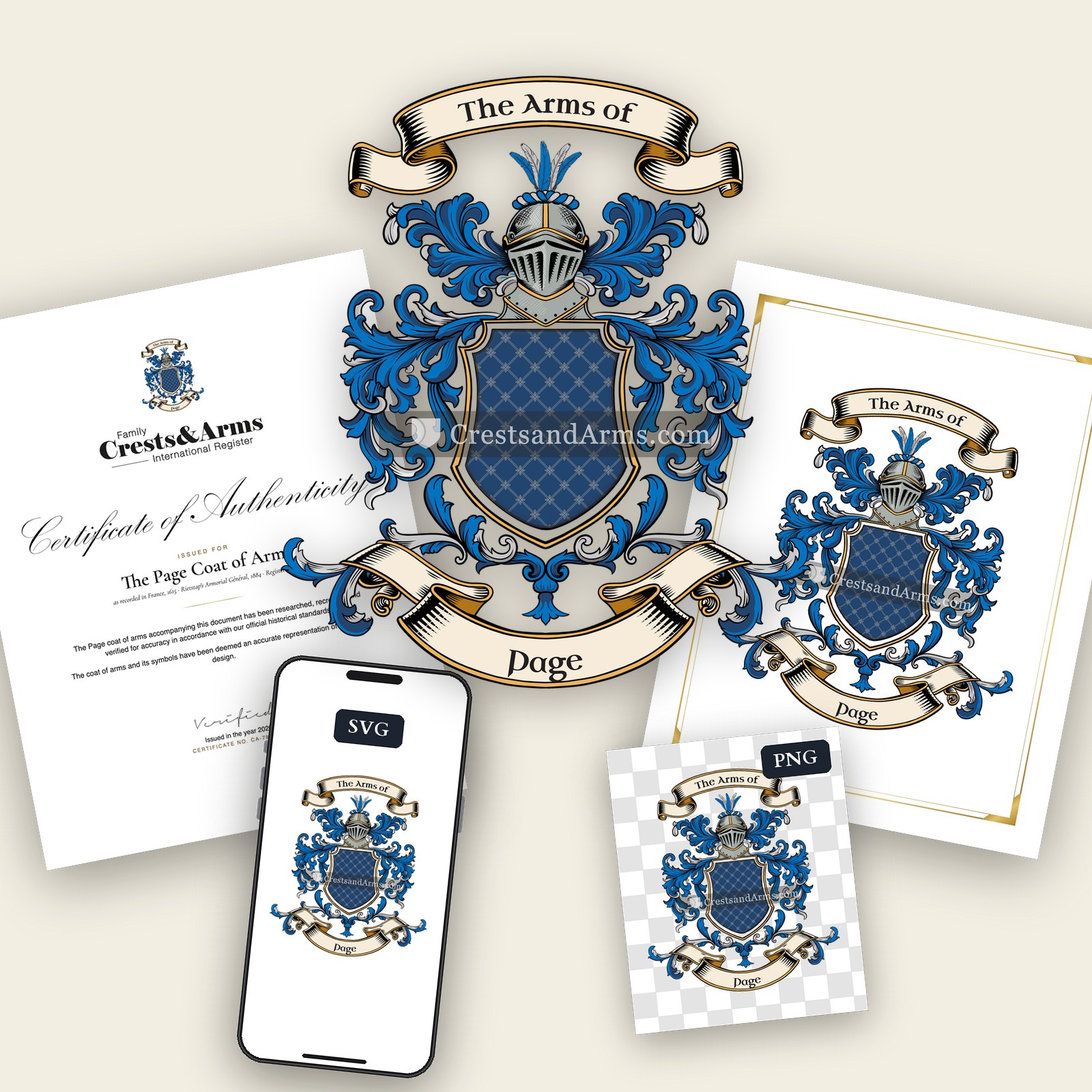
The Page arms were recorded in Franche-Comte, c. 1615.
Franche-Comte sat between France and the Empire and changed hands more than once. Border families held their land under arms and expected to defend it, so a shield was a practical thing rather than an ornament.
This is where the arms were entered in the register. Families often moved to other parts of the country, so the same name can turn up in more than one region.
The body that granted and recorded arms in France in this period.
Louis XIII of France
Sovereign of the period
Louis XIII of France
1610–1617
Reigning in France when the Page arms are first recorded.
How Arms Worked in France
In France, a coat of arms was a mark of honor that passed down through the male line to all legitimate descendants. Families often used the same shield without changes to show their shared heritage. If a branch wanted to stand out, they could add a small mark to their shield to show their specific place in the family tree.
Granting authority
The Juge d'armes de France acted as the official authority that regulated and verified coats of arms across the country.
How they got arms
Families typically inherited their arms from ancestors, though they could also receive them through royal grants or by proving their noble status.
Where arms were recorded
Coats of arms were officially recorded in the Armorial Général de France, which began its main collection in the year 1696.
The family's standing
Recorded among the armigerous families of Franche-Comte.
Origin & History of the Page Family in France
The history of the Page family in the Franche-Comté region of eastern France provides a fascinating look at life during the early seventeenth century. By 1615, records confirm that members of the family were established in this mountainous area, which was then a territory under the influence of the Spanish Habsburgs. The name itself likely originated as a descriptive term for a young attendant or a page in a noble household, reflecting a social role that was common in the feudal structures of the time. Living in Franche-Comté meant that these ancestors navigated a unique cultural crossroads between French and Germanic influences. As they settled into local village life, the family became part of the agricultural and social fabric of the region, contributing to the development of the local community long before the area was formally annexed by France in 1678. Their presence in the records from this period highlights a history of endurance and adaptation within a changing European landscape.
Meaning of the Page family crest colors & symbols
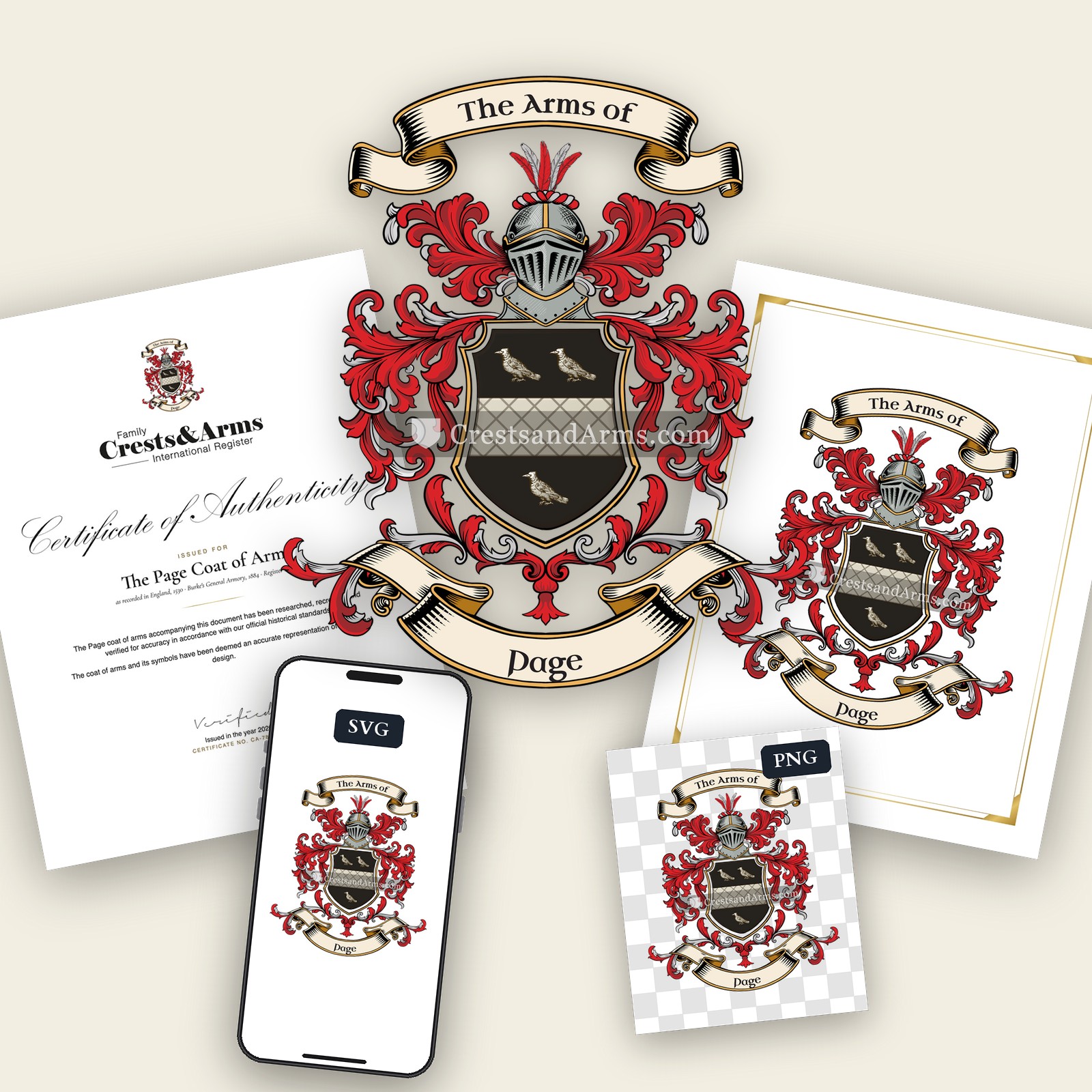
Symbols on this shield
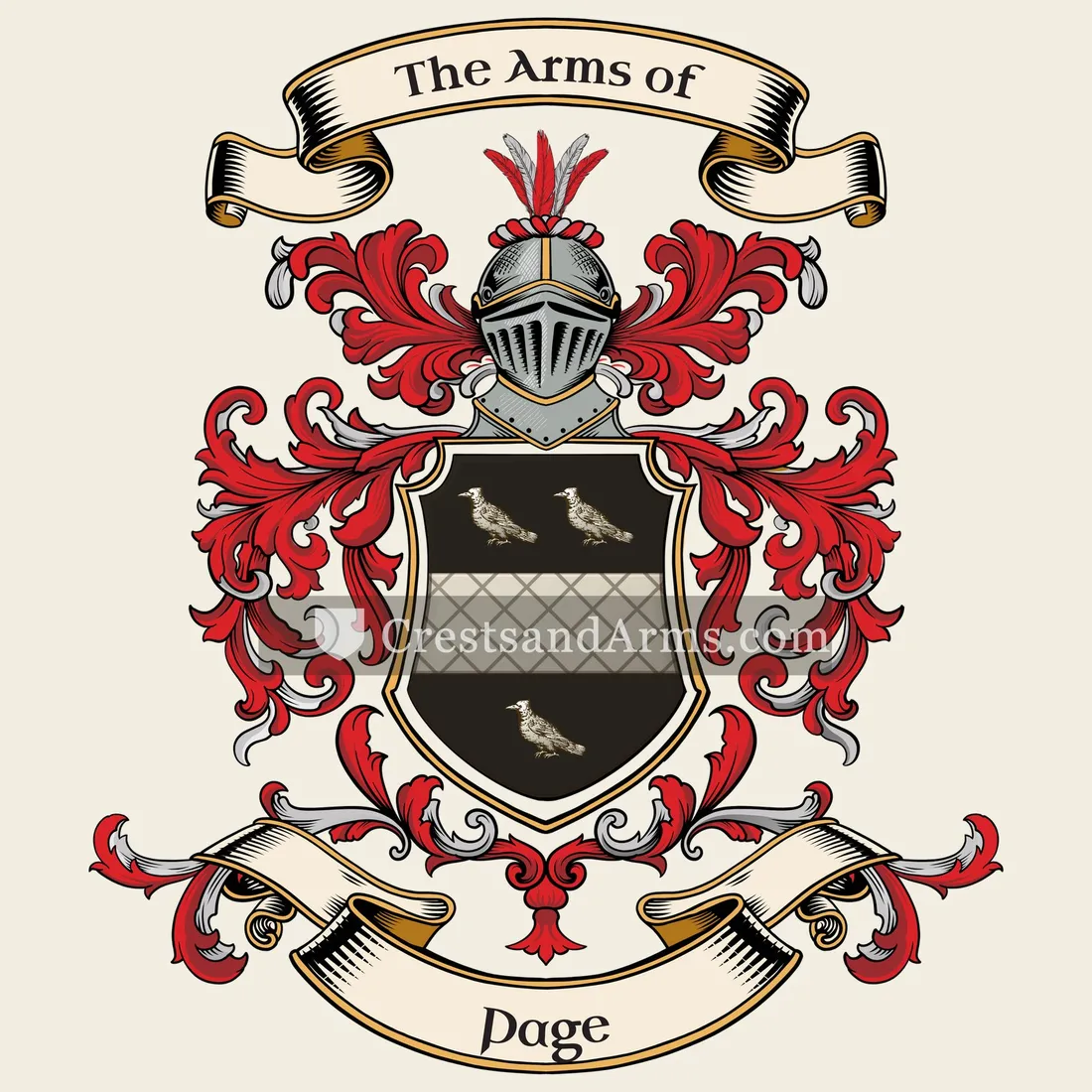
fessThe military belt, and readiness to serve
dovePeace, love and the Holy Spirit
Colours
Black (Sable)Means: Constancy
Silver (Argent)Means: Peace and sincerity
Historical info
Source
Sir Bernard Burke, The General Armory of England, Scotland, Ireland and Wales, London: Harrison & Sons, 1884
Blazon (the actual original written record)
“Sa. a fess betw. three doves ar. membered gu”
Englandc. 1530
Digital archive packCoat of arms PNG, gold border print PDF, vector SVG and the certificate of authenticity. Sent to your email in minutes.
Map of England showing where the Page arms are recorded
The Page arms were recorded in England, c. 1530.
Arms such as these were typically recorded in York.
Yorkshire is the largest of the English counties, and it held more gentry families than any other. Land there was split among a great many households rather than a few, so a great many of them carried arms.
This is where the arms were entered in the register. Families often moved to other parts of the country, so the same name can turn up in more than one region.
The body that granted and recorded arms in England in this period.
Henry VIII of England
Sovereign of the period
Henry VIII of England
1509–1547
Reigning in France when the Page arms are first recorded.
How Arms Worked in England
English heraldry allowed arms to be shared by all legitimate descendants of the original owner. These symbols were treated as personal property that moved through the generations to all children. While the eldest son kept the original design, other family members could use the same shield without needing to change it or register their own unique versions.
Granting authority
The College of Arms in London has regulated the use of coats of arms throughout England and Wales since 1484.
How they got arms
Families typically obtained their coats of arms through a formal grant from the Crown or by proving their ancient right to them.
Where arms were recorded
All official coats of arms are recorded in the registers kept at the College of Arms, which date back to the fifteenth century.
The family's standing
Recorded among the armigerous families of England.
Origin & History of the Page Family in England
The surname Page originated in medieval England as a descriptive occupational name. It was originally given to young boys who served as attendants or trainees in noble households while they learned the skills of knighthood. Because these youths were common fixtures in castles and manors across the country, the name appeared independently in many different regions as families adopted it to identify their profession. By the time records place the family in York in 1530, the name had already transitioned from a job title into a hereditary surname passed down through generations. During this period, the city of York served as a major northern hub for trade and administration, suggesting that families bearing the name were likely integrated into the local merchant or craft guilds that defined urban life in the sixteenth century. As the family established roots in the north, they became part of the broader social fabric of England, moving away from their origins as household servants to become settled members of their local communities.
Meaning of the Page family crest colors & symbols
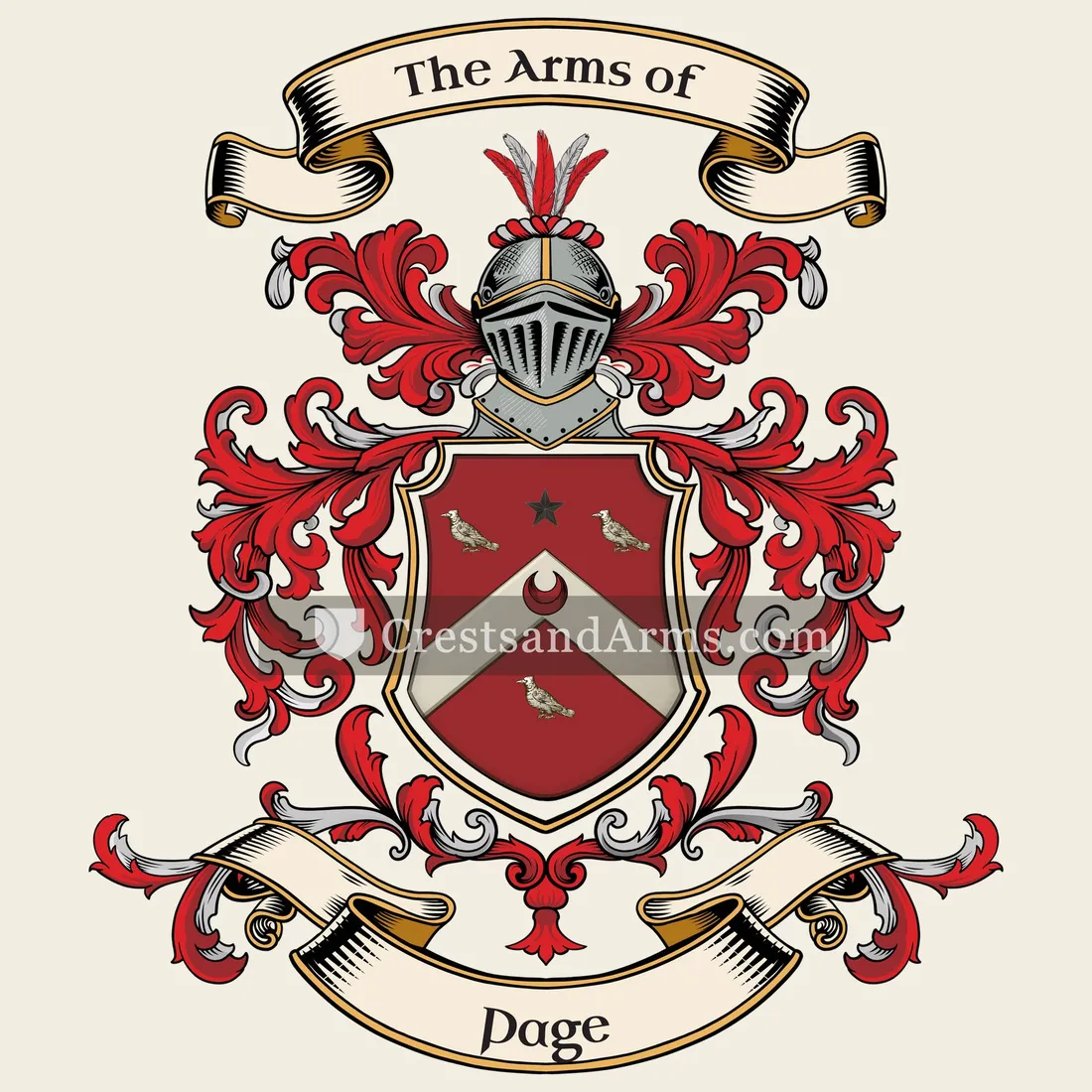
Symbols on this shield
chevronProtection, and faithful service completed
dovePeace, love and the Holy Spirit
mulletThe third son, and a divine quality from above
crescentHonour by the sovereign, and the second son
Colours
Red (Gules)Means: Military strength
Silver (Argent)Means: Peace and sincerity
Black (Sable)Means: Constancy
Historical info
Source
Sir Bernard Burke, The General Armory of England, Scotland, Ireland and Wales, London: Harrison & Sons, 1884
Blazon (the actual original written record)
“Gu. a chev. betw. three doves ar. beaked and legged sa., a mullet on a crescent for diff”
KildareNewhall · Kildare, c. 1640
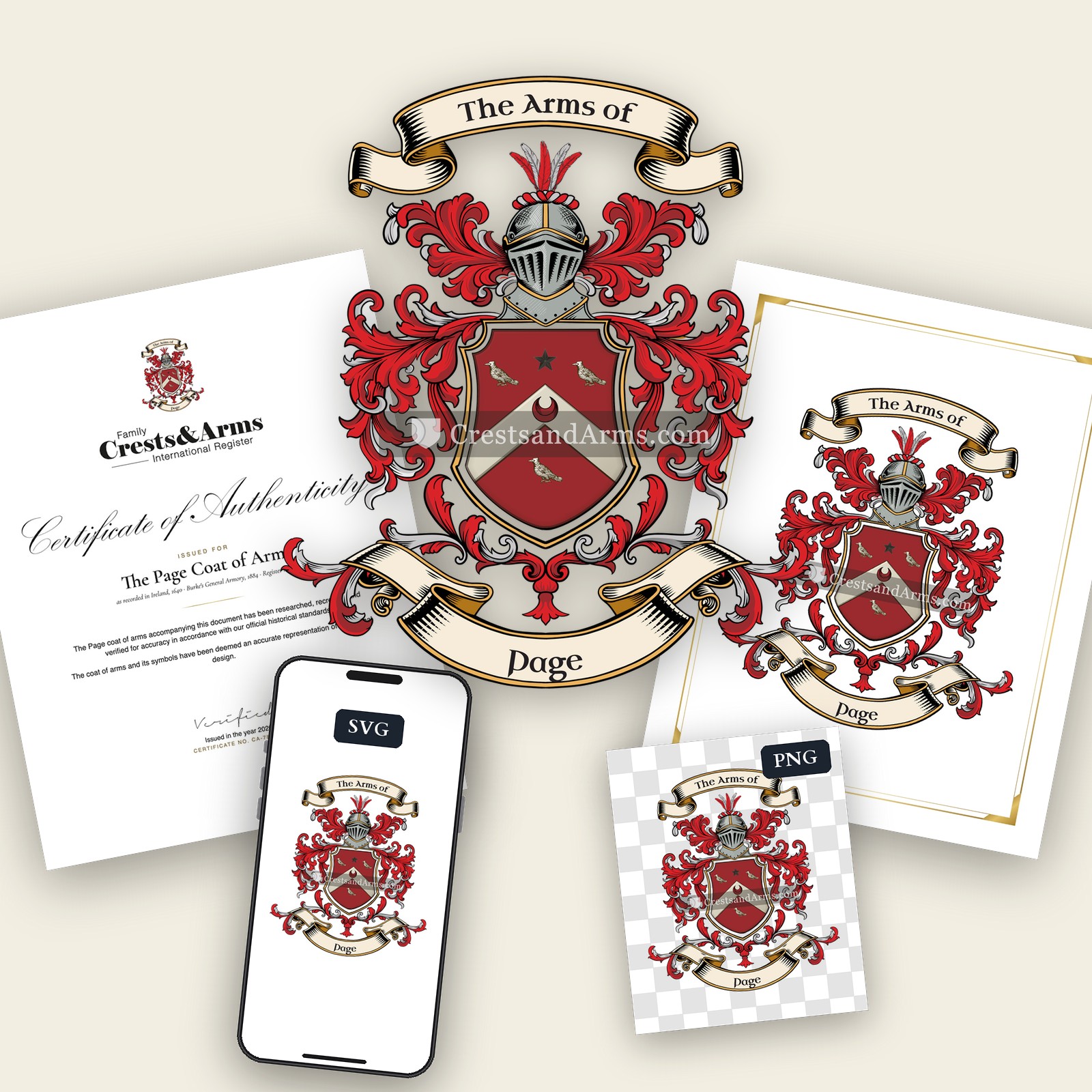
Digital archive packCoat of arms PNG, gold border print PDF, vector SVG and the certificate of authenticity. Sent to your email in minutes.
Map of Ireland showing where the Page arms are recorded
The Page arms were recorded in Kildare, c. 1640.
Kildare was flat grazing country close to Dublin, taken early by Norman families. Being near the seat of government meant being near where arms were recorded, which is why so many Kildare names appear.
This is where the arms were entered in the register. Families often moved to other parts of the country, so the same name can turn up in more than one region.
The body that granted and recorded arms in Ireland in this period.
Charles I of England
Sovereign of the period
Charles I of England
1625–1649
Reigning in France when the Page arms are first recorded.
How Arms Worked in Ireland
The Ulster King of Arms granted coats of arms to individuals who proved their social standing and good character. These symbols were typically inherited by all legitimate descendants of the original holder. If a family branch wanted a unique look, they could apply for a specific change to their design through the office to ensure their identity remained distinct.
Granting authority
The Ulster King of Arms acted as the official body that regulated and issued all coats of arms throughout Ireland.
How they got arms
Families obtained their arms through formal grants issued by the office after proving their eligibility and paying the required fees.
Where arms were recorded
All official grants were recorded in the registers held by the Ulster King of Arms starting from the year 1552.
The family's standing
Recorded among the armigerous families of Kildare.
Origin & History of the Page Family in Ireland
The history of the Page family in Ireland is deeply connected to the social and political shifts of the seventeenth century. While the name itself has roots in the service roles of medieval Europe, the family established a notable presence in County Kildare by 1640. During this period, the region was undergoing significant land ownership changes as new settlers arrived from England. Families like the Pages often held positions that required them to manage estates or serve in local administrative capacities. Their presence in Kildare suggests they were part of a group of families who integrated into the local economy during a time of great upheaval. By settling in this fertile part of the country, the Pages became part of the long and complex story of migration that shaped the demographics of eastern Ireland.
Page Meaning & Related Branches
Root word
Pagius
A Latin term derived from pagus meaning a rural district or village.
This name
PageAn occupational name for a young boy serving as an attendant or page to a knight.
also spelled
Paige
Paje
Paj
Pagg
Payge
Related arms
Allenrecorded with Page, same area
Baconrecorded with Page, same area
Beckettrecorded with Page, same area
Berringtonrecorded with Page, same area
Documented Sources
J. B. Rietstap, Armorial Général, Gouda: G. B. van Goor Zonen, 1884–87
Archives départementales du Doubs, Série B: Cours et juridictions
Benoit, Arthur, Recherches sur les familles de la Franche-Comté, 1885
Gauthier, Jules, Documents sur la Franche-Comté, 1890
Digital archive packCoat of arms PNG, gold border print PDF, vector SVG and the certificate of authenticity. Sent to your email in minutes.


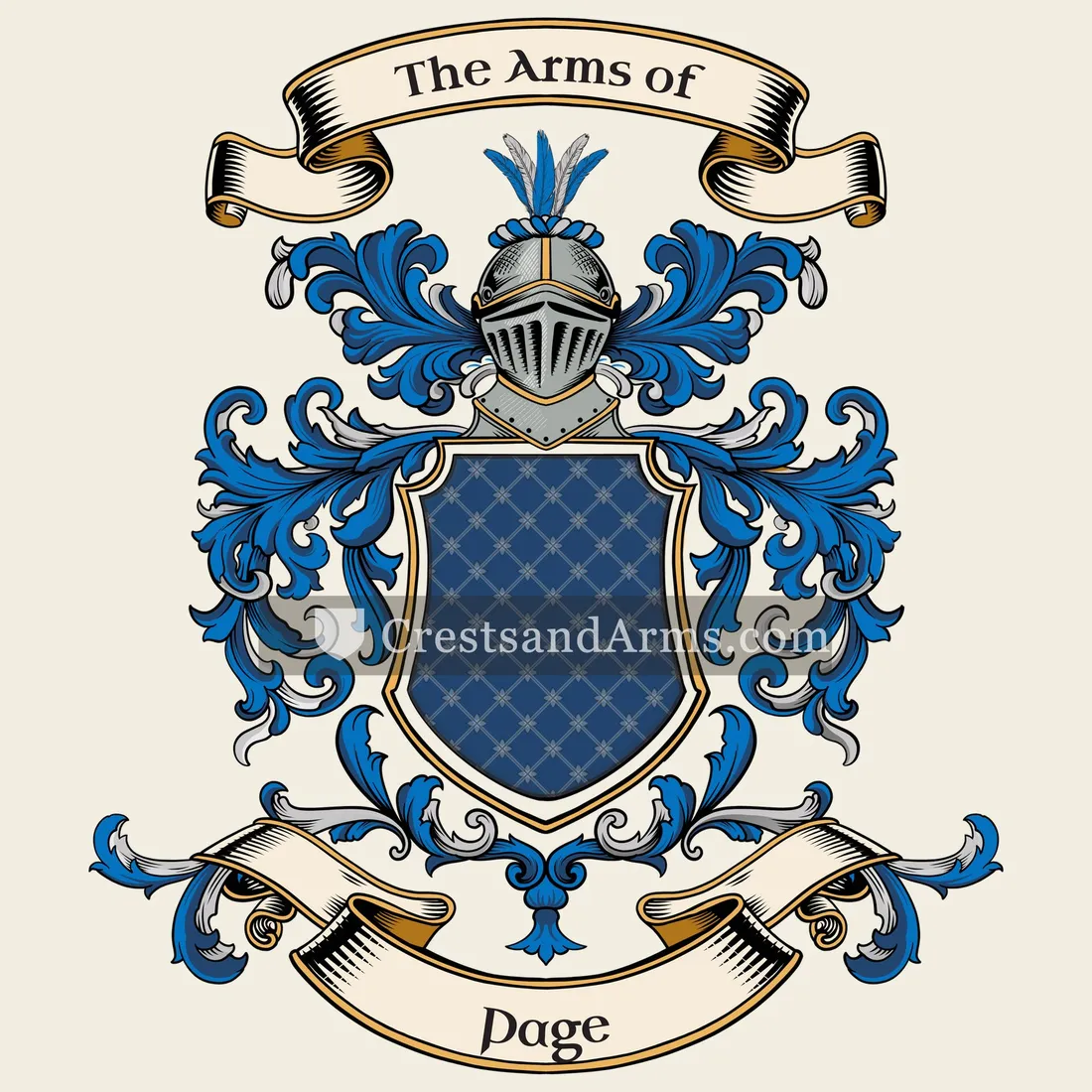


 fessThe military belt, and readiness to serve
 dovePeace, love and the Holy Spirit


 chevronProtection, and faithful service completed
 mulletThe third son, and a divine quality from above
 crescentHonour by the sovereign, and the second son