A record of documented arms, meaning and origin, researched for the Paget family lines. Documented in 3 countries.
Reg. 7660 · French, P–S
Coat of Arms & Family Crest Details
Symbols on this shield
cross symbolChristian faith and service
lionCourage, strength and royalty
eagleNobility, strength and a keen mind
Colours
Black (Sable)Means: Constancy
Silver (Argent)Means: Peace and sincerity
Historical info
Source
J. B. Rietstap, Armorial Général, Gouda: G. B. van Goor Zonen, 1884–87
Blazon (the actual original written record)
“De sa. à la croix engr. d'arg., ch. de cinq léopards du champ et cant. de quatre aigles du sec. C.: un tigre héraldique iss. de sa., criné, défendu et coll. d'une couronne d'arg. S.: deux tigres héraldiques, pareils à celui du cimier. D.: PER IL SUO CONTRARIO.”
Francec. 1552
Digital archive packCoat of arms PNG, gold border print PDF, vector SVG and the certificate of authenticity. Sent to your email in minutes.
Map of France showing where the Paget arms are recorded
The Paget arms were recorded in France, c. 1552.
Arms such as these were typically recorded in Bretagne.
More families held coats of arms in Bretagne than anywhere else in France. The land was divided into many small estates rather than a few large ones, so far more households counted as gentry, and each needed a shield of its own to be told apart.
This is where the arms were entered in the register. Families often moved to other parts of the country, so the same name can turn up in more than one region.
The body that granted and recorded arms in France in this period.
Henry II of France
Sovereign of the period
Henry II of France
1547–1559
Reigning in France when the Paget arms are first recorded.
How Arms Worked in France
In France, a coat of arms was a mark of honor that passed down through the male line to all legitimate descendants. Families often used the same shield without changes to show their shared heritage. If a branch wanted to stand out, they could add a small mark to their shield to show their specific place in the family tree.
Granting authority
The Juge d'armes de France acted as the official authority that regulated and verified coats of arms across the country.
How they got arms
Families typically inherited their arms from ancestors, though they could also receive them through royal grants or by proving their noble status.
Where arms were recorded
Coats of arms were officially recorded in the Armorial Général de France, which began its main collection in the year 1696.
The family's standing
Recorded among the armigerous families of France.
Origin & History of the Paget Family in France
The surname Paget traces its roots to the historical region of Brittany in northwestern France, where members of the family were firmly established by the mid-sixteenth century. During this era, the name was closely tied to the social and economic structures of the Breton countryside, where families often identified with specific parishes or local administrative districts. Historical records from 1552 confirm the presence of the Paget name in this region, suggesting that the family played a role in the local community life of the time. As the family grew, they became part of the complex tapestry of French provincial history, navigating the shifting political landscapes of the Renaissance. Their early presence in Brittany highlights the family’s long-standing connection to the traditions and regional identity of this distinct part of France.
Coat of Arms & Family Crest Details
Symbols on this shield
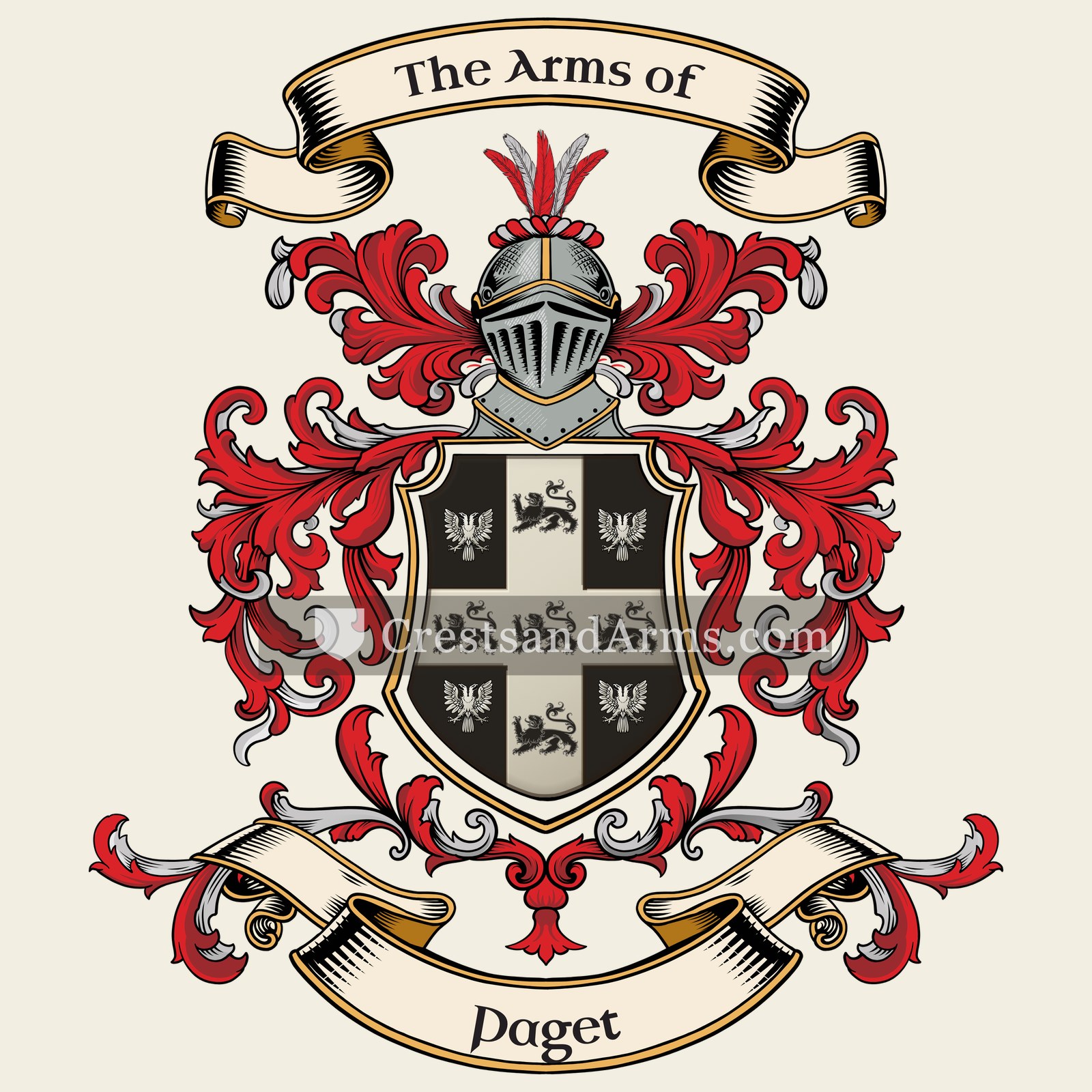
cross symbolChristian faith and service
eagleNobility, strength and a keen mind
lionCourage, strength and royalty
Colours
Black (Sable)Means: Constancy
Silver (Argent)Means: Peace and sincerity
Historical info
Source
Sir Bernard Burke, The General Armory of England, Scotland, Ireland and Wales, London: Harrison & Sons, 1884
Blazon (the actual original written record)
“Sa. on a cross engr. betw. four eagles displ. ar. five lions pass. guard. of the field”
AngleseyAnglesey, c. 1647
Digital archive packCoat of arms PNG, gold border print PDF, vector SVG and the certificate of authenticity. Sent to your email in minutes.
Map of Wales showing where the Paget arms are recorded
The Paget arms were recorded in Anglesey, c. 1647.
Anglesey was the flat, fertile island off north Wales, farmed for centuries by the same families. Good land kept them in place, and staying put is what puts a name in the records.
This is where the arms were entered in the register. Families often moved to other parts of the country, so the same name can turn up in more than one region.
The body that granted and recorded arms in Wales in this period.
Charles I of England
Sovereign of the period
Charles I of England
1625–1649
Reigning in France when the Paget arms are first recorded.
How Arms Worked in Wales
English heraldry allowed arms to be shared by all legitimate descendants of the original owner. These symbols were treated as personal property that moved through the generations to all children. While the eldest son kept the original design, other family members could use the same shield without needing to change it or register their own unique versions.
Granting authority
The College of Arms in London has regulated the use of coats of arms throughout England and Wales since 1484.
How they got arms
Families typically obtained their coats of arms through a formal grant from the Crown or by proving their ancient right to them.
Where arms were recorded
All official coats of arms are recorded in the registers kept at the College of Arms, which date back to the fifteenth century.
The family's standing
Recorded among the armigerous families of Anglesey.
Origin & History of the Paget Family in Wales
The history of the Paget family in Wales is deeply rooted in the landscape of Anglesey, where members of the family were firmly established by the middle of the seventeenth century. While the name itself has origins that stretch back to medieval England, its presence in North Wales highlights the movement of families across the border during a time of significant political and social transition. By 1647, the Pagets were active participants in the local life of the island, likely drawn to the region by the opportunities for land ownership and the influence that came with managing rural estates. Their integration into the Welsh community suggests a period of steady growth and adaptation, as they transitioned from their earlier ancestral roots to become a recognized part of the local gentry in Anglesey. This early chapter of their history reflects the broader pattern of families settling into new regions and building lasting connections within the Welsh countryside.
Coat of Arms & Family Crest Details
Symbols on this shield
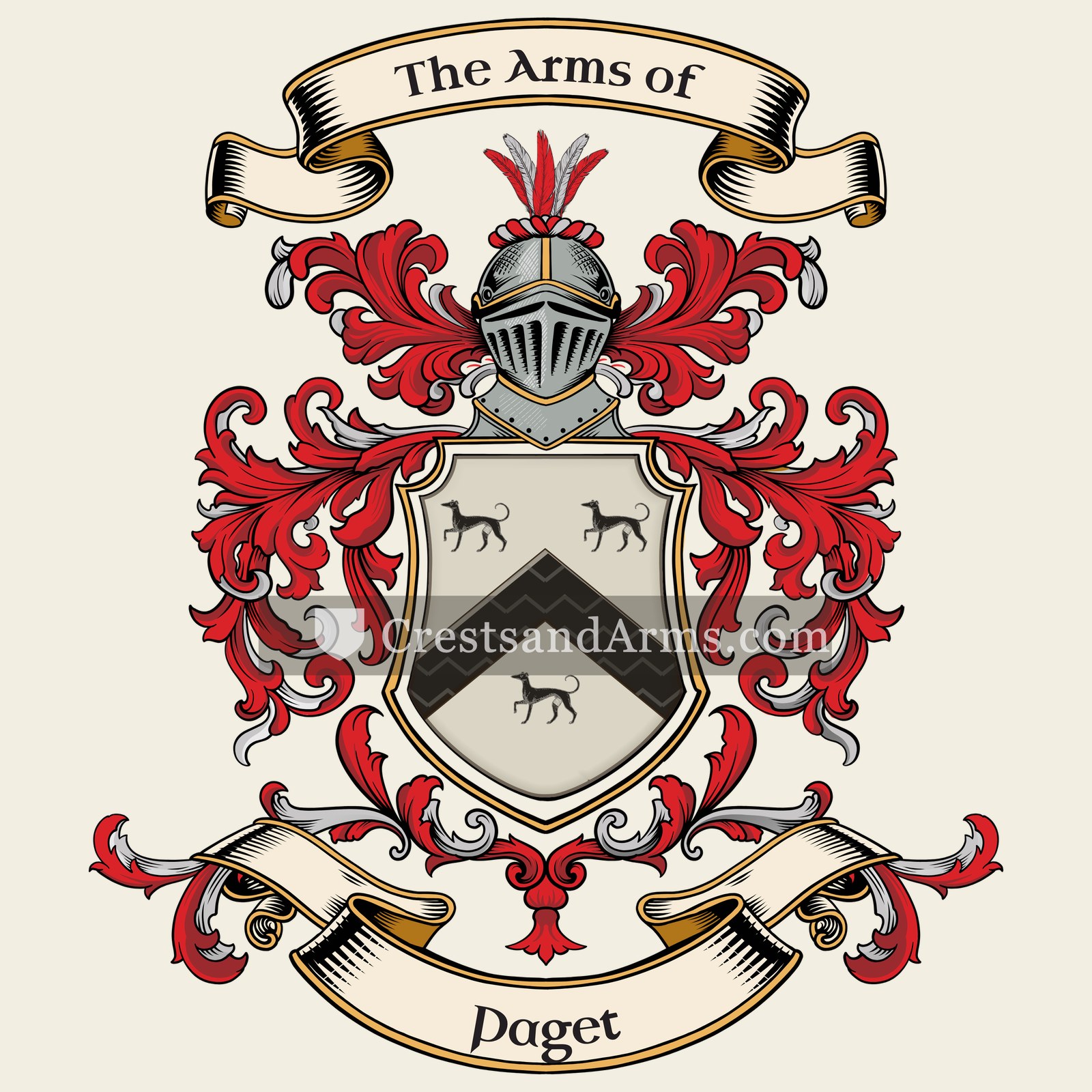
chevronProtection, and faithful service completed
vairProtection, and the winter fur
greyhoundCourage, vigilance and loyalty
Colours
Silver (Argent)Means: Peace and sincerity
Black (Sable)Means: Constancy
Historical info
Source
Sir Bernard Burke, The General Armory of England, Scotland, Ireland and Wales, London: Harrison & Sons, 1884
Blazon (the actual original written record)
“Ar. a chev. vair betw. three talbots pass. sa”
HantsLondon · Hants, c. 1536
Digital archive packCoat of arms PNG, gold border print PDF, vector SVG and the certificate of authenticity. Sent to your email in minutes.
Map of England showing where the Paget arms are recorded
The Paget arms were recorded in Hants, c. 1536.
Hampshire had the naval dockyards at Portsmouth on one side and good farmland on the other. Sea money and land money both bought estates, and an estate was what brought a family its coat of arms.
This is where the arms were entered in the register. Families often moved to other parts of the country, so the same name can turn up in more than one region.
The body that granted and recorded arms in England in this period.
Henry VIII of England
Sovereign of the period
Henry VIII of England
1509–1547
Reigning in France when the Paget arms are first recorded.
How Arms Worked in England
English heraldry allowed arms to be shared by all legitimate descendants of the original owner. These symbols were treated as personal property that moved through the generations to all children. While the eldest son kept the original design, other family members could use the same shield without needing to change it or register their own unique versions.
Granting authority
The College of Arms in London has regulated the use of coats of arms throughout England and Wales since 1484.
How they got arms
Families typically obtained their coats of arms through a formal grant from the Crown or by proving their ancient right to them.
Where arms were recorded
All official coats of arms are recorded in the registers kept at the College of Arms, which date back to the fifteenth century.
The family's standing
Recorded among the armigerous families of Hants.
Origin & History of the Paget Family in England
The surname Paget originated as a nickname derived from the Old French word "pajet," which referred to a young servant or a page boy in a noble household. By the time the family established a notable presence in the county of Hampshire during the early sixteenth century, the name had transitioned from a simple occupational descriptor to a hereditary family identifier. In 1536, the Paget family was already becoming integrated into the social and political fabric of England, a period marked by significant shifts in land ownership and administrative power. During this era, individuals bearing the name began to rise through the ranks of local governance and royal service, moving away from their humble linguistic origins to become recognized landowners. This transition reflects the broader trend of the time where families of modest beginnings utilized the stability of the Tudor period to secure their status and influence within English society.
Related Branches & Arms
Root word
page
a young servant or attendant
This name
Pageta diminutive form referring to a young servant or a page boy
also spelled
Pajet
Pagitt
Related arms
Pagittvariant spelling
Benetrecorded with Paget, same area
Documented Sources
J. B. Rietstap, Armorial Général, Gouda: G. B. van Goor Zonen, 1884–87
Archives départementales d'Ille-et-Vilaine, Série B: Cours et juridictions
Poter, Arthur, Histoire de Bretagne, 1905
Digital archive packCoat of arms PNG, gold border print PDF, vector SVG and the certificate of authenticity. Sent to your email in minutes.


 cross symbolChristian faith and service
 lionCourage, strength and royalty
 eagleNobility, strength and a keen mind
 cross symbolChristian faith and service
 lionCourage, strength and royalty
 eagleNobility, strength and a keen mind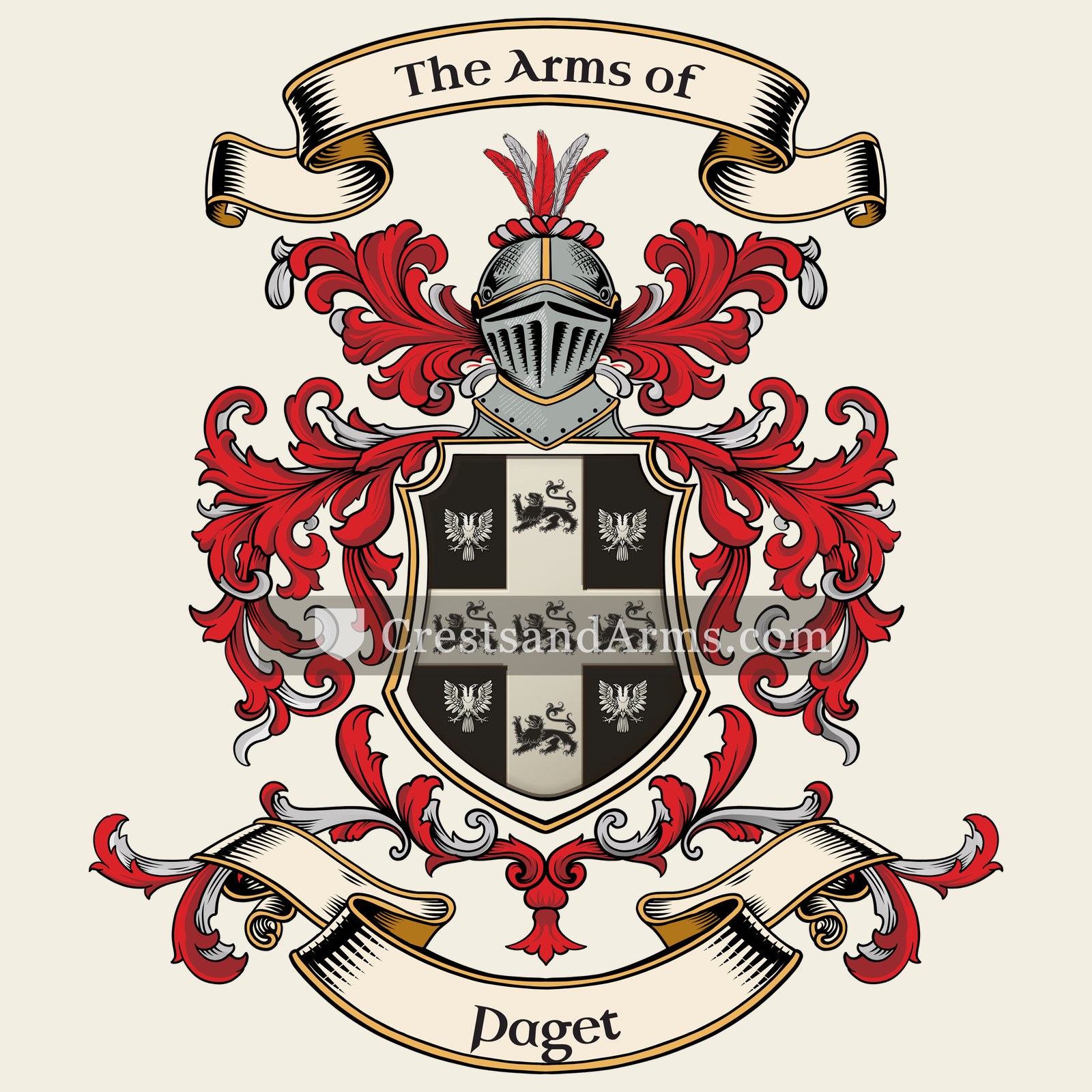




 chevronProtection, and faithful service completed
 greyhoundCourage, vigilance and loyalty