Map of France showing where the Pain arms are recorded
The Pain arms were recorded in Lorraine, c. 1510.
Lorraine sat on the border between France and the German lands, and border country bred soldiers. Families here held small estates and served in arms, and a fighting man was exactly the sort who carried a shield of his own.
This is where the arms were entered in the register. Families often moved to other parts of the country, so the same name can turn up in more than one region.
The body that granted and recorded arms in France in this period.
Louis XII of France
Sovereign of the period
Louis XII of France
1498–1515
Reigning in France when the Pain arms are first recorded.
How Arms Worked in France
In France, a coat of arms was a mark of honor that passed down through the male line to all legitimate descendants. Families often used the same shield without changes to show their shared heritage. If a branch wanted to stand out, they could add a small mark to their shield to show their specific place in the family tree.
Granting authority
The Juge d'armes de France acted as the official authority that regulated and verified coats of arms across the country.
How they got arms
Families typically inherited their arms from ancestors, though they could also receive them through royal grants or by proving their noble status.
Where arms were recorded
Coats of arms were officially recorded in the Armorial Général de France, which began its main collection in the year 1696.
The family's standing
Recorded among the armigerous families of Lorraine.
Origin & History of the Pain Family in France
The family name Pain has deep roots in the historical region of Lorraine, where records confirm the presence of family members as early as 1510. In the French language, the word "pain" translates directly to bread, which suggests that the name likely originated as a descriptive occupational surname for a baker or a merchant who dealt in grain. During the early sixteenth century, Lorraine was a vibrant crossroads of culture and trade located between the French kingdom and the Holy Roman Empire. Families living in this area were often identified by their specific trade or their role within the local village economy. As the name became established in the region, it moved from being a simple description of a person’s job to a permanent family identifier passed down through generations. This transition reflects the broader social changes of the Renaissance period when surnames became necessary to distinguish individuals in growing communities.
Coat of Arms & Family Crest Details
Symbols on this shield
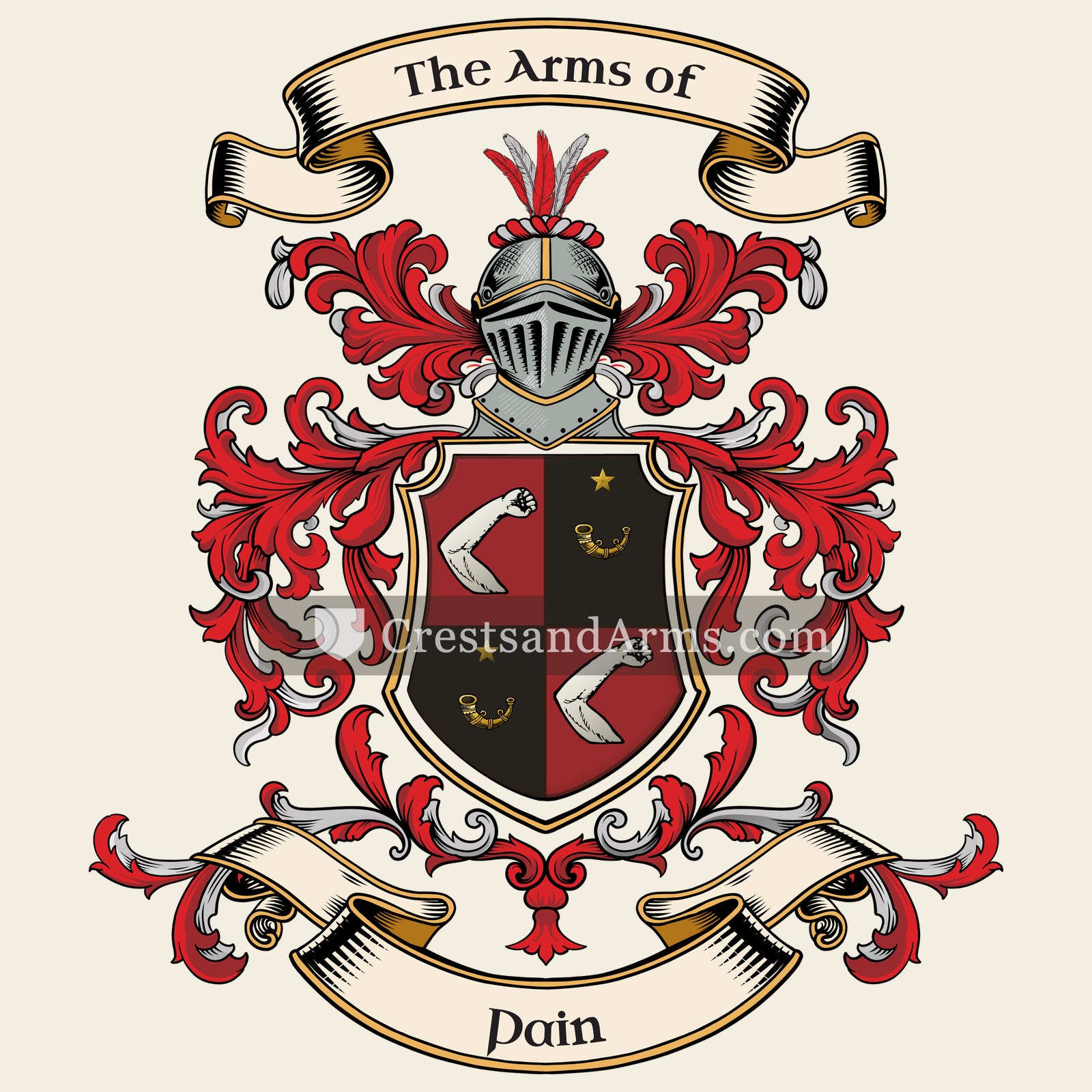
armA person of action, industrious and laborious
hunting horn stringedOne who delights in the chase
mulletThe third son, and a divine quality from above
Colours
Red (Gules)Means: Military strength
Black (Sable)Means: Constancy
Silver (Argent)Means: Peace and sincerity
Gold (Or)Means: Generosity
Historical info
Source
J. B. Rietstap, Armorial Général, Gouda: G. B. van Goor Zonen, 1884–87
Blazon (the actual original written record)
“Ec.: aux 1 et 4 de gu. à un senestrochère, paré d'arg., tenant un marteau du même; aux 2 et 3 de sa. à un cor de chasse d'or, acc. d'une étoile du même, entre le cor et son lien. Deux cq. cour. C.: 1° un vol cont. aux armes du 1: 1. d'arg. et de gu.; 2° un vol à l'antique aux armes du 2: 1. d'or et de sa.”
CarinthiaCarinthia, c. 1772
Digital archive packCoat of arms PNG, gold border print PDF, vector SVG and the certificate of authenticity. Sent to your email in minutes.
Map of Austria showing where the Pain arms are recorded
The Pain arms were recorded in Carinthia, c. 1772.
Carinthia was Alpine country in southern Austria with iron and lead in its mountains. Mining and landholding both made money, and families who held either kind of property took arms.
This is where the arms were entered in the register. Families often moved to other parts of the country, so the same name can turn up in more than one region.
Region
Carinthia
First recorded
1772
Granting Authority for the Pain Arms
Imperial and Royal chancery
Sodacan · CC BY-SA 3.0
The body that granted and recorded arms in Austria in this period.
Joseph II, Holy Roman Emperor
Sovereign of the period
Joseph II, Holy Roman Emperor
1765–1790
Reigning in France when the Pain arms are first recorded.
How Arms Worked in Austria
Austrian coats of arms were often linked directly to noble titles granted by the Emperor. These symbols belonged to the entire family line rather than just one individual. When a family grew, new branches kept the original design without needing to change it. This system allowed all members of a noble house to share the same identity across many generations.
Granting authority
The Imperial and Royal chancery managed all heraldic matters and controlled the official granting of arms throughout the Austrian lands.
How they got arms
Families typically received their arms through a formal imperial decree that often accompanied the elevation of a person to noble status.
Where arms were recorded
Official records of these grants were kept in the Imperial Register of Nobility which began its formal documentation process in 1453.
The family's standing
Recorded among the armigerous families of Carinthia.
Origin & History of the Pain Family in Austria
The history of the Pain family in Austria is deeply rooted in the rugged landscapes of Carinthia, where records confirm their presence as early as 1772. During this period, the region was part of the Habsburg Monarchy, and families like the Pains were often tied to the local agricultural economy or regional trade networks. The name itself likely evolved from older linguistic roots common in the Alpine regions, reflecting the way surnames were formed to describe a person’s occupation, physical traits, or place of origin. As residents of Carinthia, the early members of this family lived through a time of significant administrative reform under Empress Maria Theresa, which led to more formal record-keeping for tax and census purposes. By settling in this southern province, the family became part of a diverse cultural tapestry that blended Germanic and Slavic influences. Their documented presence in the late 18th century suggests they were established members of their community who contributed to the social and economic development of the Austrian countryside.
Coat of Arms & Family Crest Details
Symbols on this shield
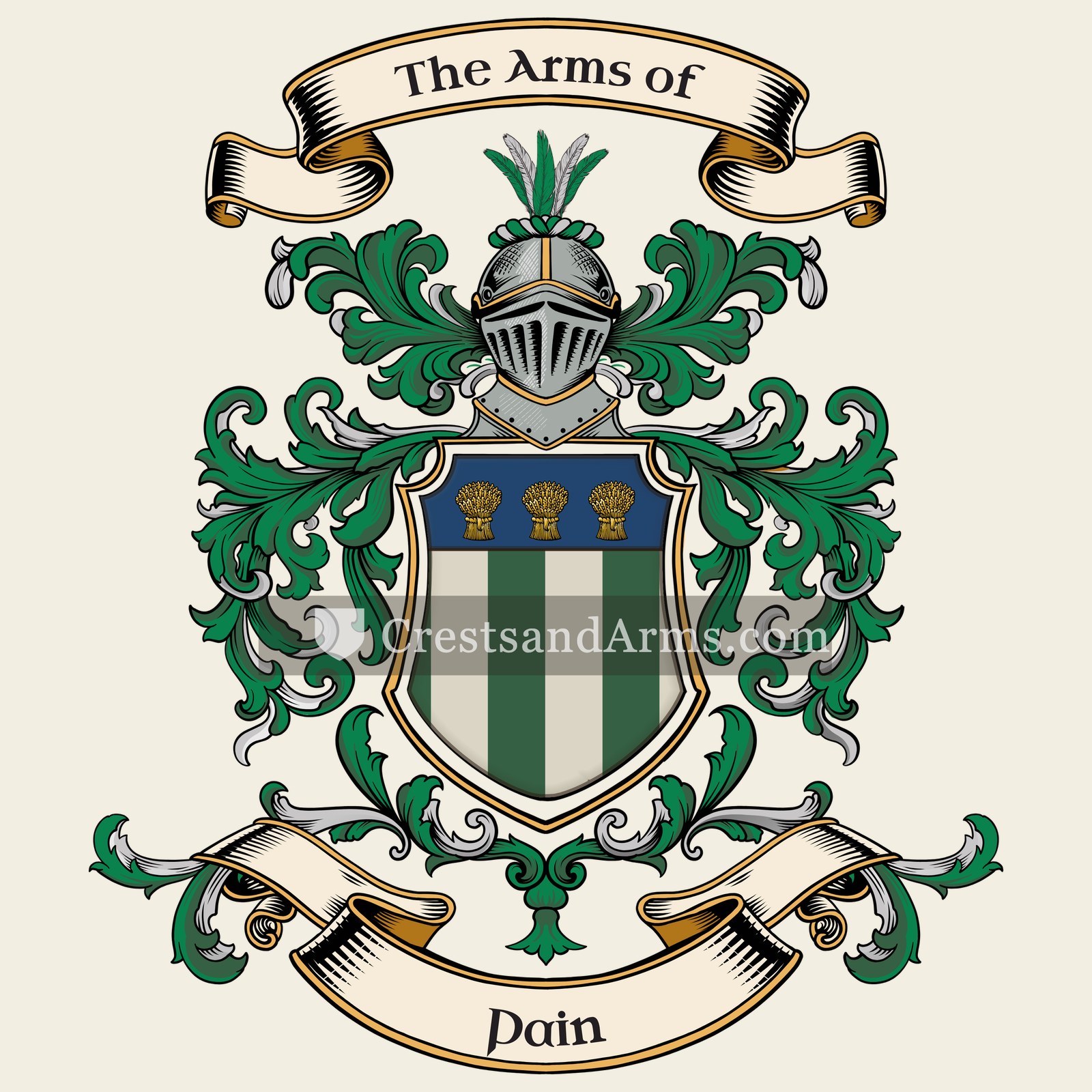
chiefAuthority, wisdom and dominion
wheatsheafPlenty, and the harvest of one's own labour
Colours
Silver (Argent)Means: Peace and sincerity
Blue (Azure)Means: Loyalty and truth
Gold (Or)Means: Generosity
Green (Vert)Means: Hope
Historical info
Source
Sir Bernard Burke, The General Armory of England, Scotland, Ireland and Wales, London: Harrison & Sons, 1884
Blazon (the actual original written record)
“Paly of six ar. and vert, on a chief az. three garbs or”
Englandc. 1620
Digital archive packCoat of arms PNG, gold border print PDF, vector SVG and the certificate of authenticity. Sent to your email in minutes.
Map of England showing where the Pain arms are recorded
The Pain arms were recorded in England, c. 1620.
Arms such as these were typically recorded in York.
Yorkshire is the largest of the English counties, and it held more gentry families than any other. Land there was split among a great many households rather than a few, so a great many of them carried arms.
This is where the arms were entered in the register. Families often moved to other parts of the country, so the same name can turn up in more than one region.
The body that granted and recorded arms in England in this period.
James VI and I
Sovereign of the period
James VI and I
1603–1625
Reigning in France when the Pain arms are first recorded.
How Arms Worked in England
English heraldry allowed arms to be shared by all legitimate descendants of the original owner. These symbols were treated as personal property that moved through the generations to all children. While the eldest son kept the original design, other family members could use the same shield without needing to change it or register their own unique versions.
Granting authority
The College of Arms in London has regulated the use of coats of arms throughout England and Wales since 1484.
How they got arms
Families typically obtained their coats of arms through a formal grant from the Crown or by proving their ancient right to them.
Where arms were recorded
All official coats of arms are recorded in the registers kept at the College of Arms, which date back to the fifteenth century.
The family's standing
Recorded among the armigerous families of England.
Origin & History of the Pain Family in England
The surname Pain has deep roots in the English language, originating as a nickname or a descriptive term during the Middle Ages. It is derived from the Old French word *paien*, which translates to pagan or countryman. In early English society, this name was often given to someone who was considered an outsider or perhaps someone who lived in a rural area far from the church’s influence. By the time the family was established in York in 1620, the name had become a permanent fixture of the local population. Families living in York during this period were often involved in the city’s vibrant trade and guild systems, which allowed them to build stable lives in the north of England. As the name spread through different regions, it evolved in spelling, but its connection to the early social structure of medieval England remained a defining part of its history.
Pain Meaning & Related Branches
Root word
panis
Latin term referring to bread or food.
This name
PainAn occupational surname for a baker or someone who sold bread.
also spelled
Payn
Pan
Payne
Paynes
Related arms
Paynevariant spelling
Paynvariant spelling
Paynesvariant spelling
Documented Sources
J. B. Rietstap, Armorial Général, Gouda: G. B. van Goor Zonen, 1884–87
Bouteiller, Ernest de. Dictionnaire topographique de l'ancien département de la Moselle. 1874
Digital archive packCoat of arms PNG, gold border print PDF, vector SVG and the certificate of authenticity. Sent to your email in minutes.


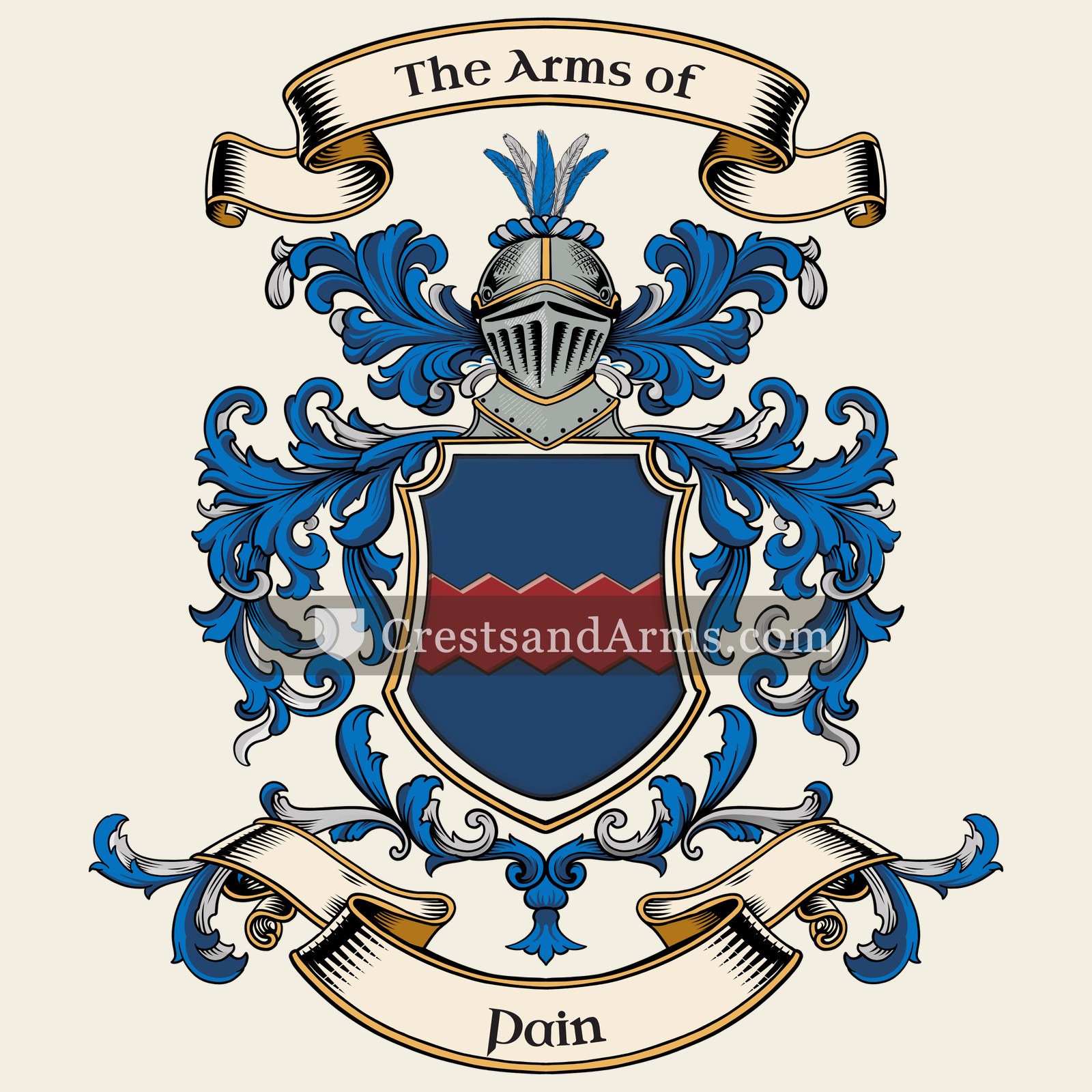
 fessThe military belt, and readiness to serve
 fessThe military belt, and readiness to serve


 armA person of action, industrious and laborious
 hunting horn stringedOne who delights in the chase
 mulletThe third son, and a divine quality from above


 chiefAuthority, wisdom and dominion
 wheatsheafPlenty, and the harvest of one's own labour