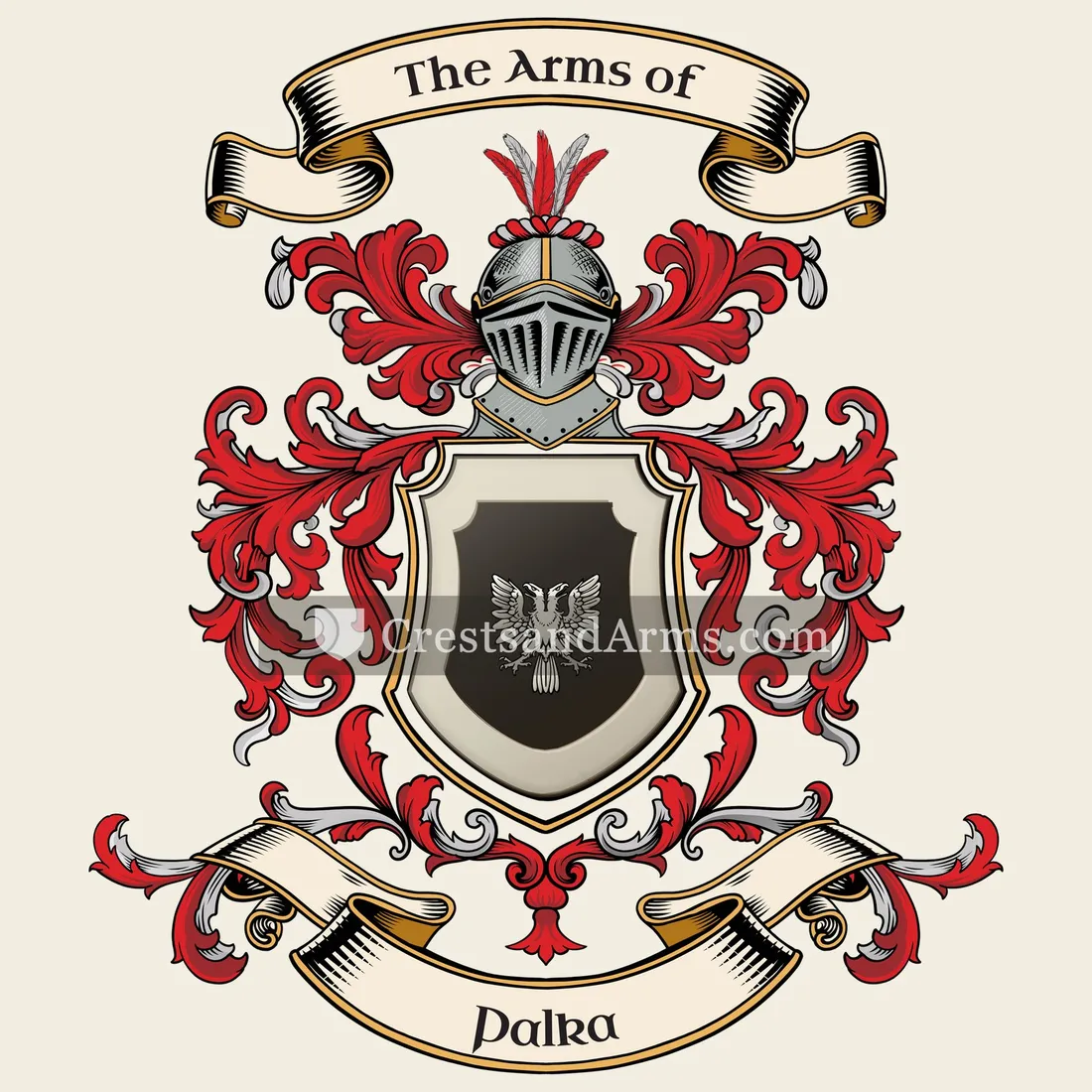
A record of documented arms, meaning and origin, researched for the Palka family lines. Documented in 2 countries.
Reg. 2913 · French, P–S
Meaning of the Palka family crest colors & symbols
Symbols on this shield
eagleNobility, strength and a keen mind
Colours
Black (Sable)Means: Constancy
Silver (Argent)Means: Peace and sincerity
Historical info
Source
J. B. Rietstap, Armorial Général, Gouda: G. B. van Goor Zonen, 1884–87
Blazon (the actual original written record)
“De sa. à l'aigle d'arg., bq. et m. d'or; à la bord. engr. du sec. C.: l'aigle, soutenue d'une sphère terrestre iss. T.: deux Hindous au nat., coiffés de turbans d'arg., les reins enveloppés d'une toile du même. D.: DEO DUCENTE.”
Francec. 1880
Digital archive packCoat of arms PNG, gold border print PDF, vector SVG and the certificate of authenticity. Sent to your email in minutes.
Map of France showing where the Palka arms are recorded
The Palka arms were recorded in France, c. 1880.
Arms such as these were typically recorded in Bretagne.
More families held coats of arms in Bretagne than anywhere else in France. The land was divided into many small estates rather than a few large ones, so far more households counted as gentry, and each needed a shield of its own to be told apart.
This is where the arms were entered in the register. Families often moved to other parts of the country, so the same name can turn up in more than one region.
The body that granted and recorded arms in France in this period.
How Arms Worked in France
In France, a coat of arms was a mark of honor that passed down through the male line to all legitimate descendants. Families often used the same shield without changes to show their shared heritage. If a branch wanted to stand out, they could add a small mark to their shield to show their specific place in the family tree.
Granting authority
The Juge d'armes de France acted as the official authority that regulated and verified coats of arms across the country.
How they got arms
Families typically inherited their arms from ancestors, though they could also receive them through royal grants or by proving their noble status.
Where arms were recorded
Coats of arms were officially recorded in the Armorial Général de France, which began its main collection in the year 1696.
The family's standing
Recorded among the armigerous families of France.
Origin & History of the Palka Family in France
The history of the Palka name in France is deeply tied to the regional identity of Bretagne during the late 19th century. While the name likely has roots that stretch further east into Slavic regions, its documented presence in the French department of Finistère by 1880 suggests a story of migration and integration. During this period, industrial growth and the expansion of the railway system encouraged families to move across borders in search of work in the maritime and agricultural sectors of western France. Settling in Bretagne, members of the family would have adapted to the local Breton language and customs while maintaining their distinct ancestral name. This transition highlights how families often preserved their cultural heritage while becoming active participants in the social and economic life of their new French communities.
Meaning of the Palka family crest colors & symbols
Symbols on this shield
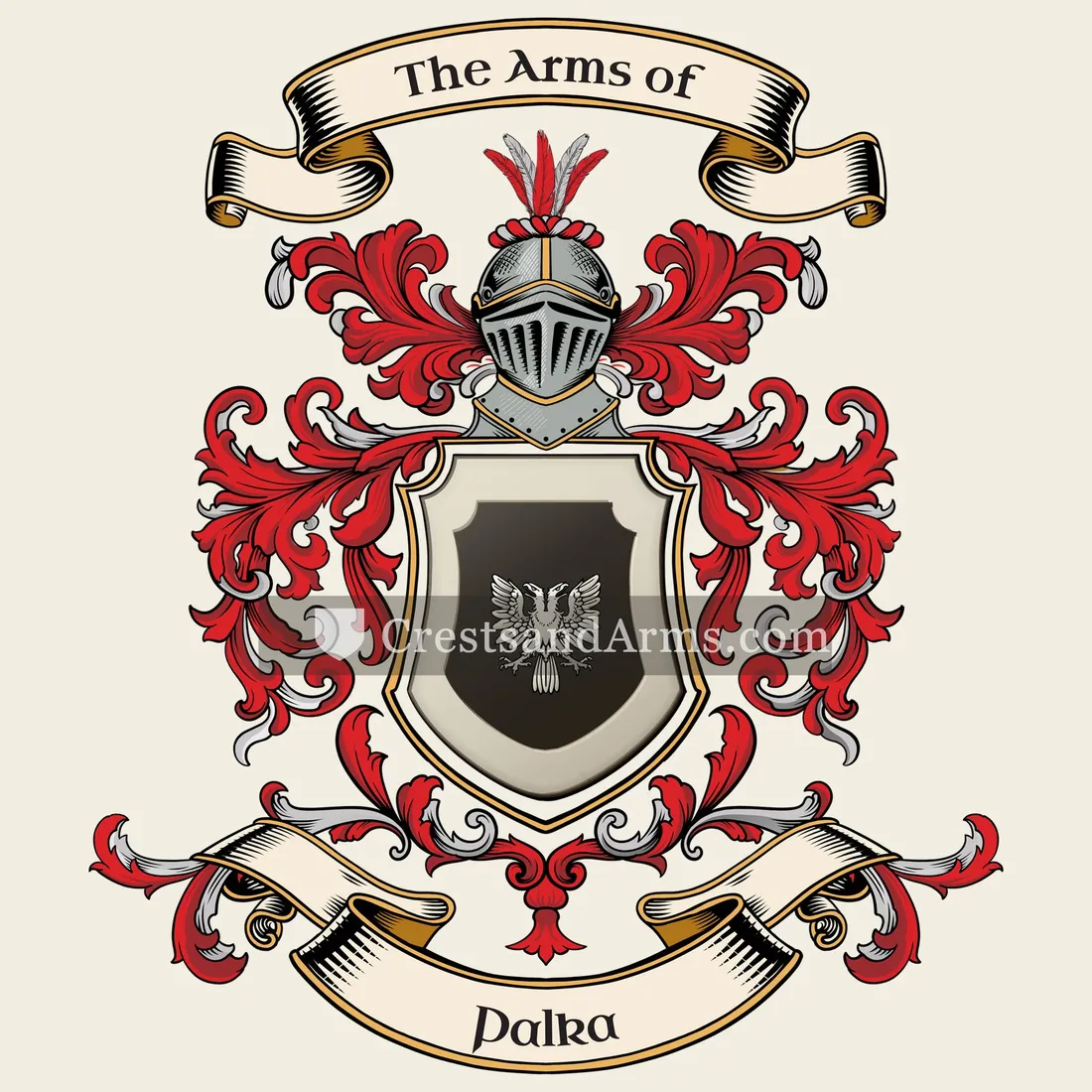
bordureA difference between branches of one family
eagleNobility, strength and a keen mind
Colours
Black (Sable)Means: Constancy
Silver (Argent)Means: Peace and sincerity
Historical info
Source
Sir Bernard Burke, The General Armory of England, Scotland, Ireland and Wales, London: Harrison & Sons, 1884
Blazon (the actual original written record)
“Sa. an eagle displ. ar. beaked and legged or, a border engr. of the second”
DevonHaldon House · Devon, c. 1620
Digital archive packCoat of arms PNG, gold border print PDF, vector SVG and the certificate of authenticity. Sent to your email in minutes.
Map of England showing where the Palka arms are recorded
The Palka arms were recorded in Devon, c. 1620.
Devon was a county of small manors and seafaring families. Its gentry were spread thickly across the countryside, and money made at sea often bought an estate, which in turn brought a coat of arms.
This is where the arms were entered in the register. Families often moved to other parts of the country, so the same name can turn up in more than one region.
The body that granted and recorded arms in England in this period.
James VI and I
Sovereign of the period
James VI and I
1603–1625
Reigning in France when the Palka arms are first recorded.
How Arms Worked in England
English heraldry allowed arms to be shared by all legitimate descendants of the original owner. These symbols were treated as personal property that moved through the generations to all children. While the eldest son kept the original design, other family members could use the same shield without needing to change it or register their own unique versions.
Granting authority
The College of Arms in London has regulated the use of coats of arms throughout England and Wales since 1484.
How they got arms
Families typically obtained their coats of arms through a formal grant from the Crown or by proving their ancient right to them.
Where arms were recorded
All official coats of arms are recorded in the registers kept at the College of Arms, which date back to the fifteenth century.
The family's standing
Recorded among the armigerous families of Devon.
Origin & History of the Palka Family in England
The history of the Palka name in England begins with a small but established presence in the county of Devon by the year 1620. During this period, the region was a bustling hub of maritime activity and agricultural development, which likely influenced the daily lives and occupations of early family members. While the name is often associated with broader European roots, its appearance in seventeenth-century Devon suggests that these individuals were part of a local community that valued trade and land management. Life in this part of England required resilience, as families often navigated the changing economic landscape of the Stuart era. By settling in Devon, these early ancestors became part of the local social fabric, leaving behind records that document their integration into English parish life. This early chapter of the family history highlights a transition into a new environment where they contributed to the growth and stability of their local neighborhood.
Palka Meaning & Related Branches
Root word
Palus
Latin term referring to a stake, pole, or marshy ground.
This name
PalkaA topographic name for someone living near a stake or a marshy area.
also spelled
Palke
Palkk
Palcke
Palck
Documented Sources
J. B. Rietstap, Armorial Général, Gouda: G. B. van Goor Zonen, 1884–87
Archives départementales du Finistère, État civil et recensements de population
Le Moing, Jean-Yves, Les noms de lieux de Bretagne, 2004
Tanguy, Bernard, Dictionnaire des noms de communes, trèves et paroisses du Finistère, 1990
Digital archive packCoat of arms PNG, gold border print PDF, vector SVG and the certificate of authenticity. Sent to your email in minutes.


 eagleNobility, strength and a keen mind
 eagleNobility, strength and a keen mind

 bordureA difference between branches of one family