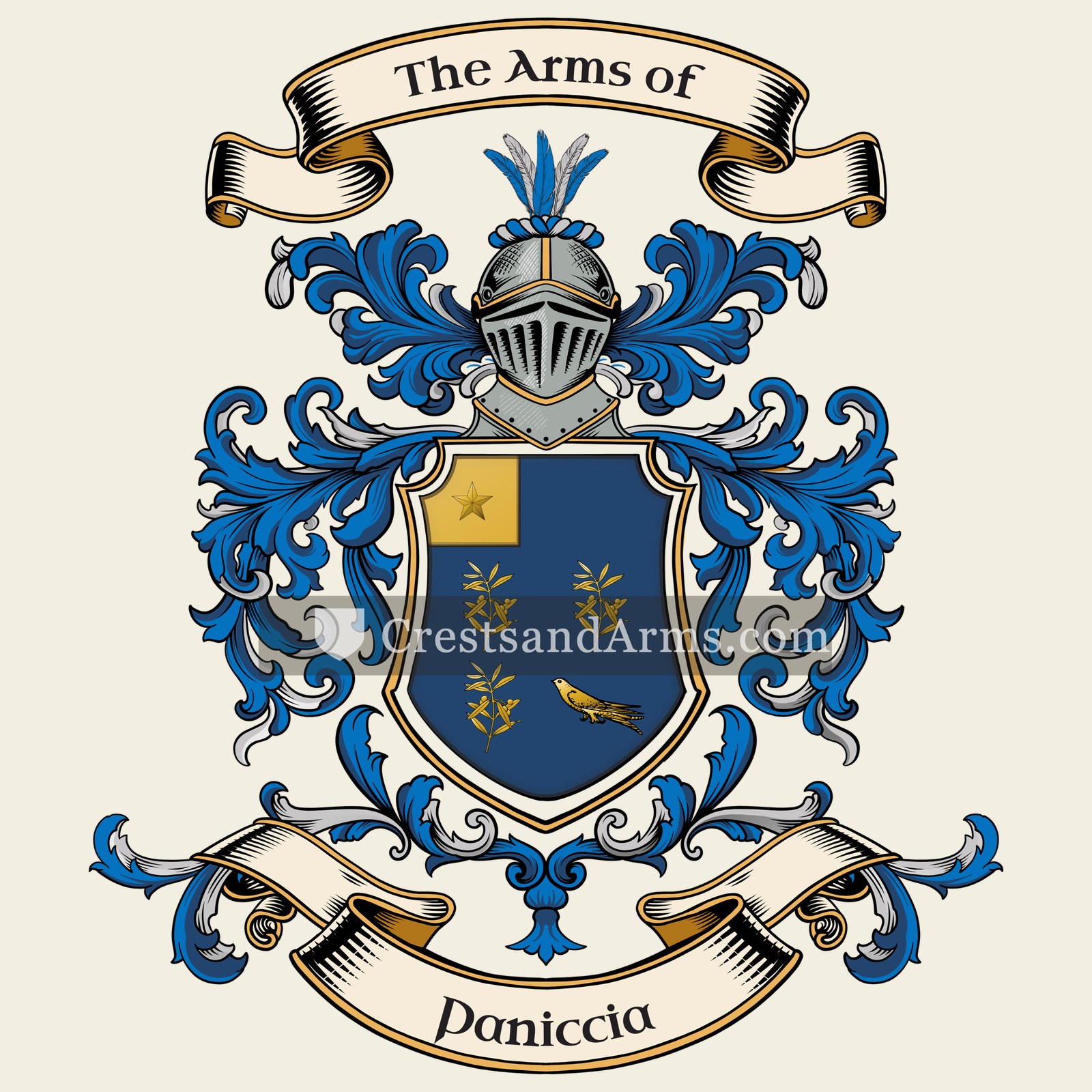
A record of documented arms, meaning and origin, researched for the Paniccia family of Italy.
Reg. 4479 · Italian, P–S
Coat of Arms & Family Crest Details
Symbols on this shield
cantonA mark of honour granted by the sovereign
branchPeace, and new growth
martletA younger son, who must win his own land
mulletThe third son, and a divine quality from above
Colours
Blue (Azure)Means: Loyalty and truth
Gold (Or)Means: Generosity
Historical info
Source
J. B. Rietstap, Armorial Général, Gouda: G. B. van Goor Zonen, 1884–87
Blazon (the actual original written record)
“D'azur à un faisceau de trois épis, lié, posé en p., surm. à sen. d'un oiseau volant qui se jette sur les épis, et acc. d'une étoile au canton dextre du chef; le tout d'or.”
ItalyRome, c. 1775
Digital archive packCoat of arms PNG, gold border print PDF, vector SVG and the certificate of authenticity. Sent to your email in minutes.
Map of Italy showing where the Paniccia arms are recorded
The Paniccia arms were recorded in Rome, c. 1775.
This is where the arms were entered in the register. Families often moved to other parts of the country, so the same name can turn up in more than one region.
The body that granted and recorded arms in Italy in this period.
Alvise Giovanni Mocenigo
Sovereign of the period
Alvise Giovanni Mocenigo
1763–1778
Reigning in Italy when the Paniccia arms are first recorded.
How Arms Worked in Italy
In the Italian states, coats of arms were often used by noble families to show their status and history. These symbols were passed down through the generations to all legitimate male descendants. Younger branches of a family usually kept the original design but sometimes added small changes to distinguish their specific line from the main branch.
Granting authority
Various local rulers and city governments controlled the use of coats of arms across the different Italian states.
How they got arms
Families often assumed their own arms or received them as official grants from local lords, popes, or city councils.
Where arms were recorded
Arms were recorded in local city archives or private family books rather than in one single national register.
The family's standing
Recorded among the armigerous families of Italy.
Origin & History of the Paniccia Family in Italy
The surname Paniccia is deeply rooted in the historical landscape of central Italy, with documented evidence placing the family in Rome by the year 1775. The name is believed to have originated as a descriptive nickname, likely derived from the Italian word "panico," which refers to a type of millet or grain. During the eighteenth century, families often received surnames based on their trade, their physical traits, or the crops they cultivated in the surrounding countryside. By the late 1700s, members of the Paniccia family were well-established within the urban fabric of Rome, participating in the daily life and social structures of the Papal States. As the family grew, they became part of the diverse population that sustained the city’s economy, contributing to the local community through their work and civic involvement during a period of significant cultural transition in Italy.
Related Branches & Arms
Root word
Panis
Latin term for bread or food sustenance.
This name
PanicciaA locative or occupational surname referring to a bread maker or seller.
also spelled
Paneesee
Documented Sources
J. B. Rietstap, Armorial Général, Gouda: G. B. van Goor Zonen, 1884–87
Archivio di Stato di Roma, Stato delle Anime
Diocesi di Roma, Libri Parrocchiali
Digital archive packCoat of arms PNG, gold border print PDF, vector SVG and the certificate of authenticity. Sent to your email in minutes.


 cantonA mark of honour granted by the sovereign
 branchPeace, and new growth
 martletA younger son, who must win his own land
 mulletThe third son, and a divine quality from above
 cantonA mark of honour granted by the sovereign
 branchPeace, and new growth
 martletA younger son, who must win his own land
 mulletThe third son, and a divine quality from above