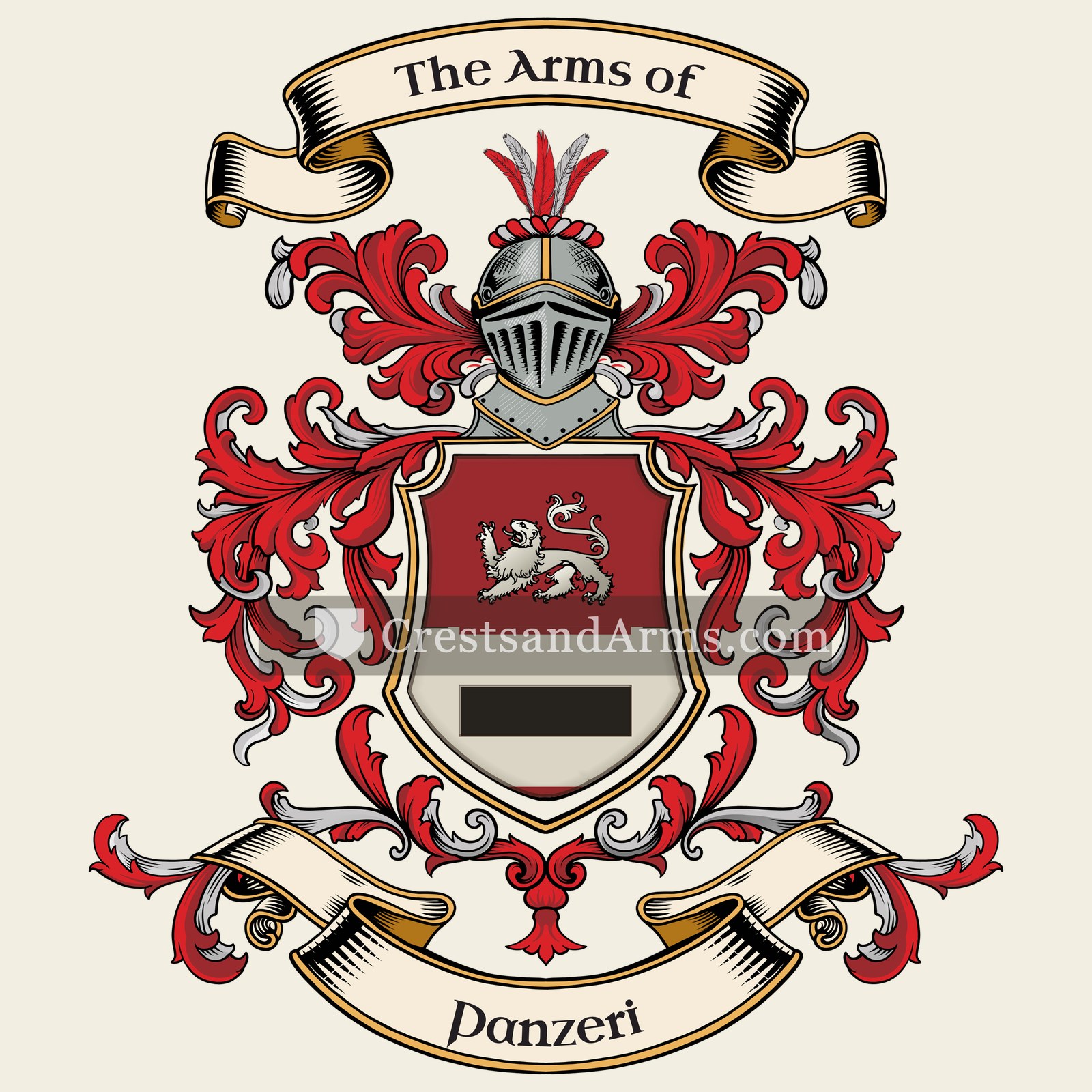
A record of documented arms, meaning and origin, researched for the Panzeri family of Germany.
Reg. 4346 · German, P–S
Coat of Arms & Family Crest Details
Symbols on this shield
fessThe military belt, and readiness to serve
lionCourage, strength and royalty
Colours
Red (Gules)Means: Military strength
Silver (Argent)Means: Peace and sincerity
Historical info
Source
J. B. Rietstap, Armorial Général, Gouda: G. B. van Goor Zonen, 1884–87
Blazon (the actual original written record)
“Coupé: au 1 de gu. à une panthère naiss. au nat., mouv. du coupé, tenant une flèche d'arg.; au 2 d'arg. à deux fasces de gu. C.: un chevalier iss., arm. d'arg., tenant une flèche d'arg., la pointe en bas. L.: à dextre d'arg. et d'azur, à sen. d'arg. et de gu.”
GermanyNuremberg, c. 1765
Digital archive packCoat of arms PNG, gold border print PDF, vector SVG and the certificate of authenticity. Sent to your email in minutes.
Map of Germany showing where the Panzeri arms are recorded
The Panzeri arms were recorded in Nuremberg, c. 1765.
This is where the arms were entered in the register. Families often moved to other parts of the country, so the same name can turn up in more than one region.
The body that granted and recorded arms in Germany in this period.
Francis I, Holy Roman Emperor
Sovereign of the period
Francis I, Holy Roman Emperor
1745–1765
Reigning in Germany when the Panzeri arms are first recorded.
How Arms Worked in Germany
In the Holy Roman Empire, coats of arms were often granted to individuals by the Emperor or his representatives. These arms were then passed down through the generations to all legitimate descendants of the original holder. Younger branches of a family usually kept the same shield design without needing to change it, as the arms belonged to the entire lineage.
Granting authority
The Holy Roman Emperor held the sole power to grant new coats of arms throughout his vast imperial territories.
How they got arms
Families typically obtained their coats of arms through a formal imperial grant or by proving their noble status to the authorities.
Where arms were recorded
These grants were officially recorded in the Imperial Chancery registers, which began keeping formal records of such honors during the Middle Ages.
The family's standing
Recorded among the armigerous families of Germany.
Origin & History of the Panzeri Family in Germany
The family name Panzeri carries a strong connection to the historical craft of metalworking and armor production. The name itself is derived from the Italian word *panziera*, which refers to a specific type of protective breastplate worn by soldiers during the Middle Ages. While many families with this name have deep roots in Northern Italy, historical records confirm that members of the family were established in the German city of Nuremberg by 1765. Nuremberg was a famous hub for skilled metalworkers and artisans during this period, making it a logical destination for a family associated with such specialized trade skills. Over time, the name transitioned from a description of a craftsman’s profession into a permanent family surname that was passed down through generations as ancestors moved across European borders.
Related Branches & Arms
Root word
Pancratius
Derived from the Greek word meaning all-powerful or entire strength.
This name
PanzeriAn Italian-influenced occupational or habitational surname derived from the name of a saint.
also spelled
Panser
Panzeri
Documented Sources
J. B. Rietstap, Armorial Général, Gouda: G. B. van Goor Zonen, 1884–87
Bauer, Karl, Nürnberg: Geschichte einer europäischen Stadt, 1986
Stadtarchiv Nürnberg, Bürgerbücher der Stadt Nürnberg, 1765
De Felice, Emidio, Dizionario dei cognomi italiani, 1978
Digital archive packCoat of arms PNG, gold border print PDF, vector SVG and the certificate of authenticity. Sent to your email in minutes.


 fessThe military belt, and readiness to serve
 lionCourage, strength and royalty
 fessThe military belt, and readiness to serve
 lionCourage, strength and royalty