A record of documented arms, meaning and origin, researched for the Pardo family lines. Documented in 2 countries.
Reg. 4544 · Spanish, P–S
Meaning of the Pardo family crest colors & symbols
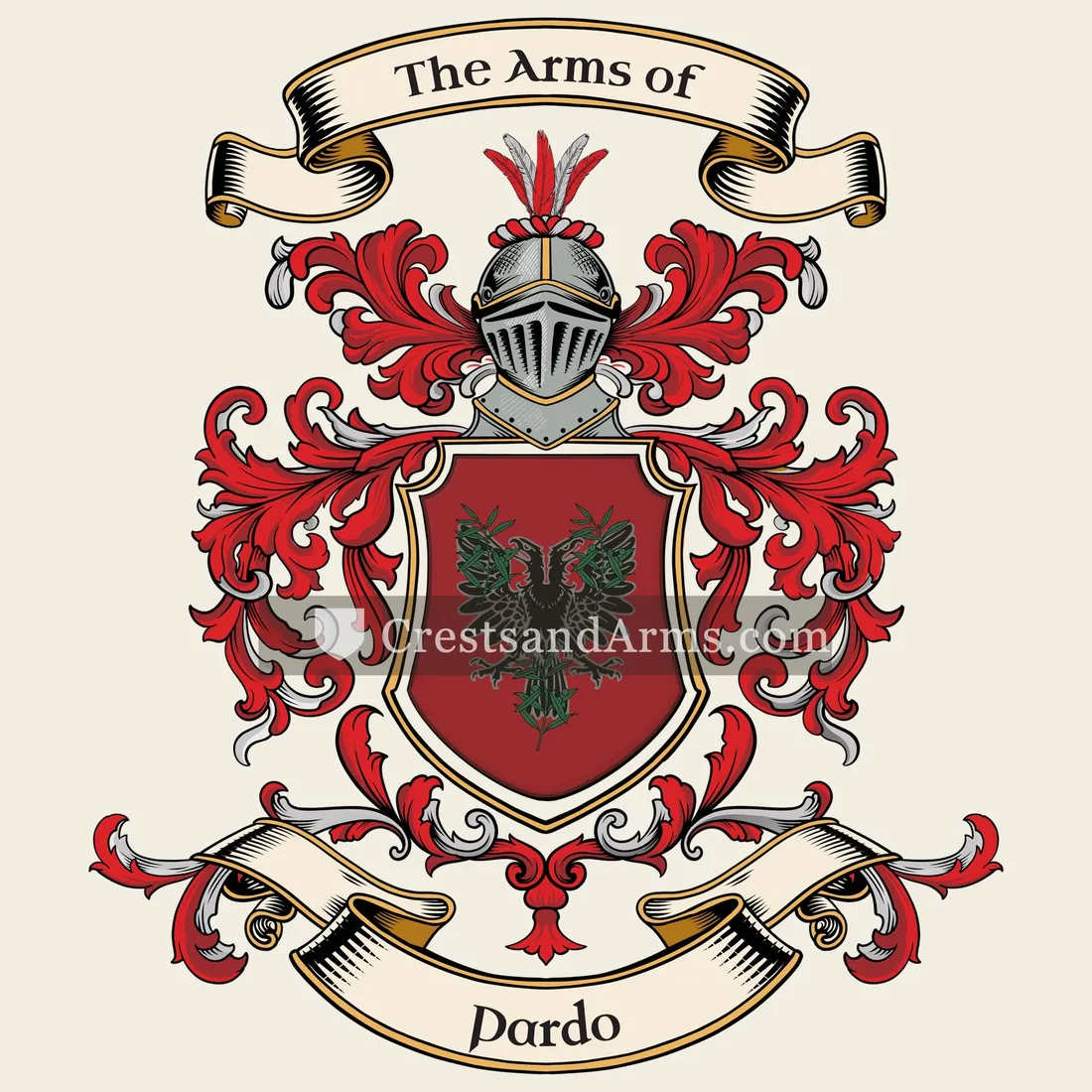
Symbols on this shield
eagleNobility, strength and a keen mind
branchPeace, and new growth
Colours
Red (Gules)Means: Military strength
Black (Sable)Means: Constancy
Green (Vert)Means: Hope
Historical info
Source
J. B. Rietstap, Armorial Général, Gouda: G. B. van Goor Zonen, 1884–87
Blazon (the actual original written record)
“De gu. à l'aigle de sa., cour. d'or, acc. en p. de trois chicots de sin., le sommet allumé de gu., posés en pals, rangés en fasce, celui du milieu br. sur la queue de l'aigle.”
CastileCastile, c. 1722
Digital archive packCoat of arms PNG, gold border print PDF, vector SVG and the certificate of authenticity. Sent to your email in minutes.
Map of Spain showing where the Pardo arms are recorded
The Pardo arms were recorded in Castile, c. 1722.
Castile was the heart of Spain and the source of most of its noble families. Land won in the long wars against the Moors was granted out to fighting men, and a man granted land was granted arms along with it.
This is where the arms were entered in the register. Families often moved to other parts of the country, so the same name can turn up in more than one region.
The body that granted and recorded arms in Spain in this period.
Philip V of Spain
Sovereign of the period
Philip V of Spain
1714–1724
Reigning in Spain when the Pardo arms are first recorded.
How Arms Worked in Spain
In Spain, a coat of arms was considered a form of property that belonged to the entire family line. These arms were passed down from a father to all his children equally. Younger branches of the family usually kept the original design without needing to add any special marks to distinguish their specific line.
Granting authority
The Cronista Rey de Armas was the official body that regulated and granted coats of arms throughout Spain.
How they got arms
Families often obtained their arms through royal grants or by proving their noble status to the official heraldic authority.
Where arms were recorded
Coats of arms were officially recorded in the registers of the Cronista Rey de Armas starting in 1496.
The family's standing
Recorded among the armigerous families of Castile.
Origin & History of the Pardo Family in Spain
The Pardo family name has deep roots in the Iberian Peninsula, emerging as a distinct surname during the Middle Ages. The name is often linked to the Spanish word "pardo," which describes a brownish-gray color, and it was likely used as a descriptive nickname for individuals with dark hair or clothing. By the early 18th century, the family had established a clear presence in the region of Castile, a historical heartland of Spain that played a central role in the unification of the country. Records from 1722 confirm that members of the Pardo family were active participants in the social and economic life of this area during the Bourbon period. As the family grew, they integrated into the local communities of the Castilian plateau, contributing to the agricultural and administrative development of their towns. Their history reflects the broader movement of families across the Spanish interior as they sought to establish stable lives and local influence during a time of significant political transition.
Meaning of the Pardo family crest colors & symbols
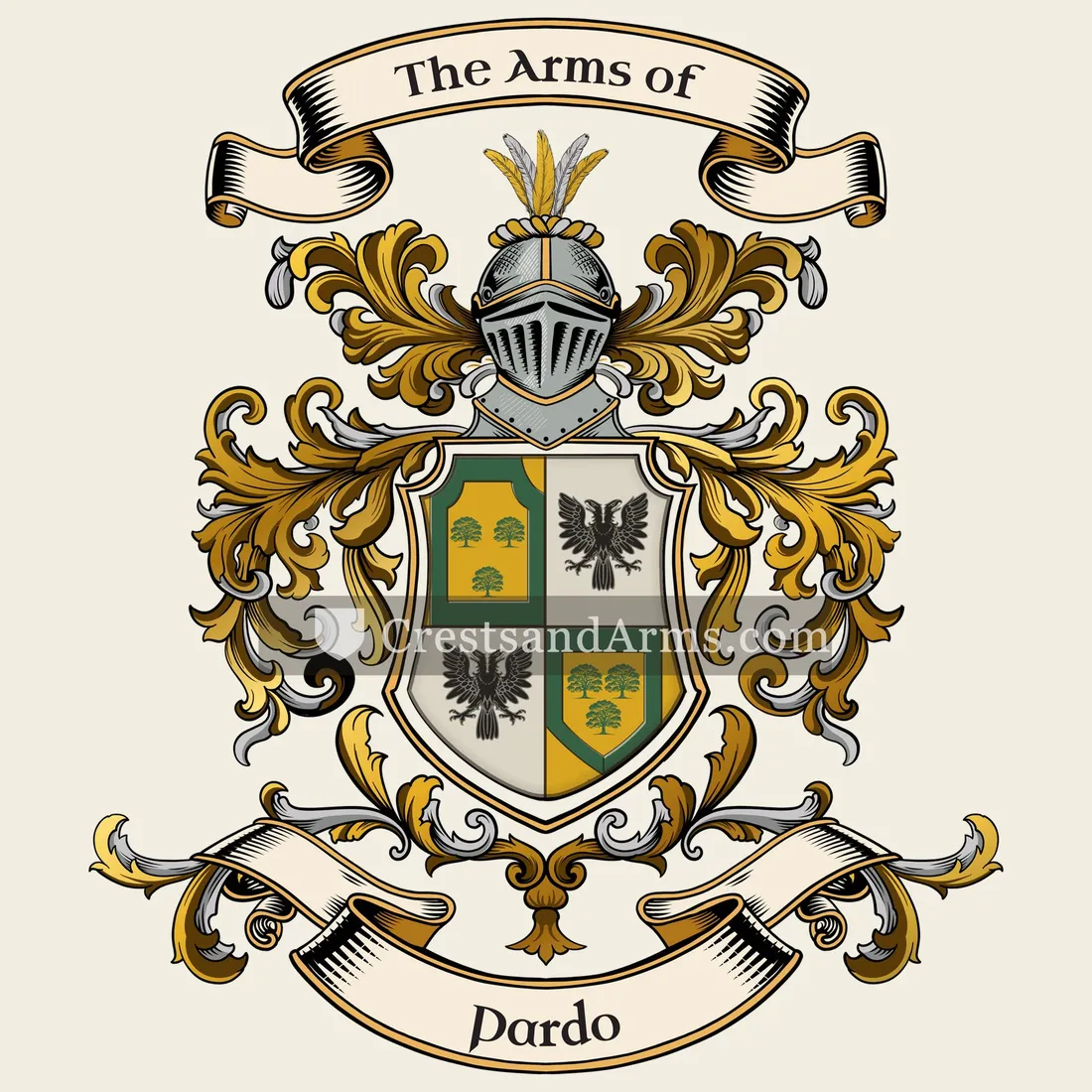
Symbols on this shield
vairProtection, and the winter fur
treeLife, endurance and deep roots
eagleNobility, strength and a keen mind
Colours
Gold (Or)Means: Generosity
Silver (Argent)Means: Peace and sincerity
Green (Vert)Means: Hope
Black (Sable)Means: Constancy
Historical info
Source
J. B. Rietstap, Armorial Général, Gouda: G. B. van Goor Zonen, 1884–87
Blazon (the actual original written record)
“Ec.: aux 1 et 4 d'or à trois arbres de sin.; à la bord. comp. de douze pièces d'or et de vair; aux 2 et 3 d'arg. à l'aigle de sa., languée de gu. C.: l'aigle, iss.”
BelgiumBruges, c. 1793
Digital archive packCoat of arms PNG, gold border print PDF, vector SVG and the certificate of authenticity. Sent to your email in minutes.
Map of Belgium showing where the Pardo arms are recorded
The Pardo arms were recorded in Bruges, c. 1793.
This is where the arms were entered in the register. Families often moved to other parts of the country, so the same name can turn up in more than one region.
The body that granted and recorded arms in Belgium in this period.
Francis II, Holy Roman Emperor
Sovereign of the period
Francis II, Holy Roman Emperor
1792–1806
Reigning in Spain when the Pardo arms are first recorded.
How Arms Worked in Belgium
In Belgium, a coat of arms is considered personal property that is passed down through the male line to legitimate descendants. Families often use the same shield design across generations to show their shared heritage. If a branch of the family wants to change the design, they must apply for an official update to their specific version of the arms.
Granting authority
The Conseil héraldique is the official body that regulates and approves all coats of arms in Belgium.
How they got arms
Families obtain their coats of arms through formal royal grants or by confirming their historical right to use existing designs.
Where arms were recorded
All approved coats of arms are officially recorded in the public registers of the Conseil héraldique since 1844.
The family's standing
Recorded among the armigerous families of Belgium.
Origin & History of the Pardo Family in Belgium
The Pardo family established a notable presence in the city of Bruges by the late eighteenth century, becoming deeply integrated into the local commercial and social fabric. While the name itself carries roots that stretch across the Iberian Peninsula and the Mediterranean, its arrival in Belgium reflects the broader movement of merchant families who sought new opportunities in the thriving trade hubs of Flanders. By 1793, members of the family were already well-settled residents, participating in the economic life of a city that served as a vital link between northern Europe and international markets. Their transition into Belgian society was marked by a steady involvement in urban affairs, allowing the family to build a lasting legacy within the region. This history highlights how the Pardo name evolved from its foreign origins to become a recognized part of the historical identity of Bruges during a period of significant political and social change.
Pardo Meaning & Related Branches
Root word
Pardus
Latin term for a leopard or a spotted animal.
This name
PardoRefers to a person with a dark, swarthy, or leopard-like spotted complexion.
Related arms
Arandarecorded with Pardo, same area
de Madridrecorded with Pardo, same area
Matancarecorded with Pardo, same area
Documented Sources
J. B. Rietstap, Armorial Général, Gouda: G. B. van Goor Zonen, 1884–87
Moll, Francesc de B., Els llinatges catalans, 1959
Faure, Roberto, Diccionario de apellidos españoles, 2001
Archivo General de Simancas, Registro del Sello de Corte
Digital archive packCoat of arms PNG, gold border print PDF, vector SVG and the certificate of authenticity. Sent to your email in minutes.


 eagleNobility, strength and a keen mind
 branchPeace, and new growth
 eagleNobility, strength and a keen mind
 branchPeace, and new growth


 treeLife, endurance and deep roots