Map of Scotland showing where the Parekh arms are recorded
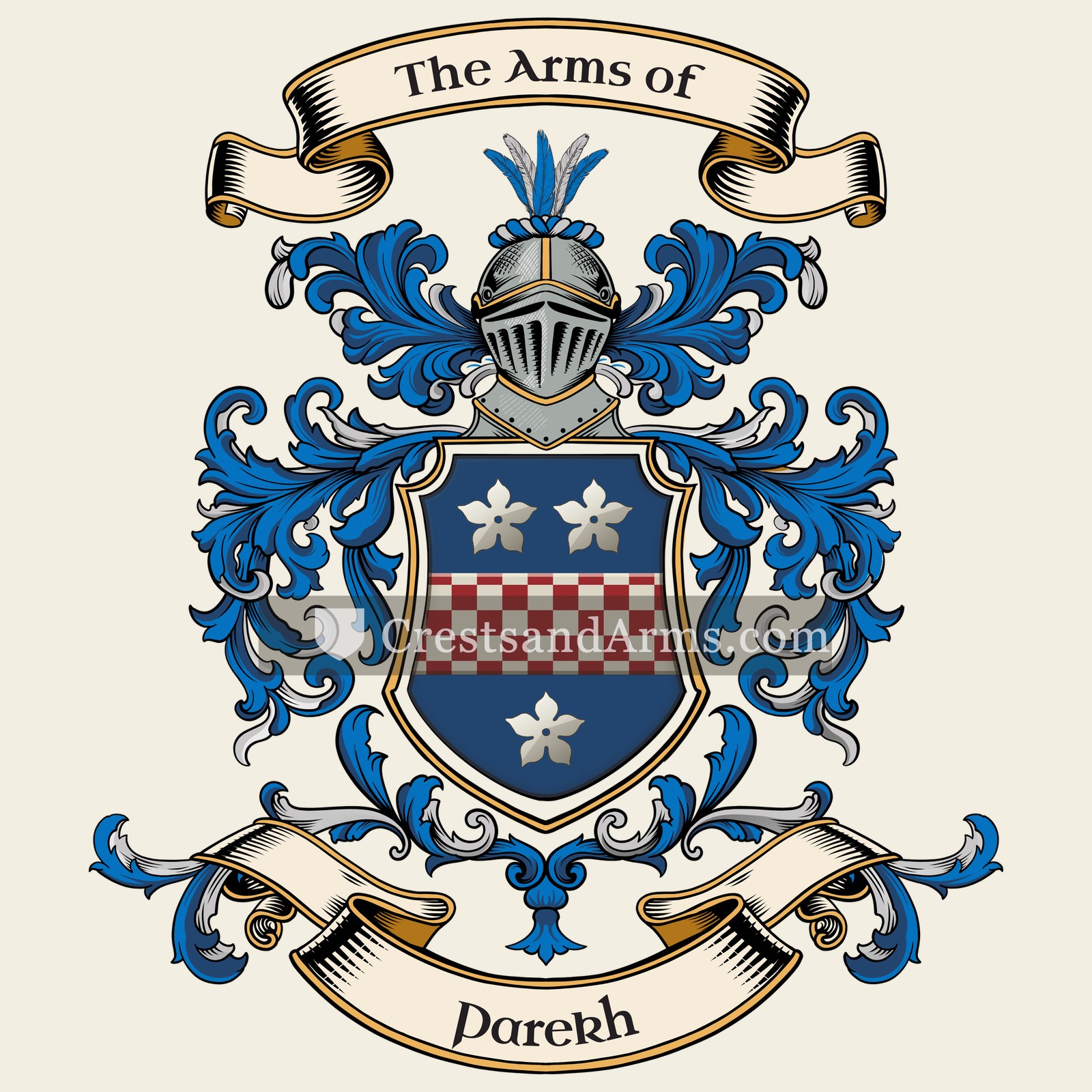
The Parekh arms were recorded in Scotland, c. 1672.
Arms such as these were typically recorded in Edinburgh.
Edinburgh was the seat of Scotland's government, its courts and its heralds. Families with business there settled nearby, and being close to where arms were recorded is exactly why so many of them appear.
This is where the arms were entered in the register. Families often moved to other parts of the country, so the same name can turn up in more than one region.
The body that granted and recorded arms in Scotland in this period.
Charles II of England
Sovereign of the period
Charles II of England
1660–1685
Reigning in Scotland when the Parekh arms are first recorded.
How Arms Worked in Scotland
Scottish heraldry is unique because it treats a coat of arms as a piece of personal property protected by law. Only one person can own a specific design at any given time. When a family grows, the head keeps the original shield while other relatives must apply for their own distinct version with slight changes to prove their specific identity.
Granting authority
The Court of the Lord Lyon acts as the official body that regulates and controls all heraldic matters throughout Scotland.
How they got arms
Individuals obtain a legal right to their arms through a formal petition process that confirms their identity and family connection.
Where arms were recorded
All valid coats of arms are officially entered into the Public Register of All Arms and Bearings starting from 1672.
The family's standing
Recorded among the armigerous families of Scotland.
Origin & History of the Parekh Family in Scotland
The surname Parekh originates from the Sanskrit word *pariksha*, which translates to an examiner, a tester, or an appraiser. Historically, this title was bestowed upon individuals who served as expert evaluators of precious metals, gems, and currency within the merchant communities of Gujarat, India. These professionals played a vital role in the financial stability of regional trade networks by verifying the quality and authenticity of goods. While the name is deeply rooted in the mercantile traditions of Western India, the presence of family members in Edinburgh by 1672 suggests a remarkably early history of global movement. During the seventeenth century, the expansion of maritime trade routes allowed skilled individuals from the Indian subcontinent to travel to major European port cities. By establishing themselves in Scotland during this period, these early ancestors likely acted as intermediaries or scholars, bridging the cultural and economic gap between the East and the West long before the height of colonial migration.
Related Branches & Arms
Root word
Parikh
Derived from the Sanskrit word for examiner or tester.
This name
ParekhA traditional occupational title for a merchant, accountant, or money changer.
also spelled
Parcke
Documented Sources
Sir Bernard Burke, The General Armory of England, Scotland, Ireland and Wales, London: Harrison & Sons, 1884
Turner, R. L., A Comparative Dictionary of the Indo-Aryan Languages, 1966
National Records of Scotland, Register of the Privy Council of Scotland, 1672
Digital archive packCoat of arms PNG, gold border print PDF, vector SVG and the certificate of authenticity. Sent to your email in minutes.


 fessThe military belt, and readiness to serve
 chequyConstancy, and the counting-board
 cinquefoilHope and joy
 fessThe military belt, and readiness to serve
 chequyConstancy, and the counting-board
 cinquefoilHope and joy