Map of England showing where the Parse arms are recorded
The Parse arms were recorded in Devon, c. 1620.
Devon was a county of small manors and seafaring families. Its gentry were spread thickly across the countryside, and money made at sea often bought an estate, which in turn brought a coat of arms.
This is where the arms were entered in the register. Families often moved to other parts of the country, so the same name can turn up in more than one region.
The body that granted and recorded arms in England in this period.
James VI and I
Sovereign of the period
James VI and I
1603–1625
Reigning in England when the Parse arms are first recorded.
How Arms Worked in England
English heraldry allowed arms to be shared by all legitimate descendants of the original owner. These symbols were treated as personal property that moved through the generations to all children. While the eldest son kept the original design, other family members could use the same shield without needing to change it or register their own unique versions.
Granting authority
The College of Arms in London has regulated the use of coats of arms throughout England and Wales since 1484.
How they got arms
Families typically obtained their coats of arms through a formal grant from the Crown or by proving their ancient right to them.
Where arms were recorded
All official coats of arms are recorded in the registers kept at the College of Arms, which date back to the fifteenth century.
The family's standing
Recorded among the armigerous families of Devon.
Origin & History of the Parse Family in England
The family name Parse has deep roots in the coastal county of Devon, where records confirm members of the family were established by the year 1620. During this period, Devon was a hub of maritime activity and agricultural growth, which likely shaped the daily lives of early family members. The name itself is thought to be a variation of older occupational or descriptive surnames common in the West Country of England. Families in this region often lived in small, tight-knit parishes where they worked as farmers or tradespeople. By the early 17th century, the Parse family was already part of the local social fabric, contributing to the development of their community long before many others migrated to the colonies. Their presence in Devon suggests a long history of stability and connection to the rugged landscape of southwestern England.
Coat of Arms & Family Crest Details
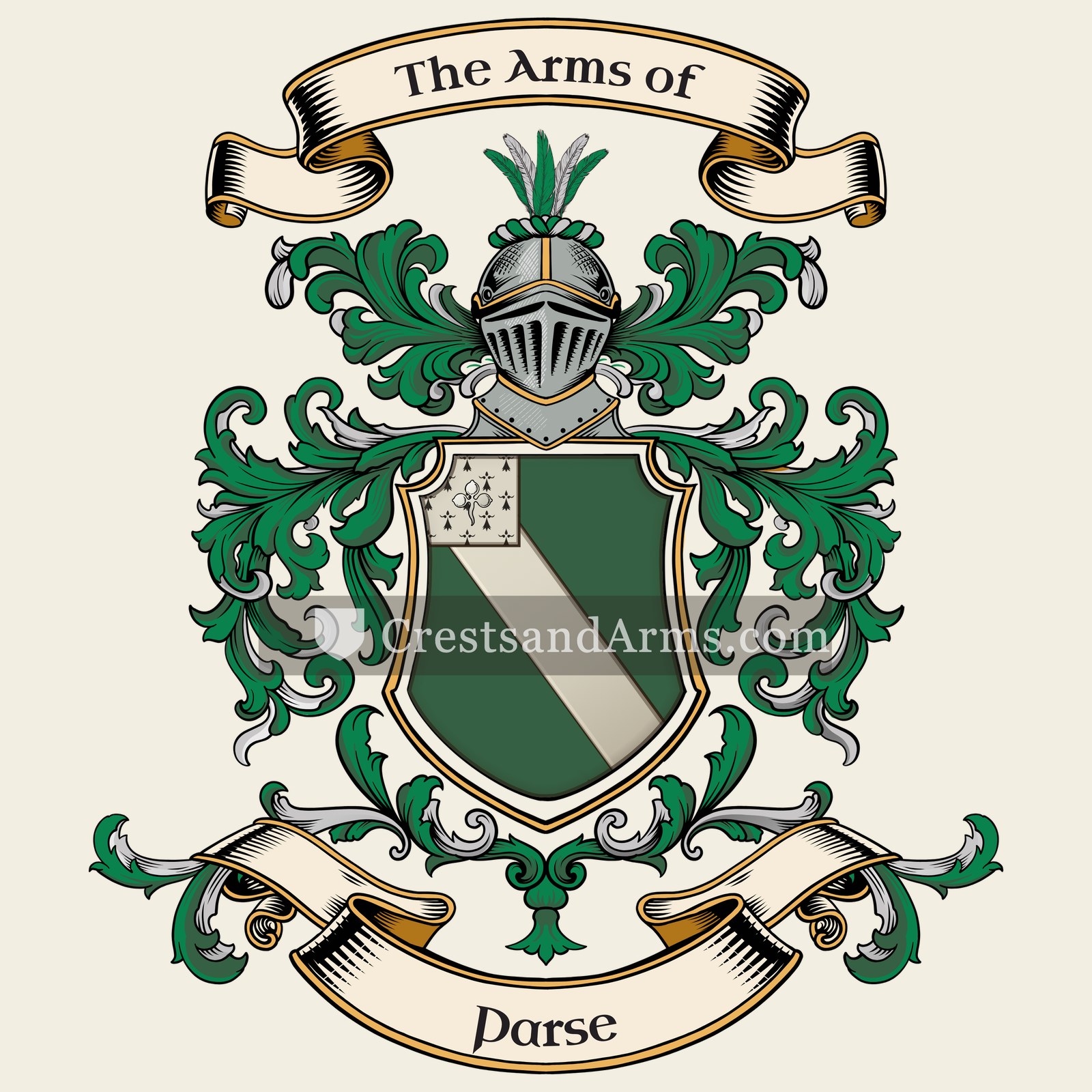
Symbols on this shield
bendDefence, and the scarf of a commander
cantonA mark of honour granted by the sovereign
trefoilPerpetuity, and the Trinity
Colours
Green (Vert)Means: Hope
ErmineMeans: Dignity
Historical info
Source
Sir Bernard Burke, The General Armory of England, Scotland, Ireland and Wales, London: Harrison & Sons, 1884
Blazon (the actual original written record)
“Vert a bend nebulée plain cotised or, a canton erm. thereon a trefoil of the field”
TipperaryTipperary, c. 1645
Digital archive packCoat of arms PNG, gold border print PDF, vector SVG and the certificate of authenticity. Sent to your email in minutes.
Map of Ireland showing where the Parse arms are recorded
The Parse arms were recorded in Tipperary, c. 1645.
Tipperary was the best grazing land in Ireland, held by a small number of powerful families. Land of that value stayed in the same hands, and unbroken holding is what puts a name in the records.
This is where the arms were entered in the register. Families often moved to other parts of the country, so the same name can turn up in more than one region.
The body that granted and recorded arms in Ireland in this period.
Charles I of England
Sovereign of the period
Charles I of England
1625–1649
Reigning in England when the Parse arms are first recorded.
How Arms Worked in Ireland
The Ulster King of Arms granted coats of arms to individuals who proved their social standing and good character. These symbols were typically inherited by all legitimate descendants of the original holder. If a family branch wanted a unique look, they could apply for a specific change to their design through the office to ensure their identity remained distinct.
Granting authority
The Ulster King of Arms acted as the official body that regulated and issued all coats of arms throughout Ireland.
How they got arms
Families obtained their arms through formal grants issued by the office after proving their eligibility and paying the required fees.
Where arms were recorded
All official grants were recorded in the registers held by the Ulster King of Arms starting from the year 1552.
The family's standing
Recorded among the armigerous families of Tipperary.
Origin & History of the Parse Family in Ireland
The history of the Parse family in Ireland is deeply rooted in the landscape of County Tipperary, where records confirm their presence by the year 1645. During this period, Ireland was undergoing significant political and social upheaval, which often forced families to establish themselves firmly within their local communities to survive and maintain their land holdings. The name itself likely evolved from older linguistic roots, possibly reflecting the movement of people across the Irish Sea or the anglicization of local Gaelic surnames that were common in the Munster region. By settling in Tipperary, the Parse family became part of a complex social fabric defined by agricultural life and the shifting loyalties of the seventeenth century. Their ability to remain documented in the region during such a turbulent era suggests that they were well-integrated into the local economy and social structure of the time.
Related Branches & Arms
Root word
Pars
Derived from the Latin word for a part or portion.
This name
ParseAn occupational name for a person who distributed shares or portions of land.
also spelled
Pearce
Pierce
Piers
Documented Sources
Sir Bernard Burke, The General Armory of England, Scotland, Ireland and Wales, London: Harrison & Sons, 1884
Hoskins, W.G., Devon, 1954
Reaney, P.H., A Dictionary of British Surnames, 1958
The National Archives, Parish registers of Devon, 1600–1650
Digital archive packCoat of arms PNG, gold border print PDF, vector SVG and the certificate of authenticity. Sent to your email in minutes.


 bendDefence, and the scarf of a commander
 unicornPurity, and extreme courage in defence of honour
 bendDefence, and the scarf of a commander
 unicornPurity, and extreme courage in defence of honour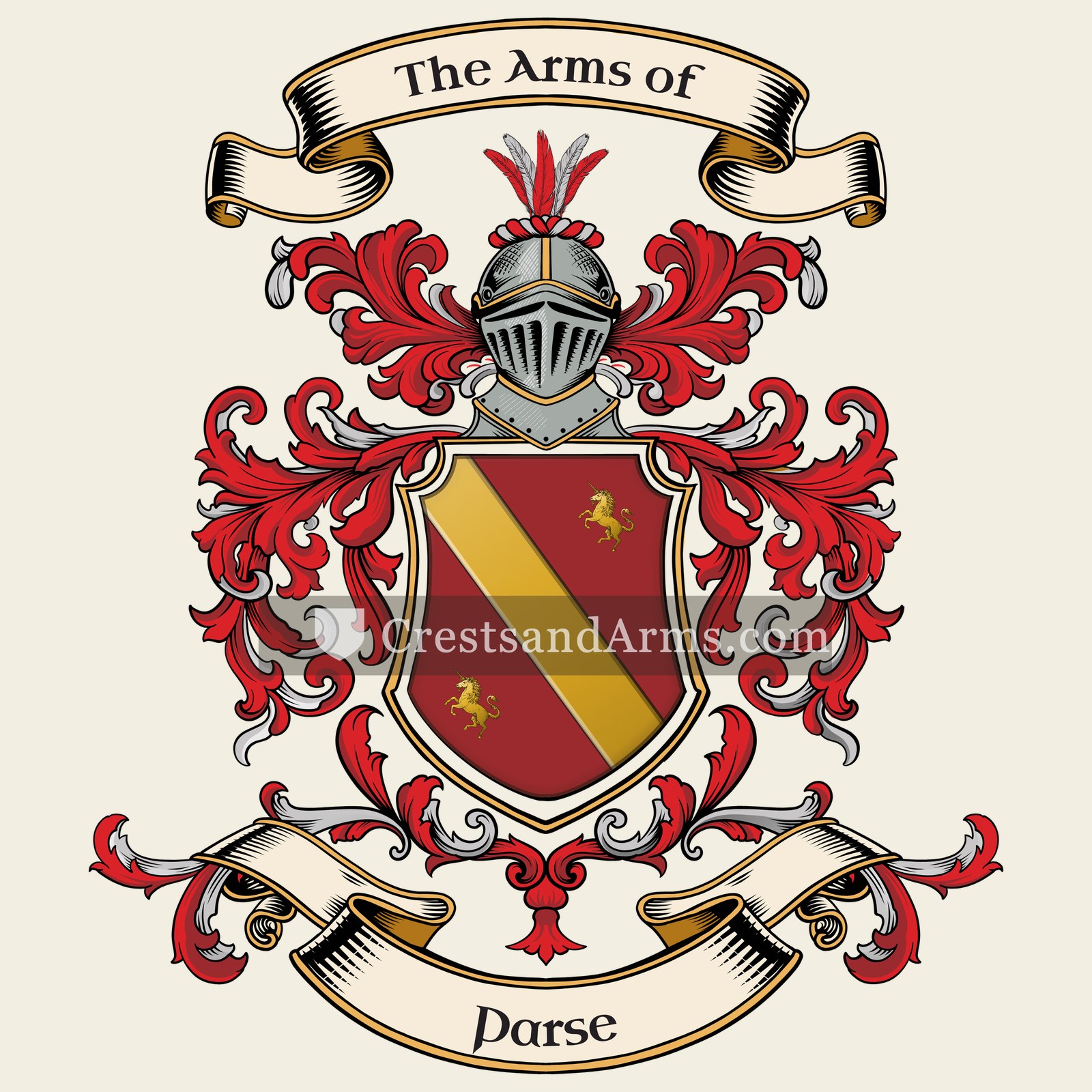


 cantonA mark of honour granted by the sovereign
 trefoilPerpetuity, and the Trinity