Map of Belgium showing where the Partain arms are recorded
The Partain arms were recorded in Flandre, c. 1663.
Flandre grew rich on cloth, and its towns were among the busiest in Europe. Merchant families bought land with their profits and took arms to go with it, so trade put as many names in the registers here as land did.
This is where the arms were entered in the register. Families often moved to other parts of the country, so the same name can turn up in more than one region.
The body that granted and recorded arms in Belgium in this period.
Philip IV of Spain
Sovereign of the period
Philip IV of Spain
1621–1665
Reigning in Belgium when the Partain arms are first recorded.
How Arms Worked in Belgium
In Belgium, a coat of arms is considered personal property that is passed down through the male line to legitimate descendants. Families often use the same shield design across generations to show their shared heritage. If a branch of the family wants to change the design, they must apply for an official update to their specific version of the arms.
Granting authority
The Conseil héraldique is the official body that regulates and approves all coats of arms in Belgium.
How they got arms
Families obtain their coats of arms through formal royal grants or by confirming their historical right to use existing designs.
Where arms were recorded
All approved coats of arms are officially recorded in the public registers of the Conseil héraldique since 1844.
The family's standing
Recorded among the armigerous families of Flandre.
Origin & History of the Partain Family in Belgium
The history of the Partain family in Belgium begins in the seventeenth century within the region of Flanders. By 1663, records confirm that members of the family were established in this area, which was then a center of trade and textile production. During this period, Flanders was part of the Spanish Netherlands, a time marked by frequent regional conflicts and shifting political boundaries. Families like the Partains often lived in small, tight-knit communities where they contributed to the local agricultural or artisanal economy. The name likely evolved as a way to identify these individuals within their specific parish or town. As they navigated life in the Low Countries, the family remained part of the local social fabric, adapting to the cultural and linguistic changes that defined the Flemish landscape during the late 1600s.
Meaning of the Partain family crest colors & symbols
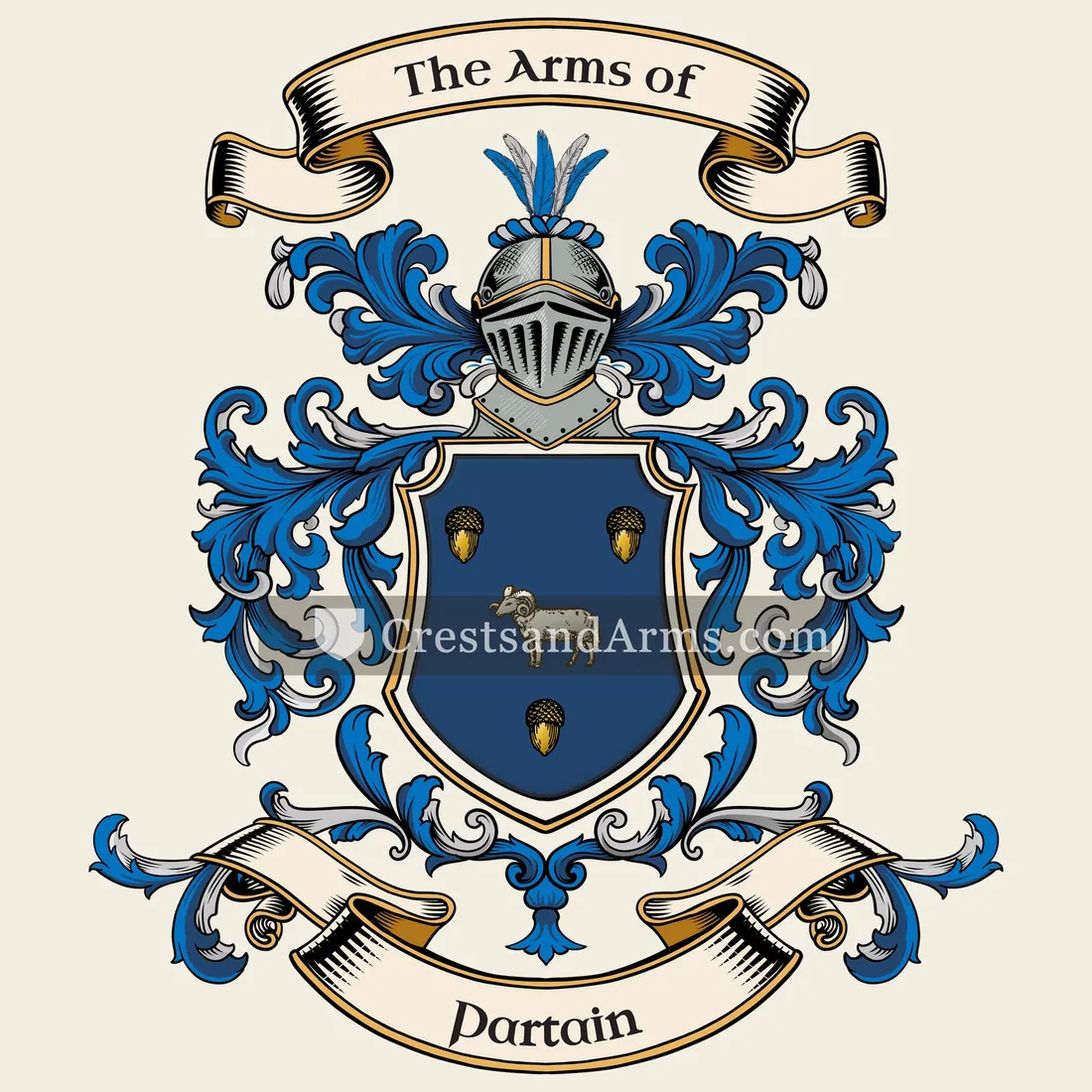
Symbols on this shield
ramLeadership and authority
acornAntiquity and strength from small beginnings
Colours
Blue (Azure)Means: Loyalty and truth
Silver (Argent)Means: Peace and sincerity
Gold (Or)Means: Generosity
Historical info
Source
J. B. Rietstap, Armorial Général, Gouda: G. B. van Goor Zonen, 1884–87
Blazon (the actual original written record)
“D'azur à un rencontre de bélier d'arg., acc. de trois glands d'or.”
LyonnaisLyonnais, c. 1663
Digital archive packCoat of arms PNG, gold border print PDF, vector SVG and the certificate of authenticity. Sent to your email in minutes.
Map of France showing where the Partain arms are recorded
The Partain arms were recorded in Lyonnais, c. 1663.
Lyonnais centred on Lyon, one of the great banking and silk towns of France. Money made in the city bought estates in the countryside around it, and those estates brought arms with them.
This is where the arms were entered in the register. Families often moved to other parts of the country, so the same name can turn up in more than one region.
The body that granted and recorded arms in France in this period.
Louis XIV of France
Sovereign of the period
Louis XIV of France
1643–1715
Reigning in Belgium when the Partain arms are first recorded.
How Arms Worked in France
In France, a coat of arms was a mark of honor that passed down through the male line to all legitimate descendants. Families often used the same shield without changes to show their shared heritage. If a branch wanted to stand out, they could add a small mark to their shield to show their specific place in the family tree.
Granting authority
The Juge d'armes de France acted as the official authority that regulated and verified coats of arms across the country.
How they got arms
Families typically inherited their arms from ancestors, though they could also receive them through royal grants or by proving their noble status.
Where arms were recorded
Coats of arms were officially recorded in the Armorial Général de France, which began its main collection in the year 1696.
The family's standing
Recorded among the armigerous families of Lyonnais.
Origin & History of the Partain Family in France
The Partain family name finds its historical roots in the Lyonnais region of France, where records confirm members of the family were established by 1663. During this period, the Lyonnais area was a vital center for trade and silk production, which likely influenced the daily lives and occupations of those living there. Families in this part of France often took their names from local landmarks, specific trades, or descriptive traits that distinguished them within their small rural communities. As the family grew, they became part of the social fabric of the region, navigating the challenges of life under the French monarchy during the seventeenth century. Their presence in Lyonnais suggests they were likely involved in the local agricultural or artisanal economy that defined the province at that time. By tracing their history to this specific location, we gain a clearer picture of their origins as a settled family rooted in the traditions and geography of central France.
Partain Meaning & Related Branches
Root word
Parthenay
Derived from the Latin name Parthenius meaning maidenly or pure.
This name
PartainA locative surname originating from a place in France or Belgium associated with the Parthenay family line.
also spelled
Paradine
Paradyne
Documented Sources
J. B. Rietstap, Armorial Général, Gouda: G. B. van Goor Zonen, 1884–87
State Archives in Belgium (Rijksarchief te Gent), Parochieregisters van de provincie Oost-Vlaanderen
State Archives in Belgium (Rijksarchief te Antwerpen), Doop-, trouw- en begraafregisters
De Flou, Karel, Woordenboek der Toponymie van westelijk Vlaanderen, Vlaamsch Artesië, het Land van den Hoek, de graafschappen Guines en Boulogne en een gedeelte van Fransch-Vlaanderen, 1914
Van der Haeghen, Ferdinand, Bibliographie gantoise: recherches sur la vie et les travaux des imprimeurs de Gand, 1858
Digital archive packCoat of arms PNG, gold border print PDF, vector SVG and the certificate of authenticity. Sent to your email in minutes.


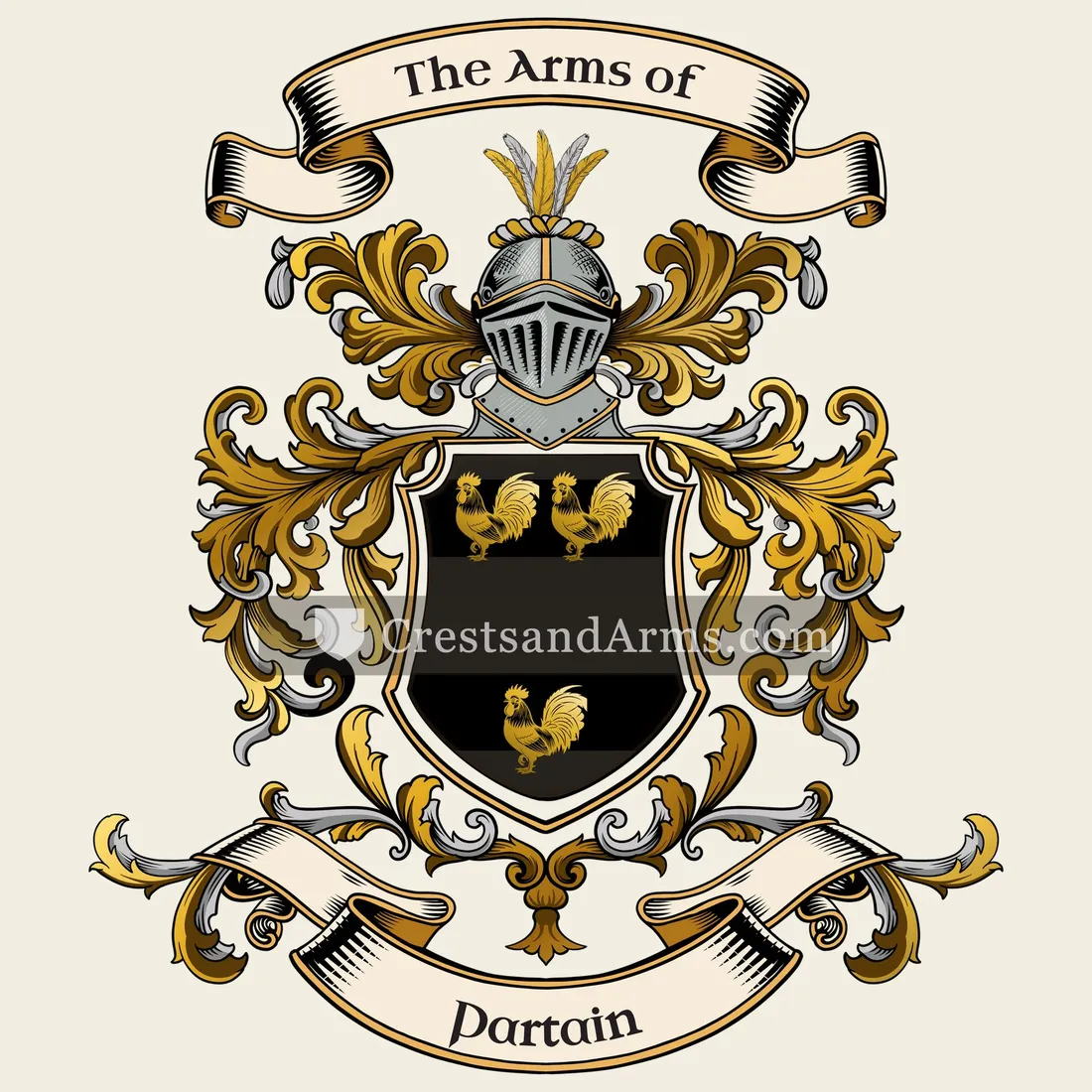
 fessThe military belt, and readiness to serve
 cockCourage, vigilance and readiness for battle
 fessThe military belt, and readiness to serve
 cockCourage, vigilance and readiness for battle


 ramLeadership and authority
 acornAntiquity and strength from small beginnings