A record of documented arms, meaning and origin, researched for the Patrick family lines. Documented in 3 countries.
Reg. 2448 · Britain, P–S
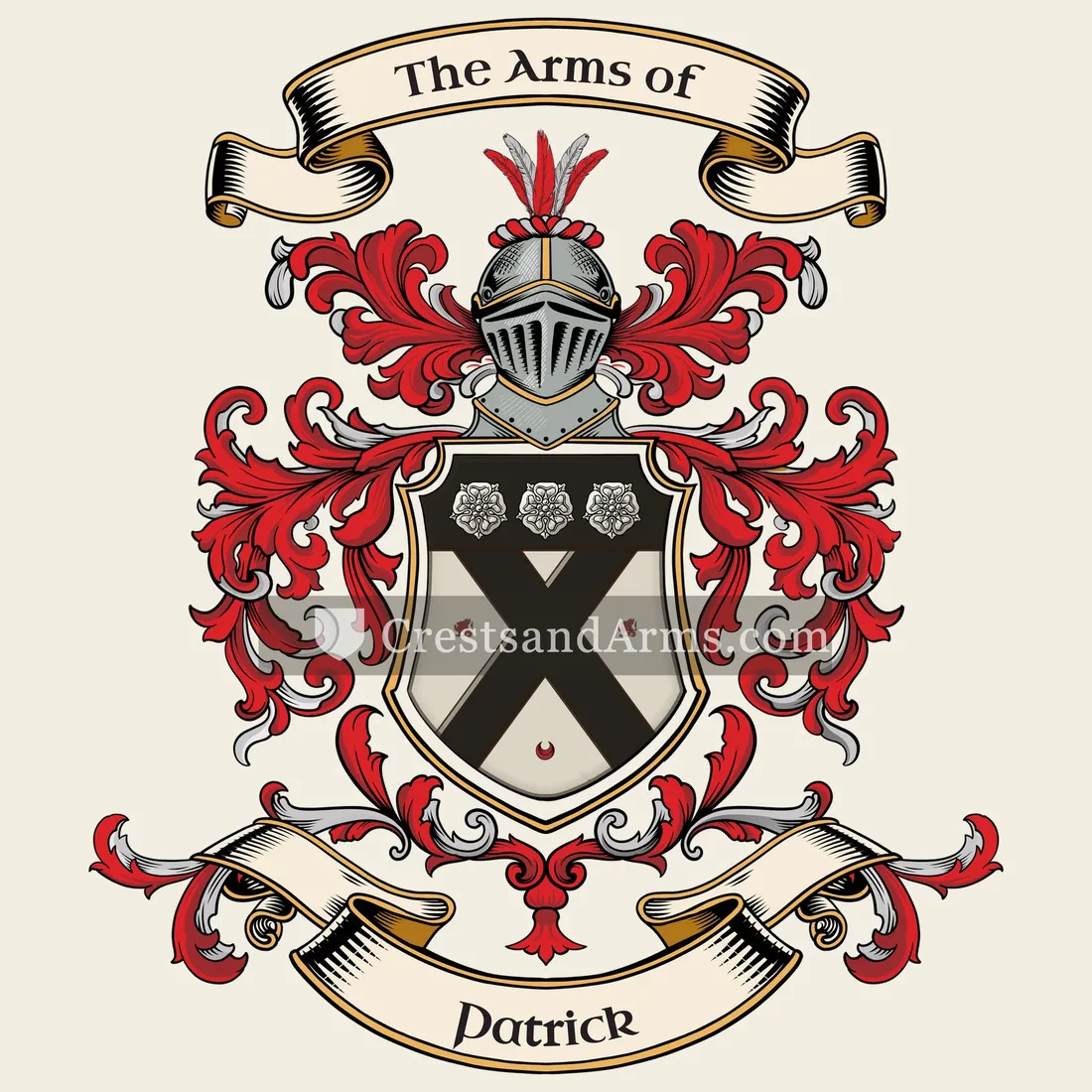
Meaning of the Patrick family crest colors & symbols
Symbols on this shield
saltireResolution, and St Andrew's cross
chiefAuthority, wisdom and dominion
cinquefoilHope and joy
crescentHonour by the sovereign, and the second son
griffinValour and vigilance, guarding great treasure
roseThe seventh son, and beauty with grace
Colours
Silver (Argent)Means: Peace and sincerity
Black (Sable)Means: Constancy
Red (Gules)Means: Military strength
Historical info
Source
J. B. Rietstap, Armorial Général, Gouda: G. B. van Goor Zonen, 1884–87
Blazon (the actual original written record)
“D'arg. au saut. de sa., acc. en chef d'une quintefeuille, en p. d'un croiss. et à dextre et à sen. d'une tête de griffon arr., le tout de gu.; au chef dentelé de sa., ch. de trois roses d'arg. C.: une main de carn., tenant un saut. de sa. D.: ORA ET LABORA.”
BritainNew-York, c. 1700
Digital archive packCoat of arms PNG, gold border print PDF, vector SVG and the certificate of authenticity. Sent to your email in minutes.
Map of Britain showing where the Patrick arms are recorded
The Patrick arms were recorded in New-York, c. 1700.
Arms such as these were typically recorded in Kent.
Kent sits between London and the short crossing to Europe, and the trade passing through made it wealthy. Merchant families bought land with that money, and it was landowners who took coats of arms.
This is where the arms were entered in the register. Families often moved to other parts of the country, so the same name can turn up in more than one region.
The body that granted and recorded arms in Britain in this period.
William III of England
Sovereign of the period
William III of England
1694–1702
Reigning in Britain when the Patrick arms are first recorded.
How Arms Worked in Britain
English heraldry allowed arms to be shared by all legitimate descendants of the original owner. These symbols were treated as personal property that moved through the generations to all children. While the eldest son kept the original design, other family members could use the same shield without needing to change it or register their own unique versions.
Granting authority
The College of Arms in London has regulated the use of coats of arms throughout England and Wales since 1484.
How they got arms
Families typically obtained their coats of arms through a formal grant from the Crown or by proving their ancient right to them.
Where arms were recorded
All official coats of arms are recorded in the registers kept at the College of Arms, which date back to the fifteenth century.
The family's standing
Recorded among the armigerous families of Britain.
Origin & History of the Patrick Family in Britain
The surname Patrick originates from the Latin name Patricius, which means noble or patrician. During the Middle Ages, the name became popular across Britain due to the widespread veneration of Saint Patrick. While the name was common as a given name, it eventually transitioned into a hereditary surname as families began to adopt permanent identifiers for legal and tax purposes. By the year 1700, records confirm that members of the Patrick family were well-established in the county of Kent. During this period, the family likely worked in agriculture or local trades, which was typical for families living in the rural parishes of southeastern England. As the population moved and grew, these early Kentish settlers helped anchor the name within the regional history of the British Isles, marking a transition from a simple personal name to a lasting family legacy.
Meaning of the Patrick family crest colors & symbols
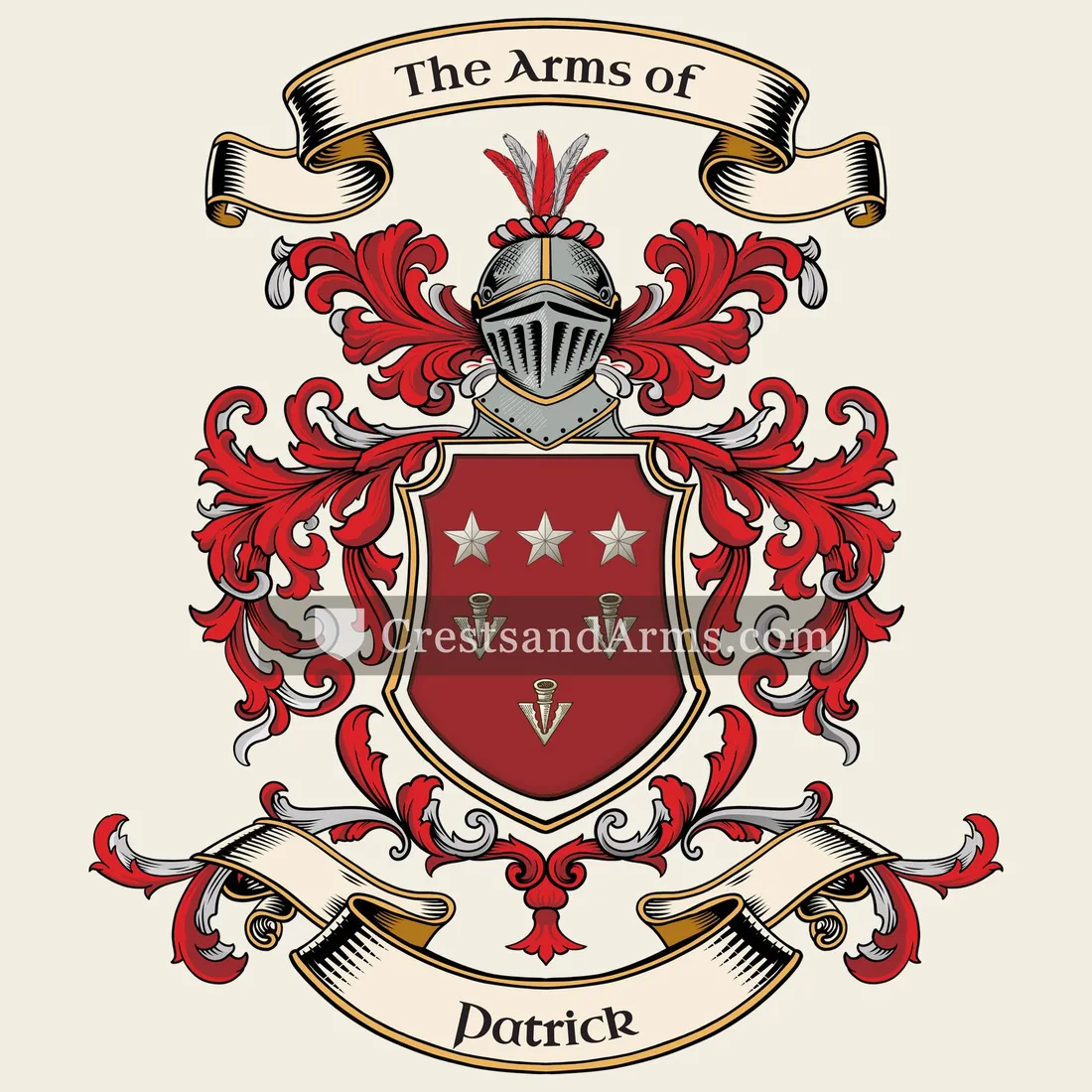
Symbols on this shield
mulletThe third son, and a divine quality from above
arms pheon arrowheadReadiness for battle, and the broad arrow of the sovereign
Colours
Red (Gules)Means: Military strength
Silver (Argent)Means: Peace and sincerity
Historical info
Source
Sir Bernard Burke, The General Armory of England, Scotland, Ireland and Wales, London: Harrison & Sons, 1884
Blazon (the actual original written record)
“Gu. three mullets of six points ar. (ERDISWICK). On the seal of WILLIAM PATRICK, father of WILLIAM PATRICK, who m. BEATRIX DE MALPAS, three pheons”
ChesterMalpas · Chester, c. 1620
Digital archive packCoat of arms PNG, gold border print PDF, vector SVG and the certificate of authenticity. Sent to your email in minutes.
Map of England showing where the Patrick arms are recorded
The Patrick arms were recorded in Chester, c. 1620.
Cheshire was governed apart from the rest of England for much of its history, with its own courts and its own gentry. That separateness bred a strong local landed class, and landed families carried arms.
This is where the arms were entered in the register. Families often moved to other parts of the country, so the same name can turn up in more than one region.
The body that granted and recorded arms in England in this period.
James VI and I
Sovereign of the period
James VI and I
1603–1625
Reigning in Britain when the Patrick arms are first recorded.
How Arms Worked in England
English heraldry allowed arms to be shared by all legitimate descendants of the original owner. These symbols were treated as personal property that moved through the generations to all children. While the eldest son kept the original design, other family members could use the same shield without needing to change it or register their own unique versions.
Granting authority
The College of Arms in London has regulated the use of coats of arms throughout England and Wales since 1484.
How they got arms
Families typically obtained their coats of arms through a formal grant from the Crown or by proving their ancient right to them.
Where arms were recorded
All official coats of arms are recorded in the registers kept at the College of Arms, which date back to the fifteenth century.
The family's standing
Recorded among the armigerous families of Chester.
Origin & History of the Patrick Family in England
The surname Patrick finds its roots in the Latin name Patricius, which translates to noble or patrician. In England, the name evolved from a given name into a hereditary surname during the Middle Ages as populations grew and people needed ways to distinguish themselves. By the early 17th century, the family had established a notable presence in the historic city of Chester. Records from 1620 show members of the Patrick family living in this region, which was a vital hub for trade and military activity near the Welsh border. Living in a city like Chester suggests that these early ancestors were likely involved in the local merchant class or skilled trades that defined the city’s economy during the Stuart period. As the family settled into urban life, they became part of the social fabric of Cheshire, contributing to the local community as the name gradually passed down through subsequent generations.
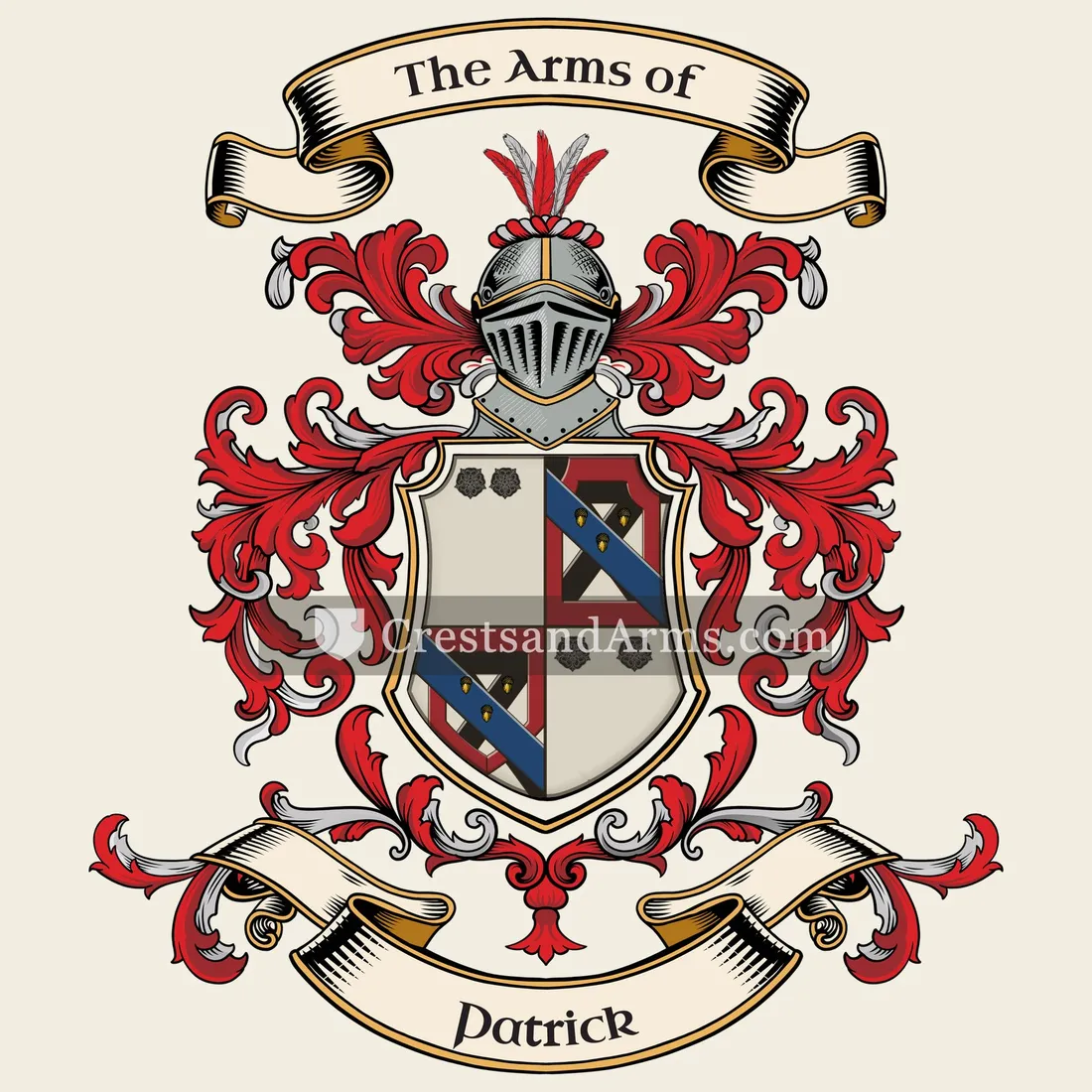
Meaning of the Patrick family crest colors & symbols
Symbols on this shield
saltireResolution, and St Andrew's cross
chiefAuthority, wisdom and dominion
bordureA difference between branches of one family
bendDefence, and the scarf of a commander
roseThe seventh son, and beauty with grace
acornAntiquity and strength from small beginnings
Colours
Silver (Argent)Means: Peace and sincerity
Black (Sable)Means: Constancy
Red (Gules)Means: Military strength
Blue (Azure)Means: Loyalty and truth
Gold (Or)Means: Generosity
Historical info
Source
Sir Bernard Burke, The General Armory of England, Scotland, Ireland and Wales, London: Harrison & Sons, 1884
Blazon (the actual original written record)
“Quarterly, 1st and 4th, ar. a saltire sa. on a chief of the second two roses of the first, all within a bordure gu., for PATRICK; 2nd and 3rd, ar. on a bend az. three acorns or, for RALSTON”
AyrAyr, c. 1861
Digital archive packCoat of arms PNG, gold border print PDF, vector SVG and the certificate of authenticity. Sent to your email in minutes.
Map of Scotland showing where the Patrick arms are recorded
The Patrick arms were recorded in Ayr, c. 1861.
Ayrshire was farming country along Scotland's south-west coast, held in a great many small estates. Its lairds were numerous rather than rich, and each holding brought its own claim to arms.
This is where the arms were entered in the register. Families often moved to other parts of the country, so the same name can turn up in more than one region.
The body that granted and recorded arms in Scotland in this period.
Victoria
Sovereign of the period
Victoria
1837–1901
Reigning in Britain when the Patrick arms are first recorded.
How Arms Worked in Scotland
Scottish heraldry is unique because it treats a coat of arms as a piece of personal property protected by law. Only one person can own a specific design at any given time. When a family grows, the head keeps the original shield while other relatives must apply for their own distinct version with slight changes to prove their specific identity.
Granting authority
The Court of the Lord Lyon acts as the official body that regulates and controls all heraldic matters throughout Scotland.
How they got arms
Individuals obtain a legal right to their arms through a formal petition process that confirms their identity and family connection.
Where arms were recorded
All valid coats of arms are officially entered into the Public Register of All Arms and Bearings starting from 1672.
The family's standing
Recorded among the armigerous families of Ayr.
Origin & History of the Patrick Family in Scotland
The surname Patrick traces its roots in Scotland to the personal name Patricius, which was popularized by the spread of Christianity. In the Scottish Lowlands, the name evolved from a first name into a hereditary surname as families began to adopt stable identifiers for legal and tax purposes. By the mid-19th century, the Patrick family had established a notable presence in the town of Ayr. This coastal burgh served as a vital hub for trade and administration, providing a stable environment for families to settle and grow. Census records from 1861 confirm that members of the Patrick family were well-integrated into the local community of Ayr during this period. They likely participated in the town's thriving maritime and mercantile industries, which defined the region's economy during the Victorian era. The transition of the name from a religious designation to a family identifier reflects the broader social changes that shaped Scottish identity over several centuries.
Patrick Meaning & Related Branches
Root word
Patricius
A Latin term meaning belonging to the nobility or a patrician.
This name
PatrickDerived from the Latin word for a nobleman or member of the aristocracy.
also spelled
Patrik
Patryck
Patryk
Related arms
Dunbarsimilar arms
Maxwellsimilar arms
Fishrecorded with Patrick, same area
Lawrencerecorded with Patrick, same area
Documented Sources
J. B. Rietstap, Armorial Général, Gouda: G. B. van Goor Zonen, 1884–87
Reaney, P.H., A Dictionary of English Surnames, 1958
Cottle, Basil, The Penguin Dictionary of Surnames, 1967
Kent Archives, Parish Registers of Kent, 1700
Digital archive packCoat of arms PNG, gold border print PDF, vector SVG and the certificate of authenticity. Sent to your email in minutes.


 saltireResolution, and St Andrew's cross
 chiefAuthority, wisdom and dominion
 cinquefoilHope and joy
 crescentHonour by the sovereign, and the second son
 griffinValour and vigilance, guarding great treasure
 roseThe seventh son, and beauty with grace
 saltireResolution, and St Andrew's cross
 chiefAuthority, wisdom and dominion
 cinquefoilHope and joy
 crescentHonour by the sovereign, and the second son
 griffinValour and vigilance, guarding great treasure
 roseThe seventh son, and beauty with grace


 mulletThe third son, and a divine quality from above
 arms pheon arrowheadReadiness for battle, and the broad arrow of the sovereign

 bordureA difference between branches of one family
 bendDefence, and the scarf of a commander
 acornAntiquity and strength from small beginnings