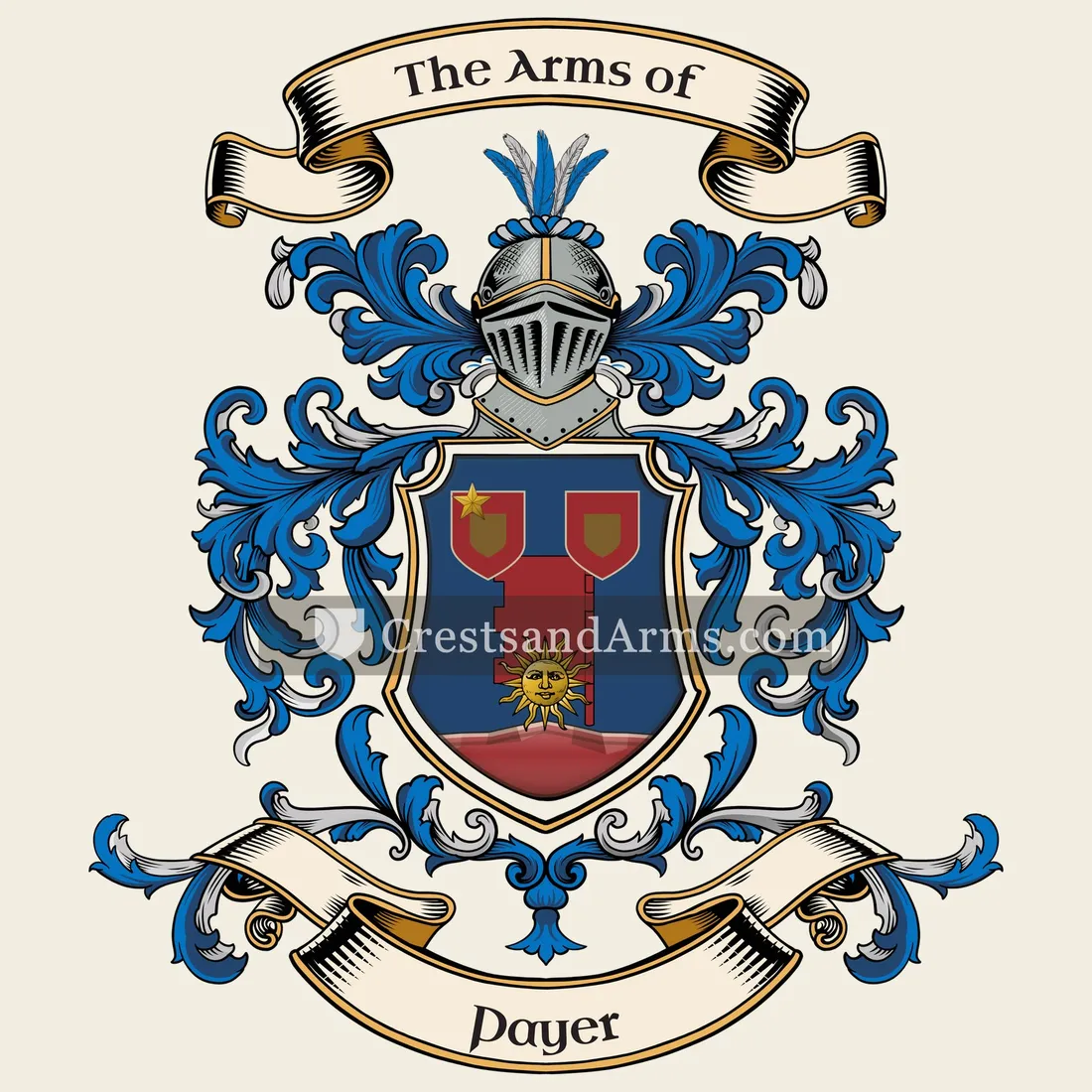
A record of documented arms, meaning and origin, researched for the Payer family of Austria.
Reg. 9173 · Austrian, P–S
Meaning of the Payer family crest colors & symbols
Symbols on this shield
mountThe ground held, and steadfastness upon it
flag / pennantA command held, and a following kept
escutcheonA shield within a shield, and a claim inherited
sunGlory, splendour and the source of life
mulletThe third son, and a divine quality from above
Colours
Blue (Azure)Means: Loyalty and truth
Red (Gules)Means: Military strength
Gold (Or)Means: Generosity
Historical info
Source
J. B. Rietstap, Armorial Général, Gouda: G. B. van Goor Zonen, 1884–87
Blazon (the actual original written record)
“d'azur un paysage arctique, montrant sur le devant à sen. une mer d'un vert noirâtre, ensuite sur le milieu et à dextre un espace rempli de neige et de glacons, et dans le fond une masse rocheuse de couleur brunâtre, ayant trois coupeaux, celui du milieu portant la grande bannière de la monarchie austro-hongroise flottante vers sen., coupée de gu. sur un parti de gu. et de sin., une fasce d'arg. br. sur ce coupé, et deux écussons timbrés de couronnes royales, accostés, br. sur la fasce (l'écusson à dextre d'Autriche qui est de gu. à la fasce d'arg., et celui à sen. de Hongrie qui est parti de gu. à quatre fasces d'arg. et de gu. à une croix de Lorraine d'arg., iss. d'une couronne d'or posée sur une colline de sin.); la hampe de la bannière br. sur le soleil de minuit d'or et sur les deux cercles du même dont il est entouré, le tout s'élevant à l'horizon derrière les rochers; et une étoile à six rais d'or, représentant l'étoile polaire, posée au canton dextre du chef. Deux cq. cour. C.: 1° un vol cont., l'aile de devant d'azur ch. d'une étoile d'or, l'aile de derrière d'arg. plein; 2° un ours blanc, iss. L. d'arg. et d'azur. D.: PER ASPERA AD ASTRA [Armes concédées au lieutenant Julius Payer, célèbre par son voyage au pôle arctique.]”
Austriac. 1877
Digital archive packCoat of arms PNG, gold border print PDF, vector SVG and the certificate of authenticity. Sent to your email in minutes.
Map of Austria showing where the Payer arms are recorded
The Payer arms were recorded in Austria, c. 1877.
Arms such as these were typically recorded in Tyrol.
Tyrol was mountain country in western Austria, where the valleys were held by families who had been there a very long time. Old tenure counted for more than money, and old families carried arms.
This is where the arms were entered in the register. Families often moved to other parts of the country, so the same name can turn up in more than one region.
Region
Tyrol
First recorded
1877
Granting Authority for the Payer Arms
Imperial and Royal chancery
Sodacan · CC BY-SA 3.0
The body that granted and recorded arms in Austria in this period.
Franz Joseph I of Austria
Sovereign of the period
Franz Joseph I of Austria
1848–1916
Reigning in Austria when the Payer arms are first recorded.
How Arms Worked in Austria
Austrian coats of arms were often linked directly to noble titles granted by the Emperor. These symbols belonged to the entire family line rather than just one individual. When a family grew, new branches kept the original design without needing to change it. This system allowed all members of a noble house to share the same identity across many generations.
Granting authority
The Imperial and Royal chancery managed all heraldic matters and controlled the official granting of arms throughout the Austrian lands.
How they got arms
Families typically received their arms through a formal imperial decree that often accompanied the elevation of a person to noble status.
Where arms were recorded
Official records of these grants were kept in the Imperial Register of Nobility which began its formal documentation process in 1453.
The family's standing
Recorded among the armigerous families of Austria.
Origin & History of the Payer Family in Austria
The surname Payer has deep roots in the Alpine regions of Central Europe, particularly within the historical territory of Tyrol. The name is occupational in origin, derived from the Middle High German word *beier* or *peier*, which historically referred to a person from Bavaria. Over many centuries, families living in the borderlands between Bavaria and the Austrian Alps adopted this name to identify their regional heritage. By the late 19th century, records confirm that the Payer family was well-established in the Tyrolean landscape, where they were likely involved in the traditional mountain trades of farming, forestry, or local commerce. These early generations lived through a period of significant social change in the Austro-Hungarian Empire, which helped shape the identity of families living in the rugged mountain valleys.
Payer Meaning & Related Branches
Root word
Payer
Derived from the Middle High German word for a baker.
This name
PayerAn occupational surname for someone who baked bread for a living.
also spelled
Payre
Related arms
Payrvariant spelling
Payrevariant spelling
Documented Sources
J. B. Rietstap, Armorial Général, Gouda: G. B. van Goor Zonen, 1884–87
Bahlow, Hans, Deutsches Namenlexikon: Familien- und Vornamen nach Ursprung und Sinn erklärt, 1967
Kohlheim, Rosa and Kohlheim, Volker, Duden Familiennamen: Herkunft und Bedeutung von 20.000 Nachnamen, 2005
Tiroler Landesarchiv, Standesausweise und Zivilstandsregister der Tiroler Gemeinden, 1877
Digital archive packCoat of arms PNG, gold border print PDF, vector SVG and the certificate of authenticity. Sent to your email in minutes.


 mountThe ground held, and steadfastness upon it
 flag / pennantA command held, and a following kept
 escutcheonA shield within a shield, and a claim inherited
 sunGlory, splendour and the source of life
 mulletThe third son, and a divine quality from above