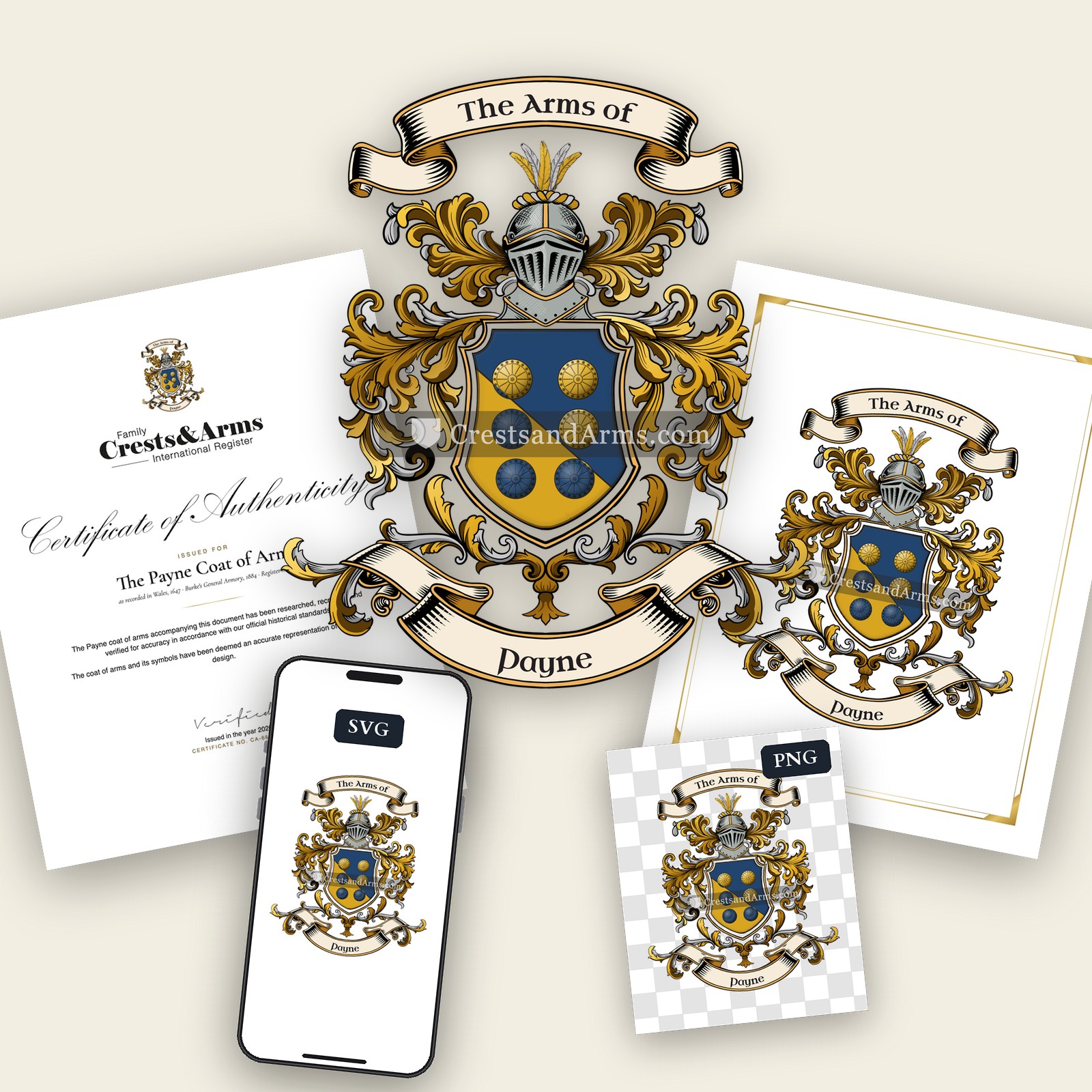
A record of documented arms, meaning and origin, researched for the Payne family lines. Documented in 3 countries.
Reg. 6615 · French, P–S
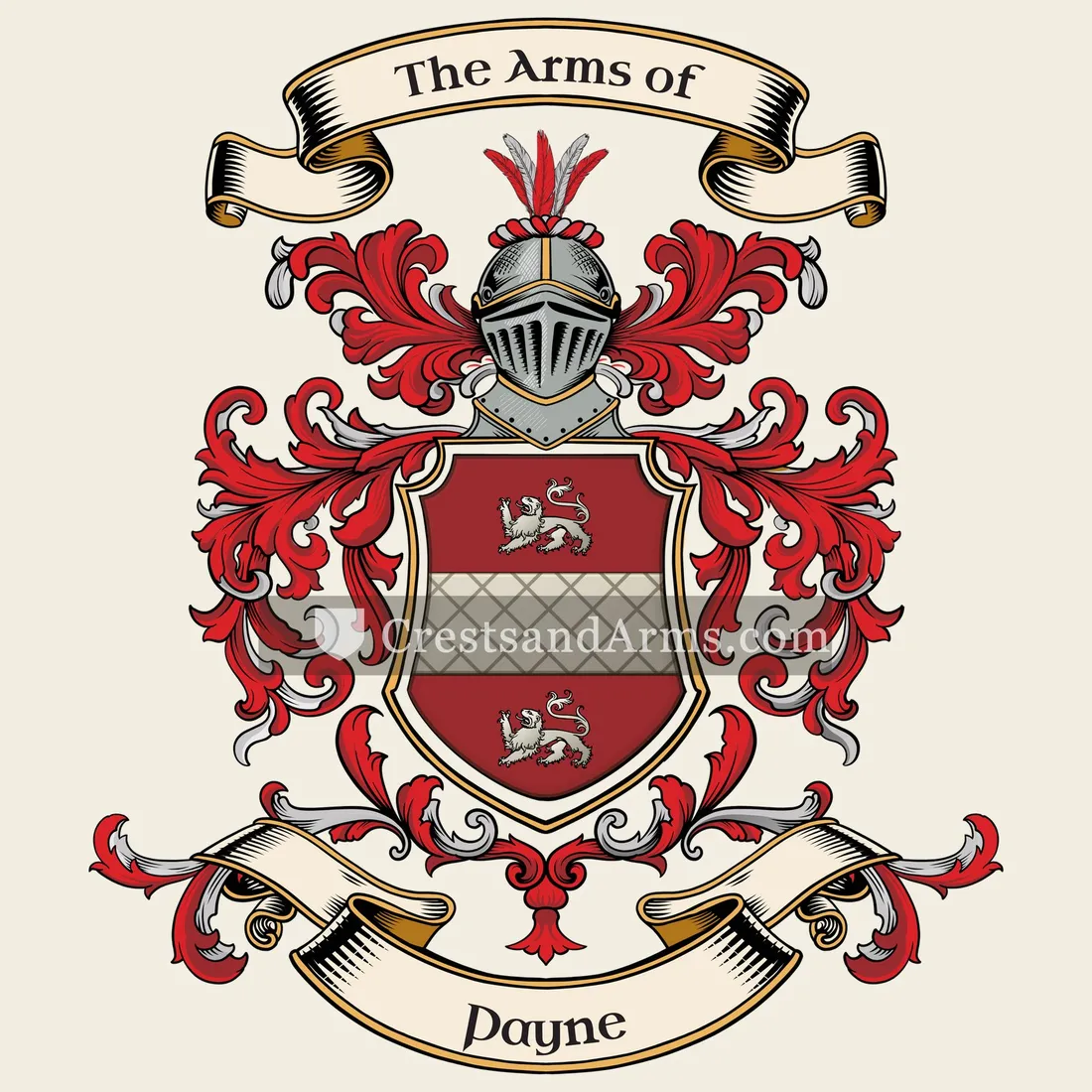
Meaning of the Payne family crest colors & symbols
Symbols on this shield
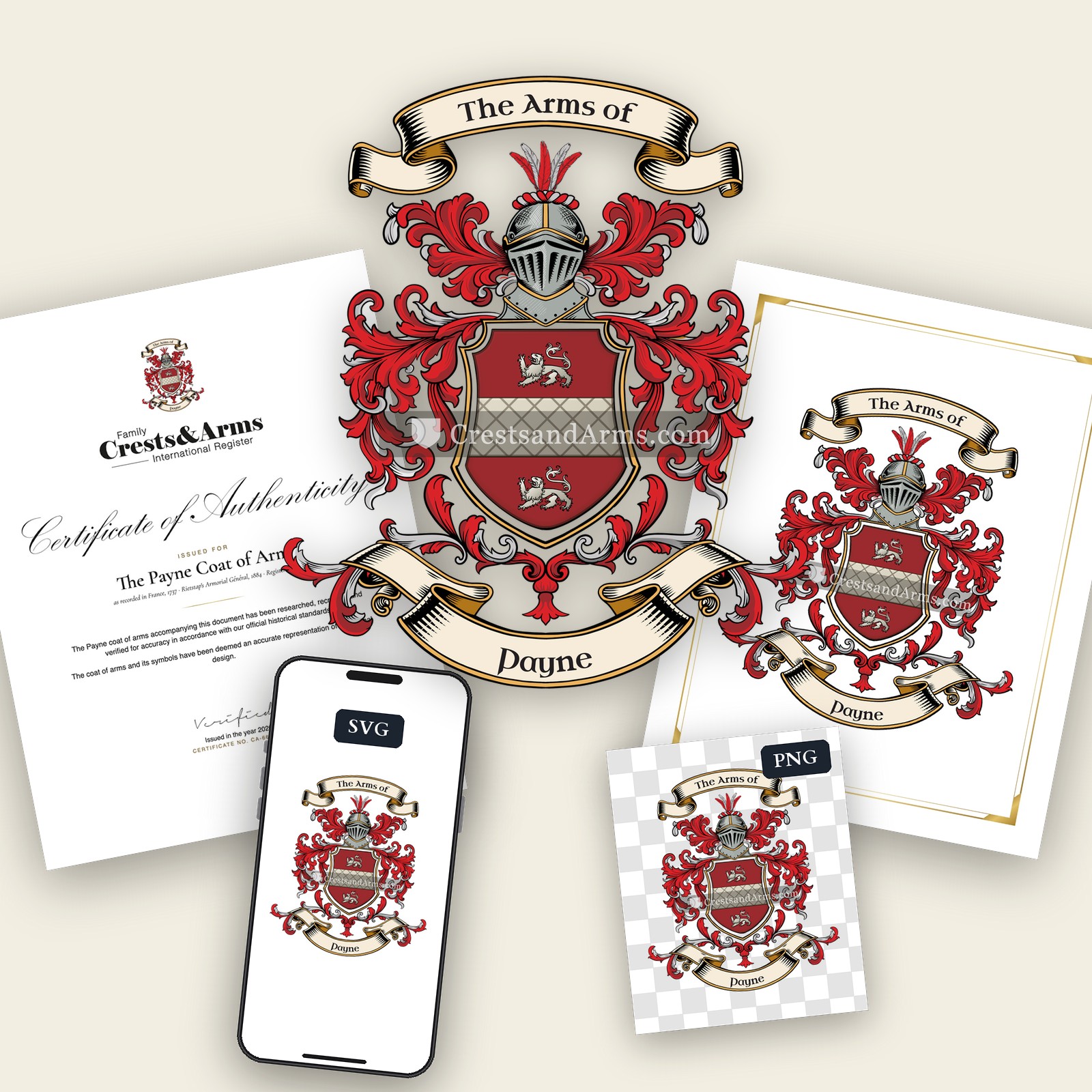
fessThe military belt, and readiness to serve
lionCourage, strength and royalty
Colours
Red (Gules)Means: Military strength
Silver (Argent)Means: Peace and sincerity
Historical info
Source
J. B. Rietstap, Armorial Général, Gouda: G. B. van Goor Zonen, 1884–87
Blazon (the actual original written record)
“De gu. à la fasce d'arg., acc. de deux léopards du même, 1 en chef et 1 en p. C.: une patte de lion d'arg., en pal, tenant une lance de tournoi de gu., brisée et posée en barre. D.: MALO MORI QUAM FOEDARI.”
BedfordshireBedfordshire, c. 1737
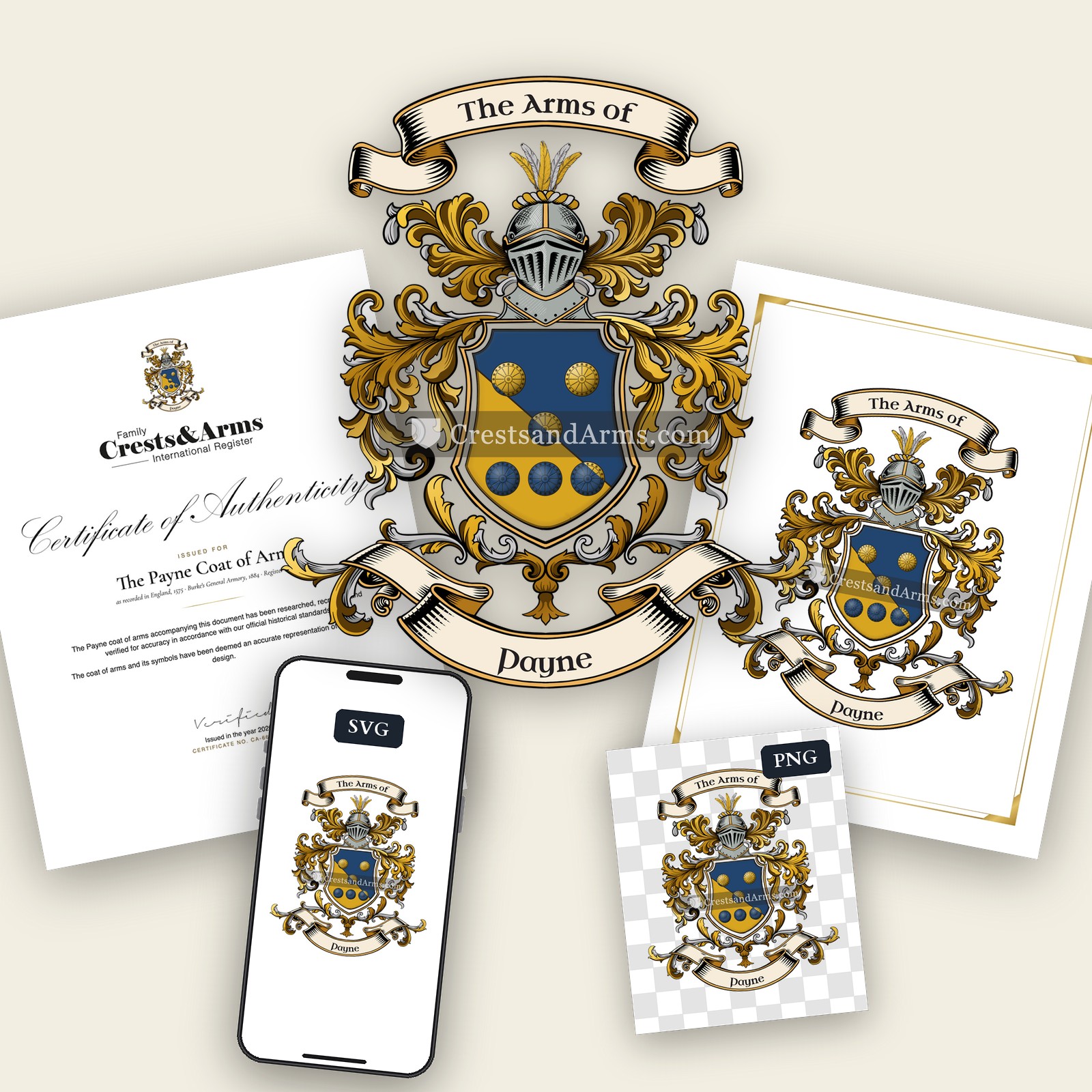
Digital archive packCoat of arms PNG, gold border print PDF, vector SVG and the certificate of authenticity. Sent to your email in minutes.
Map of France showing where the Payne arms are recorded
The Payne arms were recorded in Bedfordshire, c. 1737.
This is where the arms were entered in the register. Families often moved to other parts of the country, so the same name can turn up in more than one region.
The body that granted and recorded arms in France in this period.
Louis XV of France
Sovereign of the period
Louis XV of France
1715–1774
Reigning in France when the Payne arms are first recorded.
How Arms Worked in France
In France, a coat of arms was a mark of honor that passed down through the male line to all legitimate descendants. Families often used the same shield without changes to show their shared heritage. If a branch wanted to stand out, they could add a small mark to their shield to show their specific place in the family tree.
Granting authority
The Juge d'armes de France acted as the official authority that regulated and verified coats of arms across the country.
How they got arms
Families typically inherited their arms from ancestors, though they could also receive them through royal grants or by proving their noble status.
Where arms were recorded
Coats of arms were officially recorded in the Armorial Général de France, which began its main collection in the year 1696.
The family's standing
Recorded among the armigerous families of Bedfordshire.
Origin & History of the Payne Family in France
The surname Payne traces its roots back to the Old French term *paien*, which originally meant a pagan or a person who lived in the countryside. During the Middle Ages, this name was frequently used as a given name in France before it evolved into a hereditary surname. Many individuals carrying this name migrated across the English Channel following the Norman Conquest of 1066. While the family established a notable presence in Bedfordshire by 1737, their ancestors were part of a broader movement of settlers who brought French naming traditions into the English social fabric. Over several centuries, the name transitioned from a descriptive label for a person’s religious or geographical background into a stable family identifier that was passed down through generations of laborers and landowners alike.
Meaning of the Payne family crest colors & symbols
Symbols on this shield
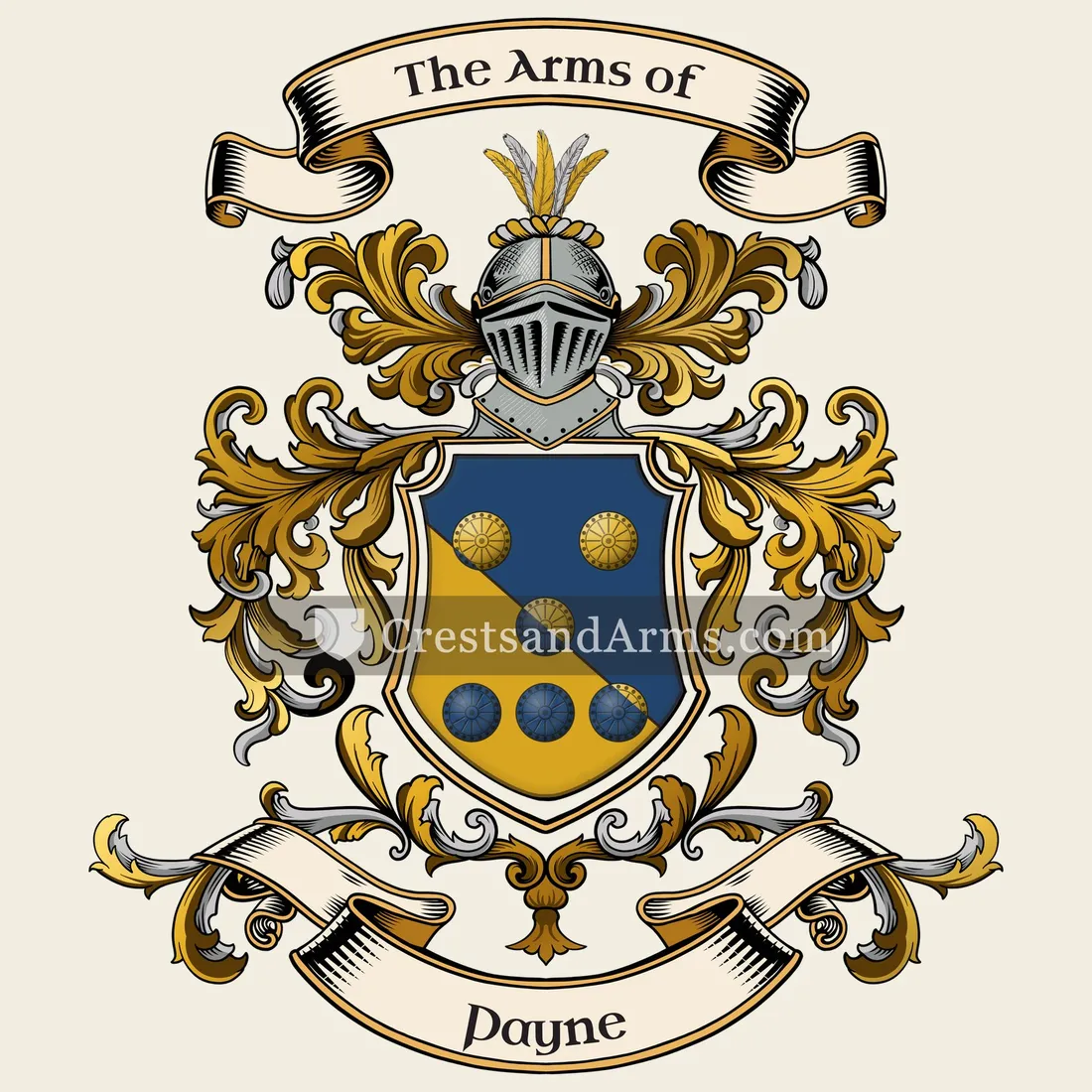
roundelA coin, and one who has been to the crusades
Colours
Gold (Or)Means: Generosity
Blue (Azure)Means: Loyalty and truth
Historical info
Source
Sir Bernard Burke, The General Armory of England, Scotland, Ireland and Wales, London: Harrison & Sons, 1884
Blazon (the actual original written record)
“Per bend or and az. three (another, six) roundles counterchanged, two and one”
Englandc. 1575
Digital archive packCoat of arms PNG, gold border print PDF, vector SVG and the certificate of authenticity. Sent to your email in minutes.
Map of England showing where the Payne arms are recorded
The Payne arms were recorded in England, c. 1575.
Arms such as these were typically recorded in York.
Yorkshire is the largest of the English counties, and it held more gentry families than any other. Land there was split among a great many households rather than a few, so a great many of them carried arms.
This is where the arms were entered in the register. Families often moved to other parts of the country, so the same name can turn up in more than one region.
The body that granted and recorded arms in England in this period.
Elizabeth I of England
Sovereign of the period
Elizabeth I of England
1558–1603
Reigning in France when the Payne arms are first recorded.
How Arms Worked in England
English heraldry allowed arms to be shared by all legitimate descendants of the original owner. These symbols were treated as personal property that moved through the generations to all children. While the eldest son kept the original design, other family members could use the same shield without needing to change it or register their own unique versions.
Granting authority
The College of Arms in London has regulated the use of coats of arms throughout England and Wales since 1484.
How they got arms
Families typically obtained their coats of arms through a formal grant from the Crown or by proving their ancient right to them.
Where arms were recorded
All official coats of arms are recorded in the registers kept at the College of Arms, which date back to the fifteenth century.
The family's standing
Recorded among the armigerous families of England.
Origin & History of the Payne Family in England
The surname Payne has deep roots in the linguistic evolution of medieval England, originating as a nickname derived from the Old French word "paien," which meant pagan or villager. During the Middle Ages, names often described a person’s character, religious status, or place of residence, and this term was frequently applied to those who lived outside of established Christian communities or simply as a descriptive label for a rustic individual. By the time the family established a documented presence in York in 1575, the name had already transitioned from a descriptive nickname into a hereditary surname passed down through generations. Families bearing this name were often integrated into the social and economic fabric of northern English cities, where they participated in the growing trade and civic life of the Elizabethan era. This transition reflects a broader historical pattern where descriptive identifiers became permanent family markers as record-keeping became more formal across the English countryside.
Meaning of the Payne family crest colors & symbols
Symbols on this shield
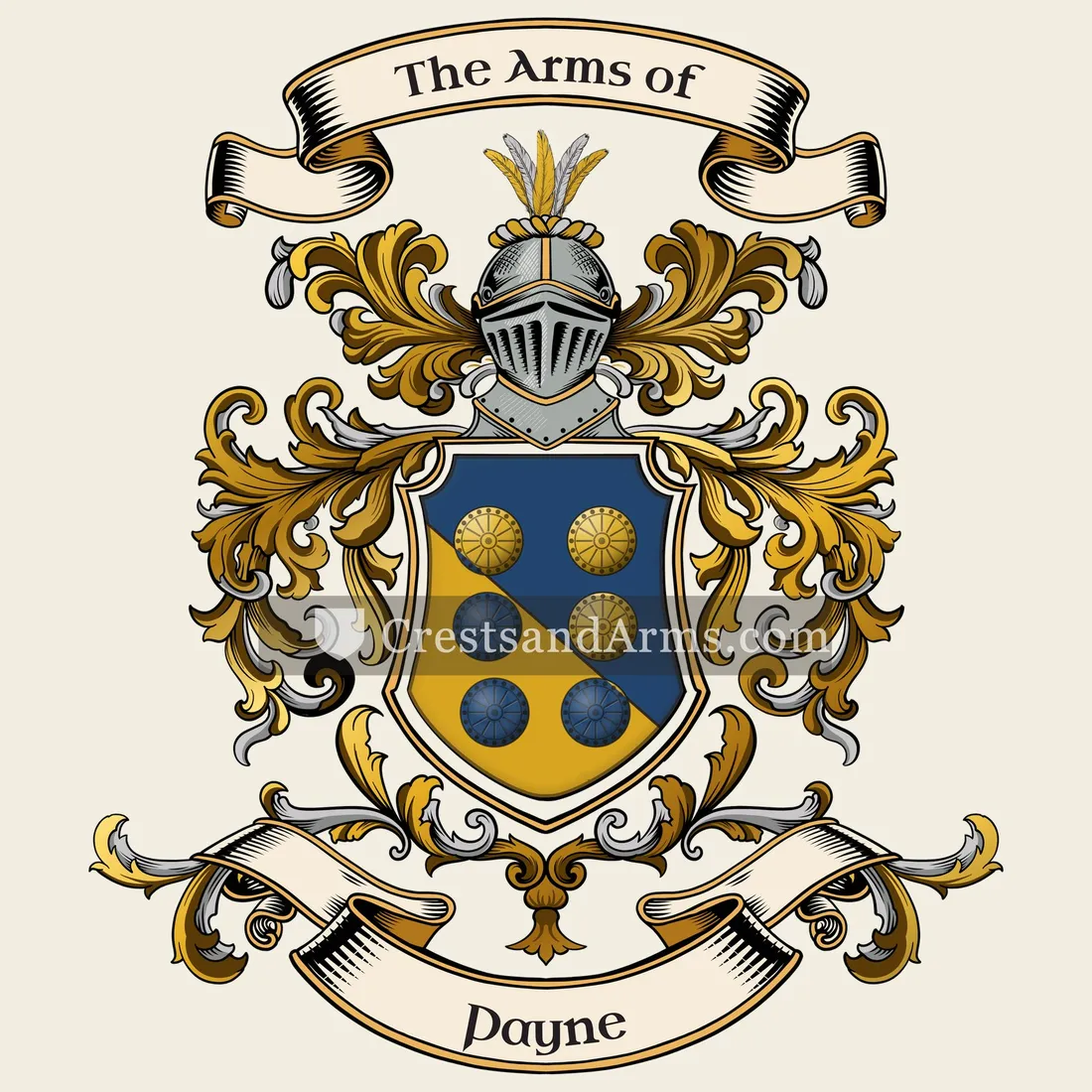
roundelA coin, and one who has been to the crusades
Colours
Gold (Or)Means: Generosity
Blue (Azure)Means: Loyalty and truth
Historical info
Source
Sir Bernard Burke, The General Armory of England, Scotland, Ireland and Wales, London: Harrison & Sons, 1884
Blazon (the actual original written record)
“Per bend or and az. six roundles counterchanged, two, two, and two”
DenbighDenbigh, c. 1647
Digital archive packCoat of arms PNG, gold border print PDF, vector SVG and the certificate of authenticity. Sent to your email in minutes.
Map of Wales showing where the Payne arms are recorded
The Payne arms were recorded in Denbigh, c. 1647.
Denbighshire was north Welsh country of hills and small estates. Land was held by a great many families rather than a few, and each holding brought its own claim to a coat of arms.
This is where the arms were entered in the register. Families often moved to other parts of the country, so the same name can turn up in more than one region.
The body that granted and recorded arms in Wales in this period.
Charles I of England
Sovereign of the period
Charles I of England
1625–1649
Reigning in France when the Payne arms are first recorded.
How Arms Worked in Wales
English heraldry allowed arms to be shared by all legitimate descendants of the original owner. These symbols were treated as personal property that moved through the generations to all children. While the eldest son kept the original design, other family members could use the same shield without needing to change it or register their own unique versions.
Granting authority
The College of Arms in London has regulated the use of coats of arms throughout England and Wales since 1484.
How they got arms
Families typically obtained their coats of arms through a formal grant from the Crown or by proving their ancient right to them.
Where arms were recorded
All official coats of arms are recorded in the registers kept at the College of Arms, which date back to the fifteenth century.
The family's standing
Recorded among the armigerous families of Denbigh.
Origin & History of the Payne Family in Wales
The surname Payne has deep roots in the British Isles, often originating as a nickname derived from the Latin word *paganus*, which originally meant a country dweller or a villager. While the name is found throughout England, its presence in Wales became particularly notable by the mid-seventeenth century. Historical records confirm that members of the Payne family were established in the town of Denbigh by 1647. During this period, Denbigh was a significant administrative and market center in North Wales, and families living there were often involved in the local trade and civic life that defined the region. The movement of the Payne name into Welsh communities reflects the broader patterns of migration and social integration that occurred as families moved across borders to settle in new towns. By establishing themselves in Denbigh, these early ancestors became part of the local fabric of the community, contributing to the history of the area during a time of great social change in Wales.
Payne Meaning & Related Branches
Root word
Paganus
A Latin term referring to a country dweller or rustic person.
This name
PayneA medieval nickname for a person who was not a Christian or lived in a rural area.
also spelled
Pain
Payn
Paine
Payen
Related arms
Gibbonssimilar arms
Launcesimilar arms
Painesimilar arms
Painvariant spelling
Documented Sources
J. B. Rietstap, Armorial Général, Gouda: G. B. van Goor Zonen, 1884–87
Reaney, P.H., A Dictionary of English Surnames, 1958
Dauzat, Albert, Dictionnaire étymologique des noms de famille et prénoms de France, 1951
Bedfordshire Archives, Parish Registers of Bedfordshire, 1737
Digital archive packCoat of arms PNG, gold border print PDF, vector SVG and the certificate of authenticity. Sent to your email in minutes.


 fessThe military belt, and readiness to serve
 lionCourage, strength and royalty
 fessThe military belt, and readiness to serve
 lionCourage, strength and royalty


 roundelA coin, and one who has been to the crusades