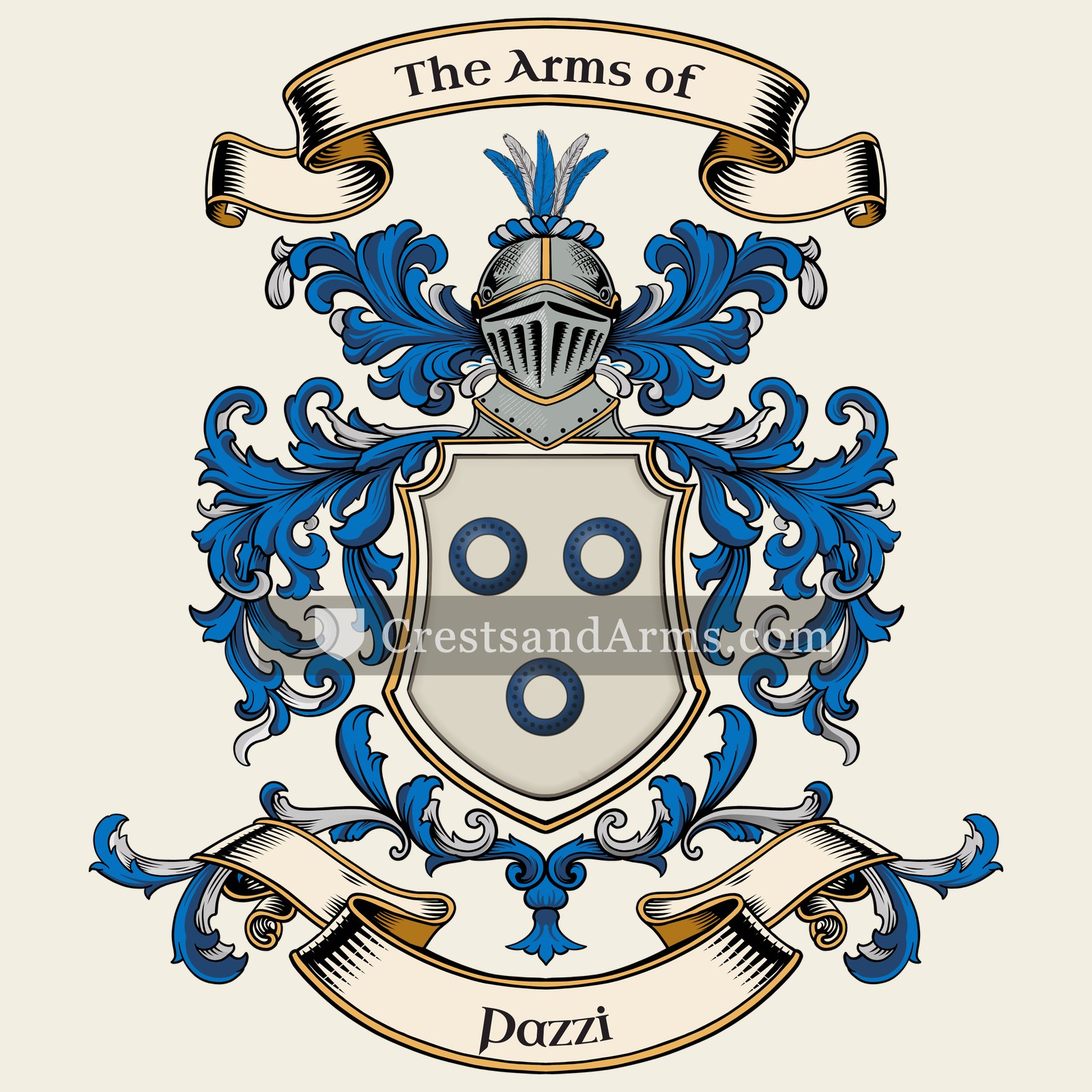
A record of documented arms, meaning and origin, researched for the Pazzi family of Italy.
Reg. 9955 · Italian, P–S
Coat of Arms & Family Crest Details
Symbols on this shield
ringFidelity, and a promise kept
Colours
Silver (Argent)Means: Peace and sincerity
Blue (Azure)Means: Loyalty and truth
Historical info
Source
J. B. Rietstap, Armorial Général, Gouda: G. B. van Goor Zonen, 1884–87
Blazon (the actual original written record)
“D'arg. à trois paires d'annelets, 2 et 1, chaque paire composée d'un annelet d'azur et d'un annelet de gu., entrelacés, l'un sur l'autre, l'annelet supérieur d'azur et l'annelet inférieur de gu.”
ItalyFlorence, c. 1775
Digital archive packCoat of arms PNG, gold border print PDF, vector SVG and the certificate of authenticity. Sent to your email in minutes.
Map of Italy showing where the Pazzi arms are recorded
The Pazzi arms were recorded in Florence, c. 1775.
This is where the arms were entered in the register. Families often moved to other parts of the country, so the same name can turn up in more than one region.
The body that granted and recorded arms in Italy in this period.
Alvise Giovanni Mocenigo
Sovereign of the period
Alvise Giovanni Mocenigo
1763–1778
Reigning in Italy when the Pazzi arms are first recorded.
How Arms Worked in Italy
In the Italian states, coats of arms were often used by noble families to show their status and history. These symbols were passed down through the generations to all legitimate male descendants. Younger branches of a family usually kept the original design but sometimes added small changes to distinguish their specific line from the main branch.
Granting authority
Various local rulers and city governments controlled the use of coats of arms across the different Italian states.
How they got arms
Families often assumed their own arms or received them as official grants from local lords, popes, or city councils.
Where arms were recorded
Arms were recorded in local city archives or private family books rather than in one single national register.
The family's standing
Recorded among the armigerous families of Italy.
Origin & History of the Pazzi Family in Italy
The Pazzi family emerged as one of the most influential and wealthy clans in medieval Florence. Their rise to power began in the eleventh century when an ancestor named Pazzo di Ranieri returned from the First Crusade. Legend claims he was the first man to scale the walls of Jerusalem, and he supposedly brought back sacred stones from the Holy Sepulchre to his home city. Over the following centuries, the family established themselves as powerful bankers and politicians who held significant sway over the city government. While they are most famous for their dramatic rivalry with the Medici family during the Renaissance, their presence in Florence remained a constant thread in local history for hundreds of years. By the time the family records show members living in the city during the late eighteenth century, they had long since cemented their reputation as a central part of the Florentine social and political landscape.
Pazzi Meaning & Related Branches
Root word
Pazzo
Derived from the Italian word for mad or foolish.
This name
PazziA nickname originally given to someone perceived as eccentric, impulsive, or mentally unstable.
also spelled
Pazzy
Pazze
Pazi
Documented Sources
J. B. Rietstap, Armorial Général, Gouda: G. B. van Goor Zonen, 1884–87
Brucker, Gene, Renaissance Florence, 1969
Kent, F.W., Lorenzo de' Medici and the Art of Magnificence, 2004
Archivio di Stato di Firenze, Carte Strozziane, serie III
Digital archive packCoat of arms PNG, gold border print PDF, vector SVG and the certificate of authenticity. Sent to your email in minutes.


 ringFidelity, and a promise kept
 ringFidelity, and a promise kept