Map of France showing where the Pena arms are recorded
The Pena arms were recorded in Provence, c. 1663.
Provence was old country, with towns dating to the Romans and families who traced their land back nearly as far. Its gentry were many and long-settled, and long settlement is what fills a register.
This is where the arms were entered in the register. Families often moved to other parts of the country, so the same name can turn up in more than one region.
The body that granted and recorded arms in France in this period.
Louis XIV of France
Sovereign of the period
Louis XIV of France
1643–1715
Reigning in France when the Pena arms are first recorded.
How Arms Worked in France
In France, a coat of arms was a mark of honor that passed down through the male line to all legitimate descendants. Families often used the same shield without changes to show their shared heritage. If a branch wanted to stand out, they could add a small mark to their shield to show their specific place in the family tree.
Granting authority
The Juge d'armes de France acted as the official authority that regulated and verified coats of arms across the country.
How they got arms
Families typically inherited their arms from ancestors, though they could also receive them through royal grants or by proving their noble status.
Where arms were recorded
Coats of arms were officially recorded in the Armorial Général de France, which began its main collection in the year 1696.
The family's standing
Recorded among the armigerous families of Provence.
Origin & History of the Pena Family in France
The history of the Pena name in France is deeply rooted in the cultural landscape of the Provence region. By the year 1663, records confirm that members of the family were well-established residents in this area of southeastern France. The name itself is often linked to the geography of the Mediterranean, as it shares linguistic connections with terms for rocky outcrops or mountain peaks found in the local dialects of the time. Families like the Penas during the seventeenth century were frequently involved in the agricultural and administrative life of their local communities. They lived through a period of significant social change as the French monarchy consolidated power across the provinces. Because Provence served as a vital gateway for trade and travel between France, Italy, and Spain, the family likely benefited from the diverse cultural exchanges occurring in the region. Their presence in the historical records of the mid-1600s highlights their role as part of the stable, land-holding population that formed the backbone of Provençal society.
Coat of Arms & Family Crest Details
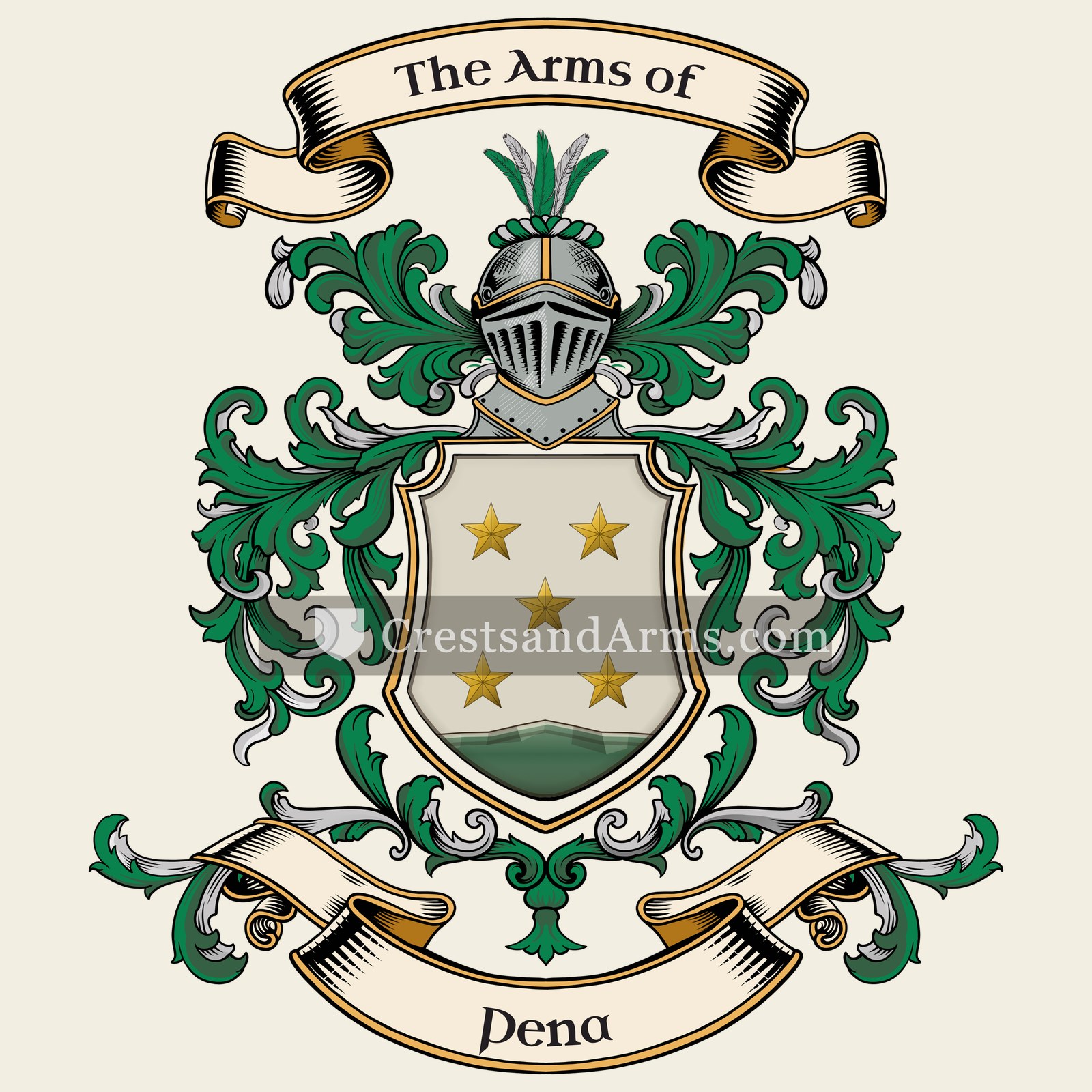
Symbols on this shield
mountThe ground held, and steadfastness upon it
mulletThe third son, and a divine quality from above
Colours
Silver (Argent)Means: Peace and sincerity
Green (Vert)Means: Hope
Gold (Or)Means: Generosity
Historical info
Source
J. B. Rietstap, Armorial Général, Gouda: G. B. van Goor Zonen, 1884–87
Blazon (the actual original written record)
“D'arg. à un mont de cinq coupeaux de sin., chaque coupeau surm. d'une étoile (8) d'or, lesdites étoiles rangées en demi-cercle.”
AragonBiscaye · Aragon, c. 1722
Digital archive packCoat of arms PNG, gold border print PDF, vector SVG and the certificate of authenticity. Sent to your email in minutes.
Map of Spain showing where the Pena arms are recorded
The Pena arms were recorded in Aragon, c. 1722.
Aragon was mountain and river country in north-eastern Spain, with a strong tradition of small independent landholders. A great many families counted as gentry there, and each one needed a shield to be told apart.
This is where the arms were entered in the register. Families often moved to other parts of the country, so the same name can turn up in more than one region.
The body that granted and recorded arms in Spain in this period.
Philip V of Spain
Sovereign of the period
Philip V of Spain
1714–1724
Reigning in France when the Pena arms are first recorded.
How Arms Worked in Spain
In Spain, a coat of arms was considered a form of property that belonged to the entire family line. These arms were passed down from a father to all his children equally. Younger branches of the family usually kept the original design without needing to add any special marks to distinguish their specific line.
Granting authority
The Cronista Rey de Armas was the official body that regulated and granted coats of arms throughout Spain.
How they got arms
Families often obtained their arms through royal grants or by proving their noble status to the official heraldic authority.
Where arms were recorded
Coats of arms were officially recorded in the registers of the Cronista Rey de Armas starting in 1496.
The family's standing
Recorded among the armigerous families of Aragon.
Origin & History of the Pena Family in Spain
The surname Peña originates from the Spanish word for a large rock or a crag, and it was historically used as a topographic name to describe families living near prominent stone formations or mountainous terrain. By the early 18th century, the family was well-established in the region of Aragon, a territory in northeastern Spain with a rich history of medieval kingdoms and rugged landscapes. During this era, families in Aragon were often deeply connected to the land, and the name likely served as a way to identify individuals based on their specific ancestral home or local geography. As the family grew, they became part of the social fabric of the region, participating in the local agricultural and community life that defined the Aragonese countryside in 1722. This period was a time of transition for Spain, and the presence of the Peña family in Aragon reflects the long-standing tradition of families remaining rooted in the same provinces for many generations.
Pena Meaning & Related Branches
Root word
penna
Latin word meaning feather, wing, or a pointed rock formation.
This name
PenaA topographic name for someone who lived near a crag, cliff, or rocky peak.
also spelled
Penna
Penae
Penah
Documented Sources
J. B. Rietstap, Armorial Général, Gouda: G. B. van Goor Zonen, 1884–87
Archives départementales des Bouches-du-Rhône, Série E (Registres paroissiaux et état civil)
Archives départementales du Var, Série E (Registres paroissiaux)
Boyer, Jean, La vie quotidienne en Provence au XVIIe siècle, 1972
Papon, Jean-Pierre, Histoire générale de Provence, 1777
Digital archive packCoat of arms PNG, gold border print PDF, vector SVG and the certificate of authenticity. Sent to your email in minutes.


 mulletThe third son, and a divine quality from above
 mulletThe third son, and a divine quality from above
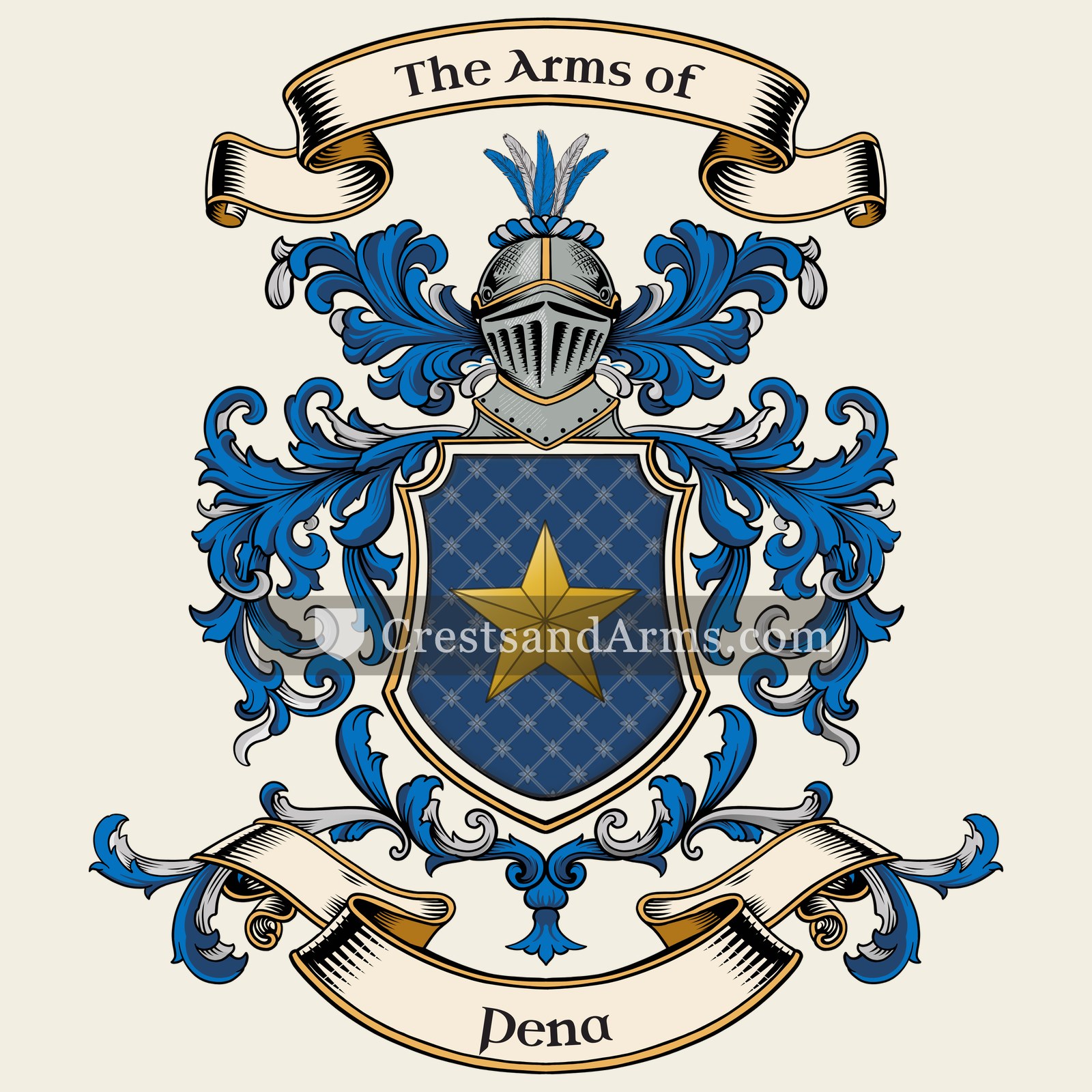


 mountThe ground held, and steadfastness upon it