Map of England showing where the Peacock arms are recorded
The Peacock arms were recorded in London, c. 1532.
This is where the arms were entered in the register. Families often moved to other parts of the country, so the same name can turn up in more than one region.
The body that granted and recorded arms in England in this period.
Henry VIII of England
Sovereign of the period
Henry VIII of England
1509–1547
Reigning in England when the Peacock arms are first recorded.
How Arms Worked in England
English heraldry allowed arms to be shared by all legitimate descendants of the original owner. These symbols were treated as personal property that moved through the generations to all children. While the eldest son kept the original design, other family members could use the same shield without needing to change it or register their own unique versions.
Granting authority
The College of Arms in London has regulated the use of coats of arms throughout England and Wales since 1484.
How they got arms
Families typically obtained their coats of arms through a formal grant from the Crown or by proving their ancient right to them.
Where arms were recorded
All official coats of arms are recorded in the registers kept at the College of Arms, which date back to the fifteenth century.
The family's standing
Recorded among the armigerous families of England.
Origin & History of the Peacock Family in England
The surname Peacock emerged in England as a descriptive nickname during the Middle Ages, a time when people were often identified by their physical traits or personality. The name likely referred to someone who was proud, showy, or perhaps someone who wore colorful clothing that resembled the bright feathers of a peacock. By the early sixteenth century, the family had established a clear presence in the bustling city of London. Records from 1532 show that members of the Peacock family were active participants in the city’s social and economic life during the reign of King Henry VIII. As London grew into a major center for trade and government, these early family members were part of the diverse population that helped shape the city’s development. Over time, the name spread from these urban roots to various parts of the country, becoming a well-established English surname.
Meaning of the Peacock family crest colors & symbols
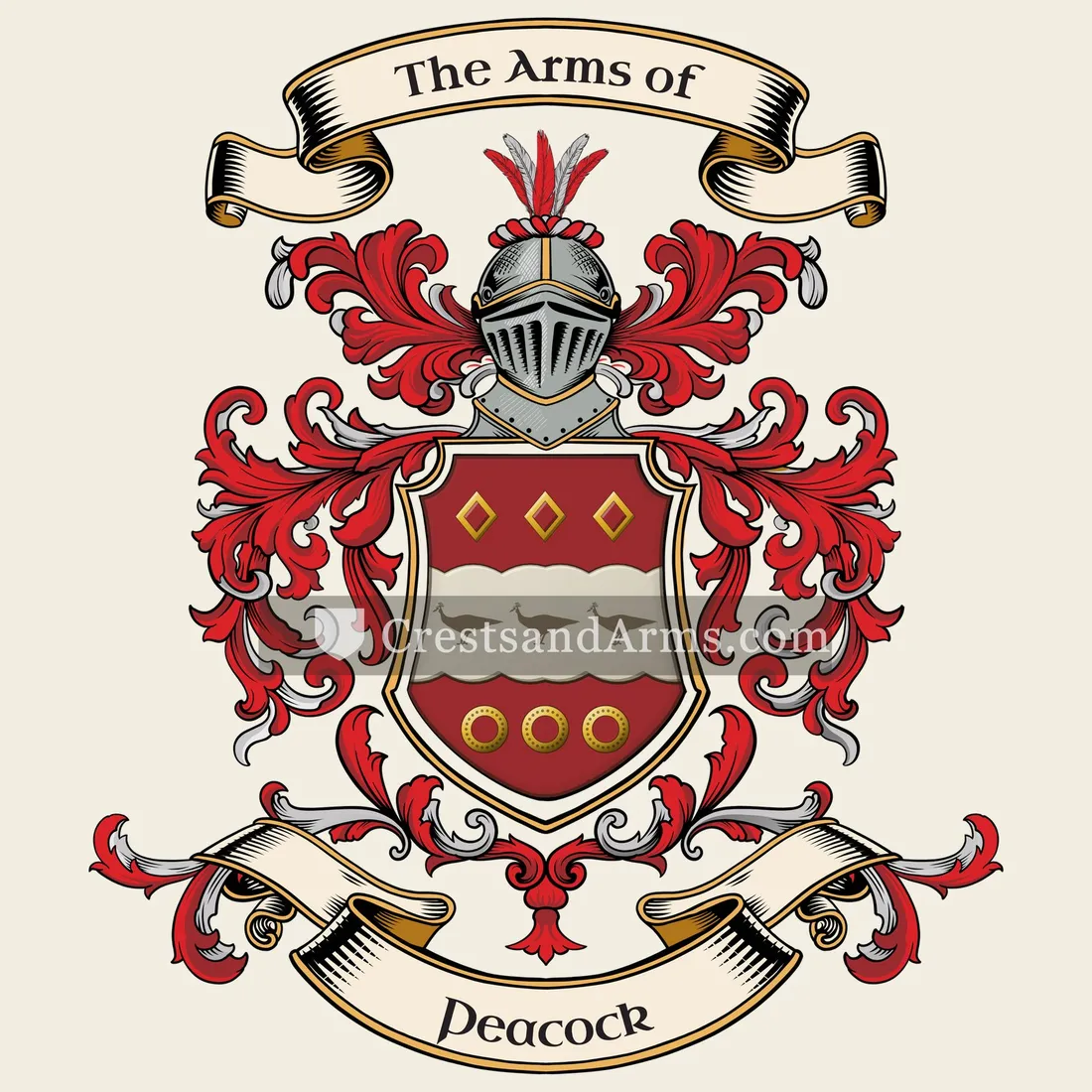
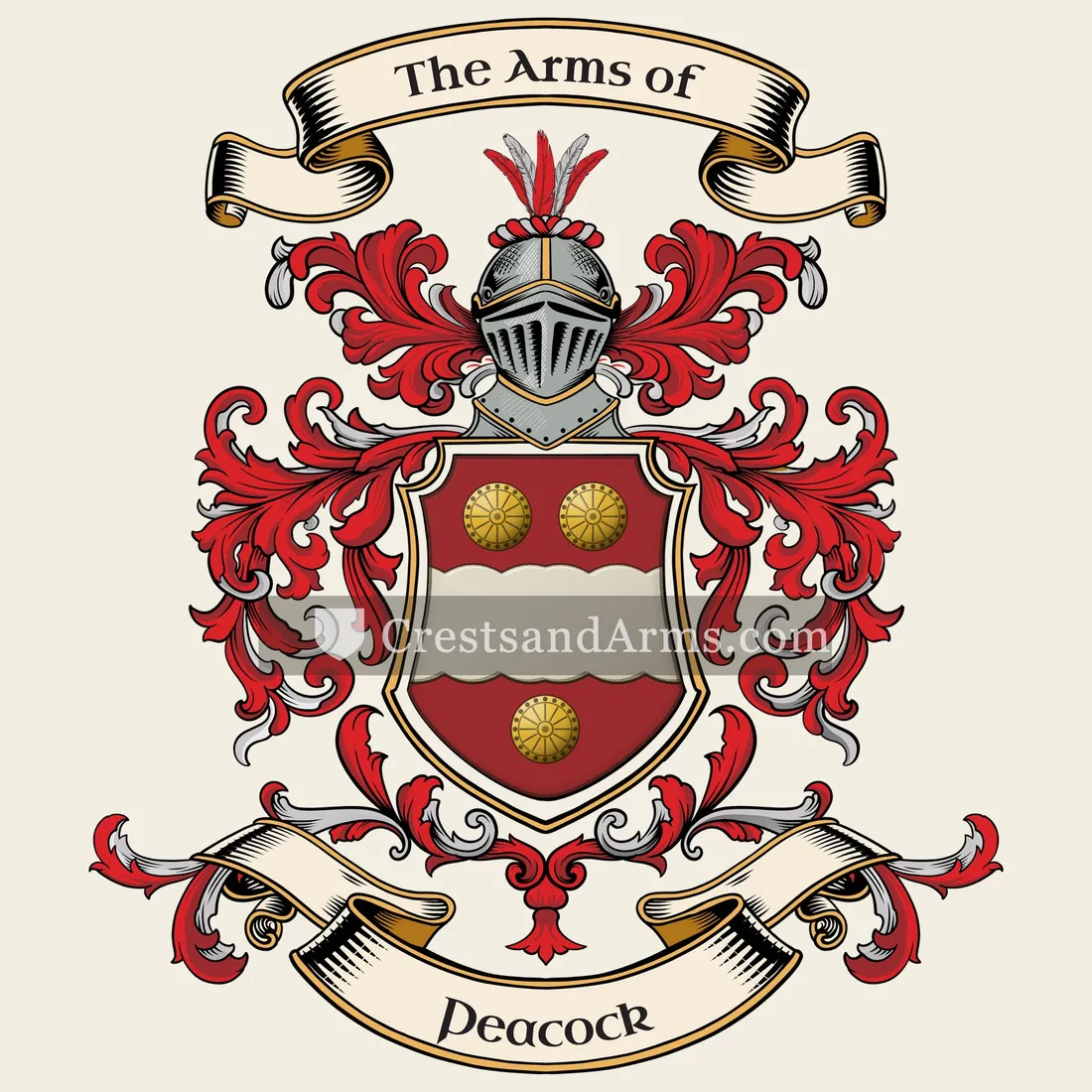
Symbols on this shield
fessThe military belt, and readiness to serve
masclePersuasion and the mail of a knight's coat
ringFidelity, and a promise kept
peacockBeauty, power and knowledge
Colours
Red (Gules)Means: Military strength
Silver (Argent)Means: Peace and sincerity
Gold (Or)Means: Generosity
Historical info
Source
Sir Bernard Burke, The General Armory of England, Scotland, Ireland and Wales, London: Harrison & Sons, 1884
Blazon (the actual original written record)
“Gu. on a fesse engr. ar. betw. three mascles, each within an annulet or, as many peacocks'”
PembrokeStone Hall · Pembroke, c. 1647
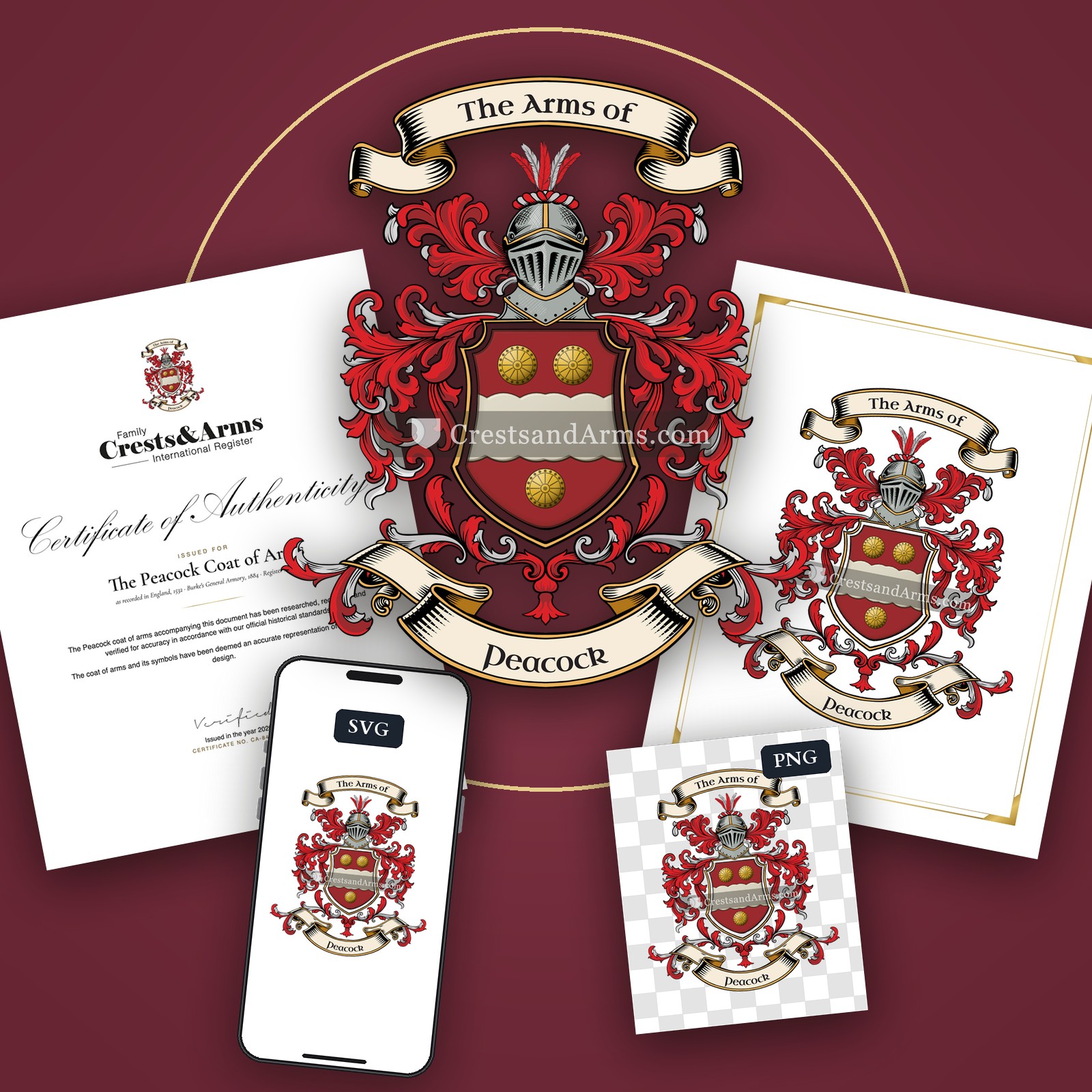
Digital archive packCoat of arms PNG, gold border print PDF, vector SVG and the certificate of authenticity. Sent to your email in minutes.
Map of Wales showing where the Peacock arms are recorded
The Peacock arms were recorded in Pembroke, c. 1647.
Pembrokeshire was settled from England early enough to be called Little England beyond Wales. Its landed families were Norman in origin and held their ground for centuries, which is what put them in the records.
This is where the arms were entered in the register. Families often moved to other parts of the country, so the same name can turn up in more than one region.
The body that granted and recorded arms in Wales in this period.
Charles I of England
Sovereign of the period
Charles I of England
1625–1649
Reigning in England when the Peacock arms are first recorded.
How Arms Worked in Wales
English heraldry allowed arms to be shared by all legitimate descendants of the original owner. These symbols were treated as personal property that moved through the generations to all children. While the eldest son kept the original design, other family members could use the same shield without needing to change it or register their own unique versions.
Granting authority
The College of Arms in London has regulated the use of coats of arms throughout England and Wales since 1484.
How they got arms
Families typically obtained their coats of arms through a formal grant from the Crown or by proving their ancient right to them.
Where arms were recorded
All official coats of arms are recorded in the registers kept at the College of Arms, which date back to the fifteenth century.
The family's standing
Recorded among the armigerous families of Pembroke.
Origin & History of the Peacock Family in Wales
The history of the Peacock name in Wales is deeply rooted in the coastal landscape of Pembrokeshire, where records confirm the family was well-established by 1647. During this period, the region was a melting pot of cultural influences due to its proximity to the sea and its history of trade with England. The name itself likely originated as a descriptive nickname, perhaps referring to a person who possessed a proud demeanor or wore bright, colorful clothing. As the family settled into the local community, they became part of the agricultural and maritime life that defined the Pembrokeshire peninsula. By the mid-seventeenth century, the Peacocks were integrated into the local social fabric, navigating the complex political shifts of the English Civil War era while maintaining their presence in the Welsh countryside. Their survival and growth in this specific region highlight the way families often adapted to the unique linguistic and social environment of western Wales during the early modern period.
Meaning of the Peacock family crest colors & symbols
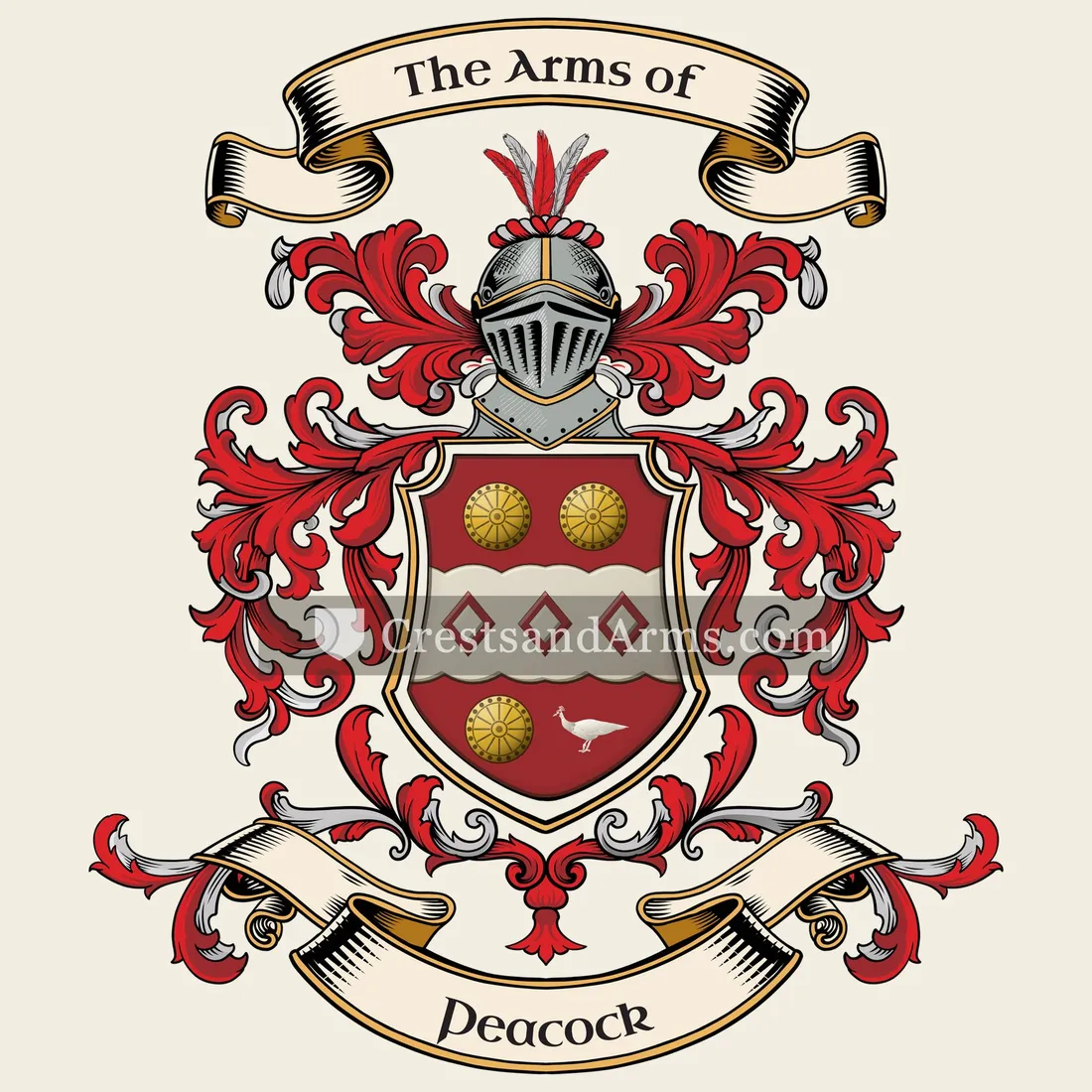
Symbols on this shield
fessThe military belt, and readiness to serve
roundelA coin, and one who has been to the crusades
masclePersuasion and the mail of a knight's coat
peacockBeauty, power and knowledge
Colours
Red (Gules)Means: Military strength
Silver (Argent)Means: Peace and sincerity
Gold (Or)Means: Generosity
Historical info
Source
Sir Bernard Burke, The General Armory of England, Scotland, Ireland and Wales, London: Harrison & Sons, 1884
Blazon (the actual original written record)
“Gu. on a fess engr. ar. betw. three bezants as many mascles ra. in the centre chief point a peacock holding in the beak a thistle leaved ppr”
DownDown, c. 1645
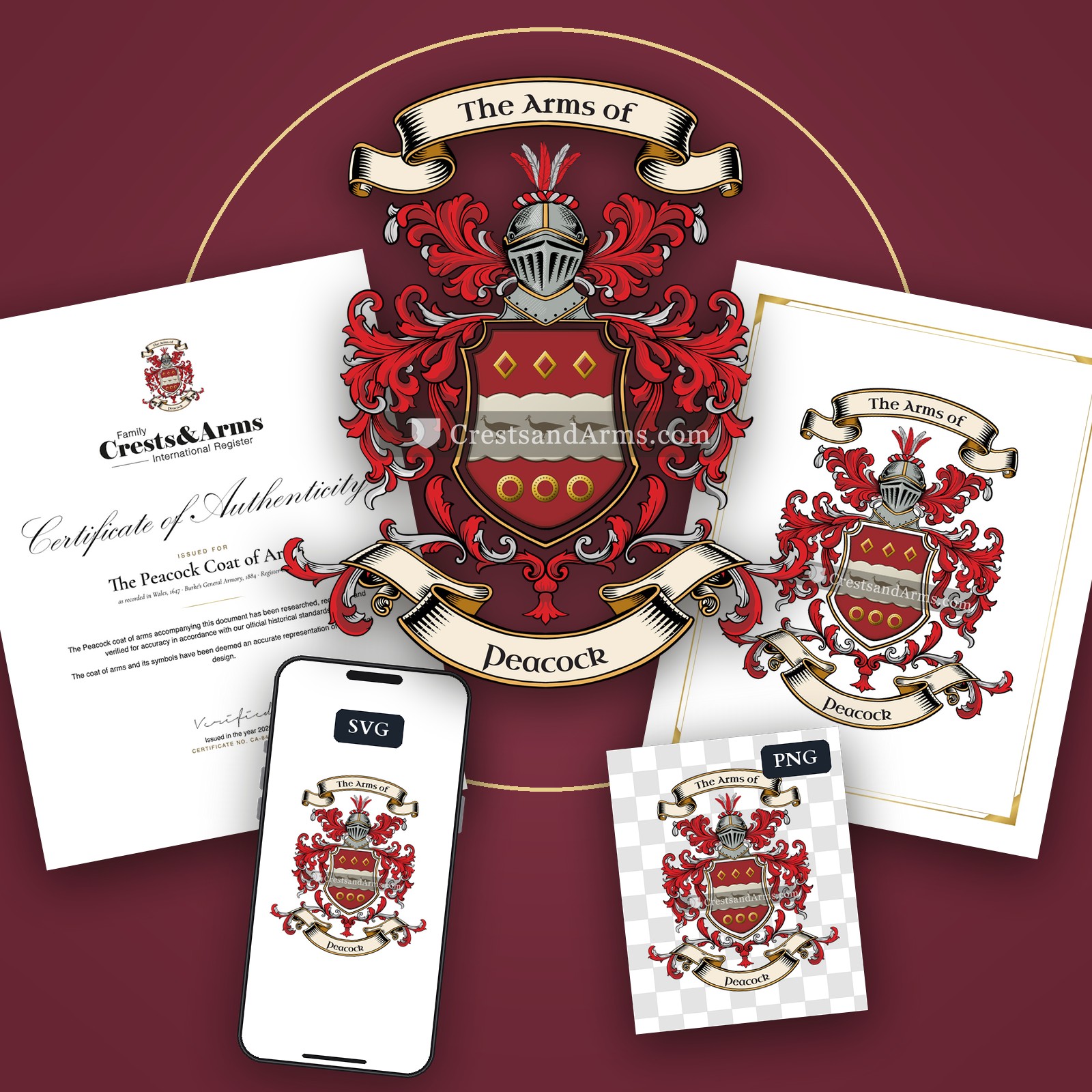
Digital archive packCoat of arms PNG, gold border print PDF, vector SVG and the certificate of authenticity. Sent to your email in minutes.
Map of Ireland showing where the Peacock arms are recorded
The Peacock arms were recorded in Down, c. 1645.
Down was north-eastern Irish country settled from Scotland in the seventeenth century. The new landowners took grants and had them recorded, which is why so many Down families carry documented shields.
This is where the arms were entered in the register. Families often moved to other parts of the country, so the same name can turn up in more than one region.
The body that granted and recorded arms in Ireland in this period.
Charles I of England
Sovereign of the period
Charles I of England
1625–1649
Reigning in England when the Peacock arms are first recorded.
How Arms Worked in Ireland
The Ulster King of Arms granted coats of arms to individuals who proved their social standing and good character. These symbols were typically inherited by all legitimate descendants of the original holder. If a family branch wanted a unique look, they could apply for a specific change to their design through the office to ensure their identity remained distinct.
Granting authority
The Ulster King of Arms acted as the official body that regulated and issued all coats of arms throughout Ireland.
How they got arms
Families obtained their arms through formal grants issued by the office after proving their eligibility and paying the required fees.
Where arms were recorded
All official grants were recorded in the registers held by the Ulster King of Arms starting from the year 1552.
The family's standing
Recorded among the armigerous families of Down.
Origin & History of the Peacock Family in Ireland
The history of the Peacock family in Ireland is deeply rooted in the northern province of Ulster, with documented evidence placing members of the family in County Down by 1645. During the mid-seventeenth century, many families with this surname migrated from Britain to Ireland as part of the broader patterns of settlement and land management occurring at the time. These early settlers often integrated into the local economy as farmers, tradespeople, or merchants, helping to establish the name within the social fabric of the region. Over the following generations, the Peacock family became a consistent presence in the local parish records and community life of County Down. Their transition into Irish society reflects the wider movement of people who sought new opportunities across the Irish Sea during a period of significant political and social change.
Peacock Meaning & Related Branches
Root word
pawa
A Proto-Germanic term referring to the bird species.
This name
PeacockA nickname for a proud or vain person, or an occupational name for a keeper of peacocks.
also spelled
Pecock
Pecocke
Related arms
Blomerrecorded with Peacock, same area
Browningrecorded with Peacock, same area
Cadmanrecorded with Peacock, same area
Cauleyrecorded with Peacock, same area
Documented Sources
Sir Bernard Burke, The General Armory of England, Scotland, Ireland and Wales, London: Harrison & Sons, 1884
Reaney, P.H., A Dictionary of English Surnames, 1958
Bardsley, Charles Wareing, A Dictionary of English and Welsh Surnames, 1901
The National Archives, Letters and Papers, Foreign and Domestic, Henry VIII, Volume 5: 1531-1532
Digital archive packCoat of arms PNG, gold border print PDF, vector SVG and the certificate of authenticity. Sent to your email in minutes.


 fessThe military belt, and readiness to serve
 roundelA coin, and one who has been to the crusades
 fessThe military belt, and readiness to serve
 roundelA coin, and one who has been to the crusades


 masclePersuasion and the mail of a knight's coat
 ringFidelity, and a promise kept
 peacockBeauty, power and knowledge