Map of England showing where the Peake arms are recorded
The Peake arms were recorded in Leicester, c. 1598.
Leicestershire was grazing country, and wool and cattle made steady money rather than spectacular fortunes. Steady money bought manors, and manors are what brought families into the registers.
This is where the arms were entered in the register. Families often moved to other parts of the country, so the same name can turn up in more than one region.
The body that granted and recorded arms in England in this period.
Elizabeth I of England
Sovereign of the period
Elizabeth I of England
1558–1603
Reigning in England when the Peake arms are first recorded.
How Arms Worked in England
English heraldry allowed arms to be shared by all legitimate descendants of the original owner. These symbols were treated as personal property that moved through the generations to all children. While the eldest son kept the original design, other family members could use the same shield without needing to change it or register their own unique versions.
Granting authority
The College of Arms in London has regulated the use of coats of arms throughout England and Wales since 1484.
How they got arms
Families typically obtained their coats of arms through a formal grant from the Crown or by proving their ancient right to them.
Where arms were recorded
All official coats of arms are recorded in the registers kept at the College of Arms, which date back to the fifteenth century.
The family's standing
Recorded among the armigerous families of Leicester.
Origin & History of the Peake Family in England
The surname Peake originated in England as a topographical name, which means it was used to describe the landscape where a person lived. The name is derived from the Old English word "peac," referring to a pointed hill or a peak. Families who took this name often lived near prominent hills or mountainous regions, particularly in the northern parts of the country. By the late sixteenth century, the name had spread into the English Midlands, with documented records confirming that members of the Peake family were well-established in Leicester by 1598. During this era, the family likely participated in the agricultural and trade life of the town, as surnames were becoming permanent markers of identity passed down through generations. These early ancestors were part of a growing class of English citizens whose names reflected their connection to the specific geography of their local communities.
Coat of Arms & Family Crest Details
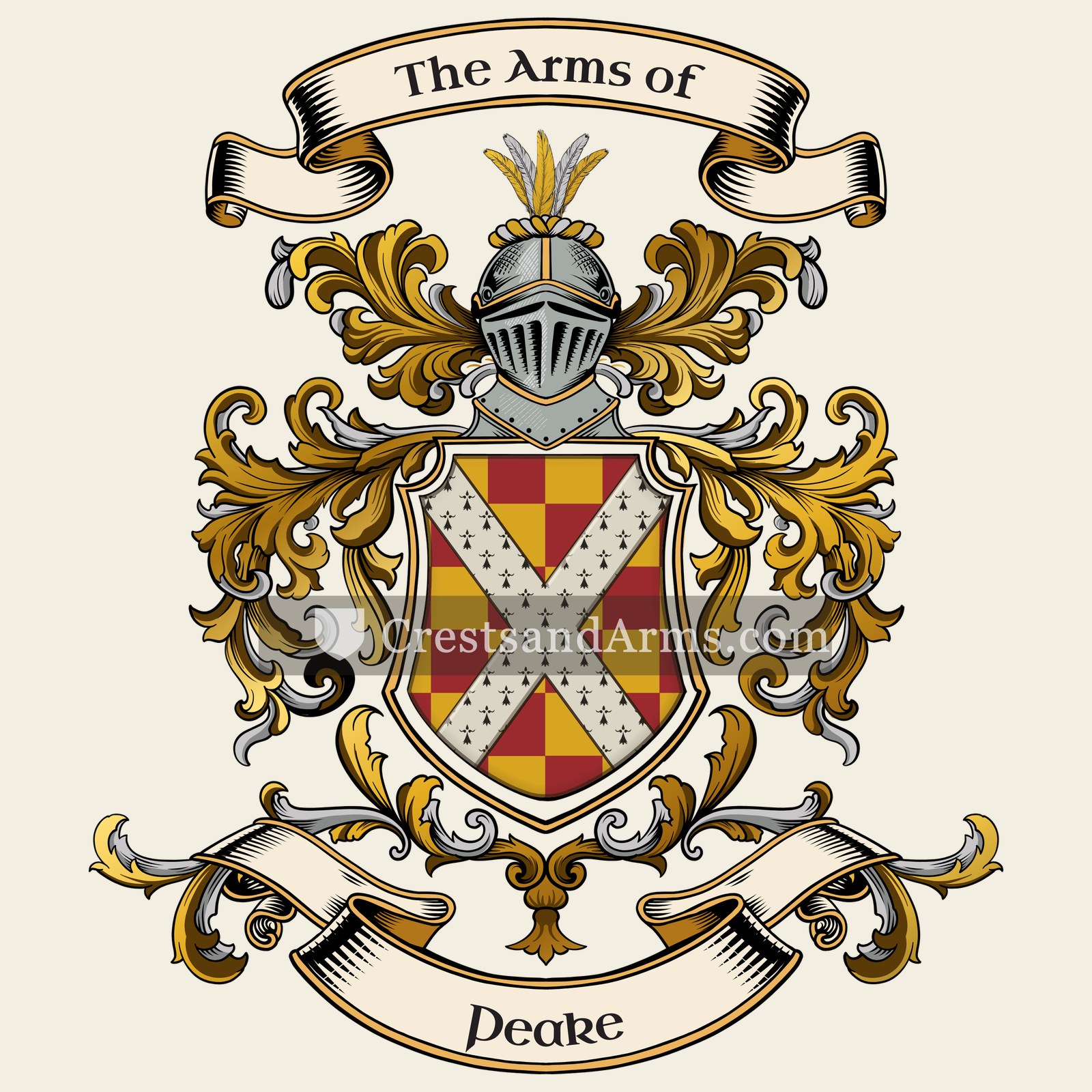
Symbols on this shield
chequyConstancy, and the counting-board
saltireResolution, and St Andrew's cross
Colours
Gold (Or)Means: Generosity
ErmineMeans: Dignity
Red (Gules)Means: Military strength
Historical info
Source
Sir Bernard Burke, The General Armory of England, Scotland, Ireland and Wales, London: Harrison & Sons, 1884
Blazon (the actual original written record)
“Chequy, or and gu. a saltire erm”
Walesc. 1647
Digital archive packCoat of arms PNG, gold border print PDF, vector SVG and the certificate of authenticity. Sent to your email in minutes.
Map of Wales showing where the Peake arms are recorded
The Peake arms were recorded in Wales, c. 1647.
Arms such as these were typically recorded in Denbigh.
Denbighshire was north Welsh country of hills and small estates. Land was held by a great many families rather than a few, and each holding brought its own claim to a coat of arms.
This is where the arms were entered in the register. Families often moved to other parts of the country, so the same name can turn up in more than one region.
The body that granted and recorded arms in Wales in this period.
Charles I of England
Sovereign of the period
Charles I of England
1625–1649
Reigning in England when the Peake arms are first recorded.
How Arms Worked in Wales
English heraldry allowed arms to be shared by all legitimate descendants of the original owner. These symbols were treated as personal property that moved through the generations to all children. While the eldest son kept the original design, other family members could use the same shield without needing to change it or register their own unique versions.
Granting authority
The College of Arms in London has regulated the use of coats of arms throughout England and Wales since 1484.
How they got arms
Families typically obtained their coats of arms through a formal grant from the Crown or by proving their ancient right to them.
Where arms were recorded
All official coats of arms are recorded in the registers kept at the College of Arms, which date back to the fifteenth century.
The family's standing
Recorded among the armigerous families of Wales.
Origin & History of the Peake Family in Wales
The family name Peake has deep roots in the Welsh landscape, particularly within the historic county of Denbighshire. By the mid-seventeenth century, the family was firmly established in the town of Denbigh, as evidenced by records dating back to 1647. The name itself is topographical in origin, likely derived from the Middle English word "peak," which referred to someone who lived near a prominent hill or a pointed mountain summit. In the context of North Wales, this suggests that early ancestors were identified by their proximity to the rugged, elevated terrain characteristic of the region. As the family integrated into the local community, they became part of the social fabric of Denbigh, a town known for its medieval castle and strategic importance. Their presence in the area during the 1640s places them in the middle of a turbulent period in Welsh history, reflecting a time when families were deeply connected to the specific geography and local governance of their home parishes.
Related Branches & Arms
Root word
Pec
Old English term for a pointed hill or mountain peak.
This name
PeakeA topographical name for someone who lived near a prominent hill or mountain summit.
also spelled
Peke
Peeke
Related arms
Bowyersimilar arms
Peaksimilar arms
Peekvariant spelling
Pekevariant spelling
Documented Sources
Sir Bernard Burke, The General Armory of England, Scotland, Ireland and Wales, London: Harrison & Sons, 1884
Bardsley, Charles Wareing, A Dictionary of English and Welsh Surnames, 1901
Reaney, Percy Hide, A Dictionary of British Surnames, 1958
Leicestershire, Leicester and Rutland Record Office, Records of the Borough of Leicester, 1598
Digital archive packCoat of arms PNG, gold border print PDF, vector SVG and the certificate of authenticity. Sent to your email in minutes.


 cross symbolChristian faith and service
 fleur de lisPurity, light, and the sixth son
 cross symbolChristian faith and service
 fleur de lisPurity, light, and the sixth son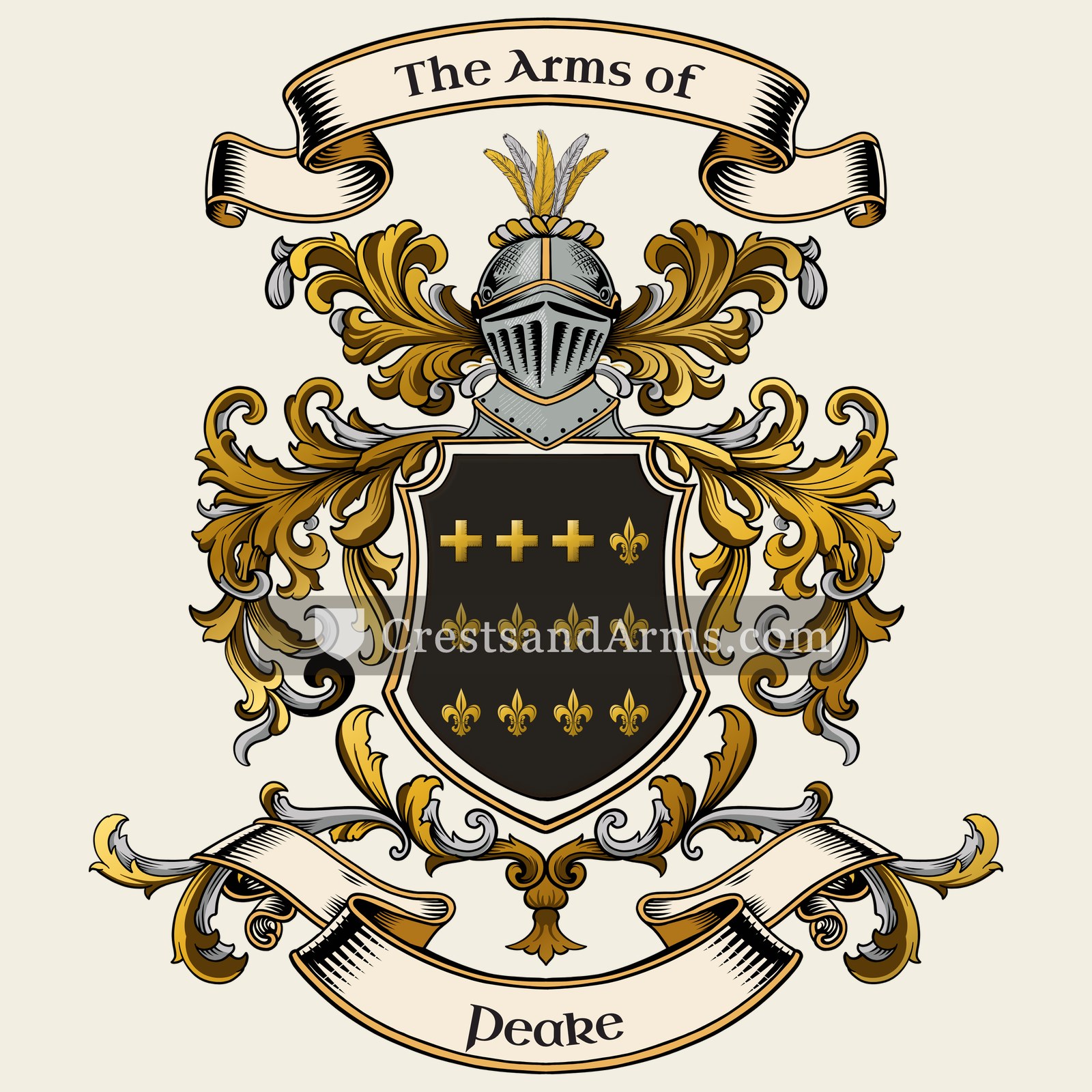


 chequyConstancy, and the counting-board
 saltireResolution, and St Andrew's cross