Map of England showing where the Pearce arms are recorded
The Pearce arms were recorded in Cornwall, c. 1620.
Cornwall was a county apart, with its own language and its own tight-knit gentry. Tin and the sea made money there, and families who made it bought land, which is what brought arms with it.
This is where the arms were entered in the register. Families often moved to other parts of the country, so the same name can turn up in more than one region.
The body that granted and recorded arms in England in this period.
James VI and I
Sovereign of the period
James VI and I
1603–1625
Reigning in England when the Pearce arms are first recorded.
How Arms Worked in England
English heraldry allowed arms to be shared by all legitimate descendants of the original owner. These symbols were treated as personal property that moved through the generations to all children. While the eldest son kept the original design, other family members could use the same shield without needing to change it or register their own unique versions.
Granting authority
The College of Arms in London has regulated the use of coats of arms throughout England and Wales since 1484.
How they got arms
Families typically obtained their coats of arms through a formal grant from the Crown or by proving their ancient right to them.
Where arms were recorded
All official coats of arms are recorded in the registers kept at the College of Arms, which date back to the fifteenth century.
The family's standing
Recorded among the armigerous families of Cornwall.
Origin & History of the Pearce Family in England
The surname Pearce is a patronymic name, which means it originated as a way to identify a person as the son of someone named Peter. The name became popular in England following the arrival of the Normans, who brought the French version of the name, Piers, into common use. By the time the name became firmly established in Cornwall during the early 17th century, it had evolved into various spellings like Pearce, Pierce, and Pearse. Families in Cornwall often lived in small, tight-knit mining or farming communities where the name became deeply rooted in the local landscape. These early ancestors were part of a regional culture that valued strong family ties and local identity. As the 1620s approached, the Pearce family was already well-integrated into the social fabric of the Cornish peninsula, contributing to the unique history and development of the region.
Coat of Arms & Family Crest Details
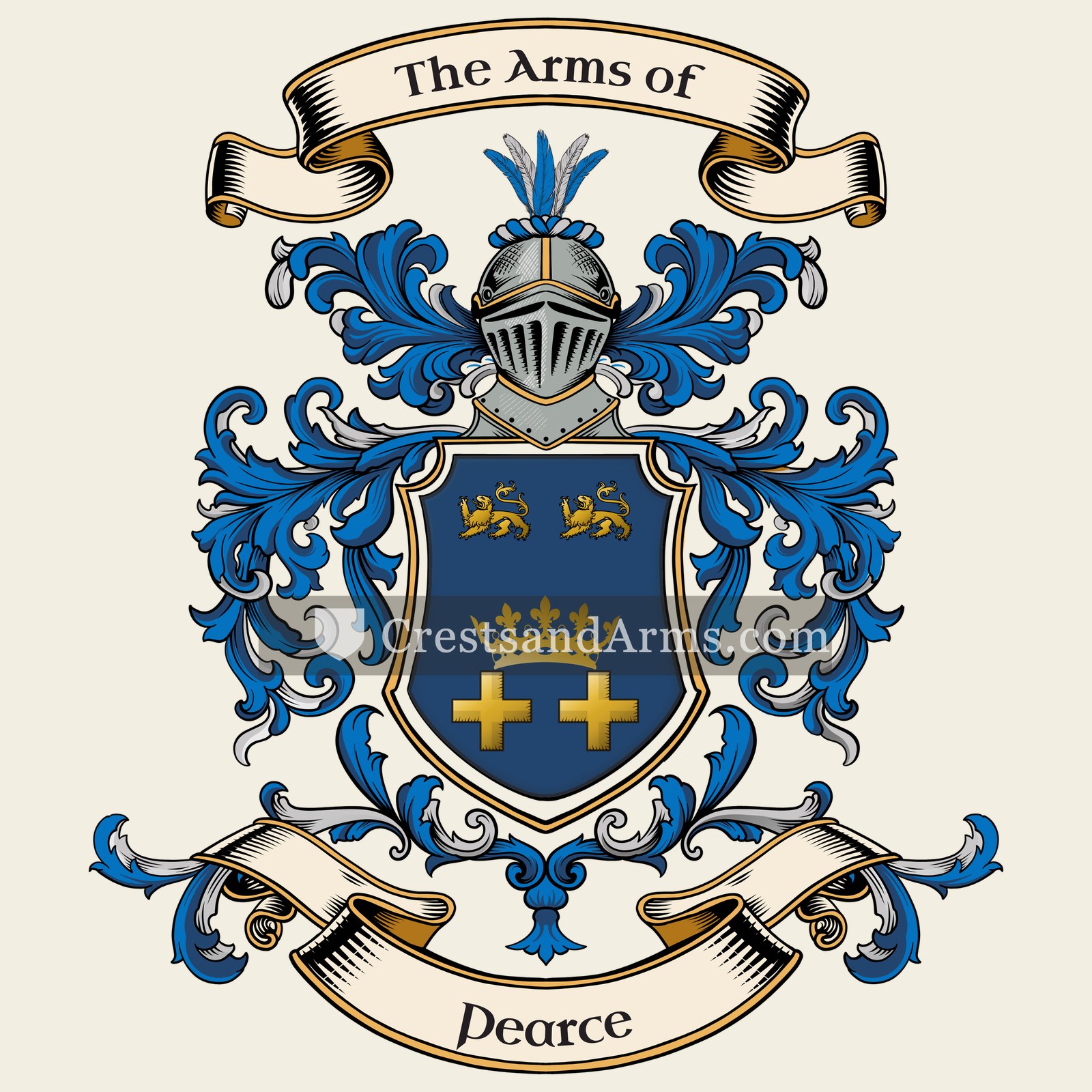
Symbols on this shield
cross symbolChristian faith and service
crownSovereignty, authority and just reward
lionCourage, strength and royalty
Colours
Blue (Azure)Means: Loyalty and truth
Gold (Or)Means: Generosity
Historical info
Source
Sir Bernard Burke, The General Armory of England, Scotland, Ireland and Wales, London: Harrison & Sons, 1884
Blazon (the actual original written record)
“Az. a mural crown betw. two lions pass. in chief and as many cross crosslets fitchée in base or”
BreconFfrwdgreech · Brecon, c. 1647
Digital archive packCoat of arms PNG, gold border print PDF, vector SVG and the certificate of authenticity. Sent to your email in minutes.
Map of Wales showing where the Pearce arms are recorded
The Pearce arms were recorded in Brecon, c. 1647.
Brecon was mid-Welsh hill country, held in small estates by families who stayed for generations. Land was worth less than in the lowlands, but holding it still brought arms.
This is where the arms were entered in the register. Families often moved to other parts of the country, so the same name can turn up in more than one region.
The body that granted and recorded arms in Wales in this period.
Charles I of England
Sovereign of the period
Charles I of England
1625–1649
Reigning in England when the Pearce arms are first recorded.
How Arms Worked in Wales
English heraldry allowed arms to be shared by all legitimate descendants of the original owner. These symbols were treated as personal property that moved through the generations to all children. While the eldest son kept the original design, other family members could use the same shield without needing to change it or register their own unique versions.
Granting authority
The College of Arms in London has regulated the use of coats of arms throughout England and Wales since 1484.
How they got arms
Families typically obtained their coats of arms through a formal grant from the Crown or by proving their ancient right to them.
Where arms were recorded
All official coats of arms are recorded in the registers kept at the College of Arms, which date back to the fifteenth century.
The family's standing
Recorded among the armigerous families of Brecon.
Origin & History of the Pearce Family in Wales
The surname Pearce is a patronymic name, meaning it originated as a way to identify a person as the son of a man named Piers or Peter. In the context of Wales, the name became established as families moved away from the traditional Welsh naming system of using "ap" to denote lineage. By the mid-seventeenth century, the name was firmly rooted in the landscape of Breconshire. Records confirm that members of the Pearce family were settled in the town of Brecon by 1647, a period marked by the aftermath of the English Civil War. During this time, families in the region were transitioning toward fixed surnames to comply with administrative changes and legal requirements. The presence of the name in Brecon suggests that these early ancestors were likely involved in the local trade or agricultural life that defined this historic market town. As the family integrated into the community, the name Pearce became a permanent fixture of the local records, reflecting the broader social shift toward hereditary naming conventions across the Welsh borderlands.
Pearce Meaning & Related Branches
Root word
Petrus
A Latin name derived from the Greek word for stone or rock.
This name
PearceA patronymic surname meaning son of Peter, denoting a steadfast or reliable person.
also spelled
Pearse
Pierce
Piers
Related arms
Peirsesimilar arms
Pearchevariant spelling
Pearsevariant spelling
Peircevariant spelling
Documented Sources
Sir Bernard Burke, The General Armory of England, Scotland, Ireland and Wales, London: Harrison & Sons, 1884
Reaney, P.H., A Dictionary of English Surnames, 1958
Cornwall Archives, Parish Registers of Cornwall, 1600–1650
Hanks, Patrick and Hodges, Flavia, A Dictionary of Surnames, 1988
Digital archive packCoat of arms PNG, gold border print PDF, vector SVG and the certificate of authenticity. Sent to your email in minutes.


 fessThe military belt, and readiness to serve
 roundelA coin, and one who has been to the crusades
 pelicanSelf-sacrifice and devotion to one's children
 fessThe military belt, and readiness to serve
 roundelA coin, and one who has been to the crusades
 pelicanSelf-sacrifice and devotion to one's children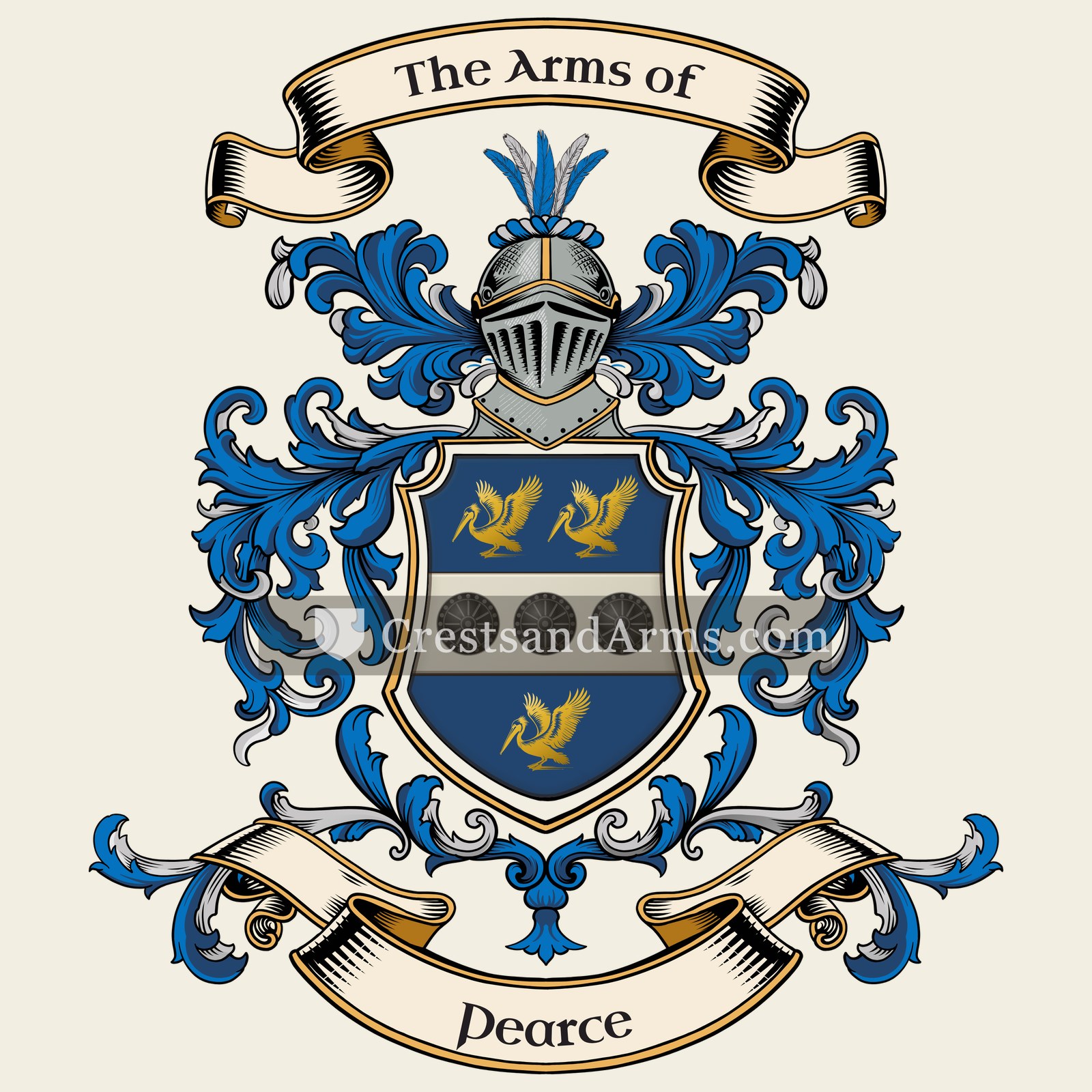


 cross symbolChristian faith and service
 crownSovereignty, authority and just reward
 lionCourage, strength and royalty