Map of England showing where the Pearson arms are recorded
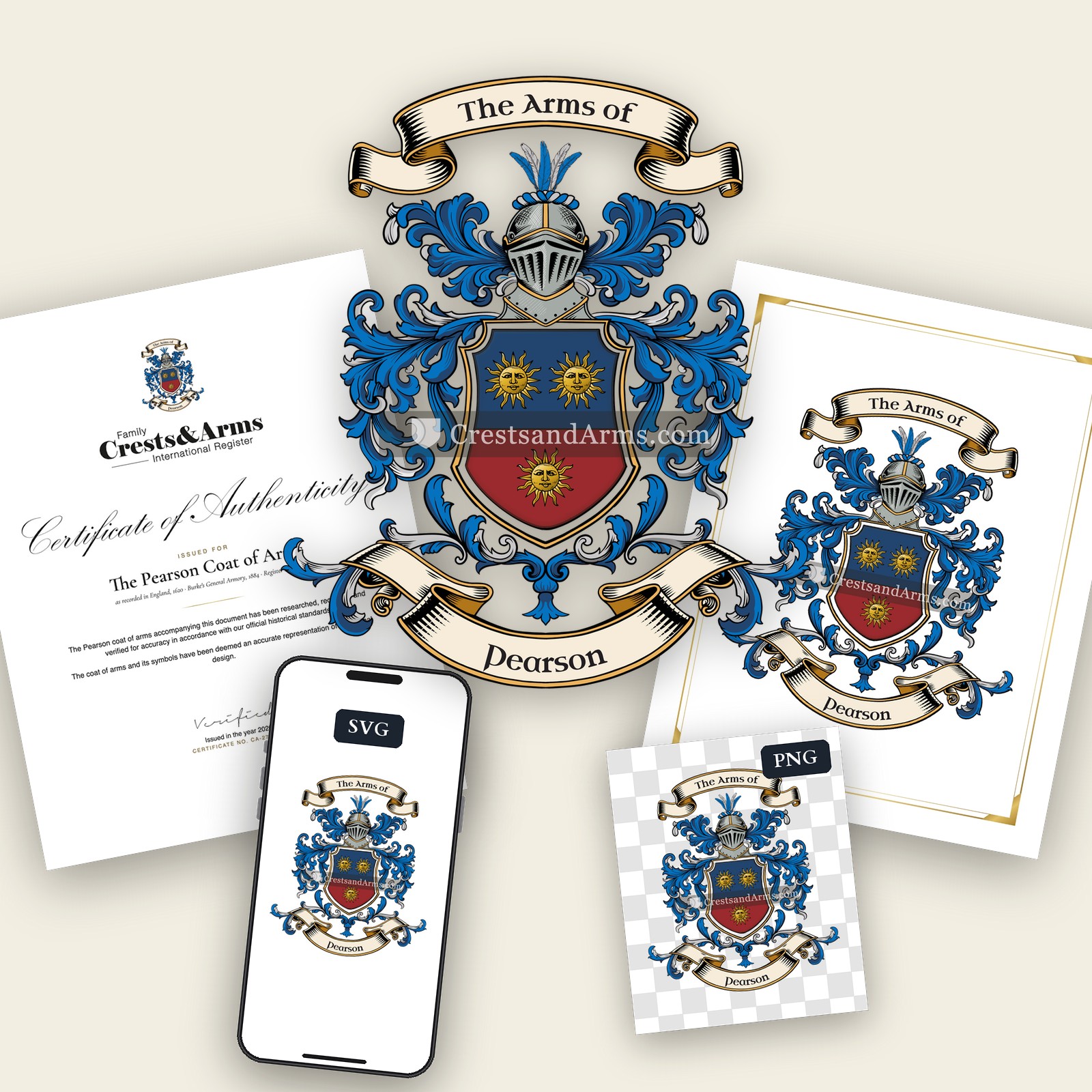
The Pearson arms were recorded in London, c. 1620.
This is where the arms were entered in the register. Families often moved to other parts of the country, so the same name can turn up in more than one region.
The body that granted and recorded arms in England in this period.
James VI and I
Sovereign of the period
James VI and I
1603–1625
Reigning in England when the Pearson arms are first recorded.
How Arms Worked in England
English heraldry allowed arms to be shared by all legitimate descendants of the original owner. These symbols were treated as personal property that moved through the generations to all children. While the eldest son kept the original design, other family members could use the same shield without needing to change it or register their own unique versions.
Granting authority
The College of Arms in London has regulated the use of coats of arms throughout England and Wales since 1484.
How they got arms
Families typically obtained their coats of arms through a formal grant from the Crown or by proving their ancient right to them.
Where arms were recorded
All official coats of arms are recorded in the registers kept at the College of Arms, which date back to the fifteenth century.
The family's standing
Recorded among the armigerous families of England.
Origin & History of the Pearson Family in England
The surname Pearson originated in medieval England as a patronymic name, which means it was derived from the name of a father or ancestor. It is a variation of "Peter’s son," signaling that the earliest individuals to carry the name were identified as the children of a man named Peter. Over time, the spelling evolved through various forms like Pierson or Peerson as regional dialects shifted and literacy became more common. By the early 17th century, the family had established a notable presence in London, a bustling hub of commerce and migration. Records from this era show that members of the Pearson family were active participants in the city’s growing social and economic life, contributing to the professional and merchant classes that defined London during the reign of King James I. This period marked a time of significant transition, as families began to solidify their identities and settle into the urban landscape that would shape their future generations.
Meaning of the Pearson family crest colors & symbols
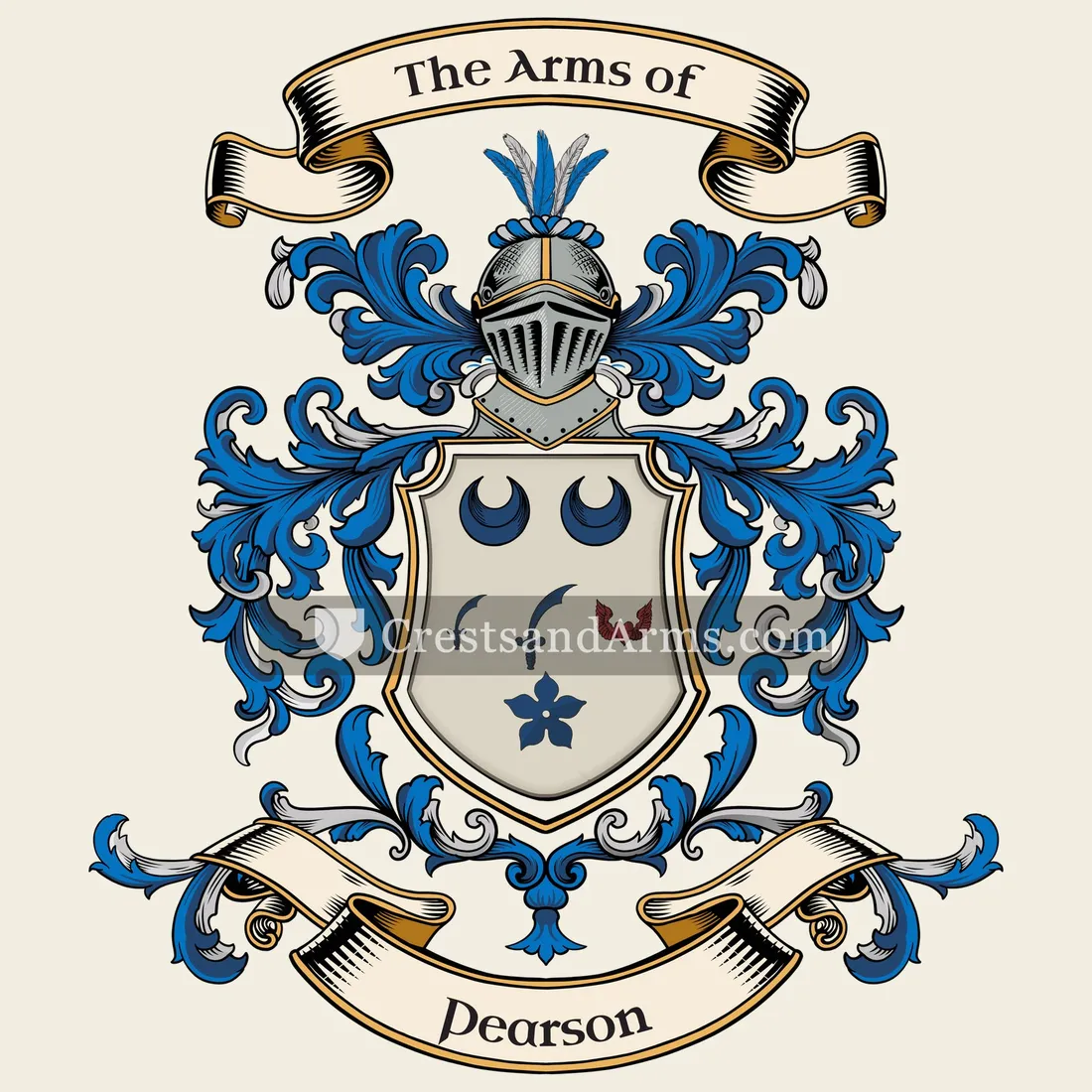
Symbols on this shield
swordJustice, and military honour
heartSincerity, charity and true affection
crescentHonour by the sovereign, and the second son
cinquefoilHope and joy
Colours
Silver (Argent)Means: Peace and sincerity
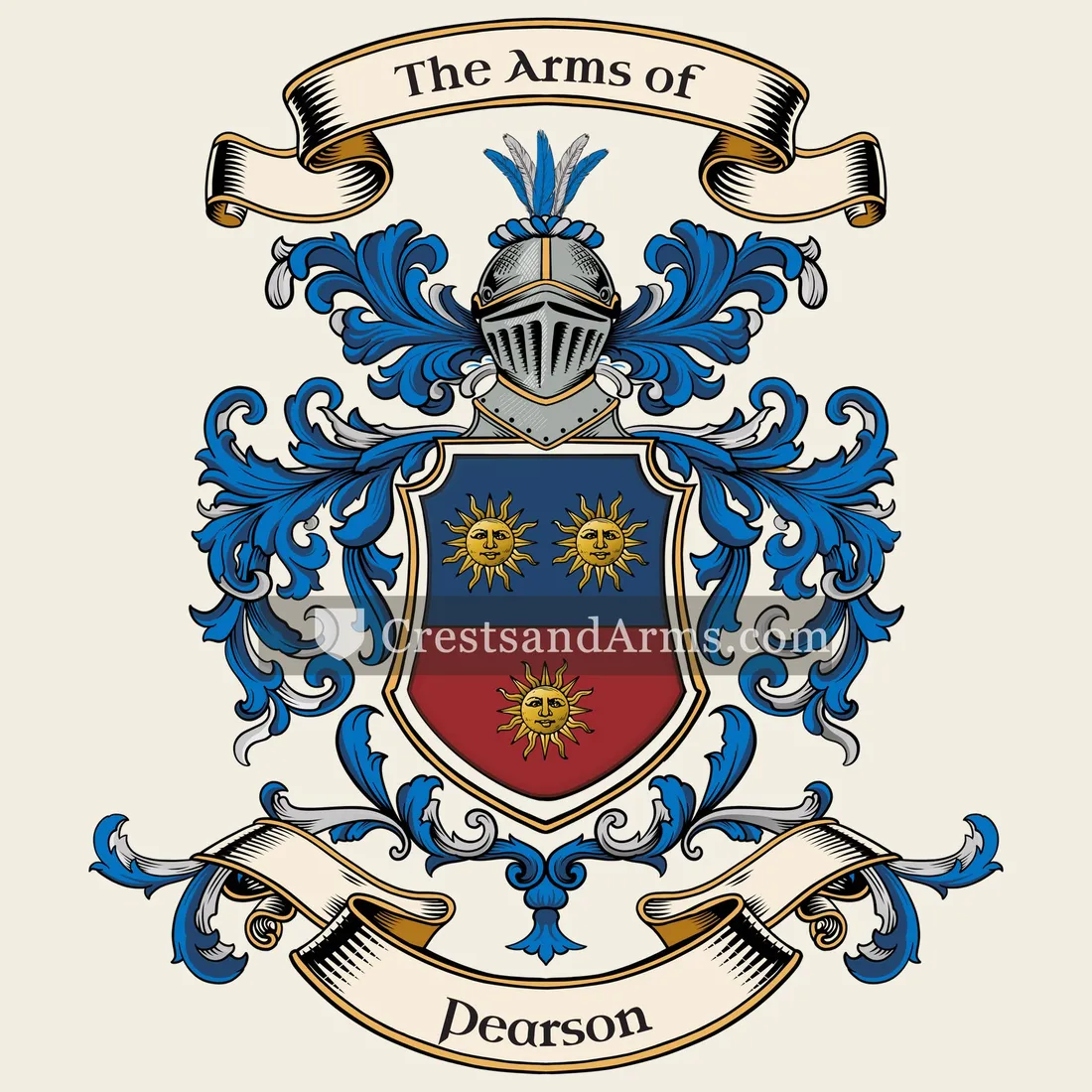
Blue (Azure)Means: Loyalty and truth
Red (Gules)Means: Military strength
Historical info
Source
Sir Bernard Burke, The General Armory of England, Scotland, Ireland and Wales, London: Harrison & Sons, 1884
Blazon (the actual original written record)
“Ar. two swords chevronways az. hilted and pomnelled or, piercing a heart gu. betw. two crescents in chief and a cinquefoil in base of the second”
ForfarWesthall · Forfar, c. 1672
Digital archive packCoat of arms PNG, gold border print PDF, vector SVG and the certificate of authenticity. Sent to your email in minutes.
Map of Scotland showing where the Pearson arms are recorded
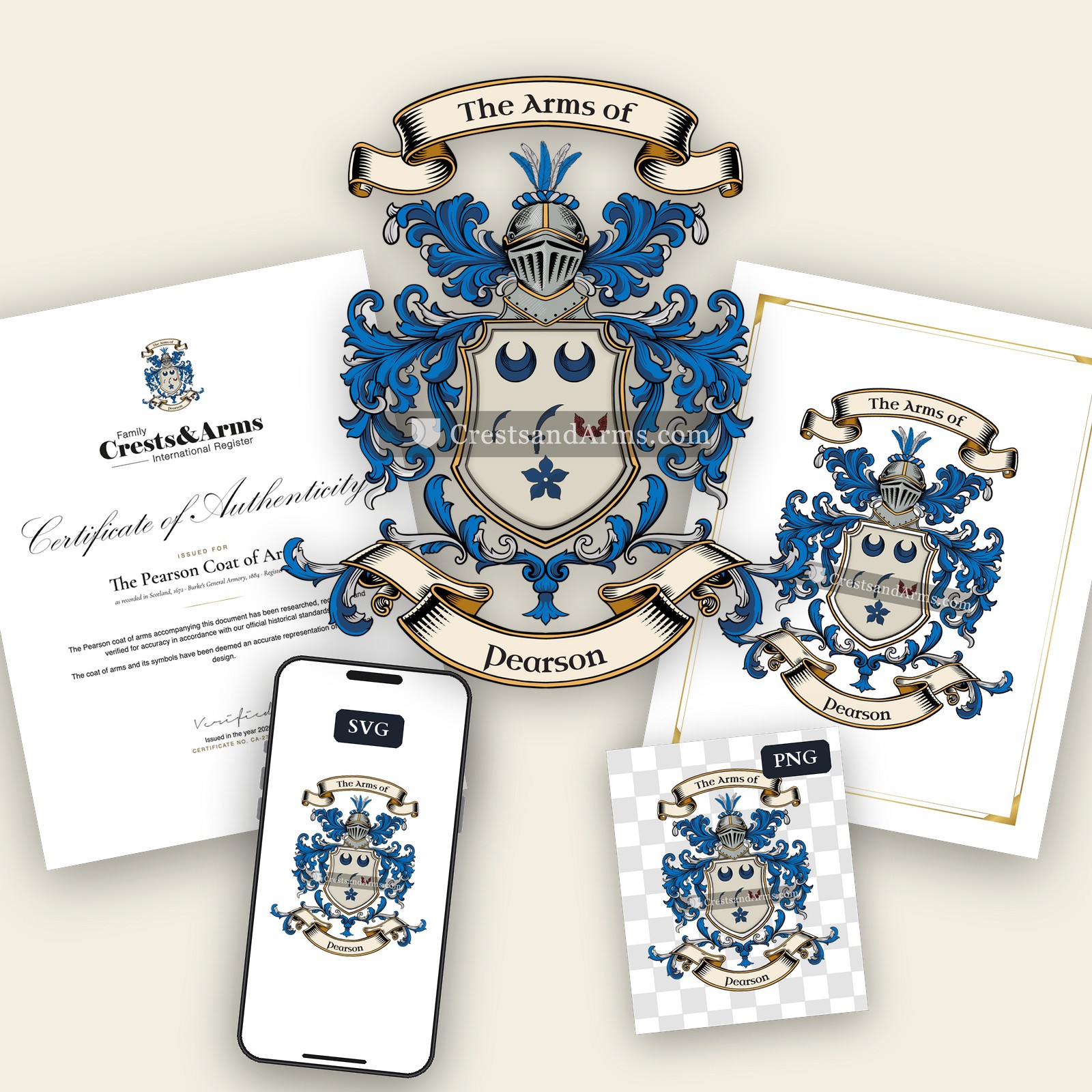
The Pearson arms were recorded in Forfar, c. 1672.
Forfar, now called Angus, was farming country on Scotland's east coast between the hills and the sea. Its landed families were long-settled, and long settlement is exactly what fills a register of arms.
This is where the arms were entered in the register. Families often moved to other parts of the country, so the same name can turn up in more than one region.
The body that granted and recorded arms in Scotland in this period.
Charles II of England
Sovereign of the period
Charles II of England
1660–1685
Reigning in England when the Pearson arms are first recorded.
How Arms Worked in Scotland
Scottish heraldry is unique because it treats a coat of arms as a piece of personal property protected by law. Only one person can own a specific design at any given time. When a family grows, the head keeps the original shield while other relatives must apply for their own distinct version with slight changes to prove their specific identity.
Granting authority
The Court of the Lord Lyon acts as the official body that regulates and controls all heraldic matters throughout Scotland.
How they got arms
Individuals obtain a legal right to their arms through a formal petition process that confirms their identity and family connection.
Where arms were recorded
All valid coats of arms are officially entered into the Public Register of All Arms and Bearings starting from 1672.
The family's standing
Recorded among the armigerous families of Forfar.
Origin & History of the Pearson Family in Scotland
The surname Pearson is a patronymic name, which means it originated as a way to identify a person as the son of Peter. In Scotland, the name became well-established by the late seventeenth century, particularly in the region of Forfar. Historical records confirm that members of the Pearson family were active in this area by 1672, likely living as farmers, tradesmen, or members of the local burgh community. During this period, families often settled in specific Scottish counties where they built long-standing connections to the land and local government. Because the name was tied to a common given name, it appeared independently in various locations, but the Forfar branch represents a significant point of origin for those tracing their roots back to the Scottish Lowlands. These early Pearsons were part of the social fabric of the region, participating in the daily life and legal documentation that defined life in seventeenth-century Scotland.
Pearson Meaning & Related Branches
Root word
Petrus
A Greek word meaning stone or rock.
This name
PearsonA patronymic surname meaning son of Peter.
also spelled
Pierson
Peerson
Person
Related arms
Peersonvariant spelling
Peirsonvariant spelling
Personvariant spelling
Piersonvariant spelling
Documented Sources
Sir Bernard Burke, The General Armory of England, Scotland, Ireland and Wales, London: Harrison & Sons, 1884
Reaney, P.H. and Wilson, R.M., A Dictionary of English Surnames, 1991
Cottle, Basil, The Penguin Dictionary of Surnames, 1967
The National Archives (UK), Records of the Prerogative Court of Canterbury, PROB 11 (Wills and testaments from the early 17th century)
Digital archive packCoat of arms PNG, gold border print PDF, vector SVG and the certificate of authenticity. Sent to your email in minutes.


 sunGlory, splendour and the source of life
 sunGlory, splendour and the source of life


 swordJustice, and military honour
 heartSincerity, charity and true affection
 crescentHonour by the sovereign, and the second son
 cinquefoilHope and joy