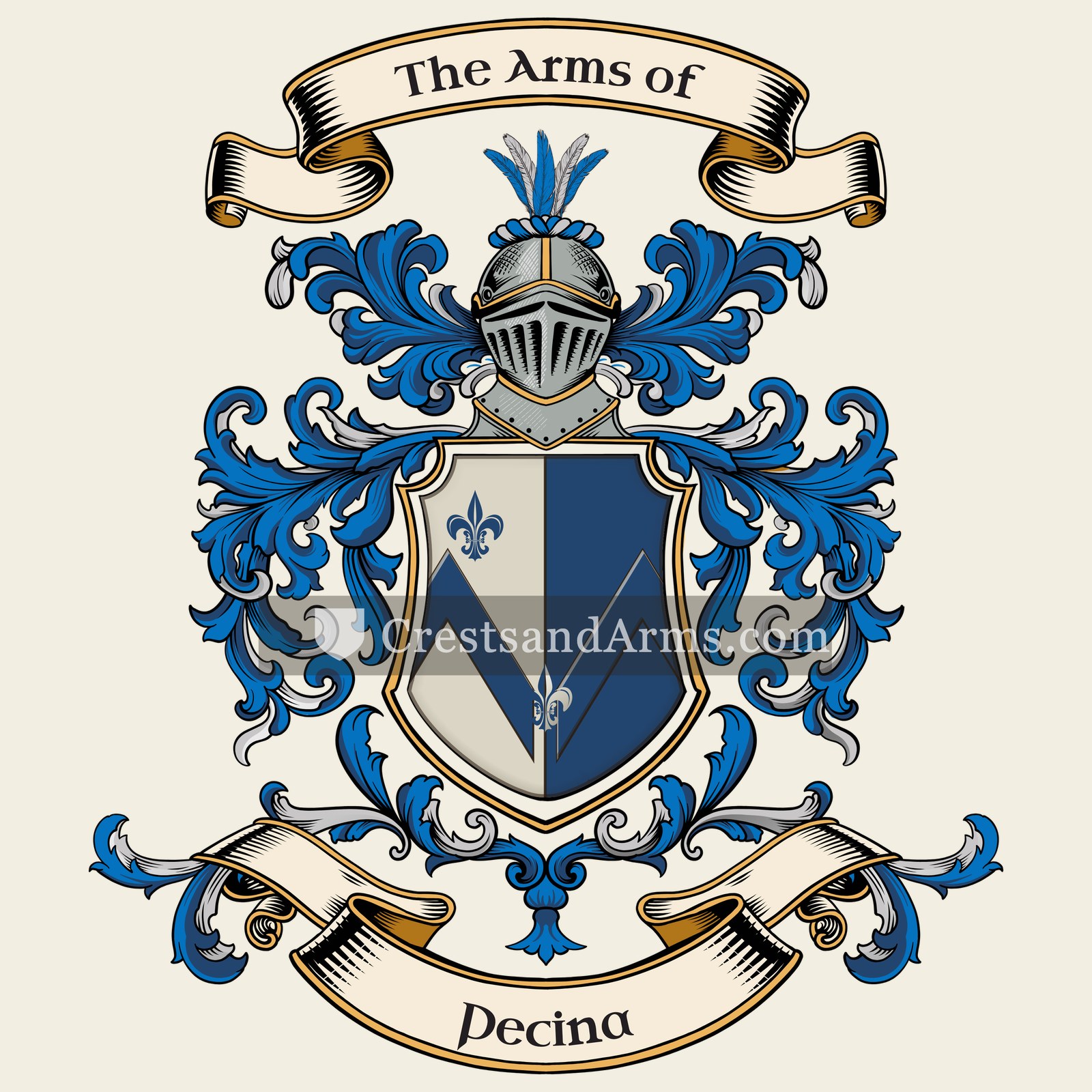
A record of documented arms, meaning and origin, researched for the Pecina family of Italy.
Reg. 3221 · Italian, P–S
Coat of Arms & Family Crest Details
Symbols on this shield
chevronProtection, and faithful service completed
fleur de lisPurity, light, and the sixth son
Colours
Silver (Argent)Means: Peace and sincerity
Blue (Azure)Means: Loyalty and truth
Historical info
Source
J. B. Rietstap, Armorial Général, Gouda: G. B. van Goor Zonen, 1884–87
Blazon (the actual original written record)
“Parti d'arg. et d'azur; au chev. de l'un en l'autre, acc. en chef à dextre d'une fleur-de-lis d'azur et en p. d'une autre fleur-de-lis de l'un en l'autre.”
VeniceVenice, c. 1775
Digital archive packCoat of arms PNG, gold border print PDF, vector SVG and the certificate of authenticity. Sent to your email in minutes.
Map of Italy showing where the Pecina arms are recorded
The Pecina arms were recorded in Venice, c. 1775.
Venice ran on trade, and its great families were merchants before they were anything else. The city kept a formal list of its noble houses, and a name on that list carried arms as a matter of record.
This is where the arms were entered in the register. Families often moved to other parts of the country, so the same name can turn up in more than one region.
The body that granted and recorded arms in Italy in this period.
Alvise Giovanni Mocenigo
Sovereign of the period
Alvise Giovanni Mocenigo
1763–1778
Reigning in Italy when the Pecina arms are first recorded.
How Arms Worked in Italy
In the Italian states, coats of arms were often used by noble families to show their status and history. These symbols were passed down through the generations to all legitimate male descendants. Younger branches of a family usually kept the original design but sometimes added small changes to distinguish their specific line from the main branch.
Granting authority
Various local rulers and city governments controlled the use of coats of arms across the different Italian states.
How they got arms
Families often assumed their own arms or received them as official grants from local lords, popes, or city councils.
Where arms were recorded
Arms were recorded in local city archives or private family books rather than in one single national register.
The family's standing
Recorded among the armigerous families of Venice.
Origin & History of the Pecina Family in Italy
The surname Pecina carries a rich history tied to the movement of people across the Adriatic region. By the year 1775, family members were well-established in Venice, a city that served as a major hub for trade and cultural exchange between Italy and the Balkans. The name itself is thought to be derived from Slavic roots, often associated with the word for an oven or a hearth. This suggests that the earliest ancestors may have been skilled craftsmen, bakers, or individuals who held a central role in their local communities. As these families migrated toward the Venetian Republic, they became part of a diverse urban population that helped shape the maritime and commercial success of the city during the late eighteenth century. Their presence in Venice highlights a long tradition of mobility and adaptation as the family integrated into the social fabric of one of Europe's most significant historical centers.
Related Branches & Arms
Root word
Pecus
Latin term for cattle, livestock, or wealth in the form of animals.
This name
PecinaA topographic or occupational name referring to a shepherd, herdsman, or someone who tended livestock.
also spelled
Pecine
Pesin
Pekin
Documented Sources
J. B. Rietstap, Armorial Général, Gouda: G. B. van Goor Zonen, 1884–87
Archivio di Stato di Venezia, Anagrafi di cittadini e forestieri, 1775
Kovačec, August, Hrvatski prezimenik, 2008
Simoni, Anna, I cognomi di origine slava nel Veneto, 1994
Digital archive packCoat of arms PNG, gold border print PDF, vector SVG and the certificate of authenticity. Sent to your email in minutes.


 chevronProtection, and faithful service completed
 fleur de lisPurity, light, and the sixth son
 chevronProtection, and faithful service completed
 fleur de lisPurity, light, and the sixth son