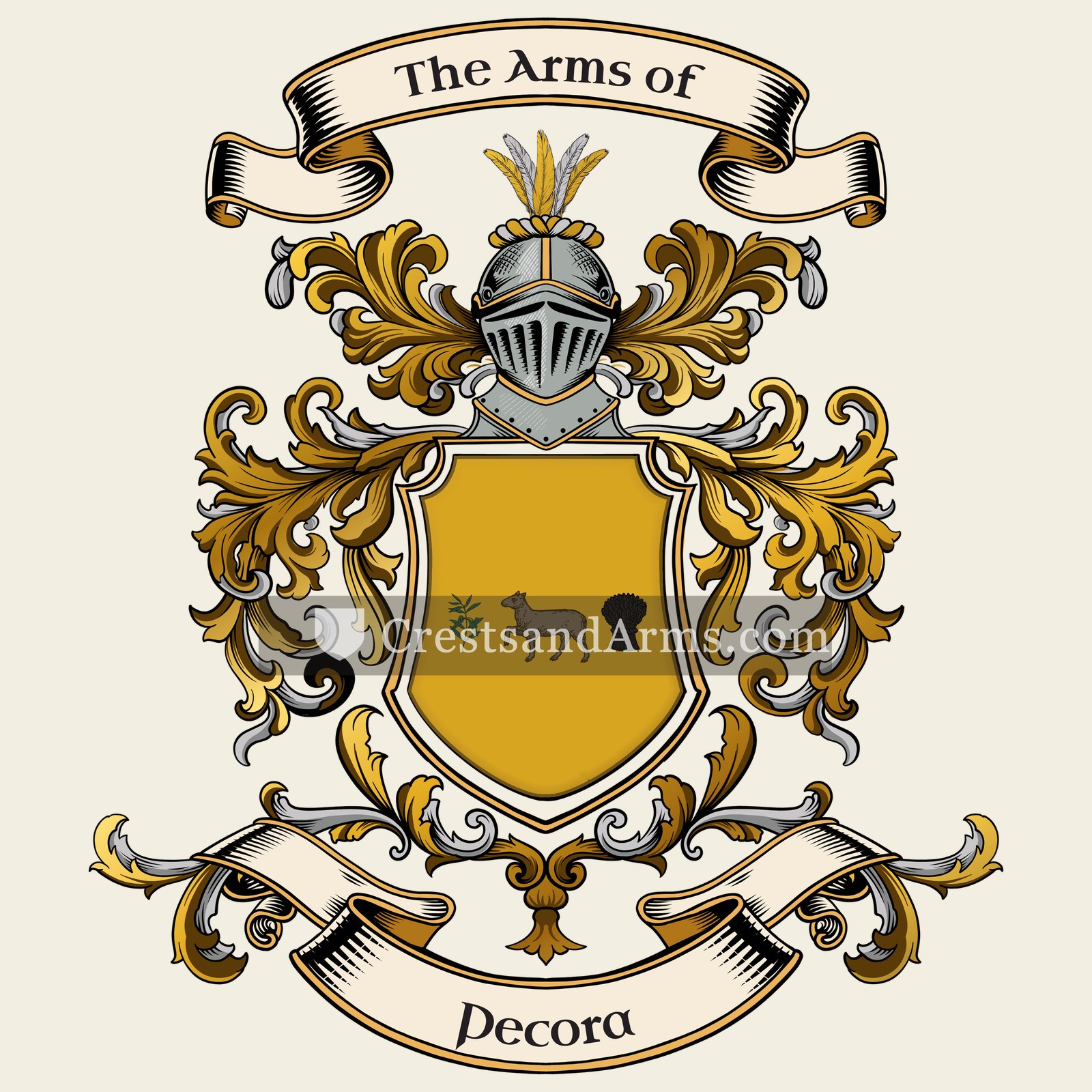
A record of documented arms, meaning and origin, researched for the Pecora family of Italy.
Reg. 9946 · Italian, P–S
Coat of Arms & Family Crest Details
Symbols on this shield
lambGentleness, patience and faith
branchPeace, and new growth
wheatsheafPlenty, and the harvest of one's own labour
Colours
Gold (Or)Means: Generosity
Green (Vert)Means: Hope
Historical info
Source
J. B. Rietstap, Armorial Général, Gouda: G. B. van Goor Zonen, 1884–87
Blazon (the actual original written record)
“D'or à un agneau au nat., ramp. contre une branche d'arbre de sin., courbée en demi-cercle, et broutant des épis d'or, qui poussent en haut de la branche.”
ItalyFlorence, c. 1775
Digital archive packCoat of arms PNG, gold border print PDF, vector SVG and the certificate of authenticity. Sent to your email in minutes.
Map of Italy showing where the Pecora arms are recorded
The Pecora arms were recorded in Florence, c. 1775.
This is where the arms were entered in the register. Families often moved to other parts of the country, so the same name can turn up in more than one region.
The body that granted and recorded arms in Italy in this period.
Alvise Giovanni Mocenigo
Sovereign of the period
Alvise Giovanni Mocenigo
1763–1778
Reigning in Italy when the Pecora arms are first recorded.
How Arms Worked in Italy
In the Italian states, coats of arms were often used by noble families to show their status and history. These symbols were passed down through the generations to all legitimate male descendants. Younger branches of a family usually kept the original design but sometimes added small changes to distinguish their specific line from the main branch.
Granting authority
Various local rulers and city governments controlled the use of coats of arms across the different Italian states.
How they got arms
Families often assumed their own arms or received them as official grants from local lords, popes, or city councils.
Where arms were recorded
Arms were recorded in local city archives or private family books rather than in one single national register.
The family's standing
Recorded among the armigerous families of Italy.
Origin & History of the Pecora Family in Italy
The surname Pecora is rooted in the Italian language, where the word translates literally to "sheep." In the context of medieval and early modern naming conventions, this name likely originated as a descriptive nickname for an ancestor who worked as a shepherd or perhaps someone known for a gentle or mild temperament. By the time the family was firmly established in Florence in 1775, they were part of a society that placed great importance on trade, craftsmanship, and civic participation. During this period, Florentine families often maintained deep ties to specific neighborhoods or professional guilds, which helped define their social standing and daily life. As the family navigated the changing political landscape of Tuscany in the late 18th century, they contributed to the vibrant urban culture that characterized one of Italy’s most influential historical cities.
Related Branches & Arms
Root word
pecus
Latin term referring to cattle, livestock, or wealth in the form of animals.
This name
PecoraAn occupational surname for a shepherd or a nickname for someone who tended sheep.
also spelled
Pecory
Pekori
Documented Sources
J. B. Rietstap, Armorial Général, Gouda: G. B. van Goor Zonen, 1884–87
De Felice, Emidio. Dizionario dei cognomi italiani. 1978
Archivio di Stato di Firenze, Stato Civile della Restaurazione, 1775
Digital archive packCoat of arms PNG, gold border print PDF, vector SVG and the certificate of authenticity. Sent to your email in minutes.


 lambGentleness, patience and faith
 branchPeace, and new growth
 wheatsheafPlenty, and the harvest of one's own labour
 lambGentleness, patience and faith
 branchPeace, and new growth
 wheatsheafPlenty, and the harvest of one's own labour