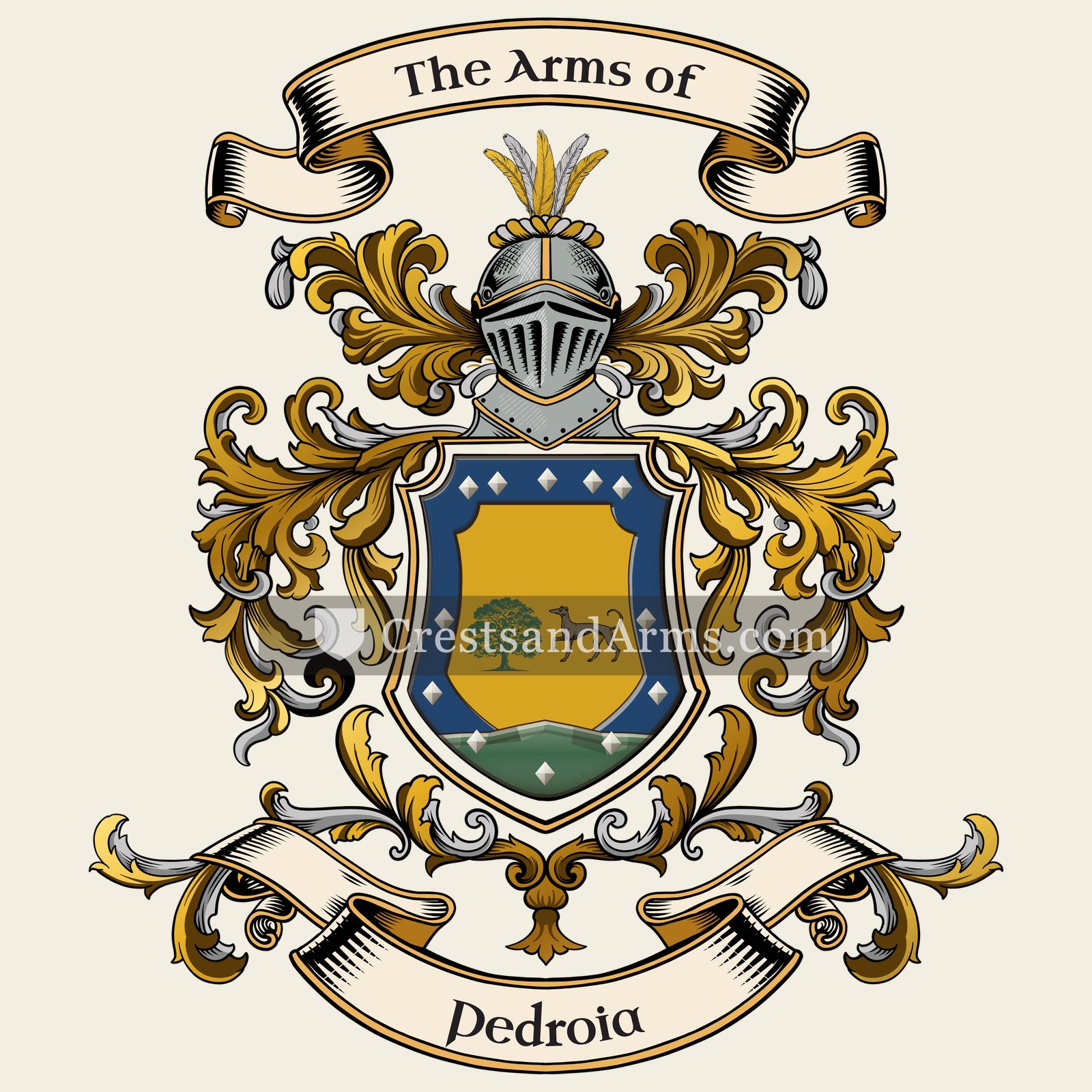
A record of documented arms, meaning and origin, researched for the Pedroia family of Spain.
Reg. 6478 · Spanish, P–S
Coat of Arms & Family Crest Details
Symbols on this shield
mountThe ground held, and steadfastness upon it
treeLife, endurance and deep roots
greyhoundCourage, vigilance and loyalty
lozengeHonour and nobility, and the arms of a woman
Colours
Gold (Or)Means: Generosity
Blue (Azure)Means: Loyalty and truth
Green (Vert)Means: Hope
Silver (Argent)Means: Peace and sincerity
Historical info
Source
J. B. Rietstap, Armorial Général, Gouda: G. B. van Goor Zonen, 1884–87
Blazon (the actual original written record)
“D'or à un arbre de sin., acc. d'un lévrier au nat., enchaîné au fût, le tout soutenu d'une terrasse du sec.; à la bord. d'azur, ch. de dix-huit los. accolées et aboutées d'arg.”
AragonAragon, c. 1722
Digital archive packCoat of arms PNG, gold border print PDF, vector SVG and the certificate of authenticity. Sent to your email in minutes.
Map of Spain showing where the Pedroia arms are recorded
The Pedroia arms were recorded in Aragon, c. 1722.
Aragon was mountain and river country in north-eastern Spain, with a strong tradition of small independent landholders. A great many families counted as gentry there, and each one needed a shield to be told apart.
This is where the arms were entered in the register. Families often moved to other parts of the country, so the same name can turn up in more than one region.
The body that granted and recorded arms in Spain in this period.
Philip V of Spain
Sovereign of the period
Philip V of Spain
1714–1724
Reigning in Spain when the Pedroia arms are first recorded.
How Arms Worked in Spain
In Spain, a coat of arms was considered a form of property that belonged to the entire family line. These arms were passed down from a father to all his children equally. Younger branches of the family usually kept the original design without needing to add any special marks to distinguish their specific line.
Granting authority
The Cronista Rey de Armas was the official body that regulated and granted coats of arms throughout Spain.
How they got arms
Families often obtained their arms through royal grants or by proving their noble status to the official heraldic authority.
Where arms were recorded
Coats of arms were officially recorded in the registers of the Cronista Rey de Armas starting in 1496.
The family's standing
Recorded among the armigerous families of Aragon.
Origin & History of the Pedroia Family in Spain
The family name Pedroia traces its historical roots to the rugged landscape of Aragon, Spain, where members of the family were documented as early as 1722. During this period, the region was characterized by a complex social structure where families often settled in specific valleys or agricultural zones to manage land and livestock. The name itself is linked to the linguistic traditions of the Iberian Peninsula, likely evolving from local dialects that identified individuals by their patronymic lineage or their specific geographic origin. As the family established itself in Aragon, they became part of the local fabric of rural life, participating in the economic and social shifts that defined the eighteenth century. Over time, the name served as a vital link to their ancestral home, marking their presence in the historical records of the region long before the family eventually expanded into other parts of the world.
Related Branches & Arms
Root word
Petrus
Latin for rock or stone
This name
PedroiaA patronymic surname derived from the given name Pedro, meaning son of Peter.
also spelled
Pedroe
Documented Sources
J. B. Rietstap, Armorial Général, Gouda: G. B. van Goor Zonen, 1884–87
Archivo de la Corona de Aragón, Catastro de Ensenada. 1750-1754
García Ciprés, Gregorio, Linajes de la Nobleza de Aragón. 1915
Digital archive packCoat of arms PNG, gold border print PDF, vector SVG and the certificate of authenticity. Sent to your email in minutes.


 mountThe ground held, and steadfastness upon it
 treeLife, endurance and deep roots
 greyhoundCourage, vigilance and loyalty
 lozengeHonour and nobility, and the arms of a woman
 mountThe ground held, and steadfastness upon it
 treeLife, endurance and deep roots
 greyhoundCourage, vigilance and loyalty
 lozengeHonour and nobility, and the arms of a woman