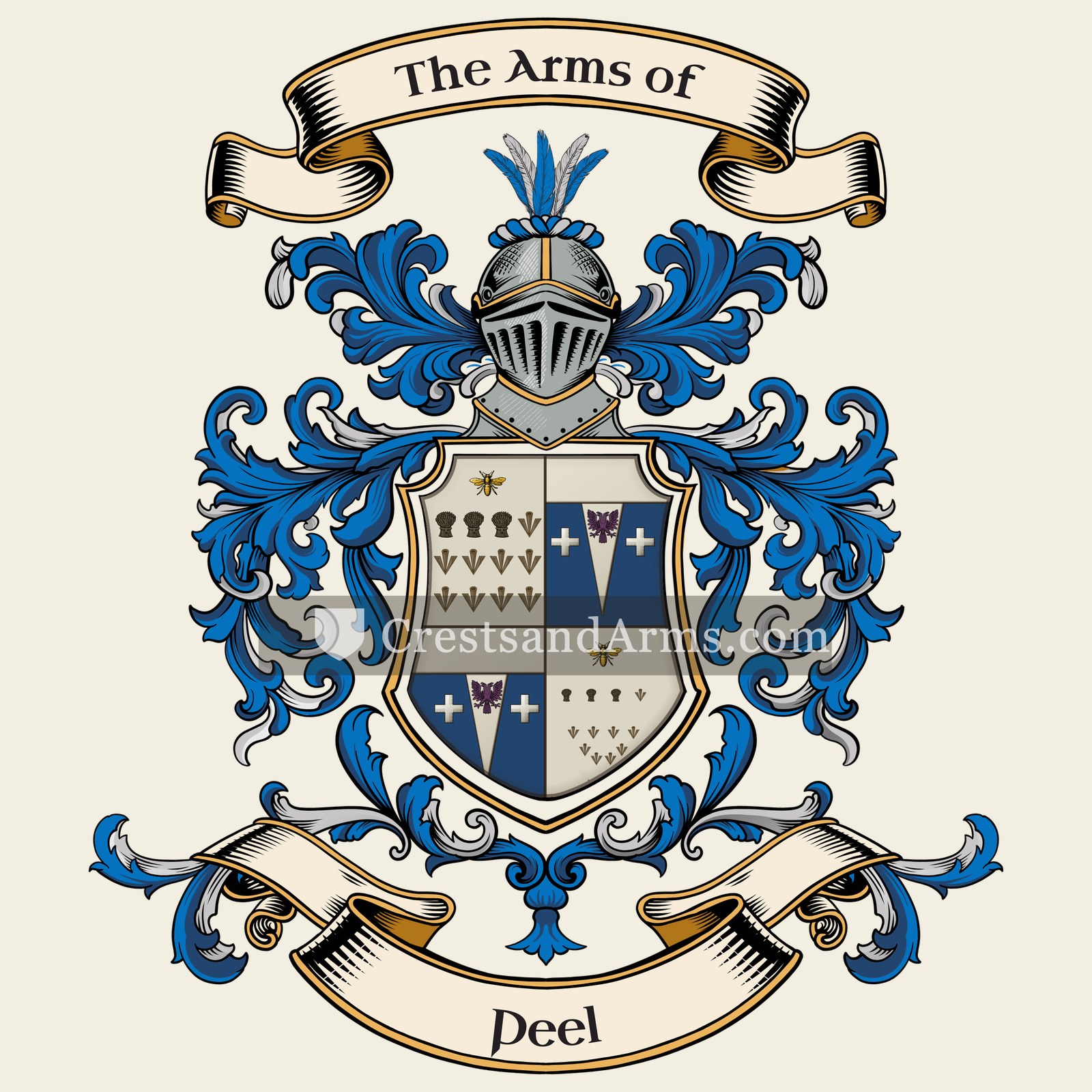
A record of documented arms, meaning and origin, researched for the Peel family lines. Documented in 3 countries.
Reg. 2345 · Britain, P–S
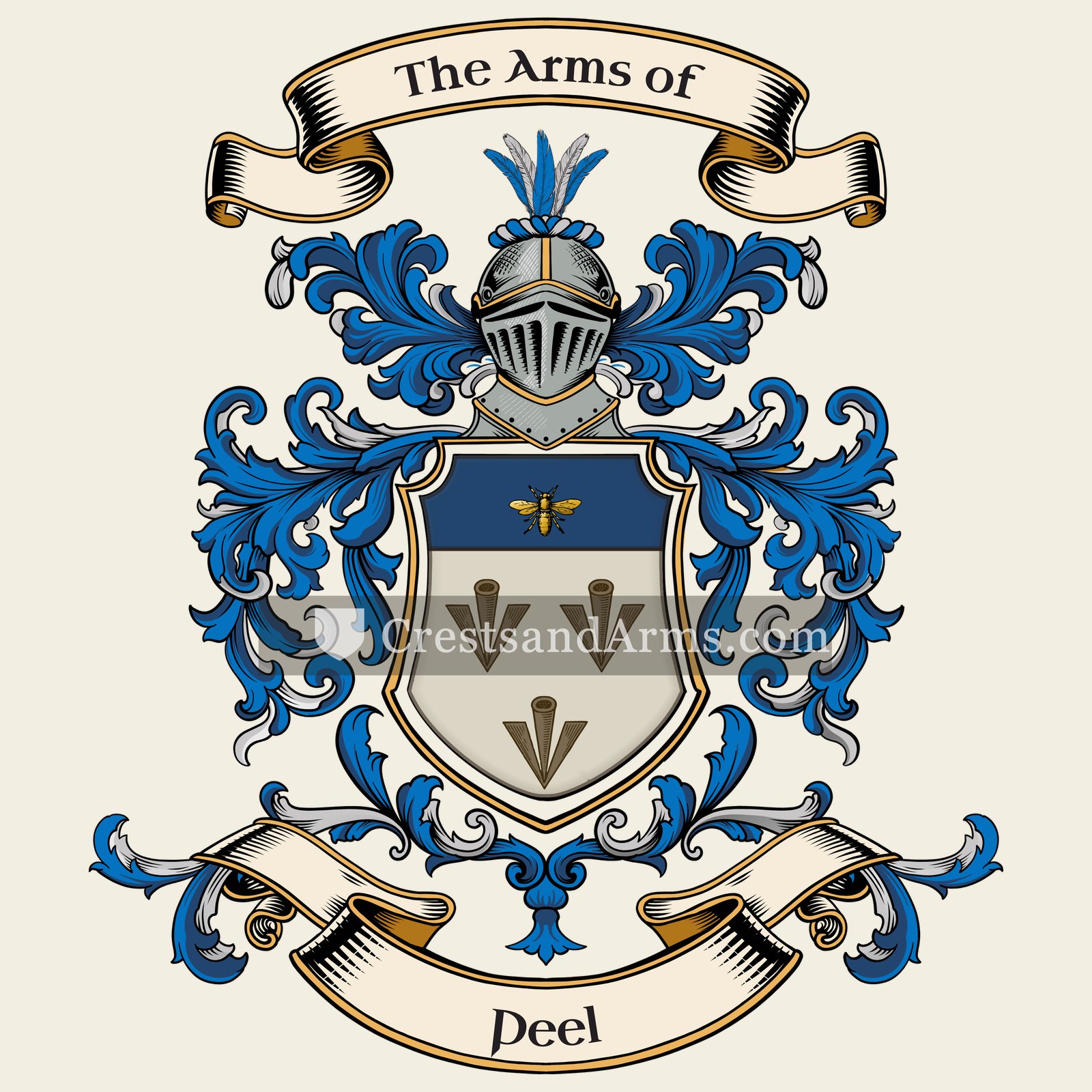
Coat of Arms & Family Crest Details
Symbols on this shield
chiefAuthority, wisdom and dominion
arrowReadiness for battle, and affliction endured
beeIndustry, order and tireless work
Colours
Silver (Argent)Means: Peace and sincerity
Blue (Azure)Means: Loyalty and truth
Gold (Or)Means: Generosity
Historical info
Source
J. B. Rietstap, Armorial Général, Gouda: G. B. van Goor Zonen, 1884–87
Blazon (the actual original written record)
“D'arg. à trois faisceaux de flèches, chacun de trois pièces, au nat., liés de gu., les pointes en bas; au chef d'azur, ch. d'une abeille d'or. C.: un lion iss. d'arg., tenant entre ses pattes un fuseau d'or en pal et orné d'un collier d'azur ch. de trois bes. d'or. S.: deux léopards lionnés d'arg., chacun ch. sur l'épaule d'un trèfle de sin. et coll. d'azur, le collier ch. de trois bes. d'or. D.: INDUSTRIA.”
StaffordshireStaffordshire, c. 1700
Digital archive packCoat of arms PNG, gold border print PDF, vector SVG and the certificate of authenticity. Sent to your email in minutes.
Map of Britain showing where the Peel arms are recorded
The Peel arms were recorded in Staffordshire, c. 1700.
This is where the arms were entered in the register. Families often moved to other parts of the country, so the same name can turn up in more than one region.
The body that granted and recorded arms in Britain in this period.
William III of England
Sovereign of the period
William III of England
1694–1702
Reigning in Britain when the Peel arms are first recorded.
How Arms Worked in Britain
English heraldry allowed arms to be shared by all legitimate descendants of the original owner. These symbols were treated as personal property that moved through the generations to all children. While the eldest son kept the original design, other family members could use the same shield without needing to change it or register their own unique versions.
Granting authority
The College of Arms in London has regulated the use of coats of arms throughout England and Wales since 1484.
How they got arms
Families typically obtained their coats of arms through a formal grant from the Crown or by proving their ancient right to them.
Where arms were recorded
All official coats of arms are recorded in the registers kept at the College of Arms, which date back to the fifteenth century.
The family's standing
Recorded among the armigerous families of Staffordshire.
Origin & History of the Peel Family in Britain
The surname Peel is a topographic name that originated in Northern England and the Midlands, describing people who lived near a fortified tower or a palisaded enclosure. By the early 18th century, the family had established a strong presence in Staffordshire, a region known for its growing industries and agricultural roots. During this period, the Peels were deeply involved in the local community, often working as yeoman farmers or small-scale tradesmen. As the Industrial Revolution began to take shape, members of the family in this area transitioned from traditional rural life into the textile trade. This shift laid the foundation for the family to become prominent figures in British manufacturing and politics in the generations that followed. Their early history reflects the broader movement of English families who moved from working the land to driving the technological progress of the 1700s.
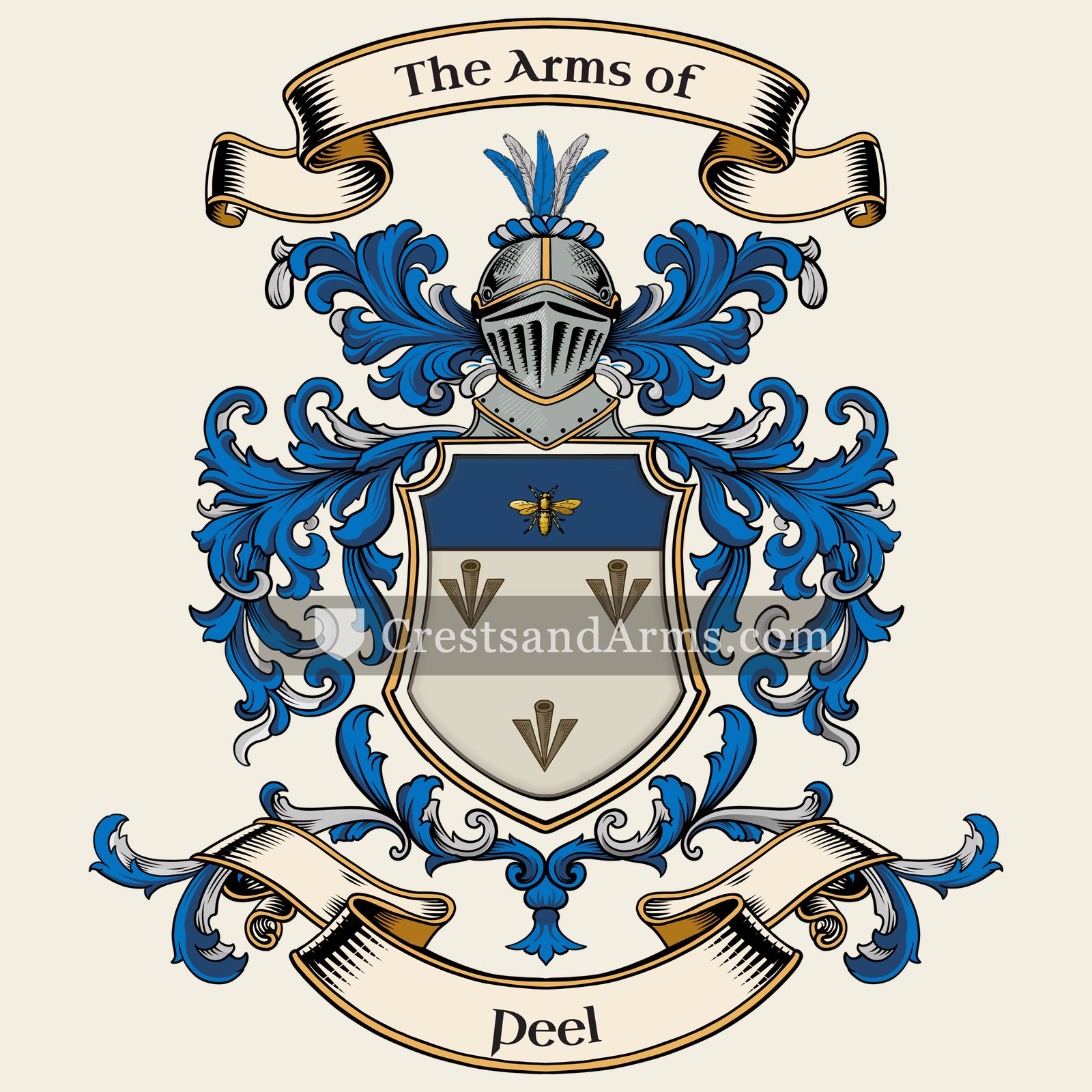
Coat of Arms & Family Crest Details
Symbols on this shield
chiefAuthority, wisdom and dominion
arrowReadiness for battle, and affliction endured
beeIndustry, order and tireless work
Colours
Silver (Argent)Means: Peace and sincerity
Blue (Azure)Means: Loyalty and truth
Gold (Or)Means: Generosity
Historical info
Source
Sir Bernard Burke, The General Armory of England, Scotland, Ireland and Wales, London: Harrison & Sons, 1884
Blazon (the actual original written record)
“Ar. three sheaves of as many arrows ppr. two and one, banded gu. on a chief az. a bee volant or”
StaffordDrayton Manor · Stafford, c. 1620
Digital archive packCoat of arms PNG, gold border print PDF, vector SVG and the certificate of authenticity. Sent to your email in minutes.
Map of England showing where the Peel arms are recorded
The Peel arms were recorded in Stafford, c. 1620.
Staffordshire was mixed country of moorland, farmland and early ironworking. Its landed families were spread widely rather than concentrated, and each holding brought its own claim to arms.
This is where the arms were entered in the register. Families often moved to other parts of the country, so the same name can turn up in more than one region.
The body that granted and recorded arms in England in this period.
James VI and I
Sovereign of the period
James VI and I
1603–1625
Reigning in Britain when the Peel arms are first recorded.
How Arms Worked in England
English heraldry allowed arms to be shared by all legitimate descendants of the original owner. These symbols were treated as personal property that moved through the generations to all children. While the eldest son kept the original design, other family members could use the same shield without needing to change it or register their own unique versions.
Granting authority
The College of Arms in London has regulated the use of coats of arms throughout England and Wales since 1484.
How they got arms
Families typically obtained their coats of arms through a formal grant from the Crown or by proving their ancient right to them.
Where arms were recorded
All official coats of arms are recorded in the registers kept at the College of Arms, which date back to the fifteenth century.
The family's standing
Recorded among the armigerous families of Stafford.
Origin & History of the Peel Family in England
The surname Peel is a topographic name, which means it was originally given to people who lived near a specific landmark. In Northern England, the word "peel" referred to a small fortified tower or a defensive enclosure built to protect residents from border raids. By the time the family was firmly established in Stafford in 1620, the name had been in use for several generations as a way to identify families by their proximity to these local structures. As the family grew, they moved away from these original defensive sites and settled into the growing towns of the English Midlands. This transition reflects a broader shift in English history where families moved from isolated rural outposts into the developing trade centers of the seventeenth century. Over time, the name became a permanent family identifier that linked the household to its ancestral roots in the landscape of England.
Coat of Arms & Family Crest Details
Symbols on this shield
chiefAuthority, wisdom and dominion
pileWell-doing, and a mark of distinction
cross symbolChristian faith and service
wheatsheafPlenty, and the harvest of one's own labour
arrowReadiness for battle, and affliction endured
beeIndustry, order and tireless work
eagleNobility, strength and a keen mind
Colours
Silver (Argent)Means: Peace and sincerity
Blue (Azure)Means: Loyalty and truth
Gold (Or)Means: Generosity
Purple (Purpure)Means: Royal majesty
Historical info
Source
Sir Bernard Burke, The General Armory of England, Scotland, Ireland and Wales, London: Harrison & Sons, 1884
Blazon (the actual original written record)
“Quarterly, 1st and 4th, ar. three sheaves of as many arrows ppr. banded gu. on a chief az. a bee volant or, for PEEL; 2nd and 3rd, az. on a pile betw two crosses crosslet in base ar. an eagle displ. purp., for ETHELSTON”
FlintBryn-y-pys · Flint, c. 1647
Digital archive packCoat of arms PNG, gold border print PDF, vector SVG and the certificate of authenticity. Sent to your email in minutes.
Map of Wales showing where the Peel arms are recorded
The Peel arms were recorded in Flint, c. 1647.
Flintshire was small north Welsh country on the Dee estuary, close to Chester. English and Welsh families both held land there, and each holding brought its own claim to arms.
This is where the arms were entered in the register. Families often moved to other parts of the country, so the same name can turn up in more than one region.
The body that granted and recorded arms in Wales in this period.
Charles I of England
Sovereign of the period
Charles I of England
1625–1649
Reigning in Britain when the Peel arms are first recorded.
How Arms Worked in Wales
English heraldry allowed arms to be shared by all legitimate descendants of the original owner. These symbols were treated as personal property that moved through the generations to all children. While the eldest son kept the original design, other family members could use the same shield without needing to change it or register their own unique versions.
Granting authority
The College of Arms in London has regulated the use of coats of arms throughout England and Wales since 1484.
How they got arms
Families typically obtained their coats of arms through a formal grant from the Crown or by proving their ancient right to them.
Where arms were recorded
All official coats of arms are recorded in the registers kept at the College of Arms, which date back to the fifteenth century.
The family's standing
Recorded among the armigerous families of Flint.
Origin & History of the Peel Family in Wales
The surname Peel is rooted in the landscape of the Welsh borderlands, where it likely served as a topographical descriptor for families living near a fortified tower or a palisaded enclosure. By the mid-seventeenth century, the name was firmly established in the town of Flint, a strategic location that grew around the construction of a major castle commissioned by Edward I. Records from 1647 confirm that members of the Peel family were active residents in this area during a period of significant political upheaval in Wales. As the family integrated into the local community, they participated in the social and economic life of the Flintshire region. Their presence in this historic town suggests a long-standing connection to the border territory, where the name evolved alongside the shifting administrative and cultural boundaries between Wales and England.
Peel Meaning & Related Branches
Root word
palus
A Latin term referring to a stake, pale, or wooden post.
This name
PeelA topographic name for someone living near a fortified enclosure or palisade.
also spelled
Peele
Piele
Peill
Related arms
Peacockrecorded with Peel, same area
Petytrecorded with Peel, same area
Documented Sources
J. B. Rietstap, Armorial Général, Gouda: G. B. van Goor Zonen, 1884–87
Bardsley, Charles Wareing, A Dictionary of English and Welsh Surnames, 1901
Reaney, P.H. and Wilson, R.M., A Dictionary of English Surnames, 1991
Staffordshire Record Office, Diocese of Lichfield and Coventry Parish Registers, 1700
Digital archive packCoat of arms PNG, gold border print PDF, vector SVG and the certificate of authenticity. Sent to your email in minutes.


 chiefAuthority, wisdom and dominion
 arrowReadiness for battle, and affliction endured
 beeIndustry, order and tireless work
 chiefAuthority, wisdom and dominion
 arrowReadiness for battle, and affliction endured
 beeIndustry, order and tireless work



 pileWell-doing, and a mark of distinction
 cross symbolChristian faith and service
 wheatsheafPlenty, and the harvest of one's own labour
 eagleNobility, strength and a keen mind