Map of Belgium showing where the Peers arms are recorded
The Peers arms were recorded in Bruges, c. 1841.
This is where the arms were entered in the register. Families often moved to other parts of the country, so the same name can turn up in more than one region.
The body that granted and recorded arms in Belgium in this period.
Leopold I of Belgium
Sovereign of the period
Leopold I of Belgium
1831–1865
Reigning in Belgium when the Peers arms are first recorded.
How Arms Worked in Belgium
In Belgium, a coat of arms is considered personal property that is passed down through the male line to legitimate descendants. Families often use the same shield design across generations to show their shared heritage. If a branch of the family wants to change the design, they must apply for an official update to their specific version of the arms.
Granting authority
The Conseil héraldique is the official body that regulates and approves all coats of arms in Belgium.
How they got arms
Families obtain their coats of arms through formal royal grants or by confirming their historical right to use existing designs.
Where arms were recorded
All approved coats of arms are officially recorded in the public registers of the Conseil héraldique since 1844.
The family's standing
Recorded among the armigerous families of Belgium.
Origin & History of the Peers Family in Belgium
The history of the Peers family in Belgium is deeply rooted in the cultural and economic life of Bruges during the nineteenth century. By 1841, the family had established a notable presence in this historic city, which was then a center for trade and social development. The name itself likely originated as a variation of the name Peter, serving as a patronymic identifier that distinguished early family members within their community. As the family integrated into the urban fabric of Bruges, they became part of the local professional and social circles that defined the region. Their presence during this era reflects the broader movement of families who settled in Belgian cities to participate in the growing industrial and civic opportunities of the time. Through their residency in Bruges, the Peers family contributed to the local history of the city, leaving behind a legacy that is tied to the development of the Flemish region.
Coat of Arms & Family Crest Details
Symbols on this shield
chevronProtection, and faithful service completed
chiefAuthority, wisdom and dominion
lionCourage, strength and royalty
Colours
Black (Sable)Means: Constancy
Silver (Argent)Means: Peace and sincerity
Gold (Or)Means: Generosity
Historical info
Source
J. B. Rietstap, Armorial Général, Gouda: G. B. van Goor Zonen, 1884–87
Blazon (the actual original written record)
“De sa. au chev. d'arg., acc. de trois têtes de lion du même; au chef d'or. C.: un griffon iss. d'arg. L. d'arg. et de gu. D.: POST NUBILA PHOEBUS.”
DevonshireDevonshire, c. 1700
Digital archive packCoat of arms PNG, gold border print PDF, vector SVG and the certificate of authenticity. Sent to your email in minutes.
Map of Britain showing where the Peers arms are recorded
The Peers arms were recorded in Devonshire, c. 1700.
This is where the arms were entered in the register. Families often moved to other parts of the country, so the same name can turn up in more than one region.
The body that granted and recorded arms in Britain in this period.
William III of England
Sovereign of the period
William III of England
1694–1702
Reigning in Belgium when the Peers arms are first recorded.
How Arms Worked in Britain
English heraldry allowed arms to be shared by all legitimate descendants of the original owner. These symbols were treated as personal property that moved through the generations to all children. While the eldest son kept the original design, other family members could use the same shield without needing to change it or register their own unique versions.
Granting authority
The College of Arms in London has regulated the use of coats of arms throughout England and Wales since 1484.
How they got arms
Families typically obtained their coats of arms through a formal grant from the Crown or by proving their ancient right to them.
Where arms were recorded
All official coats of arms are recorded in the registers kept at the College of Arms, which date back to the fifteenth century.
The family's standing
Recorded among the armigerous families of Devonshire.
Origin & History of the Peers Family in Britain
The surname Peers is rooted in the medieval period as a patronymic name, meaning it was originally derived from the given name Peter. By the time the family established a notable presence in Devonshire around 1700, the name had already evolved through various spellings such as Piers, Pearse, and Peers. In the rural landscape of southwestern England, families with this name were often connected to the local agricultural economy or the burgeoning trade industries of the region. During the seventeenth and eighteenth centuries, the Peers family in Devonshire lived through a time of significant social change, as the rise of maritime commerce and local manufacturing began to reshape the lives of common citizens. Because the name was tied to a common personal name, it appeared frequently in parish registers and tax records, marking the family as part of the steady, working population that formed the backbone of English society during the early modern era.
Coat of Arms & Family Crest Details
Symbols on this shield
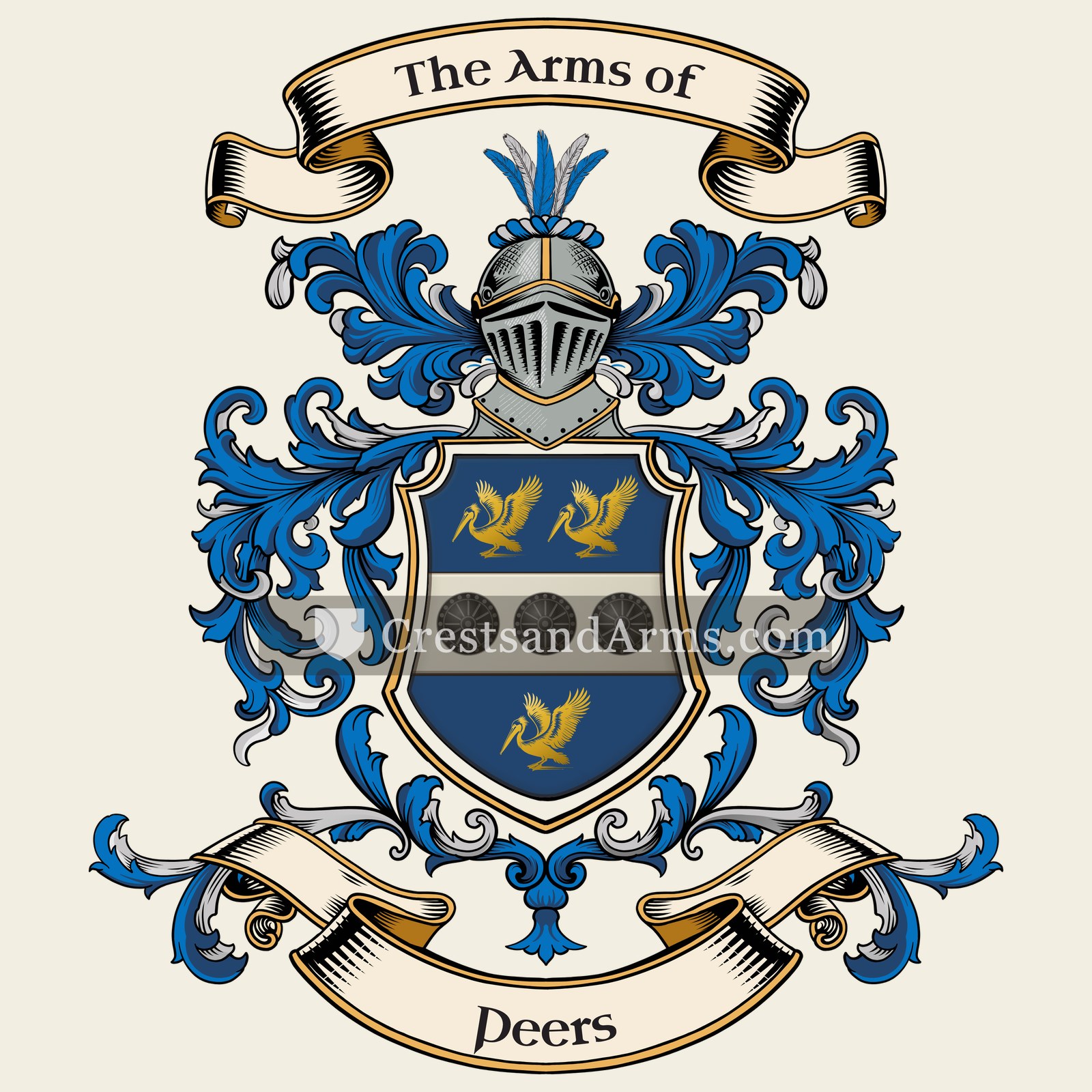
fessThe military belt, and readiness to serve
pelicanSelf-sacrifice and devotion to one's children
roundelA coin, and one who has been to the crusades
Colours
Blue (Azure)Means: Loyalty and truth
Silver (Argent)Means: Peace and sincerity
Gold (Or)Means: Generosity
Black (Sable)Means: Constancy
Historical info
Source
Sir Bernard Burke, The General Armory of England, Scotland, Ireland and Wales, London: Harrison & Sons, 1884
Blazon (the actual original written record)
“Az. on a fesse ar. betw. three pelicans or, vulning themselves gu. as many pellets”
WarwickAlveston · Warwick, c. 1620
Digital archive packCoat of arms PNG, gold border print PDF, vector SVG and the certificate of authenticity. Sent to your email in minutes.
Map of England showing where the Peers arms are recorded
The Peers arms were recorded in Warwick, c. 1620.
Warwickshire lay in the middle of England, and its landed families were spread evenly across it rather than gathered in one corner. A great many held a single manor each, and each of those holdings brought its own claim to arms.
This is where the arms were entered in the register. Families often moved to other parts of the country, so the same name can turn up in more than one region.
The body that granted and recorded arms in England in this period.
James VI and I
Sovereign of the period
James VI and I
1603–1625
Reigning in Belgium when the Peers arms are first recorded.
How Arms Worked in England
English heraldry allowed arms to be shared by all legitimate descendants of the original owner. These symbols were treated as personal property that moved through the generations to all children. While the eldest son kept the original design, other family members could use the same shield without needing to change it or register their own unique versions.
Granting authority
The College of Arms in London has regulated the use of coats of arms throughout England and Wales since 1484.
How they got arms
Families typically obtained their coats of arms through a formal grant from the Crown or by proving their ancient right to them.
Where arms were recorded
All official coats of arms are recorded in the registers kept at the College of Arms, which date back to the fifteenth century.
The family's standing
Recorded among the armigerous families of Warwick.
Origin & History of the Peers Family in England
The family name Peers has deep roots in the English landscape, emerging as a patronymic surname derived from the given name Peter. By the early 17th century, the family had established a notable presence in the town of Warwick, where records confirm their residence by 1620. During this period, Warwick was a bustling market town shaped by its proximity to the famous castle and its role as a regional center for trade and administration. Families like the Peers often occupied roles as local craftsmen, tradespeople, or landowners who contributed to the social fabric of the Midlands. As the name spread through the English countryside, it evolved from a simple way to identify a person as the son of Peter into a permanent family identity that persisted through generations of local history.
Related Branches & Arms
Root word
Petrus
Latin for stone or rock.
This name
PeersA patronymic surname derived from the given name Peter, signifying son of Peter.
also spelled
Peres
Pearce
Peere
Peeres
Peirs
Related arms
Peresvariant spelling
Peeresvariant spelling
Peirsvariant spelling
Perse, or Peerevariant spelling
Documented Sources
J. B. Rietstap, Armorial Général, Gouda: G. B. van Goor Zonen, 1884–87
Stadsarchief Brugge, Burgerlijke Stand: Geboorteakten, Huwelijksakten en Overlijdensakten
Rijksarchief te Brugge, Bevolkingsregisters van de stad Brugge
Draye, Henri, Leven en werk van de familie Peers in Brugge, 1974
Vanneste, Dominique, De sociale geschiedenis van Brugge in de 19e eeuw, 1998
Digital archive packCoat of arms PNG, gold border print PDF, vector SVG and the certificate of authenticity. Sent to your email in minutes.


 applePeace, plenty and long-standing settlement
 applePeace, plenty and long-standing settlement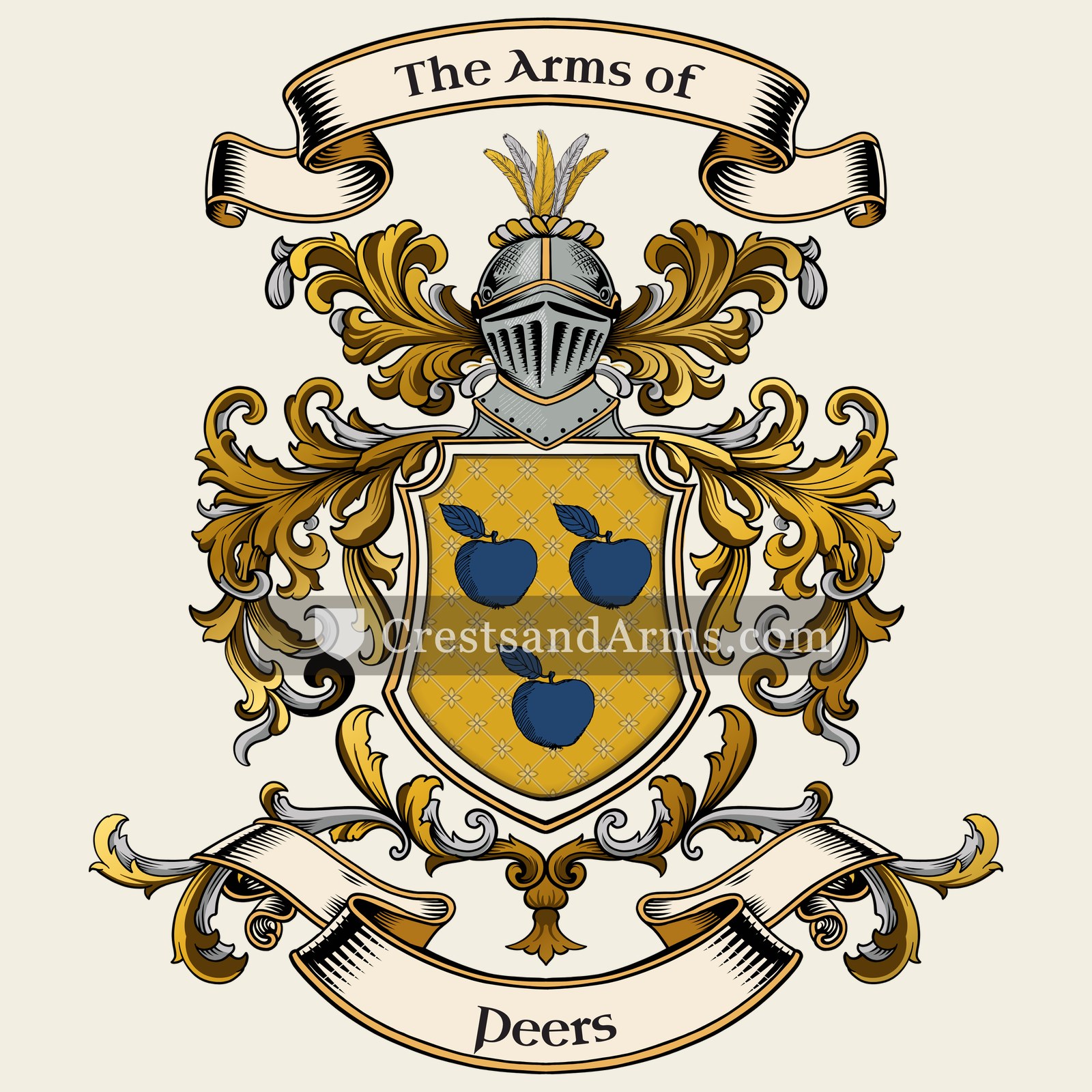


 chevronProtection, and faithful service completed
 chiefAuthority, wisdom and dominion
 lionCourage, strength and royalty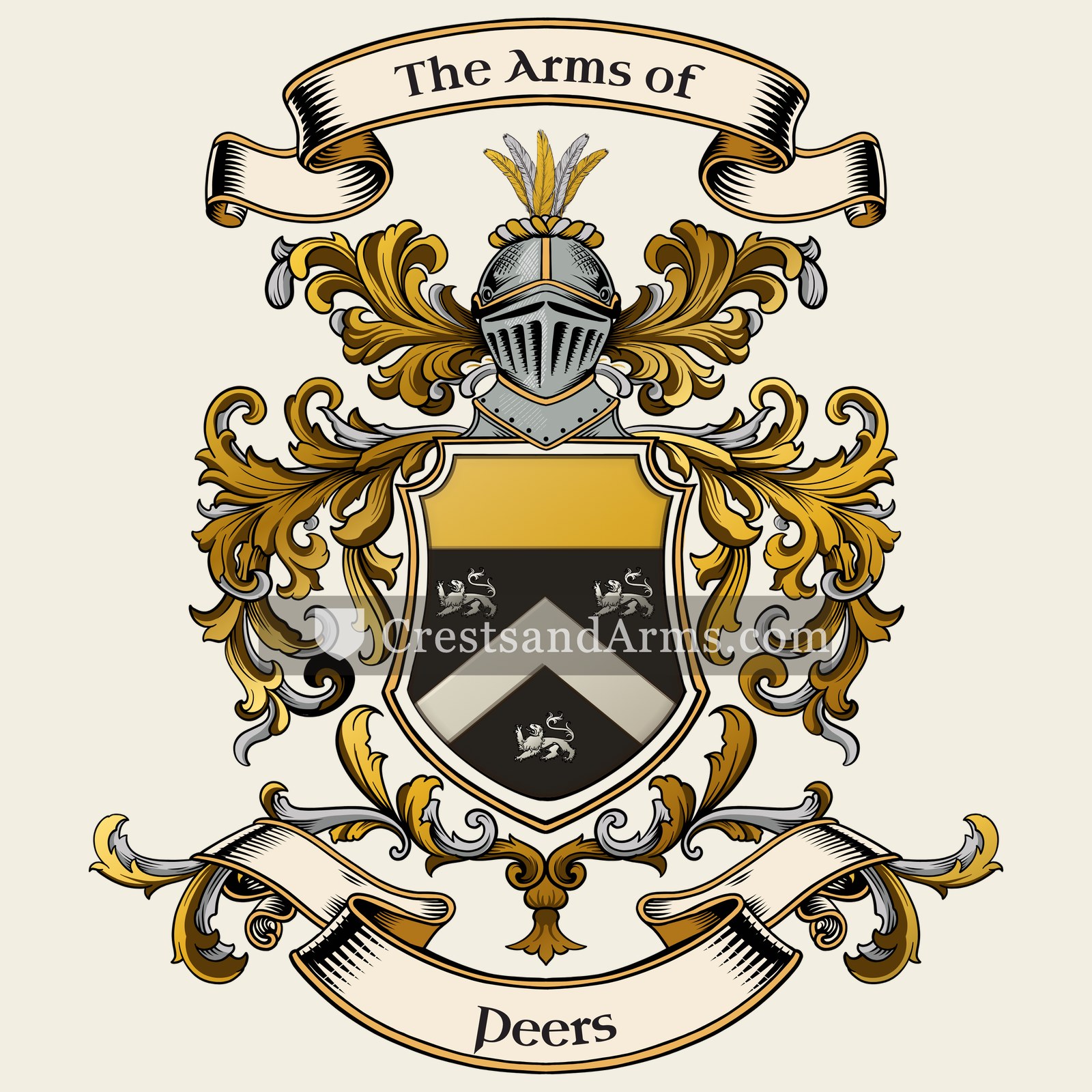


 fessThe military belt, and readiness to serve
 pelicanSelf-sacrifice and devotion to one's children
 roundelA coin, and one who has been to the crusades