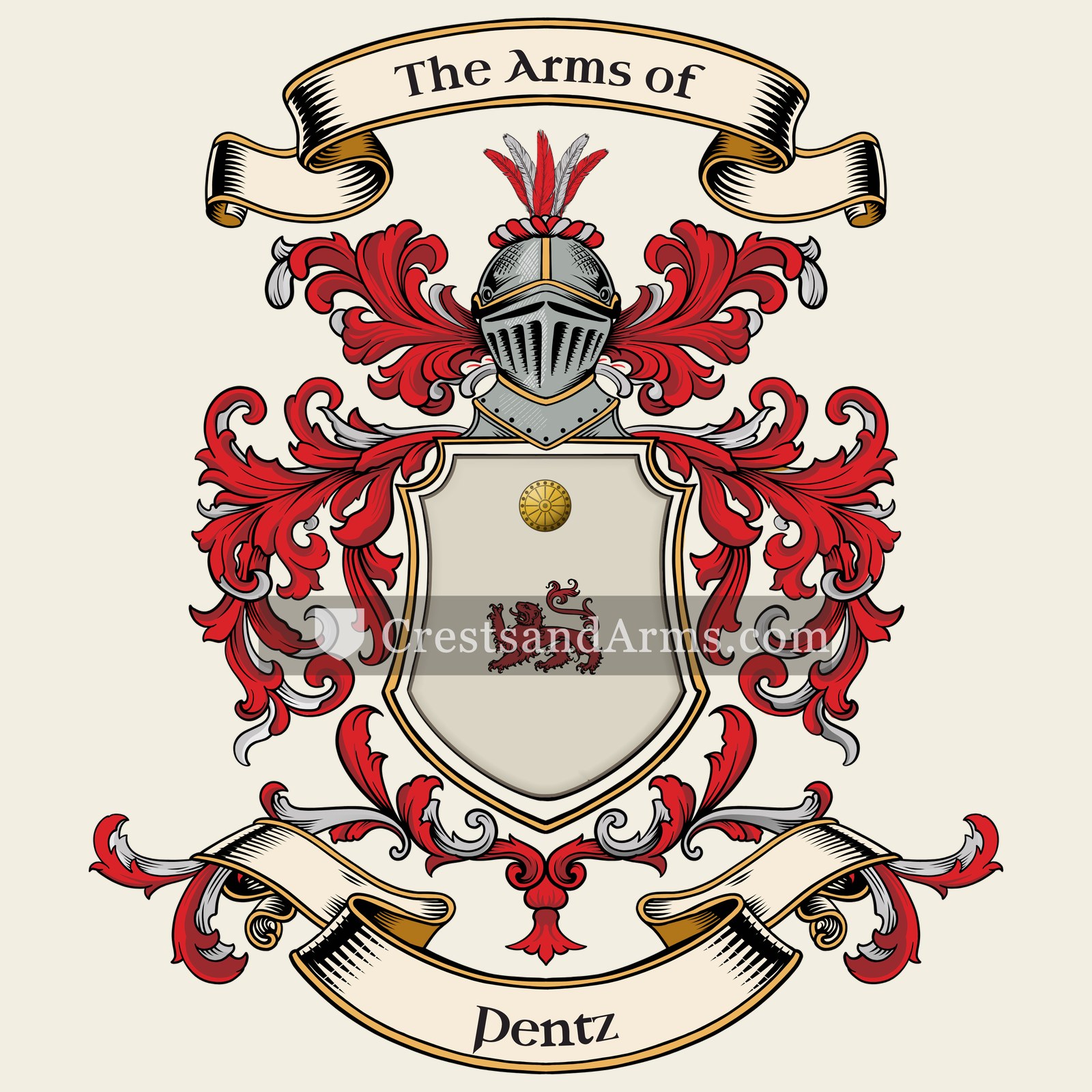
A record of documented arms, meaning and origin, researched for the Pentz family of Germany.
Reg. 4021 · German, P–S
Coat of Arms & Family Crest Details
Symbols on this shield
paleMilitary strength, and a fortified defence
lionCourage, strength and royalty
roundelA coin, and one who has been to the crusades
Colours
Silver (Argent)Means: Peace and sincerity
Red (Gules)Means: Military strength
Gold (Or)Means: Generosity
Historical info
Source
J. B. Rietstap, Armorial Général, Gouda: G. B. van Goor Zonen, 1884–87
Blazon (the actual original written record)
“D'arg. au lion léopardé de gu., cour. d'or, semé de bes. du même. Cq. cour. C.: quatre lances de tournoi, au nat., le fer remplacé par une plume de paon au nat., deux lances posées en pals, et les deux”
PomeraniaPomerania, c. 1634
Digital archive packCoat of arms PNG, gold border print PDF, vector SVG and the certificate of authenticity. Sent to your email in minutes.
Map of Germany showing where the Pentz arms are recorded
The Pentz arms were recorded in Pomerania, c. 1634.
Pomerania was flat farming country on the Baltic coast, held in large estates by a small number of families. They kept their land for generations, and generations of landholding is what fills the registers.
This is where the arms were entered in the register. Families often moved to other parts of the country, so the same name can turn up in more than one region.
The body that granted and recorded arms in Germany in this period.
Ferdinand II, Holy Roman Emperor
Sovereign of the period
Ferdinand II, Holy Roman Emperor
1619–1637
Reigning in Germany when the Pentz arms are first recorded.
How Arms Worked in Germany
In the Holy Roman Empire, coats of arms were often granted to individuals by the Emperor or his representatives. These arms were then passed down through the generations to all legitimate descendants of the original holder. Younger branches of a family usually kept the same shield design without needing to change it, as the arms belonged to the entire lineage.
Granting authority
The Holy Roman Emperor held the sole power to grant new coats of arms throughout his vast imperial territories.
How they got arms
Families typically obtained their coats of arms through a formal imperial grant or by proving their noble status to the authorities.
Where arms were recorded
These grants were officially recorded in the Imperial Chancery registers, which began keeping formal records of such honors during the Middle Ages.
The family's standing
Recorded among the armigerous families of Pomerania.
Origin & History of the Pentz Family in Germany
The family name Pentz has deep roots in the northern regions of Germany, particularly within the historical territory of Pomerania. By the year 1634, the family was well-established in this area during a time of great upheaval caused by the Thirty Years' War. The name itself is thought to be a shortened form of names like Penzlin or Penzing, which were linked to specific locations in the region. Families with this name often worked as landowners or local administrators, which allowed them to maintain a stable presence in the Baltic coastal lands for many generations. As the family grew, members moved across different parts of the German-speaking territories, but their early connection to Pomerania remains a defining part of their history.
Related Branches & Arms
Root word
Pencz
A Middle High German term for a type of small knife or dagger.
This name
PentzAn occupational surname for a cutler or a person who carried a small knife.
also spelled
Penz
Pents
Documented Sources
J. B. Rietstap, Armorial Général, Gouda: G. B. van Goor Zonen, 1884–87
Bahlow, Hans, Deutsches Namenlexikon: Familien- und Vornamen nach Ursprung und Sinn erklärt, 1967
Heintze, Albert, Die deutschen Familien-Namen: geschichtlich, geographisch, sprachlich, 1903
Landesarchiv Greifswald, General-Musterungslisten von Pommern, 1634
Digital archive packCoat of arms PNG, gold border print PDF, vector SVG and the certificate of authenticity. Sent to your email in minutes.


 paleMilitary strength, and a fortified defence
 lionCourage, strength and royalty
 roundelA coin, and one who has been to the crusades
 paleMilitary strength, and a fortified defence
 lionCourage, strength and royalty
 roundelA coin, and one who has been to the crusades