Map of France showing where the Pepin arms are recorded
The Pepin arms were recorded in Paris, c. 1663.
This is where the arms were entered in the register. Families often moved to other parts of the country, so the same name can turn up in more than one region.
The body that granted and recorded arms in France in this period.
Louis XIV of France
Sovereign of the period
Louis XIV of France
1643–1715
Reigning in France when the Pepin arms are first recorded.
How Arms Worked in France
In France, a coat of arms was a mark of honor that passed down through the male line to all legitimate descendants. Families often used the same shield without changes to show their shared heritage. If a branch wanted to stand out, they could add a small mark to their shield to show their specific place in the family tree.
Granting authority
The Juge d'armes de France acted as the official authority that regulated and verified coats of arms across the country.
How they got arms
Families typically inherited their arms from ancestors, though they could also receive them through royal grants or by proving their noble status.
Where arms were recorded
Coats of arms were officially recorded in the Armorial Général de France, which began its main collection in the year 1696.
The family's standing
Recorded among the armigerous families of France.
Origin & History of the Pepin Family in France
The surname Pepin has deep roots in the history of France, originating as a given name that eventually transitioned into a hereditary family name. The name is famously linked to the Carolingian dynasty, most notably Pepin the Short, who was the first King of the Franks to be anointed by the Pope. By the time the family was documented in Paris in 1663, the name had evolved from a royal association into a common identifier for families living in the urban centers of the kingdom. During the seventeenth century, Paris was a bustling hub of commerce and administration, and families named Pepin were often involved in the skilled trades and merchant classes that supported the city's growth. These early Parisians lived through a period of significant cultural change as France moved toward the absolute monarchy of Louis XIV. Their presence in the city records during this era suggests that the family was well-established within the social fabric of the capital long before the major political upheavals of the following century.
Coat of Arms & Family Crest Details
Symbols on this shield
chevronProtection, and faithful service completed
mulletThe third son, and a divine quality from above
Colours
Blue (Azure)Means: Loyalty and truth
Gold (Or)Means: Generosity
Historical info
Source
J. B. Rietstap, Armorial Général, Gouda: G. B. van Goor Zonen, 1884–87
Blazon (the actual original written record)
“D'azur au chev. d'or, acc. en chef de deux étoiles (5) du même.”
SwitzerlandGenève, c. 1745
Digital archive packCoat of arms PNG, gold border print PDF, vector SVG and the certificate of authenticity. Sent to your email in minutes.
Map of Switzerland showing where the Pepin arms are recorded
The Pepin arms were recorded in Genève, c. 1745.
This is where the arms were entered in the register. Families often moved to other parts of the country, so the same name can turn up in more than one region.
The body that granted and recorded arms in Switzerland in this period.
How Arms Worked in Switzerland
In Switzerland, coats of arms were not restricted to the nobility and were often adopted by common citizens and families. These symbols were passed down through generations to show family identity. When branches of a family grew, they often changed small details of the design to distinguish their own line from the original group.
Granting authority
Cantonal and civic authorities managed the use of coats of arms within their specific regions and local jurisdictions.
How they got arms
Families typically assumed their own coats of arms based on local custom rather than receiving them from a central monarch.
Where arms were recorded
Arms were recorded in various cantonal and civic registers starting from the fourteenth century throughout the Swiss region.
The family's standing
Recorded among the armigerous families of Switzerland.
Origin & History of the Pepin Family in Switzerland
The history of the Pepin family in Switzerland is deeply rooted in the cultural and social landscape of Geneva during the eighteenth century. By 1745, records confirm that members of the family were already established residents within the city walls. During this period, Geneva was a bustling center of trade and intellectual exchange, and families like the Pepins often integrated into the local artisan or merchant classes. The name itself likely originated from older Frankish roots, reflecting a long history of migration across Western Europe before the family settled in the Swiss confederation. As they established their lives in Geneva, they became part of the city’s unique political structure, which was then a self-governing republic. Living in such a vibrant urban environment, the early Pepin family members contributed to the local economy and participated in the daily life of a city that was rapidly becoming a focal point for European thought.
Coat of Arms & Family Crest Details
Colours
Blue (Azure)Means: Loyalty and truth
Gold (Or)Means: Generosity
Historical info
Source
J. B. Rietstap, Armorial Général, Gouda: G. B. van Goor Zonen, 1884–87
Blazon (the actual original written record)
“d'azur sur or, l'or ch. d'un P de gu.”
Italyc. 1775
Digital archive packCoat of arms PNG, gold border print PDF, vector SVG and the certificate of authenticity. Sent to your email in minutes.
Map of Italy showing where the Pepin arms are recorded
The Pepin arms were recorded in Italy, c. 1775.
Arms such as these were typically recorded in Venice.
Venice ran on trade, and its great families were merchants before they were anything else. The city kept a formal list of its noble houses, and a name on that list carried arms as a matter of record.
This is where the arms were entered in the register. Families often moved to other parts of the country, so the same name can turn up in more than one region.
The body that granted and recorded arms in Italy in this period.
Alvise Giovanni Mocenigo
Sovereign of the period
Alvise Giovanni Mocenigo
1763–1778
Reigning in France when the Pepin arms are first recorded.
How Arms Worked in Italy
In the Italian states, coats of arms were often used by noble families to show their status and history. These symbols were passed down through the generations to all legitimate male descendants. Younger branches of a family usually kept the original design but sometimes added small changes to distinguish their specific line from the main branch.
Granting authority
Various local rulers and city governments controlled the use of coats of arms across the different Italian states.
How they got arms
Families often assumed their own arms or received them as official grants from local lords, popes, or city councils.
Where arms were recorded
Arms were recorded in local city archives or private family books rather than in one single national register.
The family's standing
Recorded among the armigerous families of Italy.
Origin & History of the Pepin Family in Italy
The family name Pepin carries a deep history that connects to the cultural shifts of Northern Italy during the late eighteenth century. By 1775, records confirm that members of the family were established within the vibrant social and commercial landscape of Venice. During this period, Venice served as a major crossroads for trade and intellectual exchange, allowing families like the Pepins to integrate into the local urban fabric. The name itself likely evolved from older linguistic roots common in Western Europe, eventually adapting to the phonetic patterns of the Italian peninsula. As residents of a city defined by its maritime power and complex bureaucracy, the family members were part of a society that valued documentation and civic participation. Their presence in Venetian records suggests they were active participants in a city that was transitioning through the final decades of its independence before the arrival of foreign powers.
Related Branches & Arms
Root word
Pippin
Derived from the Germanic word for a pip or seed.
This name
PepinA name of Frankish origin meaning a seed or kernel, often associated with royalty.
also spelled
Pepyn
Documented Sources
J. B. Rietstap, Armorial Général, Gouda: G. B. van Goor Zonen, 1884–87
Dauzat, Albert. Dictionnaire étymologique des noms et prénoms de France. 1951
Morlet, Marie-Thérèse. Dictionnaire étymologique des noms de famille. 1991
Archives nationales de France, Minutier central des notaires de Paris
Digital archive packCoat of arms PNG, gold border print PDF, vector SVG and the certificate of authenticity. Sent to your email in minutes.


 chiefAuthority, wisdom and dominion
 martletA younger son, who must win his own land
 crescentHonour by the sovereign, and the second son
 chiefAuthority, wisdom and dominion
 martletA younger son, who must win his own land
 crescentHonour by the sovereign, and the second son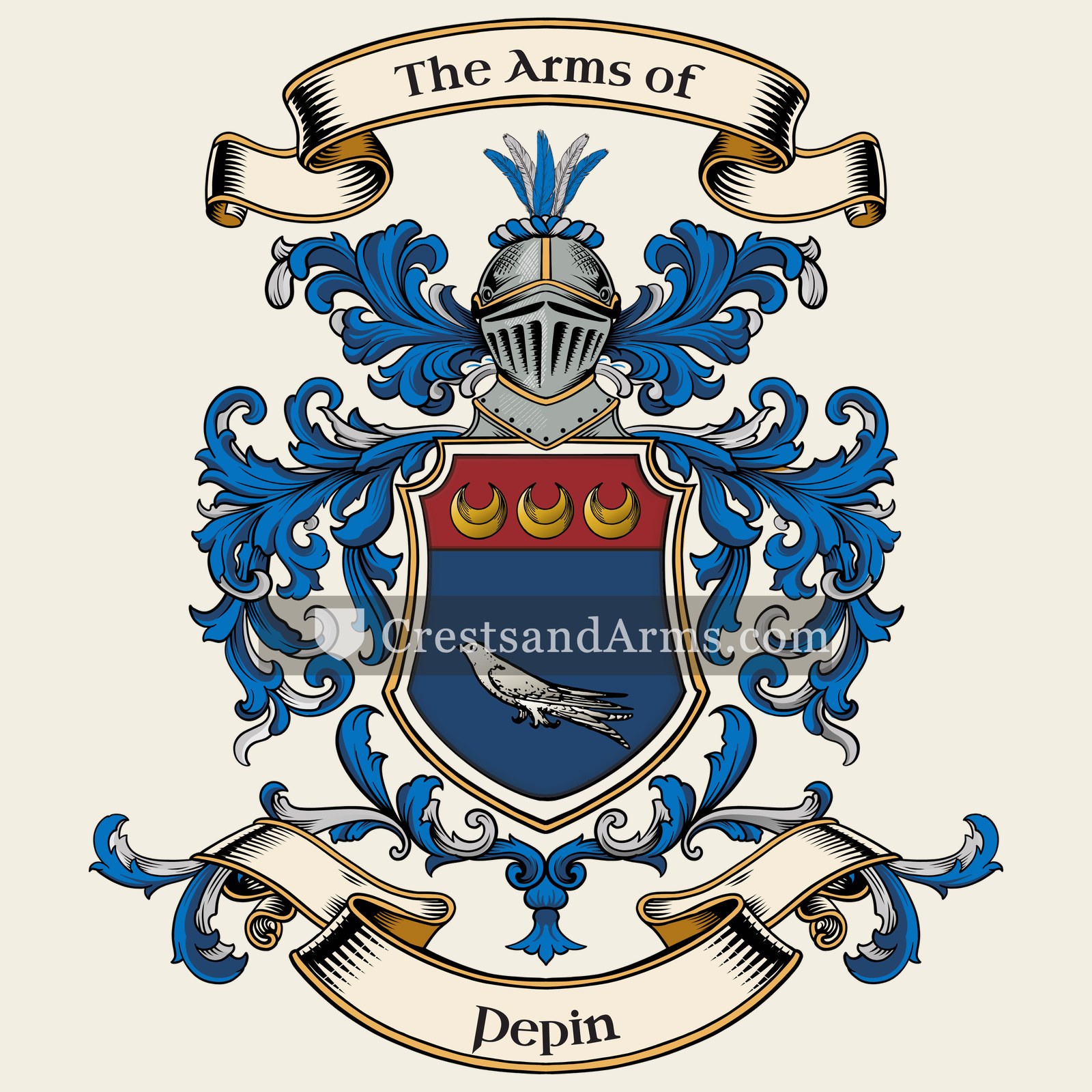


 chevronProtection, and faithful service completed
 mulletThe third son, and a divine quality from above