Map of France showing where the Perret arms are recorded
The Perret arms were recorded in Champagne, c. 1663.
Champagne made its money at its great trade fairs, where merchants from across Europe met. Wealth of that kind bought land, and land brought arms, so the region carries a lot of names.
This is where the arms were entered in the register. Families often moved to other parts of the country, so the same name can turn up in more than one region.
The body that granted and recorded arms in France in this period.
Louis XIV of France
Sovereign of the period
Louis XIV of France
1643–1715
Reigning in France when the Perret arms are first recorded.
How Arms Worked in France
In France, a coat of arms was a mark of honor that passed down through the male line to all legitimate descendants. Families often used the same shield without changes to show their shared heritage. If a branch wanted to stand out, they could add a small mark to their shield to show their specific place in the family tree.
Granting authority
The Juge d'armes de France acted as the official authority that regulated and verified coats of arms across the country.
How they got arms
Families typically inherited their arms from ancestors, though they could also receive them through royal grants or by proving their noble status.
Where arms were recorded
Coats of arms were officially recorded in the Armorial Général de France, which began its main collection in the year 1696.
The family's standing
Recorded among the armigerous families of Champagne.
Origin & History of the Perret Family in France
The surname Perret finds its roots in the medieval French language as a diminutive form of the name Pierre, which translates to Peter. By using the suffix et, families historically indicated a smaller or younger version of the original name, often serving as a term of endearment for a child or a way to distinguish between two men named Pierre in the same village. While the name appeared across various regions of France, records confirm that members of the Perret family were established in the Champagne province by 1663. During this era, life in Champagne was defined by the transition from feudal traditions to the centralized rule of the French monarchy. Families like the Perrets were typically integrated into the local agricultural or artisanal economy, contributing to the development of the region long before it became world-famous for its viticulture. Their presence in the 17th century suggests they were part of the stable, land-holding population that formed the backbone of rural French society during the reign of King Louis XIV.
Meaning of the Perret family crest colors & symbols
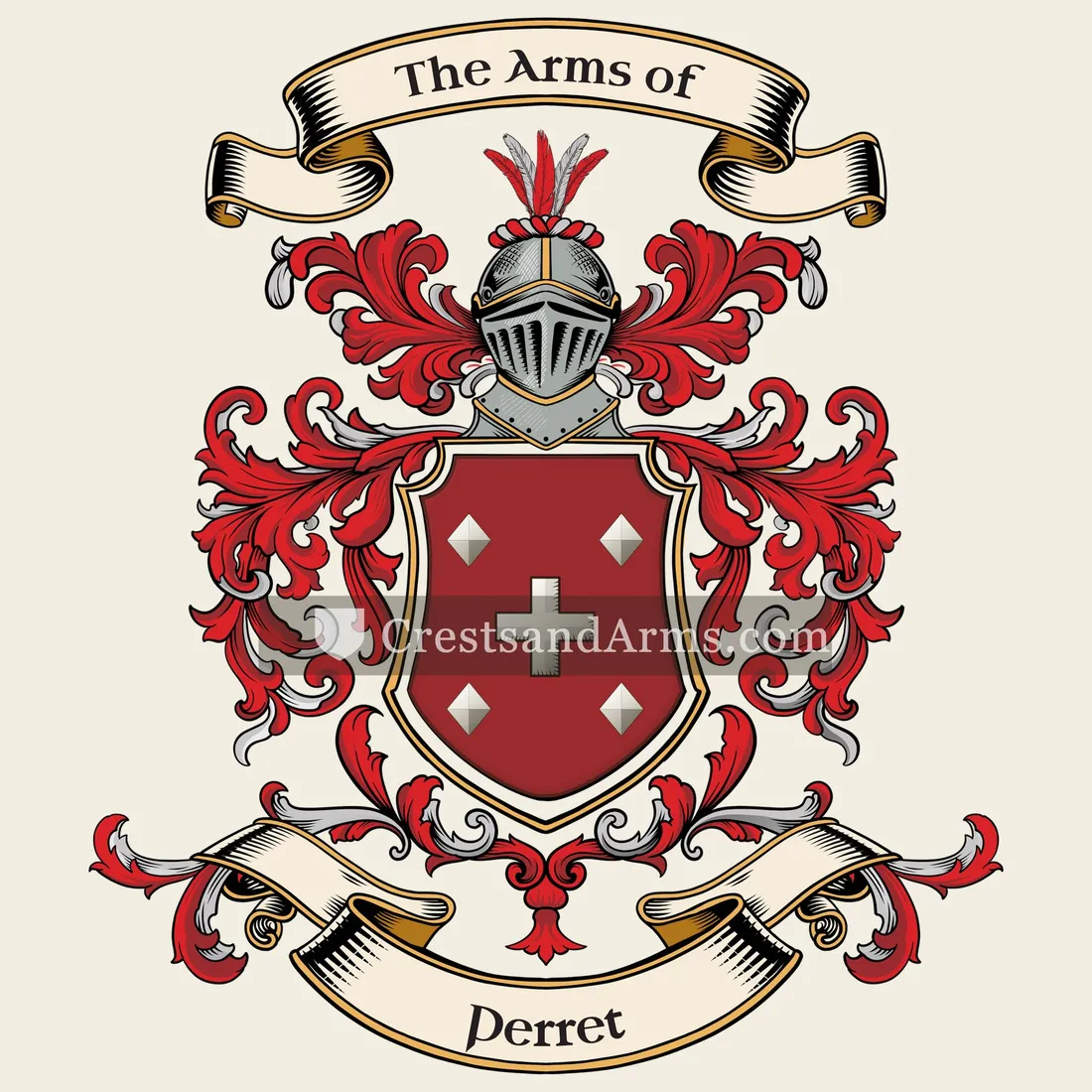
Symbols on this shield
cross symbolChristian faith and service
lozengeHonour and nobility, and the arms of a woman
Colours
Red (Gules)Means: Military strength
Silver (Argent)Means: Peace and sincerity
Historical info
Source
J. B. Rietstap, Armorial Général, Gouda: G. B. van Goor Zonen, 1884–87
Blazon (the actual original written record)
“De gu. à la croix alésée d'arg., cant. de quatre los. du même et ch. en coeur d'une los. du champ.”
SwitzerlandFribourg, c. 1745
Digital archive packCoat of arms PNG, gold border print PDF, vector SVG and the certificate of authenticity. Sent to your email in minutes.
Map of Switzerland showing where the Perret arms are recorded
The Perret arms were recorded in Fribourg, c. 1745.
This is where the arms were entered in the register. Families often moved to other parts of the country, so the same name can turn up in more than one region.
The body that granted and recorded arms in Switzerland in this period.
How Arms Worked in Switzerland
In Switzerland, coats of arms were not restricted to the nobility and were often adopted by common citizens and families. These symbols were passed down through generations to show family identity. When branches of a family grew, they often changed small details of the design to distinguish their own line from the original group.
Granting authority
Cantonal and civic authorities managed the use of coats of arms within their specific regions and local jurisdictions.
How they got arms
Families typically assumed their own coats of arms based on local custom rather than receiving them from a central monarch.
Where arms were recorded
Arms were recorded in various cantonal and civic registers starting from the fourteenth century throughout the Swiss region.
The family's standing
Recorded among the armigerous families of Switzerland.
Origin & History of the Perret Family in Switzerland
The surname Perret is a classic example of a name derived from a diminutive form of the given name Pierre, which is the French version of Peter. In the context of Switzerland, the name has deep roots in the French-speaking regions, particularly within the cantons of Fribourg, Neuchâtel, and Vaud. By the middle of the 18th century, families bearing this name were well-established members of the local community in Fribourg. During this period, the Perret family was often integrated into the agricultural and artisan life of the Swiss plateau. Because Switzerland was a collection of distinct territories at the time, families like the Perrets were typically deeply tied to their specific parish and local village governance. Their presence in Fribourg by 1745 reflects a long history of settlement in the region, where they contributed to the social and economic fabric of the Swiss Confederation long before the modern state was fully formed.
Perret Meaning & Related Branches
Root word
Pierre
Derived from the Greek word petros meaning a stone or rock.
This name
PerretA diminutive form indicating a small stone or a son of Peter.
also spelled
Peret
Peray
Related arms
Bizeausame arms
Espinassame arms
Gaillard de Montmiresame arms
Perrevariant spelling
Documented Sources
J. B. Rietstap, Armorial Général, Gouda: G. B. van Goor Zonen, 1884–87
Dauzat, Albert. Dictionnaire étymologique des noms et prénoms de France. 1951
Morlet, Marie-Thérèse. Dictionnaire étymologique des noms de famille. 1991
Digital archive packCoat of arms PNG, gold border print PDF, vector SVG and the certificate of authenticity. Sent to your email in minutes.


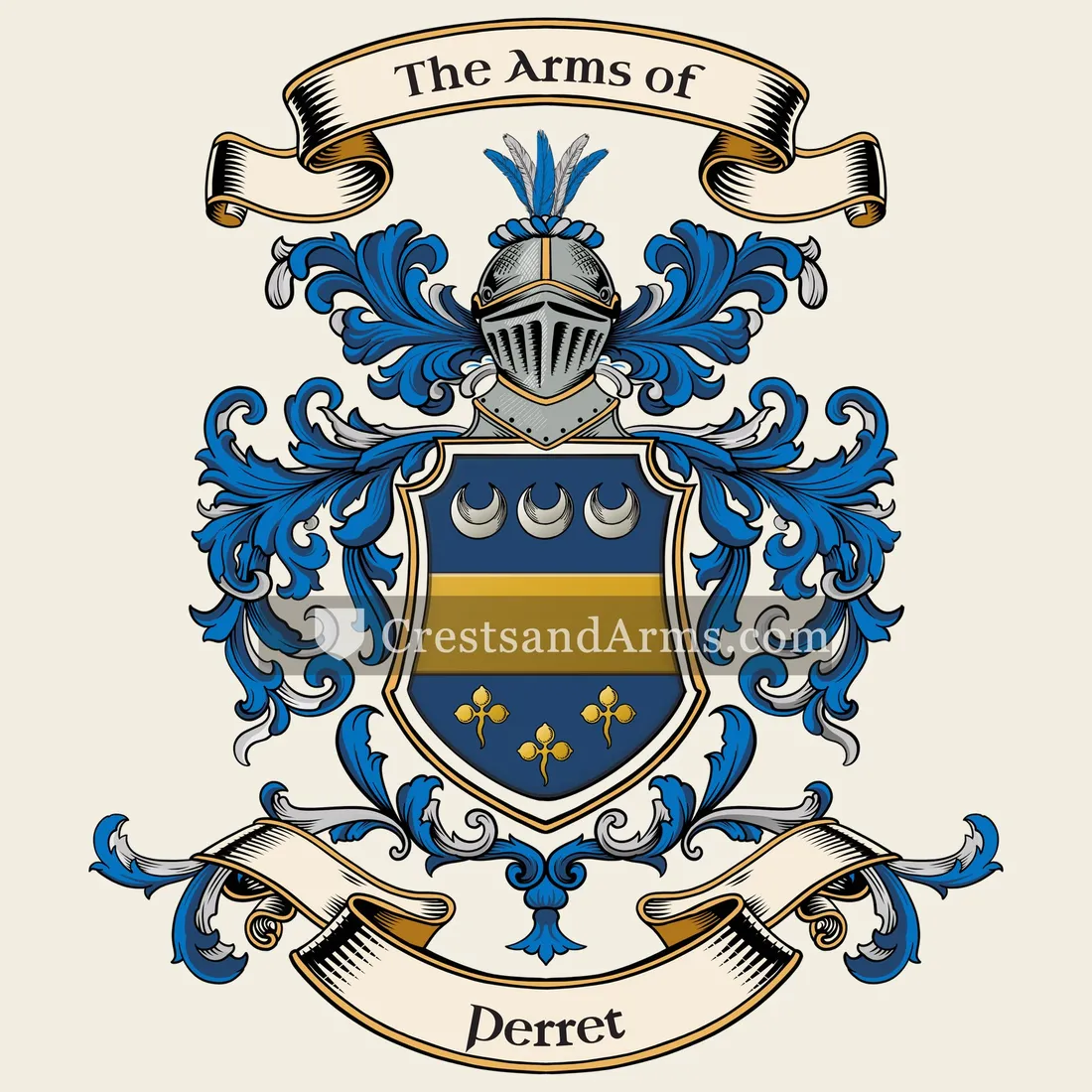
 fessThe military belt, and readiness to serve
 crescentHonour by the sovereign, and the second son
 trefoilPerpetuity, and the Trinity
 fessThe military belt, and readiness to serve
 crescentHonour by the sovereign, and the second son
 trefoilPerpetuity, and the Trinity


 cross symbolChristian faith and service
 lozengeHonour and nobility, and the arms of a woman