Map of France showing where the Perrin arms are recorded
The Perrin arms were recorded in Lorraine, c. 1514.
Lorraine sat on the border between France and the German lands, and border country bred soldiers. Families here held small estates and served in arms, and a fighting man was exactly the sort who carried a shield of his own.
This is where the arms were entered in the register. Families often moved to other parts of the country, so the same name can turn up in more than one region.
The body that granted and recorded arms in France in this period.
Louis XII of France
Sovereign of the period
Louis XII of France
1498–1515
Reigning in France when the Perrin arms are first recorded.
How Arms Worked in France
In France, a coat of arms was a mark of honor that passed down through the male line to all legitimate descendants. Families often used the same shield without changes to show their shared heritage. If a branch wanted to stand out, they could add a small mark to their shield to show their specific place in the family tree.
Granting authority
The Juge d'armes de France acted as the official authority that regulated and verified coats of arms across the country.
How they got arms
Families typically inherited their arms from ancestors, though they could also receive them through royal grants or by proving their noble status.
Where arms were recorded
Coats of arms were officially recorded in the Armorial Général de France, which began its main collection in the year 1696.
The family's standing
Recorded among the armigerous families of Lorraine.
Origin & History of the Perrin Family in France
The family name Perrin traces its roots to the medieval period in France as a diminutive form of the name Pierre, or Peter. By the early sixteenth century, the name was firmly established in the region of Lorraine, a territory known for its complex history at the crossroads of French and Germanic cultures. In 1514, records indicate that members of the Perrin family were active in this area, likely working within the agricultural or artisan communities that defined the local economy. During this era, surnames were becoming increasingly standardized to help local officials track tax payments and military obligations. As the family grew, they moved through the villages and towns of the Lorraine countryside, adapting to the shifting political borders of the duchy. Their presence in the historical record during this time highlights a family deeply integrated into the social fabric of eastern France long before the modern era.
Coat of Arms & Family Crest Details
Symbols on this shield
mountThe ground held, and steadfastness upon it
axeThe execution of military duty
Colours
Silver (Argent)Means: Peace and sincerity
Green (Vert)Means: Hope
Black (Sable)Means: Constancy
Historical info
Source
J. B. Rietstap, Armorial Général, Gouda: G. B. van Goor Zonen, 1884–87
Blazon (the actual original written record)
“D'arg. à une hache de boucher de sa., emm. de gu., posée en fasce, surmontant un tertre de trois coupeaux de sin., le manche à dextre.”
SwitzerlandNeufchâtel, c. 1745
Digital archive packCoat of arms PNG, gold border print PDF, vector SVG and the certificate of authenticity. Sent to your email in minutes.
Map of Switzerland showing where the Perrin arms are recorded
The Perrin arms were recorded in Neufchâtel, c. 1745.
This is where the arms were entered in the register. Families often moved to other parts of the country, so the same name can turn up in more than one region.
The body that granted and recorded arms in Switzerland in this period.
How Arms Worked in Switzerland
In Switzerland, coats of arms were not restricted to the nobility and were often adopted by common citizens and families. These symbols were passed down through generations to show family identity. When branches of a family grew, they often changed small details of the design to distinguish their own line from the original group.
Granting authority
Cantonal and civic authorities managed the use of coats of arms within their specific regions and local jurisdictions.
How they got arms
Families typically assumed their own coats of arms based on local custom rather than receiving them from a central monarch.
Where arms were recorded
Arms were recorded in various cantonal and civic registers starting from the fourteenth century throughout the Swiss region.
The family's standing
Recorded among the armigerous families of Switzerland.
Origin & History of the Perrin Family in Switzerland
The surname Perrin is a French diminutive of the name Pierre, which translates to Peter. In the context of Switzerland, the name became deeply rooted in the French-speaking regions, particularly within the canton of Neuchâtel. By the mid-eighteenth century, families bearing this name were well-established in the area, often working as skilled craftsmen, farmers, or watchmakers. The history of the Perrin family in Neuchâtel is closely tied to the region's development as a center for precision manufacturing and trade. Because the name was common among the local population, it appears frequently in parish registers and civil records that document the daily lives of citizens during the 1700s. These early ancestors helped shape the social and economic fabric of the Jura mountain communities, passing their name down through generations as they integrated into the evolving Swiss landscape.
Coat of Arms & Family Crest Details
Symbols on this shield
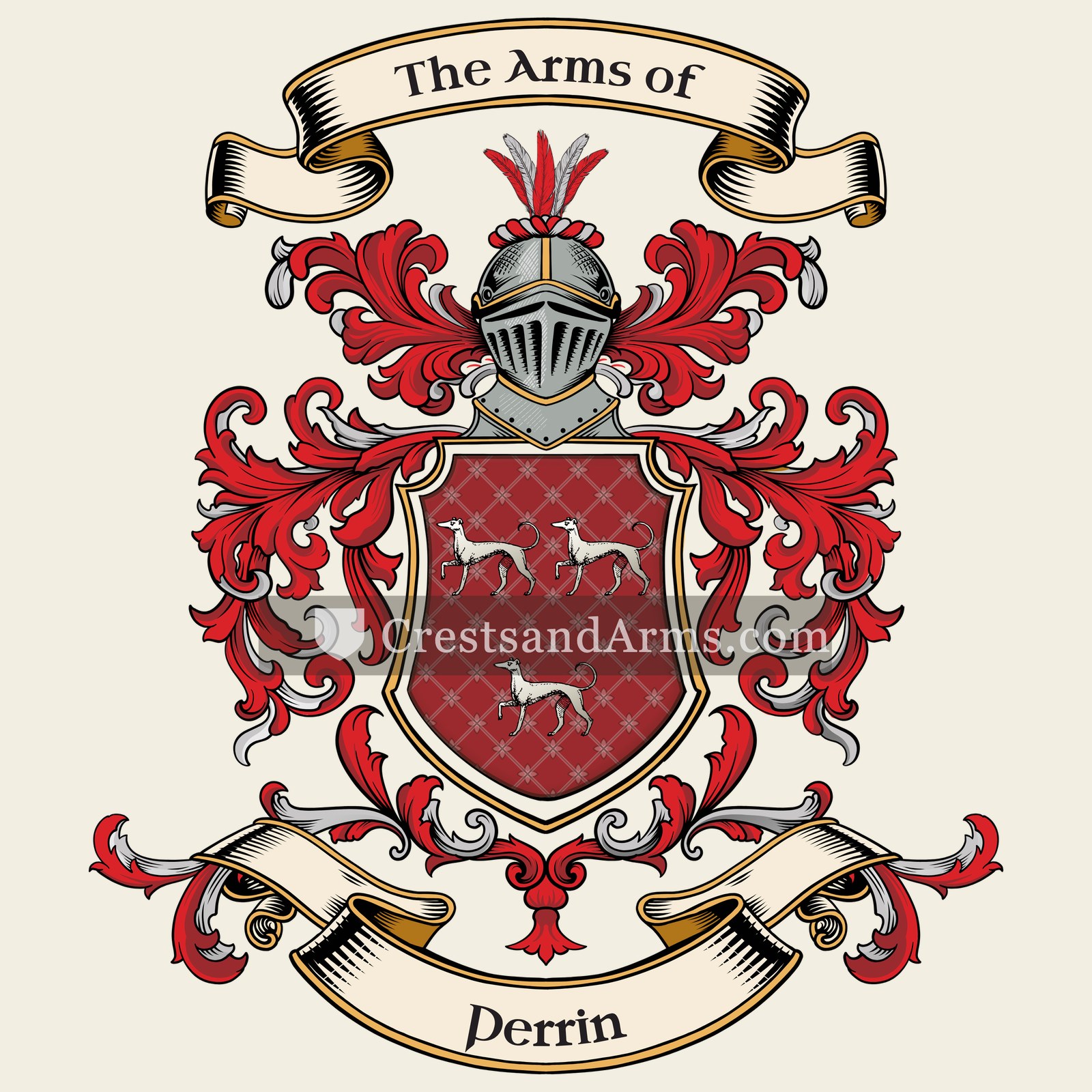
greyhoundCourage, vigilance and loyalty
Colours
Red (Gules)Means: Military strength
Silver (Argent)Means: Peace and sincerity
Historical info
Source
Sir Bernard Burke, The General Armory of England, Scotland, Ireland and Wales, London: Harrison & Sons, 1884
Blazon (the actual original written record)
“Gu. three greyhounds courant in pale ar”
EnglandJersey, c. 1620
Digital archive packCoat of arms PNG, gold border print PDF, vector SVG and the certificate of authenticity. Sent to your email in minutes.
Map of England showing where the Perrin arms are recorded
The Perrin arms were recorded in Jersey, c. 1620.
Arms such as these were typically recorded in York.
Yorkshire is the largest of the English counties, and it held more gentry families than any other. Land there was split among a great many households rather than a few, so a great many of them carried arms.
This is where the arms were entered in the register. Families often moved to other parts of the country, so the same name can turn up in more than one region.
The body that granted and recorded arms in England in this period.
James VI and I
Sovereign of the period
James VI and I
1603–1625
Reigning in France when the Perrin arms are first recorded.
How Arms Worked in England
English heraldry allowed arms to be shared by all legitimate descendants of the original owner. These symbols were treated as personal property that moved through the generations to all children. While the eldest son kept the original design, other family members could use the same shield without needing to change it or register their own unique versions.
Granting authority
The College of Arms in London has regulated the use of coats of arms throughout England and Wales since 1484.
How they got arms
Families typically obtained their coats of arms through a formal grant from the Crown or by proving their ancient right to them.
Where arms were recorded
All official coats of arms are recorded in the registers kept at the College of Arms, which date back to the fifteenth century.
The family's standing
Recorded among the armigerous families of England.
Origin & History of the Perrin Family in England
The surname Perrin is a derivative of the name Peter, originating as a diminutive form that became popular across medieval Europe. By the time members of the family were recorded in York in 1620, the name had already been established in England for several centuries following the Norman influence. Families bearing this name were often part of the growing merchant and artisan classes in northern English cities. During the early seventeenth century, York served as a vital regional hub for trade and administration, which likely drew families like the Perrins to settle there for economic opportunity. These early residents were typically integrated into the local parish life, where their names were documented in church registers during a period of significant social and religious change in England.
Related Branches & Arms
Root word
Petrus
A Latin name derived from the Greek word for rock or stone.
This name
PerrinA diminutive form of Pierre, signifying a small rock or stone.
also spelled
Perin
Peryn
Perryn
Related arms
Bonnotsame arms
Houdaillesame arms
Beschesimilar arms
Perinvariant spelling
Documented Sources
J. B. Rietstap, Armorial Général, Gouda: G. B. van Goor Zonen, 1884–87
Albert Dauzat, Dictionnaire étymologique des noms et prénoms de France, 1951
Marie-Thérèse Morlet, Dictionnaire étymologique des noms de famille, 1991
Archives départementales de Meurthe-et-Moselle, Série B: Cours et juridictions
Digital archive packCoat of arms PNG, gold border print PDF, vector SVG and the certificate of authenticity. Sent to your email in minutes.


 cross symbolChristian faith and service
 cross symbolChristian faith and service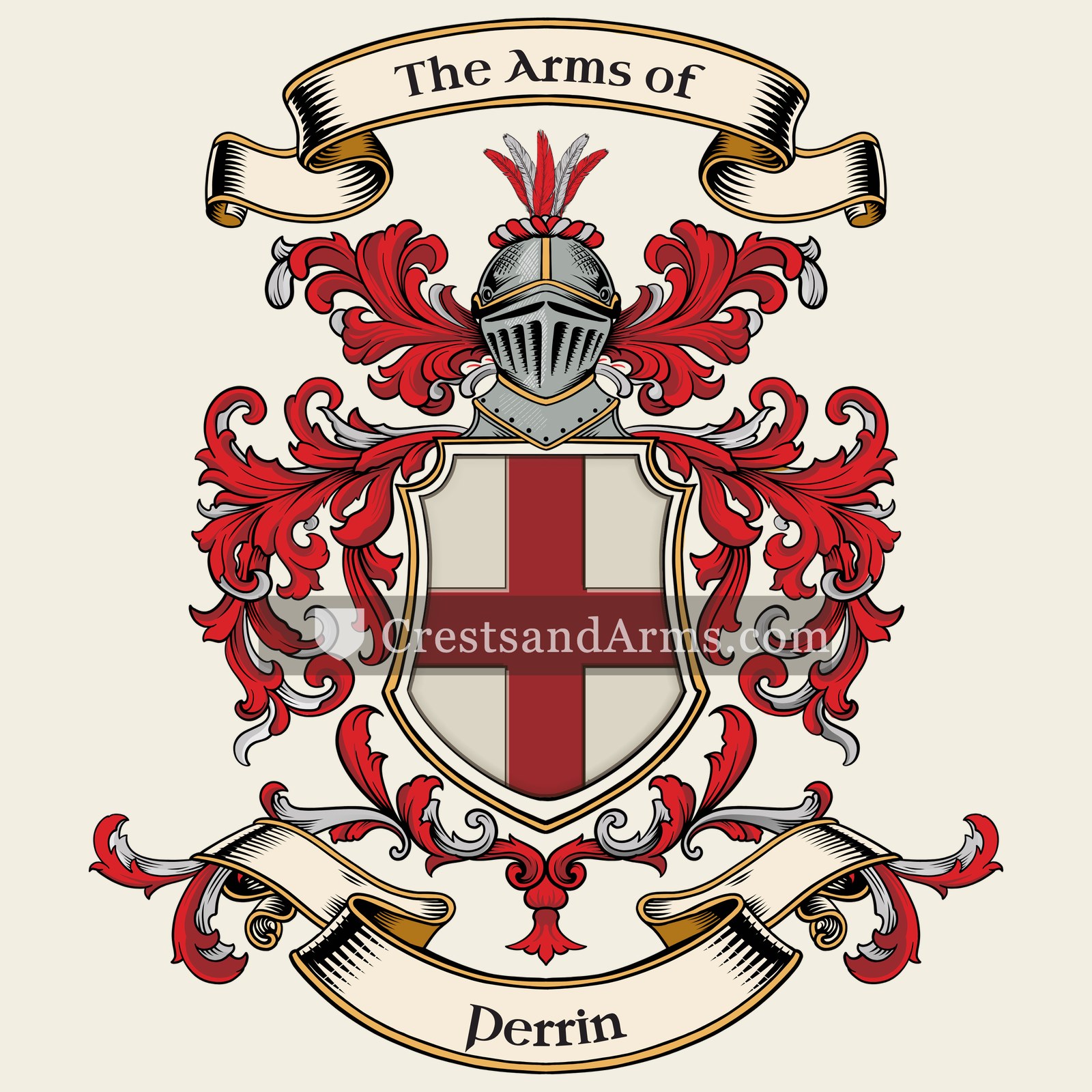


 mountThe ground held, and steadfastness upon it
 axeThe execution of military duty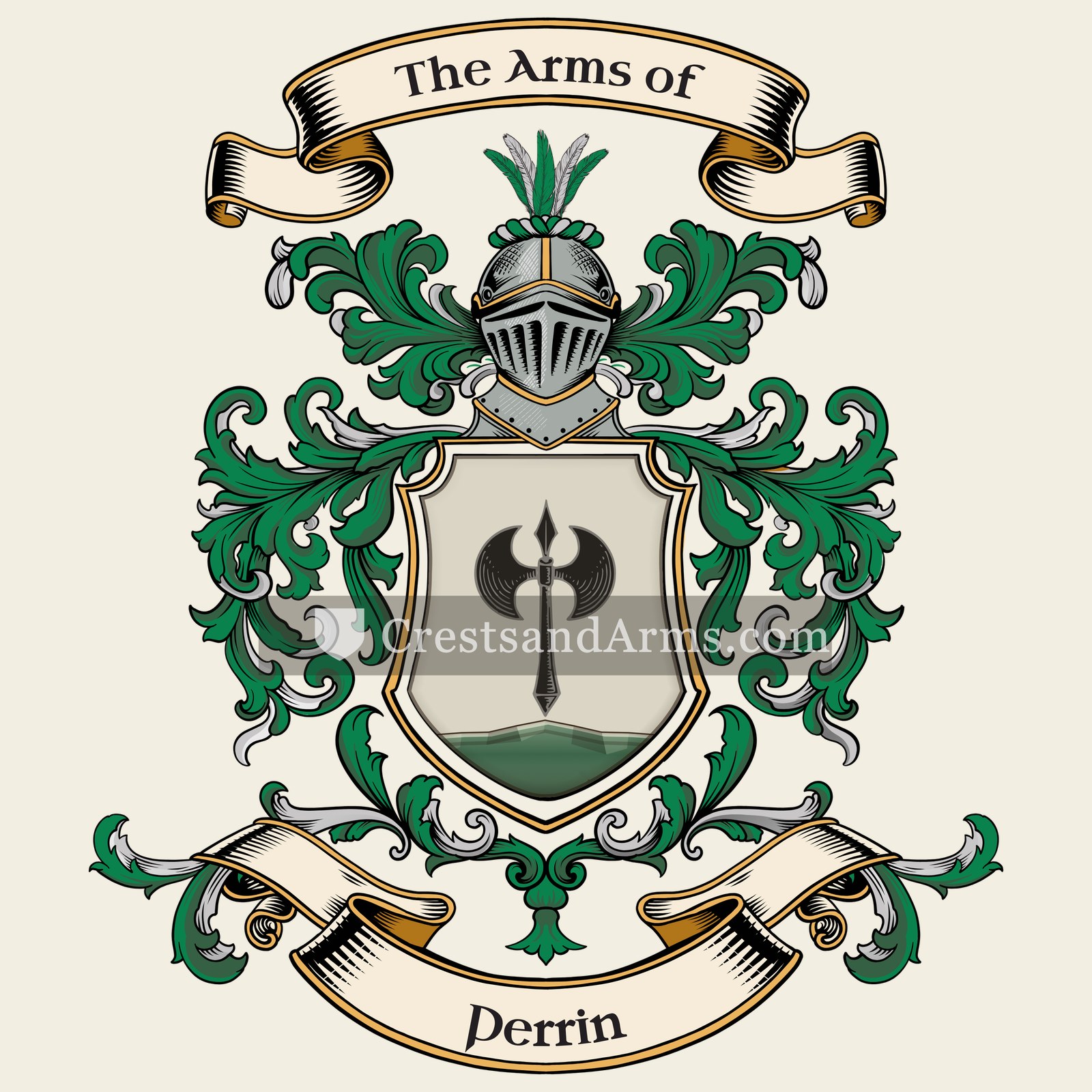

 greyhoundCourage, vigilance and loyalty