Map of France showing where the Perron arms are recorded
The Perron arms were recorded in Bretagne, c. 1663.
More families held coats of arms in Bretagne than anywhere else in France. The land was divided into many small estates rather than a few large ones, so far more households counted as gentry, and each needed a shield of its own to be told apart.
This is where the arms were entered in the register. Families often moved to other parts of the country, so the same name can turn up in more than one region.
The body that granted and recorded arms in France in this period.
Louis XIV of France
Sovereign of the period
Louis XIV of France
1643–1715
Reigning in France when the Perron arms are first recorded.
How Arms Worked in France
In France, a coat of arms was a mark of honor that passed down through the male line to all legitimate descendants. Families often used the same shield without changes to show their shared heritage. If a branch wanted to stand out, they could add a small mark to their shield to show their specific place in the family tree.
Granting authority
The Juge d'armes de France acted as the official authority that regulated and verified coats of arms across the country.
How they got arms
Families typically inherited their arms from ancestors, though they could also receive them through royal grants or by proving their noble status.
Where arms were recorded
Coats of arms were officially recorded in the Armorial Général de France, which began its main collection in the year 1696.
The family's standing
Recorded among the armigerous families of Bretagne.
Origin & History of the Perron Family in France
The surname Perron is a classic example of a patronymic name, which means it originated as a way to identify a person by their father’s given name. It is derived from the name Pierre, which is the French equivalent of Peter. In the region of Bretagne, the suffix "on" was often added to names as a diminutive, essentially meaning "little Peter" or "son of Pierre." By the year 1663, records confirm that families bearing this name were well-established in the Breton countryside. During this period, the Perron family members were typically part of the rural population, often working as skilled farmers or craftsmen who contributed to the local economy of the province. Because the name was tied to such a common given name, it emerged independently in several different villages across the region, meaning that not all people named Perron share a single common ancestor. Instead, the name grew in popularity as a way to distinguish different branches of the local population during a time when surnames were becoming a permanent requirement for official government and church records.
Perron Meaning & Related Branches
Root word
Petrus
Latin for stone or rock
This name
PerronA diminutive form referring to a small stone or a person living near rocks
also spelled
Perron
Fontaine
Peron de la Fonten Menar
Documented Sources
J. B. Rietstap, Armorial Général, Gouda: G. B. van Goor Zonen, 1884–87
Dauzat, Albert. Dictionnaire étymologique des noms de famille et prénoms de France. 1951
Morlet, Marie-Thérèse. Dictionnaire étymologique des noms de famille. 1991
Digital archive packCoat of arms PNG, gold border print PDF, vector SVG and the certificate of authenticity. Sent to your email in minutes.


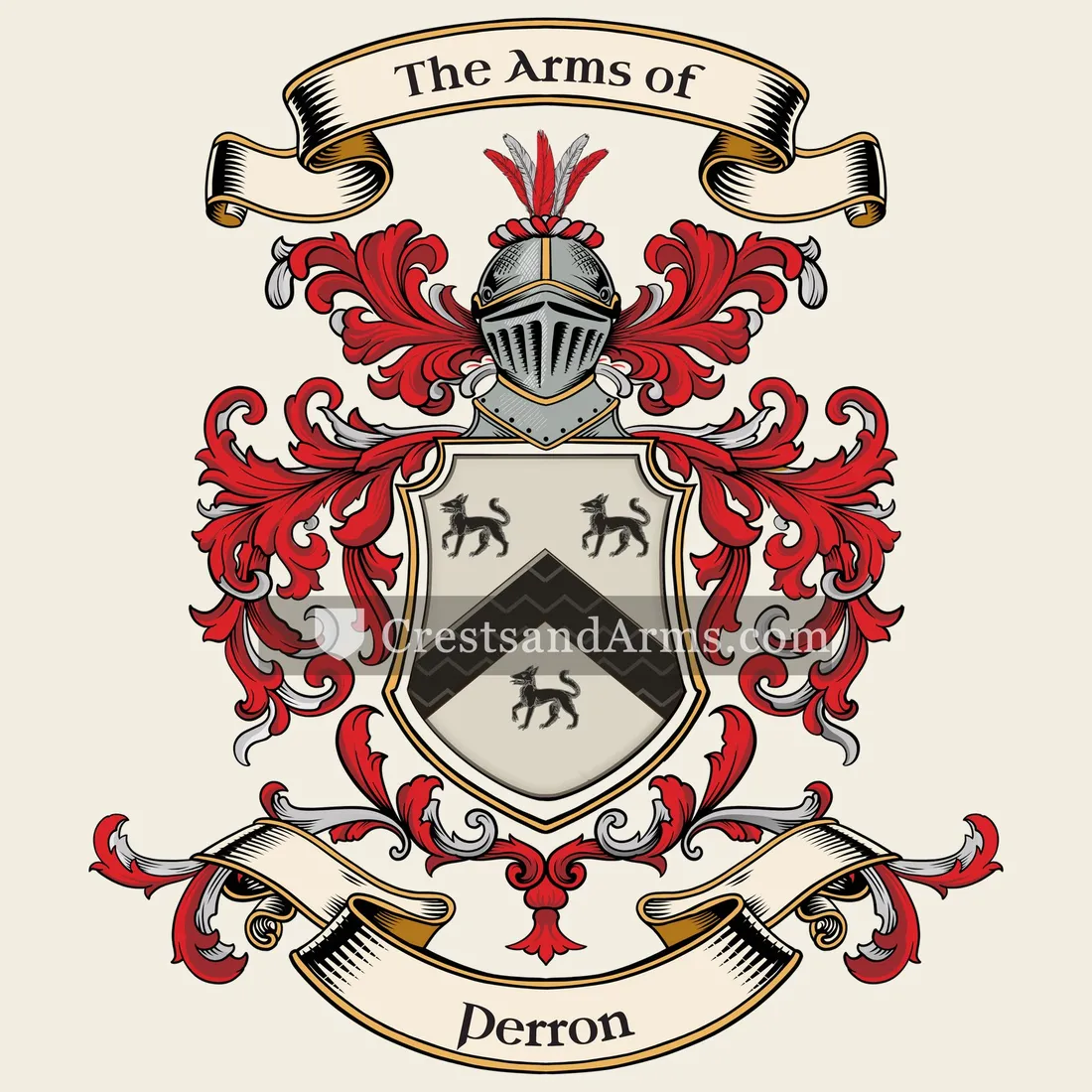
 chevronProtection, and faithful service completed
 wolfReward from long service and hard work
 chevronProtection, and faithful service completed
 wolfReward from long service and hard work