A record of documented arms, meaning and origin, researched for the Perrotta family lines. Documented in 2 countries.
Reg. 3006 · Britain, P–S
Coat of Arms & Family Crest Details
Symbols on this shield
chiefAuthority, wisdom and dominion
applePeace, plenty and long-standing settlement
lionCourage, strength and royalty
Colours
Red (Gules)Means: Military strength
Silver (Argent)Means: Peace and sincerity
Gold (Or)Means: Generosity
Black (Sable)Means: Constancy
Historical info
Source
J. B. Rietstap, Armorial Général, Gouda: G. B. van Goor Zonen, 1884–87
Blazon (the actual original written record)
“De gu. à trois poires d'or, les queues en haut; au chef d'arg., ch. d'un lion iss. de sa., arm. et lamp. du champ. C.: un léopard d'or, sommé d'une couronne royale du même, posé sur un chapeau de tournoi de gu., retr. d'herm. T.: à dextre un ancien Breton, au nat., à sen. un dragon ailé de gu., les ailes armoriées d'un écartelé de gu. et d'or, à quatre léopards de l'un à l'autre. D.: AMO UT INVENIO.”
KentKent, c. 1716
Digital archive packCoat of arms PNG, gold border print PDF, vector SVG and the certificate of authenticity. Sent to your email in minutes.
Map of Britain showing where the Perrotta arms are recorded
The Perrotta arms were recorded in Kent, c. 1716.
Kent sits between London and the short crossing to Europe, and the trade passing through made it wealthy. Merchant families bought land with that money, and it was landowners who took coats of arms.
This is where the arms were entered in the register. Families often moved to other parts of the country, so the same name can turn up in more than one region.
The body that granted and recorded arms in Britain in this period.
George I of Great Britain
Sovereign of the period
George I of Great Britain
1714–1727
Reigning in Britain when the Perrotta arms are first recorded.
How Arms Worked in Britain
English heraldry allowed arms to be shared by all legitimate descendants of the original owner. These symbols were treated as personal property that moved through the generations to all children. While the eldest son kept the original design, other family members could use the same shield without needing to change it or register their own unique versions.
Granting authority
The College of Arms in London has regulated the use of coats of arms throughout England and Wales since 1484.
How they got arms
Families typically obtained their coats of arms through a formal grant from the Crown or by proving their ancient right to them.
Where arms were recorded
All official coats of arms are recorded in the registers kept at the College of Arms, which date back to the fifteenth century.
The family's standing
Recorded among the armigerous families of Kent.
Origin & History of the Perrotta Family in Britain
The surname Perrotta is of Italian origin, derived from a diminutive form of the name Pietro, meaning little Peter. While the name is deeply rooted in Mediterranean history, its presence in Britain began to emerge during the early eighteenth century. By 1716, records confirm that members of the Perrotta family had established themselves in the county of Kent. During this era, Kent served as a vital gateway for travel and trade between the European continent and London. Families arriving from abroad often settled in these coastal regions to find work in local agriculture or maritime industries. As these early settlers integrated into English society, they contributed to the cultural diversity of the region while maintaining the unique linguistic heritage of their ancestral name.
Coat of Arms & Family Crest Details
Symbols on this shield
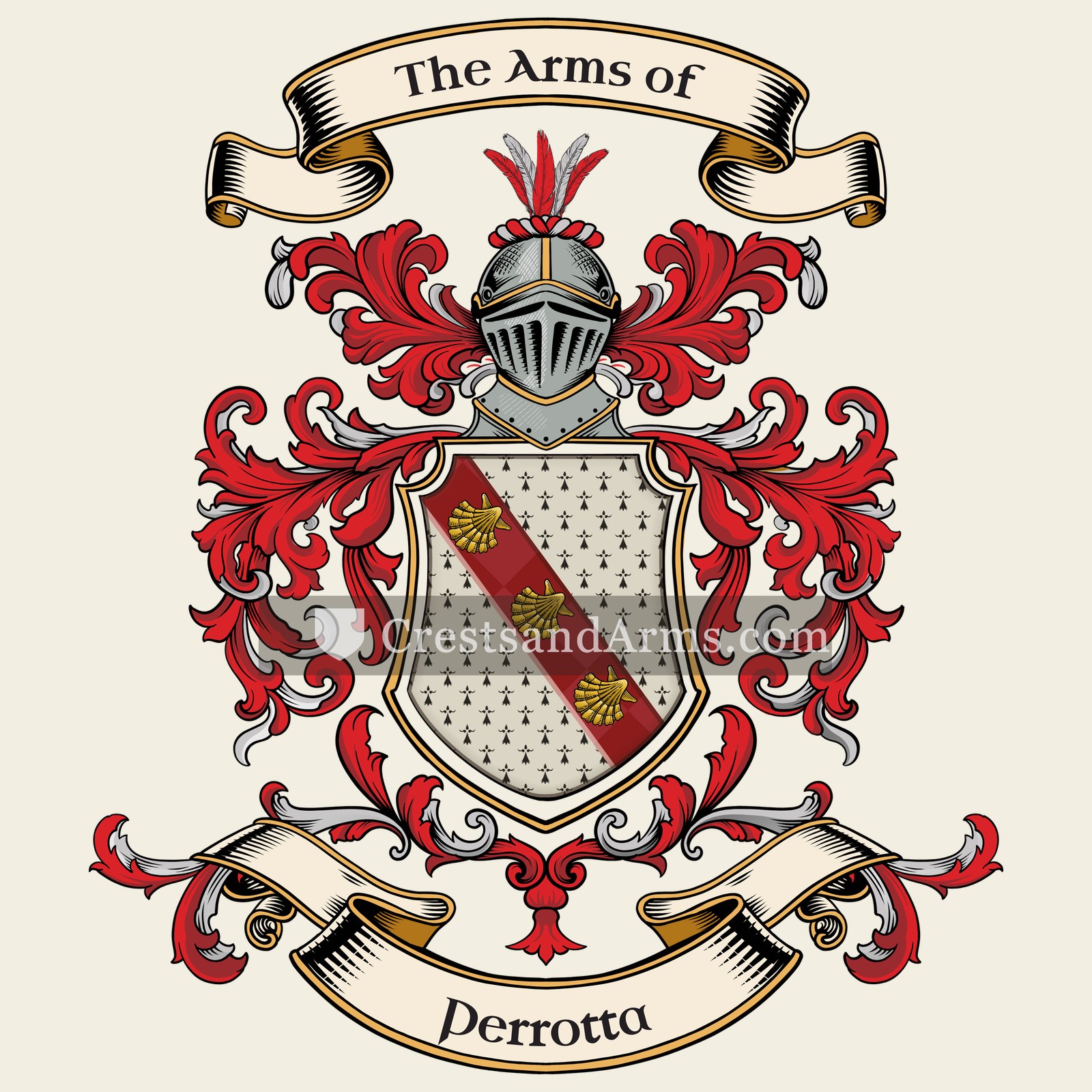
bendDefence, and the scarf of a commander
escallopThe pilgrim's shell, and a long journey made
Colours
ErmineMeans: Dignity
Red (Gules)Means: Military strength
Gold (Or)Means: Generosity
Historical info
Source
Sir Bernard Burke, The General Armory of England, Scotland, Ireland and Wales, London: Harrison & Sons, 1884
Blazon (the actual original written record)
“Erm. on a bend cotised gu. three escallops or; another, Az. a bend lozengy (another fusily), betw. six martlets or; another, Ar. five mullets pierced in cross sa., with crest, a bull's head couped sa. armed or, gorged on the neck with two bars gold; another, Ar. a boar pass. sa. enraged and unguled gu”
Englandc. 1620
Digital archive packCoat of arms PNG, gold border print PDF, vector SVG and the certificate of authenticity. Sent to your email in minutes.
Map of England showing where the Perrotta arms are recorded
The Perrotta arms were recorded in England, c. 1620.
Arms such as these were typically recorded in York.
Yorkshire is the largest of the English counties, and it held more gentry families than any other. Land there was split among a great many households rather than a few, so a great many of them carried arms.
This is where the arms were entered in the register. Families often moved to other parts of the country, so the same name can turn up in more than one region.
The body that granted and recorded arms in England in this period.
James VI and I
Sovereign of the period
James VI and I
1603–1625
Reigning in Britain when the Perrotta arms are first recorded.
How Arms Worked in England
English heraldry allowed arms to be shared by all legitimate descendants of the original owner. These symbols were treated as personal property that moved through the generations to all children. While the eldest son kept the original design, other family members could use the same shield without needing to change it or register their own unique versions.
Granting authority
The College of Arms in London has regulated the use of coats of arms throughout England and Wales since 1484.
How they got arms
Families typically obtained their coats of arms through a formal grant from the Crown or by proving their ancient right to them.
Where arms were recorded
All official coats of arms are recorded in the registers kept at the College of Arms, which date back to the fifteenth century.
The family's standing
Recorded among the armigerous families of England.
Origin & History of the Perrotta Family in England
The family name Perrotta carries a history that reflects the movement of people across Europe before the name became established in England. While the name originates from Mediterranean roots, specifically as a diminutive form of the name Pietro, it appeared in the historical record of York by 1620. During this period, York was a bustling center of trade and religious transition, drawing individuals from various backgrounds to settle within its ancient walls. Families arriving in Northern England at this time often integrated into the local economy as merchants or skilled tradespeople. By settling in a city with deep Roman and Viking history, the early Perrotta family members became part of the diverse social fabric that defined seventeenth-century urban life. Their presence in the city archives suggests they were among the many families who helped shape the local community during a time of significant cultural change in England.
Related Branches & Arms
Root word
Petrus
Latin for stone or rock derived from the Greek word petros.
This name
PerrottaA diminutive form indicating a little rock or small stone.
also spelled
Perrot
Perot
Pero
Parrott
Documented Sources
J. B. Rietstap, Armorial Général, Gouda: G. B. van Goor Zonen, 1884–87
Kent History and Library Centre, Quarter Sessions Records, Q/S/P (1716)
Reaney, P.H., A Dictionary of English Surnames, 1958
Cottle, Basil, The Penguin Dictionary of Surnames, 1967
Digital archive packCoat of arms PNG, gold border print PDF, vector SVG and the certificate of authenticity. Sent to your email in minutes.


 chiefAuthority, wisdom and dominion
 applePeace, plenty and long-standing settlement
 lionCourage, strength and royalty
 chiefAuthority, wisdom and dominion
 applePeace, plenty and long-standing settlement
 lionCourage, strength and royalty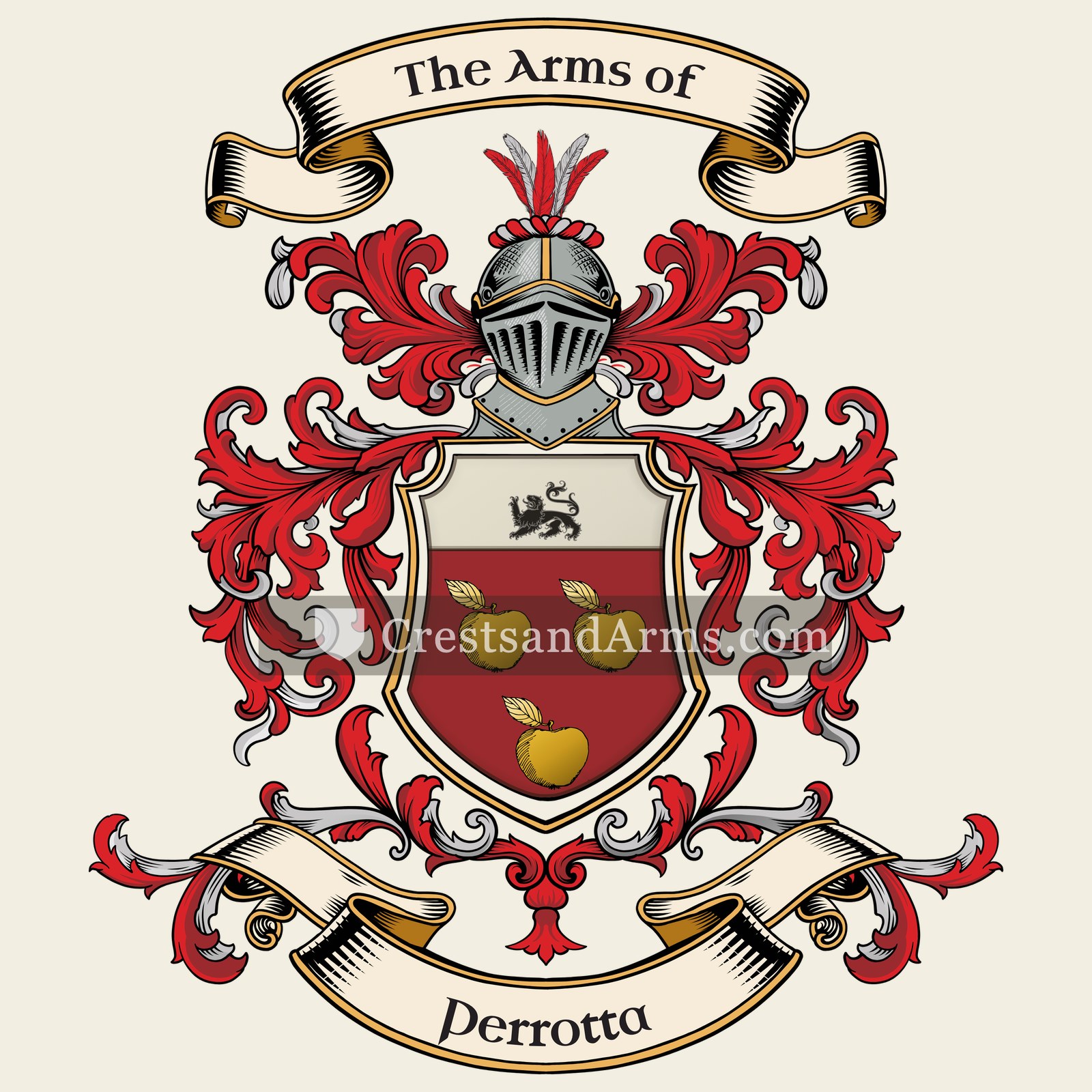


 bendDefence, and the scarf of a commander
 escallopThe pilgrim's shell, and a long journey made