A record of documented arms, meaning and origin, researched for the Perrotto family lines. Documented in 2 countries.
Reg. 0853 · Britain, P–S
Meaning of the Perrotto family crest colors & symbols
Symbols on this shield
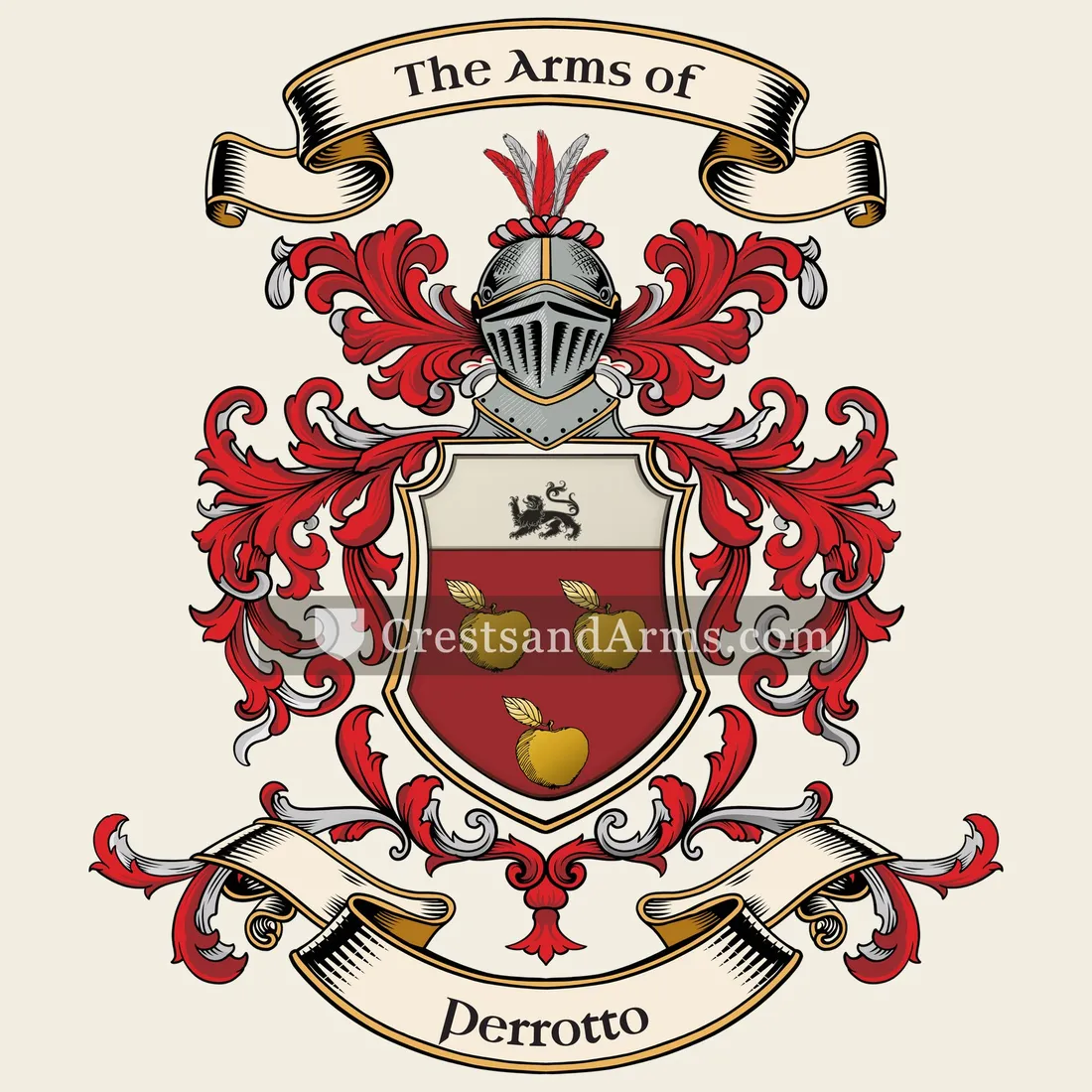
chiefAuthority, wisdom and dominion
applePeace, plenty and long-standing settlement
lionCourage, strength and royalty
Colours
Red (Gules)Means: Military strength
Silver (Argent)Means: Peace and sincerity
Gold (Or)Means: Generosity
Black (Sable)Means: Constancy
Historical info
Source
J. B. Rietstap, Armorial Général, Gouda: G. B. van Goor Zonen, 1884–87
Blazon (the actual original written record)
“De gu. à trois poires d'or, les queues en haut; au chef d'arg., ch. d'un lion iss. de sa., arm. et lamp. du champ. C.: un léopard d'or, sommé d'une couronne royale du même, posé sur un chapeau de tournoi de gu., retr. d'herm. T.: à dextre un ancien Breton, au nat., à sen. un dragon ailé de gu., les ailes armoriées d'un écartelé de gu. et d'or, à quatre léopards de l'un à l'autre. D.: AMO UT INVENIO.”
KentKent, c. 1716
Digital archive packCoat of arms PNG, gold border print PDF, vector SVG and the certificate of authenticity. Sent to your email in minutes.
Map of Britain showing where the Perrotto arms are recorded
The Perrotto arms were recorded in Kent, c. 1716.
Kent sits between London and the short crossing to Europe, and the trade passing through made it wealthy. Merchant families bought land with that money, and it was landowners who took coats of arms.
This is where the arms were entered in the register. Families often moved to other parts of the country, so the same name can turn up in more than one region.
The body that granted and recorded arms in Britain in this period.
George I of Great Britain
Sovereign of the period
George I of Great Britain
1714–1727
Reigning in Britain when the Perrotto arms are first recorded.
How Arms Worked in Britain
English heraldry allowed arms to be shared by all legitimate descendants of the original owner. These symbols were treated as personal property that moved through the generations to all children. While the eldest son kept the original design, other family members could use the same shield without needing to change it or register their own unique versions.
Granting authority
The College of Arms in London has regulated the use of coats of arms throughout England and Wales since 1484.
How they got arms
Families typically obtained their coats of arms through a formal grant from the Crown or by proving their ancient right to them.
Where arms were recorded
All official coats of arms are recorded in the registers kept at the College of Arms, which date back to the fifteenth century.
The family's standing
Recorded among the armigerous families of Kent.
Origin & History of the Perrotto Family in Britain
The Perrotto family name traces its roots in Britain to the early eighteenth century, with documented evidence confirming their presence in the county of Kent by 1716. While the name itself carries strong Mediterranean linguistic influences, suggesting an origin rooted in the Romance languages, its arrival in England reflects the broader patterns of migration and trade that defined the era. During this period, Kent served as a vital gateway for travelers and merchants entering the country from the continent. Settling in this region allowed the early members of the family to integrate into the local agricultural and mercantile communities that thrived in the southeast of England. Over time, the family adapted to the social and economic landscape of their new home, transitioning from newcomers to established residents within the local parish systems. Their presence in the historical record during the early 1700s highlights how families of diverse origins contributed to the evolving cultural identity of rural Kent.
Meaning of the Perrotto family crest colors & symbols
Symbols on this shield
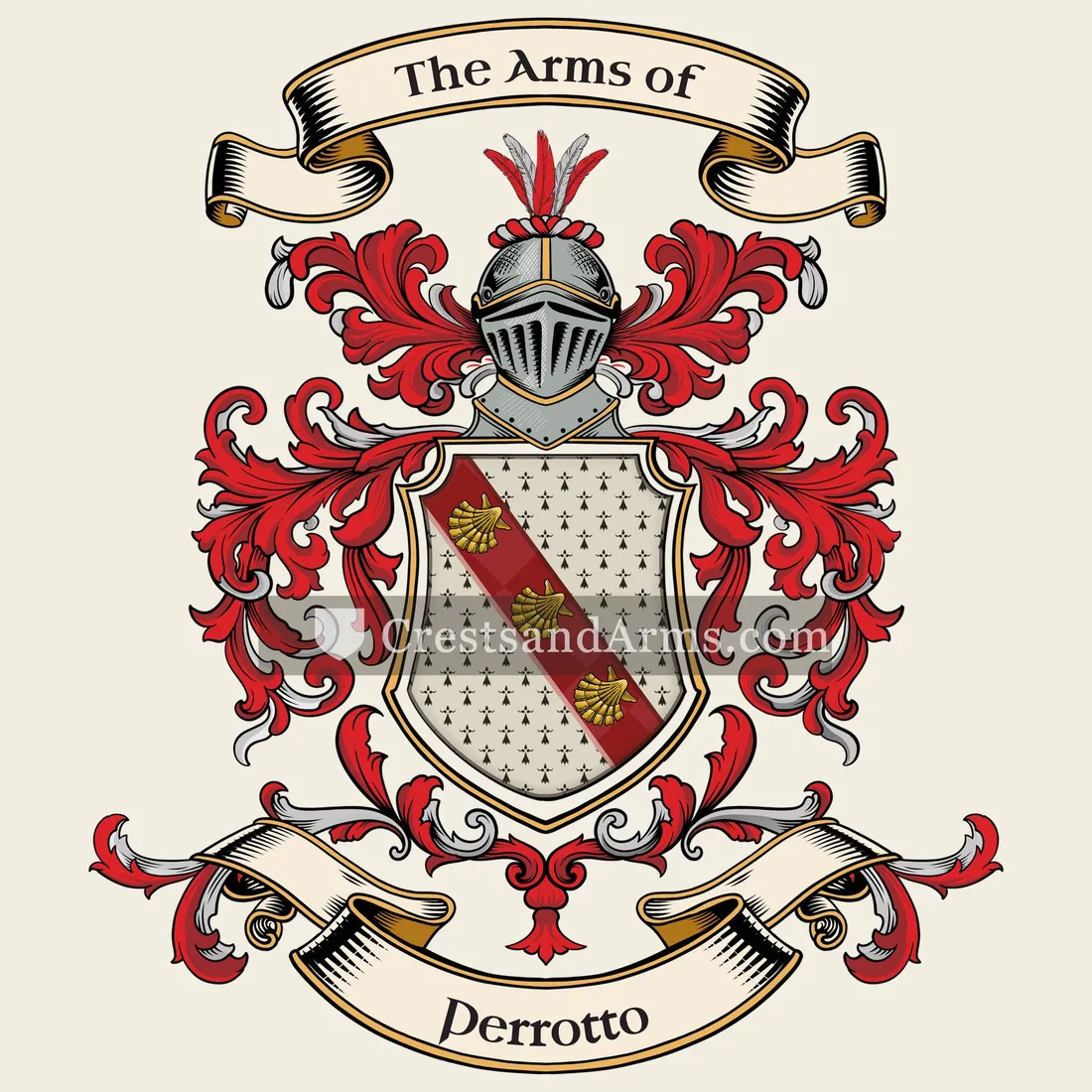
bendDefence, and the scarf of a commander
escallopThe pilgrim's shell, and a long journey made
Colours
ErmineMeans: Dignity
Red (Gules)Means: Military strength
Gold (Or)Means: Generosity
Historical info
Source
Sir Bernard Burke, The General Armory of England, Scotland, Ireland and Wales, London: Harrison & Sons, 1884
Blazon (the actual original written record)
“Erm. on a bend cotised gu. three escallops or; another, Az. a bend lozengy (another fusily), betw. six martlets or; another, Ar. five mullets pierced in cross sa., with crest, a bull's head couped sa. armed or, gorged on the neck with two bars gold; another, Ar. a boar pass. sa. enraged and unguled gu”
Englandc. 1620
Digital archive packCoat of arms PNG, gold border print PDF, vector SVG and the certificate of authenticity. Sent to your email in minutes.
Map of England showing where the Perrotto arms are recorded
The Perrotto arms were recorded in England, c. 1620.
Arms such as these were typically recorded in York.
Yorkshire is the largest of the English counties, and it held more gentry families than any other. Land there was split among a great many households rather than a few, so a great many of them carried arms.
This is where the arms were entered in the register. Families often moved to other parts of the country, so the same name can turn up in more than one region.
The body that granted and recorded arms in England in this period.
James VI and I
Sovereign of the period
James VI and I
1603–1625
Reigning in Britain when the Perrotto arms are first recorded.
How Arms Worked in England
English heraldry allowed arms to be shared by all legitimate descendants of the original owner. These symbols were treated as personal property that moved through the generations to all children. While the eldest son kept the original design, other family members could use the same shield without needing to change it or register their own unique versions.
Granting authority
The College of Arms in London has regulated the use of coats of arms throughout England and Wales since 1484.
How they got arms
Families typically obtained their coats of arms through a formal grant from the Crown or by proving their ancient right to them.
Where arms were recorded
All official coats of arms are recorded in the registers kept at the College of Arms, which date back to the fifteenth century.
The family's standing
Recorded among the armigerous families of England.
Origin & History of the Perrotto Family in England
The history of the Perrotto name in England is deeply tied to the movement of people across Europe during the early seventeenth century. While the name possesses clear roots in Mediterranean linguistic traditions, its presence in the city of York by 1620 suggests that the family had established a foothold in Northern England during a period of significant social and economic transition. At this time, York served as a vital regional hub for trade and administration, attracting individuals from diverse backgrounds who sought new opportunities in a rapidly changing society. The family likely integrated into the local community by participating in the city's active mercantile or craft guilds, which were essential for professional success in urban centers of that era. By settling in York, the early members of the Perrotto family became part of the long history of migration that shaped the demographic landscape of England, leaving behind a record of their presence in local parish registers and legal documents that confirm their integration into English life.
Perrotto Meaning & Related Branches
Root word
Petrus
Latin for stone or rock
This name
PerrottoA diminutive form referring to a little Peter or son of Peter
also spelled
Perrot
Perot
Pero
Parrott
Documented Sources
J. B. Rietstap, Armorial Général, Gouda: G. B. van Goor Zonen, 1884–87
Kent Archives, Archdeaconry of Canterbury Marriage Licences, 1716
Kent Archives, Parish Registers of the Diocese of Canterbury, 1716
Digital archive packCoat of arms PNG, gold border print PDF, vector SVG and the certificate of authenticity. Sent to your email in minutes.


 chiefAuthority, wisdom and dominion
 applePeace, plenty and long-standing settlement
 lionCourage, strength and royalty
 chiefAuthority, wisdom and dominion
 applePeace, plenty and long-standing settlement
 lionCourage, strength and royalty


 bendDefence, and the scarf of a commander
 escallopThe pilgrim's shell, and a long journey made