Map of Ireland showing where the Persson arms are recorded
The Persson arms were recorded in Ireland, c. 1645.
Arms such as these were typically recorded in Dublin.
Dublin was the seat of government in Ireland and the place where grants were sought and recorded. Families with business at the castle or the courts settled nearby, and settling there put their arms on record.
This is where the arms were entered in the register. Families often moved to other parts of the country, so the same name can turn up in more than one region.
The body that granted and recorded arms in Ireland in this period.
Charles I of England
Sovereign of the period
Charles I of England
1625–1649
Reigning in Ireland when the Persson arms are first recorded.
How Arms Worked in Ireland
The Ulster King of Arms granted coats of arms to individuals who proved their social standing and good character. These symbols were typically inherited by all legitimate descendants of the original holder. If a family branch wanted a unique look, they could apply for a specific change to their design through the office to ensure their identity remained distinct.
Granting authority
The Ulster King of Arms acted as the official body that regulated and issued all coats of arms throughout Ireland.
How they got arms
Families obtained their arms through formal grants issued by the office after proving their eligibility and paying the required fees.
Where arms were recorded
All official grants were recorded in the registers held by the Ulster King of Arms starting from the year 1552.
The family's standing
Recorded among the armigerous families of Ireland.
Origin & History of the Persson Family in Ireland
The surname Persson is traditionally a patronymic name, which means it was formed by adding a suffix to the father’s first name to signify "son of Per." While the name is most commonly associated with Swedish and Scandinavian roots, the presence of the family in Dublin by 1645 suggests a history of migration and cultural blending. During the mid-seventeenth century, Dublin was a bustling port city that attracted merchants and soldiers from across Northern Europe. Families arriving from the Baltic regions often integrated into the local community by adapting their naming conventions to fit the English-speaking environment of Ireland. This early settlement indicates that the ancestors of this line were likely part of the professional or mercantile classes who moved across the North Sea to seek new opportunities in trade or military service. Over time, the name persisted as a distinct marker of their Scandinavian heritage while they established deep roots within the social fabric of seventeenth-century Ireland.
Persson Meaning & Related Branches
Root word
Petrus
A Latin name derived from the Greek word for stone or rock.
This name
PerssonA patronymic surname meaning son of Per, a Scandinavian variation of Peter.
also spelled
Pierson
Pearson
Documented Sources
Sir Bernard Burke, The General Armory of England, Scotland, Ireland and Wales, London: Harrison & Sons, 1884
Canny, Nicholas, Making Ireland British, 1580–1650, 2001
National Archives of Ireland, Civil Survey of the County of Dublin, 1654–1656
Royal Irish Academy, A New History of Ireland, Volume III: Early Modern Ireland 1534–1691, 1976
Digital archive packCoat of arms PNG, gold border print PDF, vector SVG and the certificate of authenticity. Sent to your email in minutes.


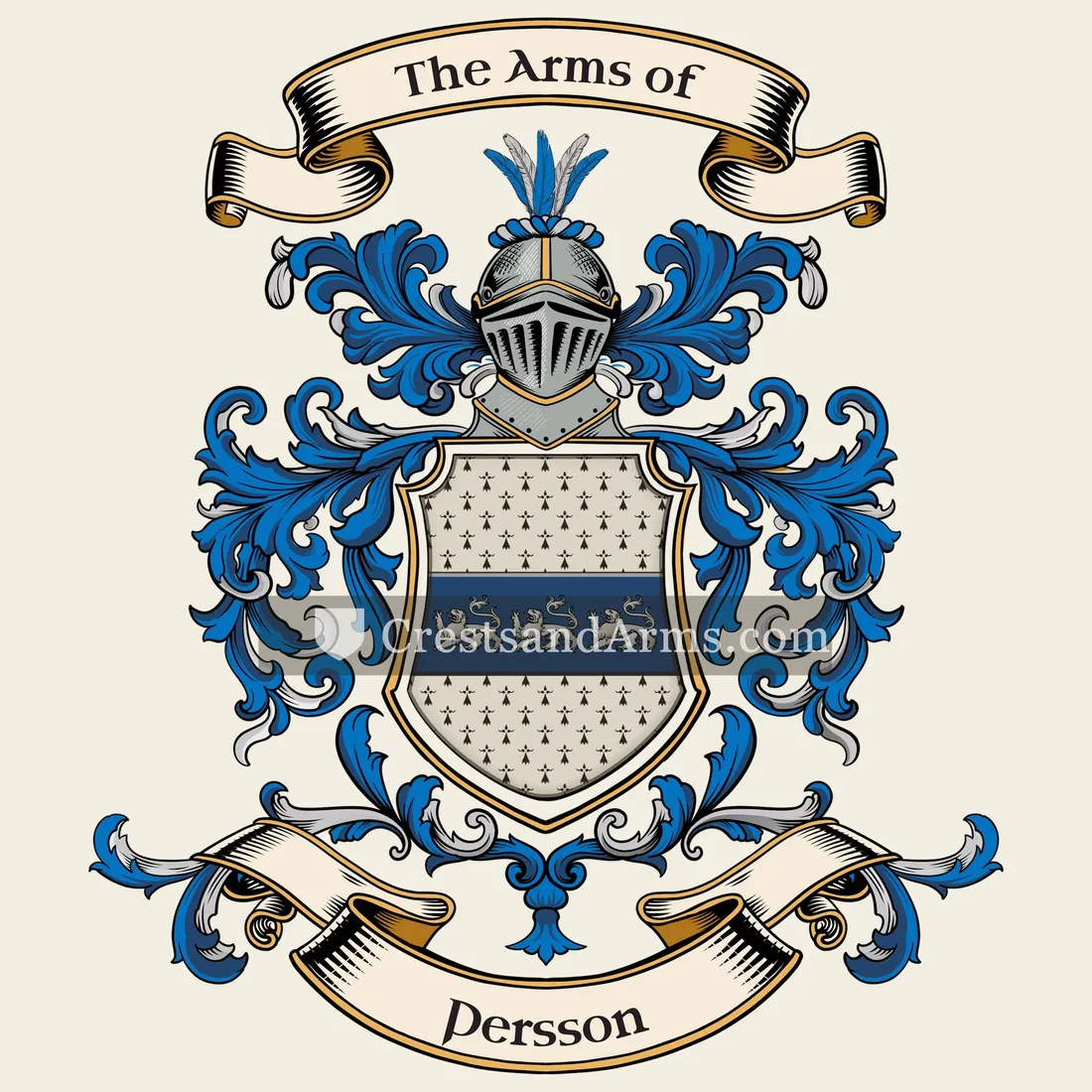
 fessThe military belt, and readiness to serve
 lionCourage, strength and royalty
 fessThe military belt, and readiness to serve
 lionCourage, strength and royalty